


Texas Birth Injury Lawyer
Written by: Hastings Law Firm | Reviewed by: Tommy Hastings | Updated: July 27, 2026
Birth injuries tied to labor and delivery negligence can leave families facing lasting medical needs and unanswered concerns about what went wrong. This topic covers how preventable errors during monitoring, medication use, assisted delivery, or delayed decisions can lead to serious harm, including permanent disability or worse. It also explains how responsibility may extend beyond a single physician to nurses, hospitals, and in some situations device makers. If you or a loved one were harmed or worse due to birth injury and labor negligence in Texas, contact Hastings Law Firm for a free, confidential case review.

Trusted Texas Attorneys for Birth Injury and Labor Negligence Claims
What You Should Know About Labor & Delivery Negligence Claims in Texas:
- Long term disability or stillbirth can follow preventable labor and delivery errors when oxygen deprivation or mechanical trauma occurs.
- Accountability can extend beyond the obstetrician when nursing monitoring failures or hospital staffing and supervision problems contribute to harm.
- Confusion between a birth defect and a birth injury can change legal options because defects are often tied to pregnancy factors while injuries are linked to preventable delivery room errors.
- Recovery can be limited by Texas caps on non economic damages while economic losses for medical care and life care needs are not capped.
- Options can be lost if required notices and expert report obligations are missed because Texas imposes strict procedural requirements for medical negligence claims.
- Disputes often focus on fetal monitoring interpretation and response because abnormal heart rate patterns may appear before intervention.
- Severe injury risk can rise when Pitocin is used without adequate monitoring because overly frequent contractions can restrict blood flow to the baby.
- Physical trauma can result from improper vacuum or forceps use because excessive force during difficult delivery can injure the head, brain, or nerves.
- Additional liability may exist when a vacuum extractor is defective or used contrary to FDA warnings because both the provider and manufacturer may share responsibility.
- Critical evidence can be harder to obtain over time because fetal monitoring strips, nursing notes, medication records, and staffing logs can deteriorate or disappear.

A Healthcare Focused Law Firm
When your child has been harmed during labor or delivery, the weight of that experience can feel heavy. You may sense that something went wrong, yet feel unsure about whether you have a right to question the doctors and nurses who were supposed to protect your baby. That instinct matters, and you deserve clear answers about what happened and why.
At Hastings Law Firm, we focus exclusively on medical malpractice. Our legal team, which includes in-house nurse consultants and former defense attorneys, works alongside families to uncover the truth behind birth injuries and hold negligent providers accountable. As a dedicated Texas birth injury lawyer team, we prepare every case as if it will go before a jury, because that level of preparation is what your family’s future demands.
If you believe your child was harmed by a preventable medical error, we welcome the opportunity to review what happened and explain your options in a free, confidential evaluation.
Understanding Birth Injuries and Medical Negligence During Labor
Birth injuries caused by medical negligence occur when a healthcare provider deviates from the accepted standard of care during labor or delivery, resulting in preventable injury to the infant or mother. This duty of care requires the level of treatment that a reasonably competent medical professional would provide under similar circumstances. When a doctor, nurse, or hospital falls below that standard and a child is injured as a result, it may constitute medical malpractice under Texas law.
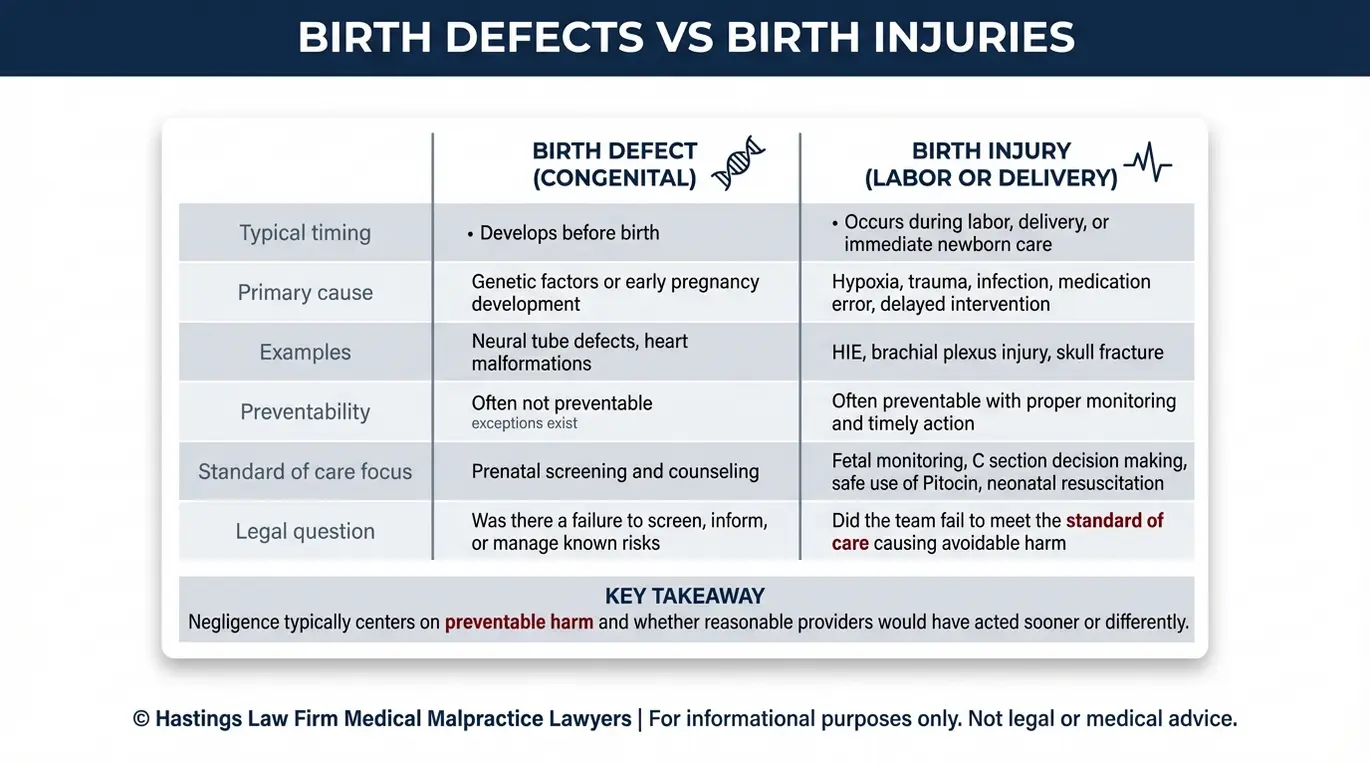
One of the most important distinctions Texas birth injury attorneys help families understand is the difference between a birth defect and a birth injury. These terms are often confused, but they carry very different legal implications.
| Birth Defect | Birth Injury | |
|---|---|---|
| Cause | Genetic, chromosomal, or environmental factors during pregnancy | Preventable error or omission during labor, delivery, or postpartum care |
| Timing | Develops before or during pregnancy | Occurs during or shortly after delivery |
| Preventability | Generally not preventable through medical intervention during delivery | Often preventable with proper monitoring, timely decisions, and appropriate technique |
| Legal Relevance | Typically not grounds for a malpractice claim | May support a claim if linked to a breach of the standard of care |
Texas law governs medical negligence claims through the Texas Civil Practice and Remedies Code Chapter 74, which sets specific procedural requirements for filing these cases. The Texas Department of State Health Services also publishes definitions and guidance on reportable preventable adverse events, reinforcing that many delivery room injuries are recognized as avoidable.
If you suspect something went wrong during your child’s birth, trust that instinct. Years of conditioning, often referred to as The White Coat Effect, may tell you to defer to a doctor’s judgment, but questioning the care your child received is not disrespectful. It is your right, and it may be the first step toward answers. Experienced birth injury legal counsel can help you separate what was unavoidable from what should never have happened.
Common Causes of Birth Injuries in Texas Hospitals
The most common causes of preventable birth injuries include failure to monitor fetal distress, C-section delivery errors such as delayed C-sections, misuse of labor-inducing drugs like Pitocin, and improper use of extraction tools. Each of these failures reflects a breakdown in the duty of care owed to both mother and child. Fetal distress is a condition indicating the baby is not receiving enough oxygen or is under physical stress during labor.
Delayed C-Sections. When a baby shows signs of fetal distress on the electronic monitor, the delivery team has a narrow window to act. In many cases we review, the warning signs were present on the fetal monitoring strips well before intervention occurred. A delay of even minutes can lead to oxygen deprivation, also known as hypoxia, which may cause permanent brain damage.
Medication Errors. Pitocin, a synthetic form of the hormone oxytocin, is commonly used to induce or strengthen labor contractions. When administered improperly or without adequate monitoring, Pitocin can trigger uterine tachysystole, a condition where contractions come too frequently and restrict blood flow to the baby. This is a known risk, and the standard of care requires close surveillance whenever Pitocin is in use.
Monitoring Failures. Nursing staff are often the first line of defense in recognizing fetal distress. When monitors are misread, alarms are ignored, or staffing shortages prevent adequate observation, critical changes in the baby’s fetal heart rate pattern can go unaddressed.
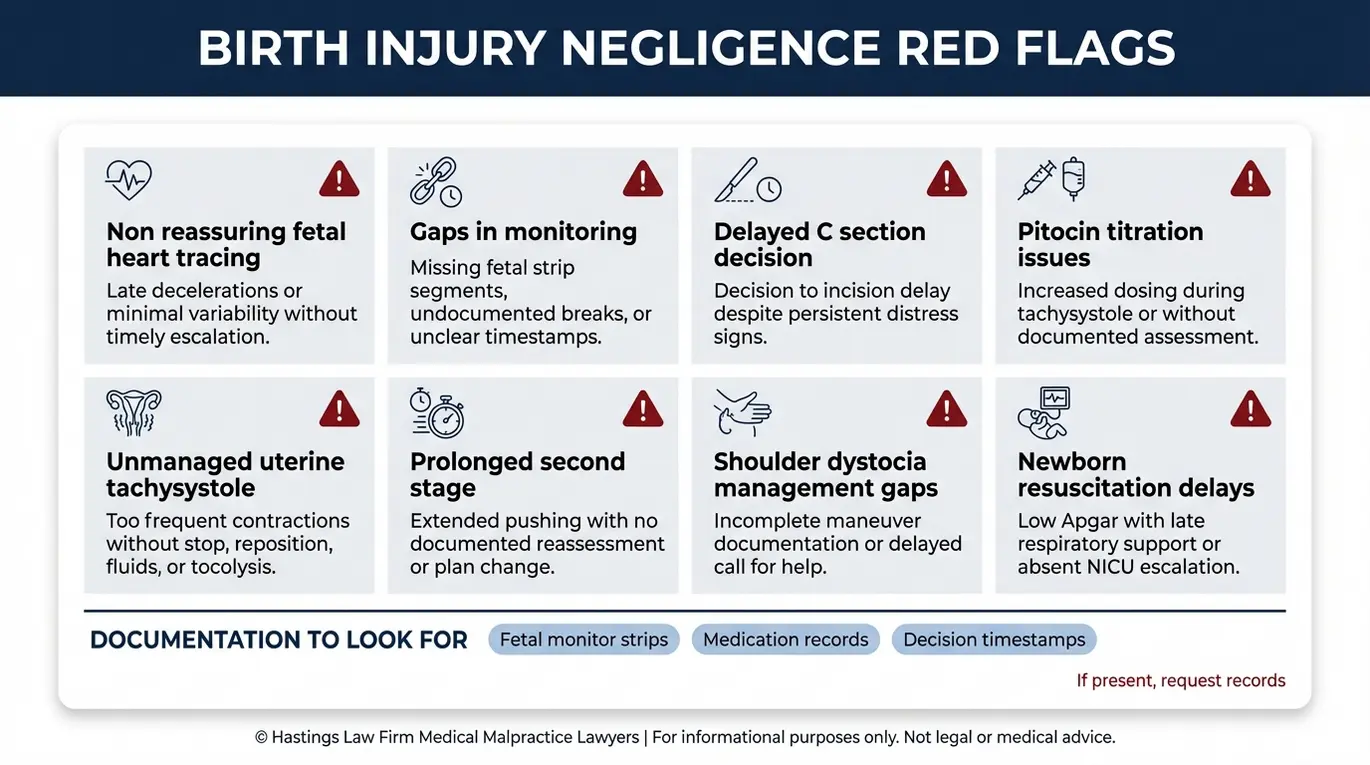
Here are some of the red flags birth injury lawyers in Texas look for when evaluating a potential case:
- Prolonged periods of abnormal fetal heart rate patterns without documented intervention
- Pitocin administration continued despite signs of uterine tachysystole
- Delayed decision-to-incision time for an emergency C-section
- Gaps in nursing documentation or fetal monitoring strip records
- Failure to notify the attending physician of changes in the baby’s condition
If any of these patterns appear in your child’s medical records, legal help for birth injuries can determine whether negligence contributed to the outcome.
The Hastings Law Firm Difference
Results matter, but what truly sets us apart is how we achieve them. Every verdict, every settlement, and every Texas courtroom victory comes from one guiding promise: To treat each client’s fight for justice as if it were our own.
This balance of skill, experience, and empathy reflects our core philosophy that justice should not only compensate the injured, but also make healthcare safer nationwide.

Mechanical Trauma and Instrument-Assisted Delivery Errors
Improper use of vacuum extractors or forceps during delivery can cause severe physical trauma, including skull fractures, brain bleeds, and nerve damage. These instruments have a role in obstetric care, but they must be used correctly, at the right time, and only when specific clinical criteria are met. Lateral traction refers to the force applied to the side of a baby’s head or neck during a difficult delivery.
One of the most serious risks during a difficult delivery is shoulder dystocia, a complication where the baby’s shoulder becomes lodged behind the mother’s pelvic bone after the head has been delivered. When this occurs, specific maneuvers are required to free the baby safely. If a provider applies excessive lateral traction or force to the baby’s head and neck during shoulder dystocia, it can cause a brachial plexus injury, a tearing of the network of nerves running from the spinal cord through the neck, shoulder, and arm.
This type of injury can result in Erb’s palsy, a condition that limits movement and sensation in the affected arm. The Merck Manual Professional Edition outlines the recognized protocols for managing shoulder dystocia and the risks associated with improper technique.
There are clinical situations where a provider should pivot to a C-section rather than continue attempting vaginal delivery with instruments. When multiple vacuum attempts fail, when the baby is not progressing despite intervention, or when there are signs of worsening distress, continued use of extraction tools may fall below the accepted standard of care. Texas birth injury counsel can evaluate whether the decision to persist with an assisted delivery was medically justified.
FDA Warnings and Device Liability
Vacuum extractors themselves may also contribute to injury if the device is defective or used contrary to FDA warnings and guidelines. A vacuum extractor, a suction cup device applied to the baby’s head to assist delivery, may contribute to liability. If the device malfunctions, or if a provider applies it in a manner inconsistent with its approved use, both the manufacturer and the provider may share liability. A malpractice lawyer for birth trauma can assess whether a product liability claim for defective medical devices should be pursued alongside a negligence claim.
Severe Outcomes and Common Types of Birth Conditions
We represent families whose children suffer from life-altering conditions such as cerebral palsy and Hypoxic Ischemic Encephalopathy (HIE) resulting from oxygen deprivation at birth. These diagnoses often carry lifelong consequences, and when they are linked to preventable medical errors, families have a right to pursue accountability and the resources their child will need. Hypoxic Ischemic Encephalopathy is brain damage caused by restricted blood flow and oxygen around the time of birth.
Cerebral Palsy (CP) is a group of disorders affecting movement, muscle tone, and posture. While cerebral palsy has multiple potential causes, a significant number of cases are connected to oxygen loss during labor and delivery. According to the CDC’s data on cerebral palsy tracking methods, ongoing surveillance helps researchers understand the prevalence and causes of CP across the United States. When oxygen deprivation during birth damages the areas of the brain that control motor function, the result can be a permanent disability requiring a lifetime of therapy, adaptive equipment, and specialized care.
Hypoxic Ischemic Encephalopathy (HIE) is brain damage caused by restricted blood flow and oxygen to the baby’s brain around the time of birth. HIE can range from mild to severe, and in the most serious cases, it leads to seizures, cognitive impairment, and developmental delays that persist throughout the child’s life.
Wrongful Death. In the most devastating cases, medical negligence during delivery results in stillbirth or neonatal death. As a Texas birth injury law firm, we also represent families grieving these losses, pursuing wrongful death claims that hold providers accountable for errors that should never have occurred. No legal outcome can undo that loss, but attorneys for infant injuries can help ensure the responsible parties answer for what happened.
Identifying Liability in the Delivery Room
Liability often extends beyond the attending obstetrician to include nurses for monitoring failures and the hospital itself for negligent supervision or inadequate staffing. Determining who is responsible requires a careful examination of every person and institution involved in the delivery. Liability is the legal responsibility one party has for the harm caused to another.
The Physician. The delivering doctor is typically the most visible decision-maker. Liability may apply when an obstetrician fails to respond to fetal distress, mismanages shoulder dystocia, or delays a necessary C-section. We evaluate the physician’s decisions against what a competent provider in the same specialty would have done under the same circumstances.
The Nurses. Labor and delivery nurses are responsible for continuous monitoring of both mother and baby. When a nurse fails to recognize warning signs, delays notifying the physician, or does not escalate concerns through the chain of command, that failure can independently support a negligence claim.
The Hospital. Hospitals can be held liable through vicarious liability, which means the institution is legally responsible for the negligent acts of its employees. Hospitals may also face direct liability claims for hospital negligence, negligent supervision, insufficient staffing levels, or failure to enforce safety protocols.
When evaluating liability, a Texas birth injury lawyer will look at:
- Whether the physician’s clinical decisions met the standard of care
- Whether nursing staff properly monitored and documented the labor
- Whether the hospital maintained adequate staffing for the unit’s patient volume
- Whether chain-of-command protocols were followed when concerns arose
- Whether the hospital had a pattern of similar failures, suggesting systemic issues related to suing a hospital for birth injury
The Investigation Process and Proving the Case
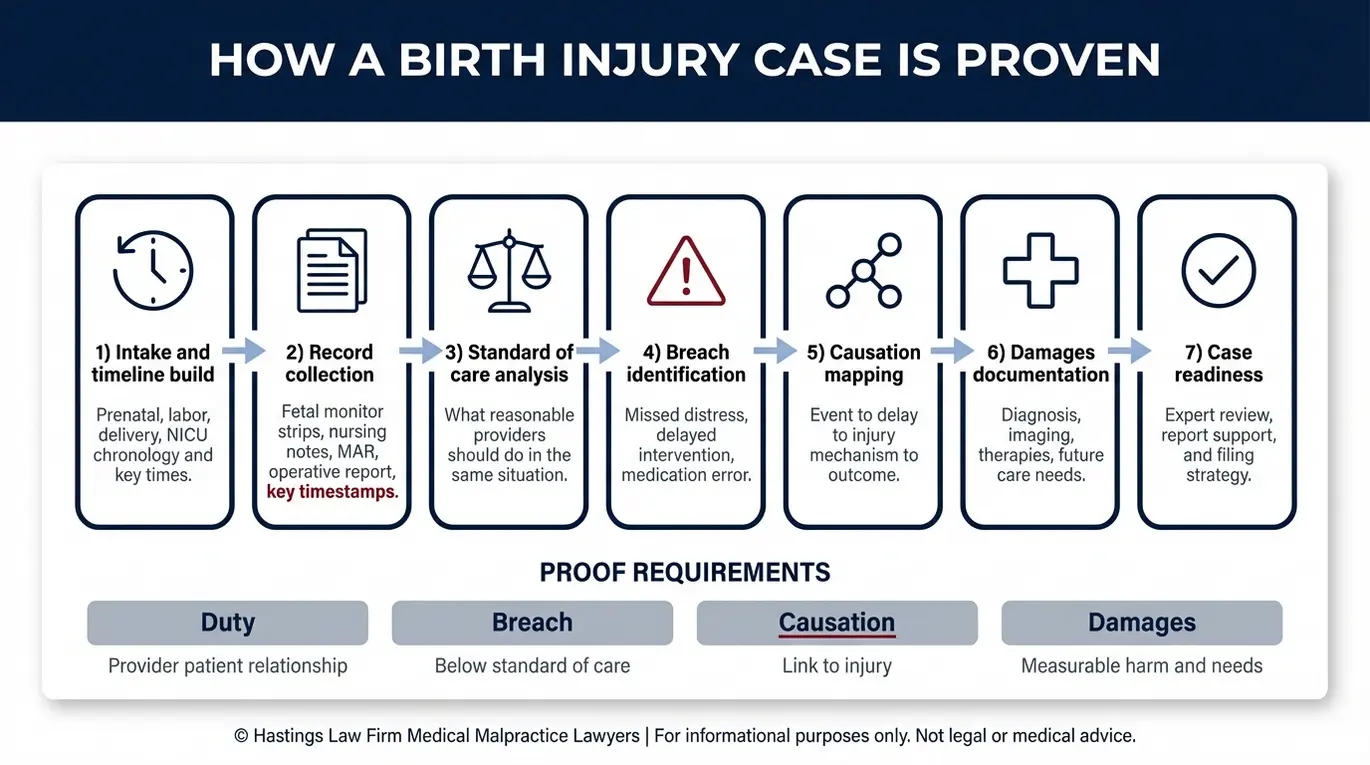
Building a successful case requires a thorough investigation that includes securing medical records, electronic fetal monitoring strips, and staffing logs to identify the exact moment negligence occurred. At Hastings Law Firm, we begin this process immediately, because evidence can deteriorate or disappear if action is delayed. Discovery is the formal process where both sides exchange information and evidence before a trial.
Securing Records. Electronic fetal monitoring (EFM), a technology that continuously tracks the baby’s heart rate and the mother’s contractions during labor, produces data that is central to nearly every birth injury case. We identify signs of fetal distress, a condition indicating the baby is unwell, within the records. We also obtain nursing notes, physician orders, medication administration records, and staffing schedules. Under Texas Civil Practice and Remedies Code § 74.051, a written notice must be provided to each healthcare provider at least 60 days before filing suit, which makes early preparation essential.
Expert Review. Our national network of medical experts reviews the complete clinical picture to determine whether the care provided fell below the accepted standard. These specialists include maternal-fetal medicine physicians, neonatologists, and labor and delivery nurses who can speak to exactly what should have happened at each stage and provide expert testimony if necessary.
Establishing Causation. Proving that negligence occurred is only part of the equation. A birth injury attorney in Texas must also demonstrate that the specific breach of duty directly caused the child’s injury. This requires connecting the timeline of events, the medical evidence, and the expert analysis into a clear chain showing how different decisions would have led to a different outcome.
Analysis of System-Wide Hospital Errors
As part of our medical malpractice investigation, we also look beyond the individual case. If a hospital has a history of similar errors, repeated safety violations, or providers with documented patterns of negligence, that information can strengthen the claim by showing systemic negligence in the facility’s hospital risk management practices.
Calculating Damages and the Lifetime Cost of Care
Compensation in birth injury cases is calculated to cover the child’s lifetime medical needs, including future surgeries, around-the-clock care, adaptive equipment, and loss of earning capacity. Because many birth injuries result in permanent disabilities, the financial stakes of these cases are significant, and getting the calculation right is one of the most important things a Texas birth injury lawyer does for a family. Economic damages represent the actual financial losses incurred by the family due to medical errors.
Economic Damages cover the measurable financial costs associated with the injury. These include past and future medical bills, physical therapy, occupational therapy, speech therapy, home modifications, specialized transportation, and assistive devices. A study published by the CDC in its Morbidity and Mortality Weekly Report (MMWR) estimated that the lifetime cost of care for a person with cerebral palsy was approximately $921,000 in 2003 dollars, a figure that exceeds $1 million when adjusted for inflation and does not account for the full range of supportive services many families require.
Non-Economic Damages address the harm that cannot be easily measured in dollars: the child’s physical pain, mental anguish, physical impairment, and disfigurement. In cases of extreme recklessness, punitive damages may also be pursued.
The Life Care Plan. We work with medical economists and life care planners to project costs over the child’s expected lifespan, often spanning 50 years or more. This plan becomes a central piece of evidence at trial or during settlement negotiations, ensuring that compensation for birth injuries reflects the true long-term burden on the family.
Two-Plaintiff Structure
A birth injury claim often involves two separate plaintiffs. The child has their own claim for pain and suffering, physical impairment, and future medical expenses. The parents also have independent claims for medical bills they have already paid, mental anguish, and loss of companionship. This structure allows for distinct minors claims and parental claims within the same action. A birth injury settlement must account for both sets of damages to fully protect the family’s interests.
Why Choose Hastings Law Firm for Your Family
Hastings Law Firm offers a unique combination of board-certified trial experience and in-house medical expertise, ensuring that complex medical evidence is translated into a compelling case for a jury. We do not handle car accidents, slip-and-fall cases, or anything other than medical malpractice. That singular focus is what sets us apart.
Founder Tommy Hastings is Board Certified in Personal Injury Trial Law by the Texas Board of Legal Specialization, a distinction held by fewer than 2% of Texas attorneys. In 2025, he was inducted into the American Board of Trial Advocates (ABOTA), an invitation-only organization for experienced trial lawyers. His track record demonstrates a commitment to securing the resources needed for a child’s future care needs.
We are not a high-volume settlement operation. We take a limited number of cases so that every family receives the personal attention and resources their situation demands. Our team includes former hospital defense attorneys who understand how the other side builds its case, and in-house nurse consultants who can identify charting inconsistencies and protocol violations that other firms may miss. We handle every case on a contingency fee basis.
Immediate Steps for Parents Suspecting Malpractice
Parents should immediately request a full copy of their medical records, document all conversations with hospital staff, and avoid signing any settlement waivers before consulting an attorney. Taking these steps early ensures evidence preservation for the legal team.
- Do not admit fault. Avoid apologizing or saying “it’s okay” to staff, as these statements can be used against you.
- Request your complete medical records. Contact the hospital’s medical records department and request everything: labor and delivery notes, fetal monitoring strips, nursing flow sheets, medication logs, and operative reports. You have a legal right to these documents.
- Document everything you remember. Write down the timeline of events as you recall them, including what staff said to you, when decisions were communicated, and anything that felt rushed or unexplained. Details fade quickly, so do this as soon as possible.
- Do not sign anything from the hospital or an insurance company. Settlement waivers, releases, or statements can limit your legal options. Politely decline until you have spoken with an attorney.
- Keep a journal of your child’s symptoms and development. Note any seizures, feeding difficulties, limited movement in an arm or leg, low muscle tone (hypotonia), or missed developmental milestones. These observations can be important evidence.
- Contact a Texas birth injury lawyer before time runs out. Texas imposes a statute of limitations on medical malpractice claims, and while there are special rules for minors, evidence becomes harder to preserve the longer you wait.
Clinical Signs Checklist
Watch for these signs in your newborn, which may indicate an injury occurred during delivery. Identifying these newborn symptoms early is an important part of protecting your child’s health:
- Seizures within the first 24 to 72 hours of life
- Floppy or unusually low muscle tone (hypotonia)
- Difficulty feeding or swallowing
- Favoring one arm or limited movement on one side of the body
- Excessive fussiness or unusual lethargy
- Developmental delays as your child grows
If you notice any of these signs and have concerns about the care your child received, birth injury legal advice from an experienced attorney can help you understand whether further investigation is warranted.
Contact the Texas Birth Injury Attorneys at Hastings Law Firm Today for Help
You trusted a medical team to protect your child, and if that trust was broken, you deserve to know what happened and why. At Hastings Law Firm, our only mission is to uncover the truth, hold the responsible parties accountable, and secure the resources your child needs for the road ahead. Our team includes a patient advocate who understands your family’s needs. We handle birth injury cases all across Texas from our Houston, Dallas, and Austin offices.
Time matters in these cases. Medical records can be altered, memories fade, and Texas law sets firm deadlines for filing claims. The sooner you reach out, the sooner we can begin preserving evidence and building your case.
Your initial consultation is free, completely confidential, and led by a team that understands what your family is going through. There is no fee unless we recover compensation for you, so there is no financial risk in reaching out.
If you are looking for a Texas birth injury lawyer who will treat your family’s case with the seriousness and care it deserves, contact Hastings Law Firm today. Let us help you find the answers you need.
Frequently Asked Questions About Birth Injury in Texas


This content was researched and written by the Hastings Law Firm editorial team, which includes attorneys, medical professionals, and experienced researchers. Our writing is informed by internal knowledge and practical experience, and we cross-check critical details against authoritative sources cited throughout. Every piece undergoes human-led fact-checking and legal review. Because legal and medical information can change, if you spot an error, please contact us. Learn more about our content standards and review process on our editorial policy page.

Tommy Hastings, founder of Hastings Law Firm, is a board-certified personal injury trial lawyer dedicated exclusively to healthcare injury cases. Since 2001, he has represented injured patients and families in litigation against major hospital systems, pharmaceutical companies, and negligent healthcare providers nationwide. He has handled numerous high-profile cases that have drawn national media attention and resulted in multi-million dollar recoveries. He draws on that experience in his writing, helping readers understand how these cases work and what options may be available to them.
