


Texas Infant Wrongful Death Lawyer
Written by: Hastings Law Firm | Reviewed by: Tommy Hastings | Updated: July 27, 2026
An infant wrongful death tied to a medical error can leave families grieving while also searching for clear answers about what went wrong. Texas law allows certain family members to pursue civil claims when preventable mistakes in pregnancy, delivery, or newborn care contribute to an infant loss. These cases often turn on proving medical negligence, causation, and the full scope of damages, including emotional harm and financial costs. If you or a loved one were harmed or worse due to infant wrongful death in Texas, contact Hastings Law Firm for a free, confidential case review.
Compassionate Legal Advocacy for Grieving Families in Texas
What You Should Know About Claims in Texas:
- Accountability options can be limited if key filing deadlines are missed, even when the underlying evidence is strong.
- Recovery can be constrained by Texas limits on non economic damages in medical malpractice cases.
- Standing to file for a minor wrongful death in Texas is generally limited to the parents, with other relatives typically excluded unless they legally adopted the child.
- Compensation can address both emotional losses and out of pocket costs, including mental anguish and funeral expenses.
- Additional damages may be available only in cases involving gross negligence.
- Separate claims can affect who receives compensation, since wrongful death damages go to parents while survival damages go through the infant estate.
- Disputes often focus on causation, including arguments that the outcome was inevitable due to underlying conditions.
- A SIDS classification can affect accountability decisions when later review suggests a missed diagnosis or unsafe positioning.
- Medical errors cited in these cases span delivery and newborn care, including delayed C sections and medication dosing mistakes.
- Medical records and expert review can be central to evaluating the standard of care and the medical timeline.

A Healthcare Focused Law Firm
Losing an infant is a pain unlike any other, and when that loss stems from a medical error, the grief carries an added weight of betrayal and unanswered questions. You trusted your child’s care to professionals who were supposed to protect them. If that trust was broken, you deserve honest answers and a legal team that knows how to find them.
At Hastings Law Firm, we focus exclusively on medical malpractice. Founded by Tommy Hastings, a board-certified trial lawyer with over 20 years of experience, we help families find the truth. If you need a Texas Infant Wrongful Death Lawyer, we are here to help families understand what happened, why it happened, and what options exist under Texas law.
If you have questions about your child’s care, we can review what happened and explain your options in a free, confidential consultation.
Understanding Texas Wrongful Death Claims for Minors
A wrongful death claim for a minor in Texas is a civil action filed by surviving parents to hold negligent parties accountable for the preventable death of their child, seeking compensation for emotional and financial losses under the Texas Civil Practice and Remedies Code. Texas governs these cases under Civil Practice and Remedies Code Chapter 71, commonly referred to as the Texas Wrongful Death Act. This act defines who can file, what damages are available, and how the legal process works. Identifying the correct statutory beneficiaries is the first step in this process.
Filing a wrongful death claim serves two purposes. The first is financial: families face real costs, from medical bills to funeral expenses, on top of the immeasurable emotional toll. The second purpose is broader. When a hospital or provider is held accountable for gross negligence or a preventable error, it sends a clear signal that shortcuts in patient safety carry consequences.
For many families, this motivation is important. Preventing the same thing from happening to someone else matters as much as any financial recovery. A wrongful death lawsuit is a civil process. It is entirely separate from any criminal investigation or medical board review.
Civil claims provide a mechanism for families to demand transparency and justice through a preponderance of the evidence, even if prosecutors decline to act. An infant wrongful death attorney can explain how these claims work under Texas wrongful death laws and help determine whether the facts of your situation support a case. An experienced lawyer for child wrongful death understands that this process is about more than money; it is about enforcing accountability in a healthcare system that failed to protect the most vulnerable.
Proving Medical Negligence in Infant Death Cases
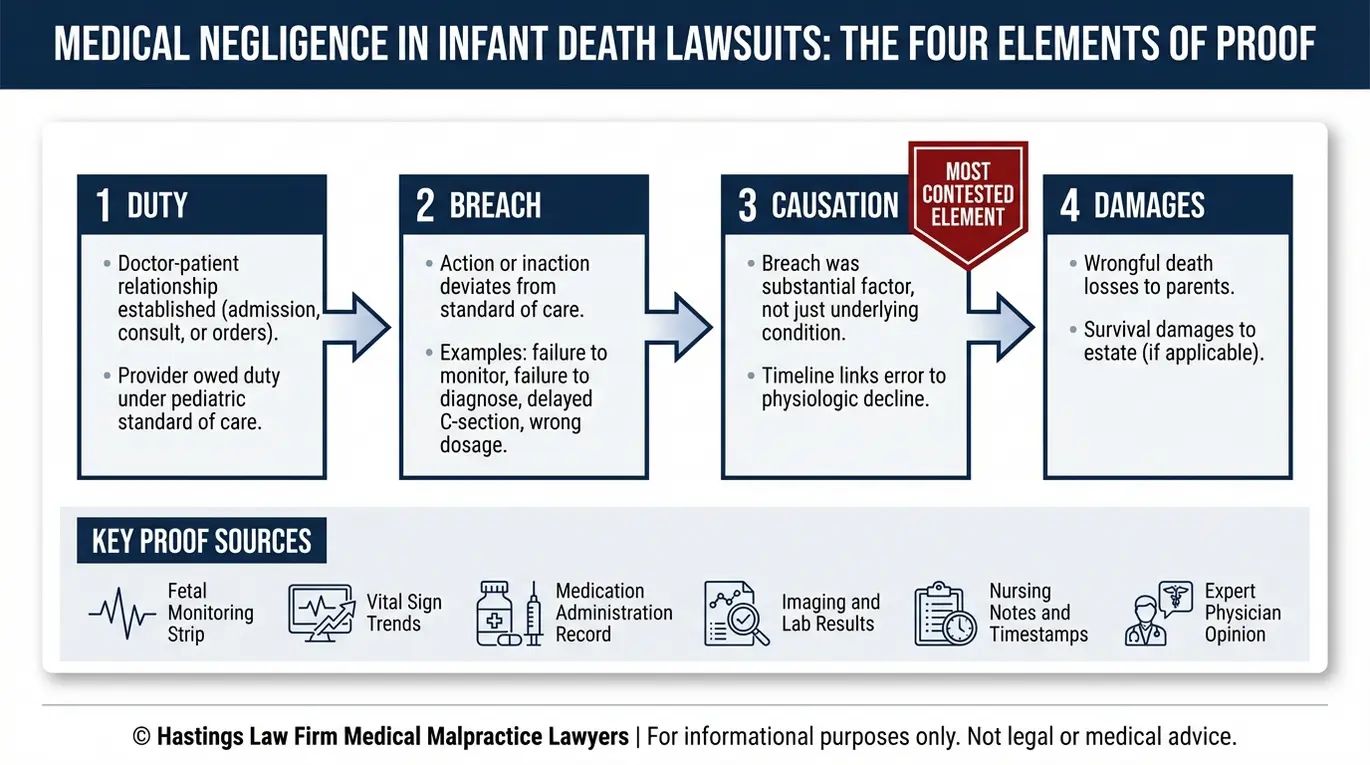
To prove liability in an infant death lawsuit, the plaintiff must demonstrate that the medical provider owed a duty of care, breached that standard through action or inaction, and that this specific breach was the proximate cause of the infant’s death. This framework applies whether the case involves a birth injury, a NICU error, or a misdiagnosis.
Texas law requires that medical malpractice claims meet specific procedural requirements from the outset. Under Texas Civil Practice and Remedies Code, Chapter 74.051, the client must provide written notice to the defendant at least 60 days before filing suit. This notice gives the provider an opportunity to respond. An attorney for medical negligence will handle this requirement and the investigation that supports it.
We support each element of the claim with evidence and expert testimony. Without all four elements, the claim cannot succeed. Defense teams often focus on causation, arguing that the outcome was inevitable due to congenital issues. We overcome this defense with a meticulous independent review of the medical timeline to show that the provider’s errors directly altered the outcome.
Proving wrongful death in these cases requires building a clear evidentiary chain through each of the four legal elements of negligence:
- Duty of care: The provider had an established doctor-patient or hospital-patient relationship with the infant, creating a legal obligation to provide competent medical treatment.
- Breach of duty: The provider deviated from the standard of care, meaning the level of treatment that a reasonably competent medical professional would have provided under similar circumstances. We use Expert opinions from qualified physicians to define that standard and identify where the care fell short.
- Causation: Evidence must show the breach was the direct cause of the infant’s death, not simply the underlying medical condition. We work with medical experts to analyze records, including evidence from electronic fetal monitoring (EFM) and fetal heart rate decelerations, which can signal distress during labor.
- Damages: You must show the specific losses that resulted from the death, which are addressed in detail below.
The Hastings Law Firm Difference
Results matter, but what truly sets us apart is how we achieve them. Every verdict, every settlement, and every Texas courtroom victory comes from one guiding promise: To treat each client’s fight for justice as if it were our own.
This balance of skill, experience, and empathy reflects our core philosophy that justice should not only compensate the injured, but also make healthcare safer nationwide.

Who Has Standing to File for a Deceased Infant in Texas
Under the Texas Wrongful Death Act, the parents (biological or legally adoptive) are the primary statutory beneficiaries with the exclusive right to file a claim for the wrongful death of their minor child. Both parents may file together or individually, and the law evaluates each parent’s claim for damages based on their own personal losses. Standing refers to the legal right to bring a lawsuit.
A separate but related claim can also be filed by the personal representative of the infant’s estate. This is the survival action, which addresses the damages the child experienced before death. If no estate has been established, a Texas infant wrongful death lawyer can guide the family through the process of opening one.
One common question families ask is whether grandparents, siblings, or other relatives can file a wrongful death claim for the infant. In Texas, the answer is generally no. The wrongful death statute limits standing to parents, spouses, and children of the deceased.
Because an infant has no spouse or children, the parents are typically the only parties with legal standing to bring the claim. While grandparents often share deeply in the grief, they are not authorized to file suit unless they have legally adopted the child. Strict adherence to the statute makes filing a wrongful death claim correctly from the start essential.
Medical Errors Frequently Cited in Infant Death Lawsuits
Common grounds for infant wrongful death suits include birth injuries caused by oxygen deprivation, failure to perform timely C-sections, medication dosing errors in the NICU, and misdiagnosis of critical conditions like meningitis or heart defects. These cases span from the delivery room through postnatal care, and the causes of infant wrongful death often involve a chain of missed warning signs rather than a single isolated event.
Any medical malpractice death requires a deep investigation into hospital protocols. A skilled hospital negligence lawyer can identify where systemic failures contributed to the tragedy. Medical malpractice resulting in an infant’s death can generally be grouped into several categories:
- Birth injuries: Hypoxia, or oxygen deprivation to the brain, is one of the most frequently cited causes in these cases. It can result from delayed C-sections, improper use of forceps or vacuum extractors, or failure to recognize signs of fetal distress on monitoring strips. An emergency Cesarean section may be required when distress is identified, and delays in performing this surgical delivery can have fatal consequences.
- NICU and pediatric care errors: Infants in the neonatal intensive care unit are especially vulnerable to medication dosing mistakes. Because drug dosages for newborns are calculated based on body weight, even small measurement errors can lead to dangerous overdoses. Research published through the National Library of Medicine on pediatric weight errors and medication dosing has documented how common these errors are, particularly in emergency settings.
- Surgical errors: When infants require surgery, anesthesia complications and procedural mistakes carry heightened risk due to the child’s size and fragile physiology. Negligence in these settings may involve inadequate surgical planning or understaffing.
- Pharmaceutical injury and errors: Contaminated medications, compounding pharmacy mistakes, or incorrect prescriptions can be fatal for an infant whose body has almost no margin for error. Pharmaceutical injury can also occur when known drug allergies are ignored.
- Diagnosis errors: A failure to diagnose treatable conditions such as bacterial meningitis, pneumonia, or congenital heart defects deprives the infant of life-saving interventions.
An infant death attorney can retain independent forensic and medical experts to review the circumstances surrounding the death.
Re-examining SIDS Classifications for Negligence
Some infant deaths classified as Sudden Infant Death Syndrome (SIDS), the unexplained death of an apparently healthy infant typically during sleep, may warrant closer examination. In certain cases, what is labeled SIDS may actually involve an undiagnosed metabolic disorder, an infection that was missed, or positional asphyxia, which is suffocation caused by improper bedding or positioning. If evidence suggests that a treatable condition went undiagnosed or that hospital protocols for safe infant positioning were not followed, the SIDS classification may not tell the full story of a preventable death.
Calculable Damages for the Loss of a Child
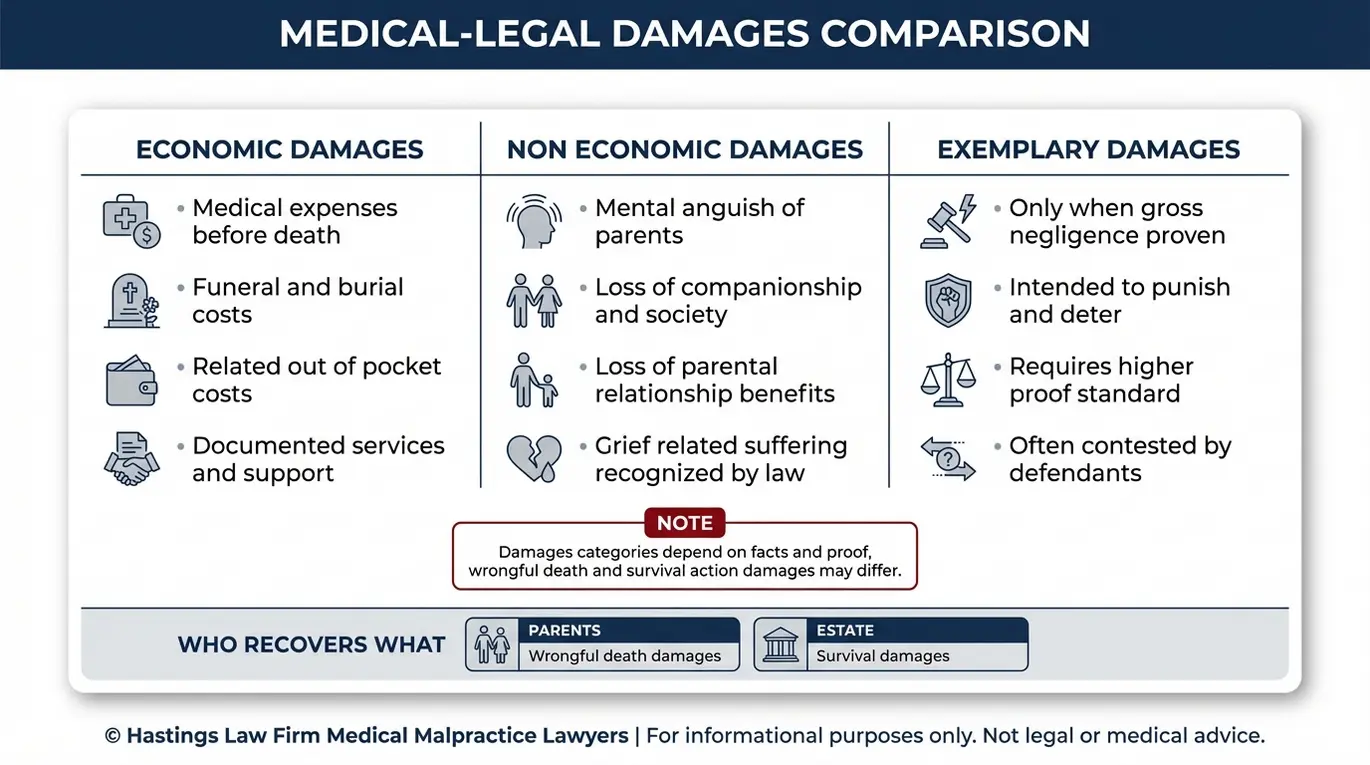
Damages in infant wrongful death cases typically include non-economic losses like mental anguish and loss of companionship, as well as economic costs such as funeral expenses and medical bills incurred prior to death. No dollar amount can replace a child, but Texas law provides a framework for compensating families for both the tangible and intangible harm they have suffered.
Mental anguish refers to the emotional pain, torment, and suffering the parents experience as a result of their child’s death. Texas courts recognize that this is not a temporary condition; it reflects the ongoing impact of living without a child who should still be here. Each parent’s mental anguish is evaluated individually.
Loss of companionship compensates for the loss of the positive benefits that flow from the love, comfort, companionship, and society the child would have provided throughout the parents’ lives. Courts consider the nature of the parent-child relationship and the expected duration of that bond.
One challenge specific to infant cases is proving pecuniary loss, or the financial contributions the child would have made over a lifetime. Because an infant has no earnings history or established career path, these economic damages are difficult to quantify and are typically a smaller component of the recovery compared to non-economic damages. Attorneys often use economists to project potential lifetime earnings based on statistical data to argue for fair compensation for loss of child.
| Damage Category | Type | Examples |
|---|---|---|
| Medical expenses | Economic | Hospital bills, emergency care, NICU costs incurred before death |
| Funeral and burial costs | Economic | Burial, cremation, memorial services |
| Mental anguish | Non-economic | Emotional suffering, grief, psychological harm to each parent |
| Loss of companionship | Non-economic | Loss of love, comfort, society, and the parent-child relationship |
| Exemplary (punitive) damages | Punitive | Available only in cases involving gross negligence; intended to punish and deter |
Exemplary damages, also called punitive damages, are not available in every case. Texas law reserves them for situations involving gross negligence, where the provider’s conduct reflects an extreme degree of risk and a conscious indifference to the safety of the patient. When the evidence supports it, a Texas infant wrongful death lawyer can pursue exemplary damages on top of compensatory damages. Accurately calculating wrongful death damages and determining the settlement value of the claim requires a deep understanding of how Texas juries evaluate these profound losses.
Distinguishing Survival Actions from Wrongful Death Claims
While a wrongful death claim compensates the family for their loss, a survival action is filed on behalf of the deceased infant’s estate to recover damages the child suffered personally (such as pain and suffering) before passing away. These are two separate legal claims, and in many cases, both can and should be pursued together.
A survival action exists because Texas law recognizes that a person’s legal claims do not simply disappear at death. The claim “survives” and can be brought by the personal representative of the estate. The key differences include:
- Who benefits: A wrongful death claim compensates the parents directly. A survival action recovers damages on behalf of the infant’s estate, which are then distributed according to Texas heirship laws.
- What is recovered: The survival action covers the infant’s own pain and suffering before death. This includes physical pain experienced during failed neonatal resuscitation (NRP), which are emergency interventions performed on a newborn who is not breathing adequately.
- Who files: The wrongful death claim is filed by the parents as statutory beneficiaries. The estate claim for infant damages is filed by the personal representative of the estate, which may need to be formally established through the court.
When pursuing a survival action Texas law allows for the recovery of damages for the conscious pain and mental anguish the infant suffered in the moments leading up to death. Understanding the distinction between these claims matters because each one captures a different category of harm. Filing both ensures the fullest possible recovery under Texas law.
Statute of Limitations and Deadlines for Filing Infant Death Claims
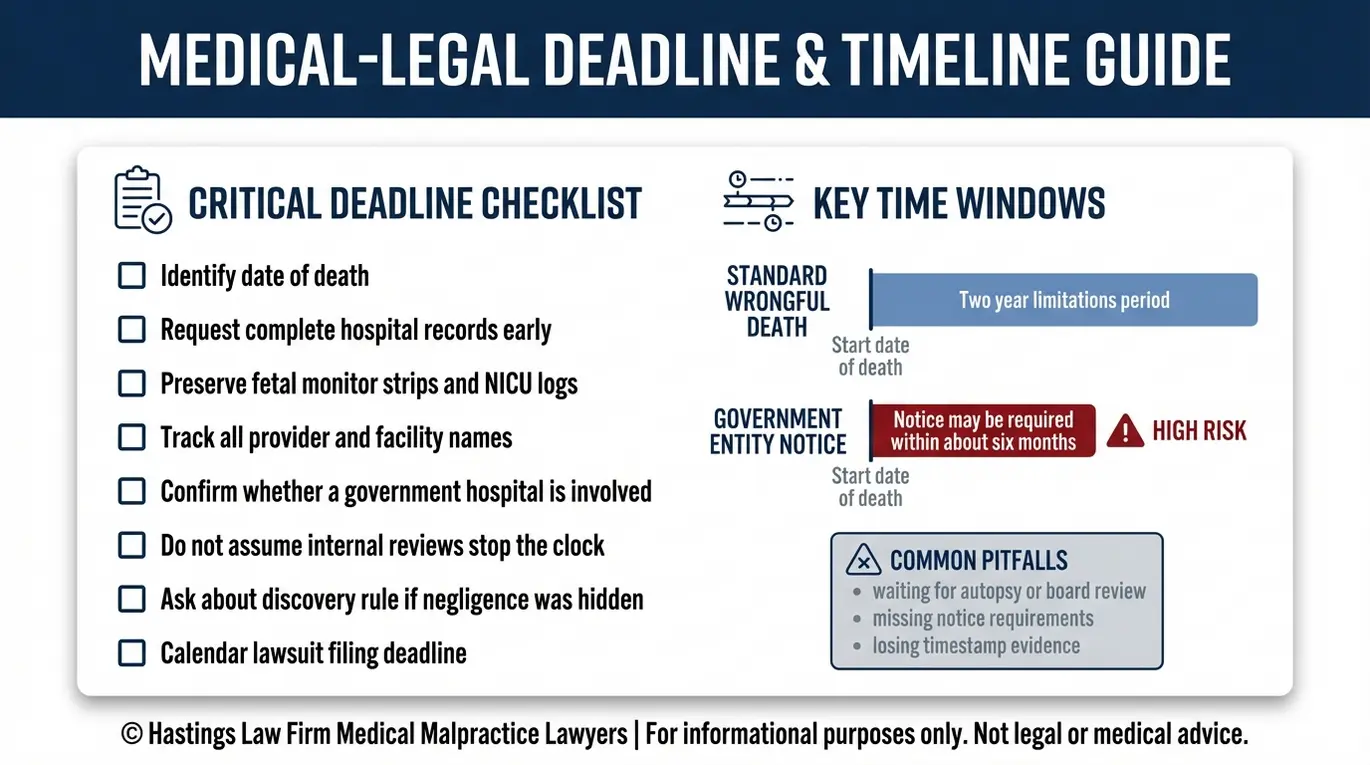
The general statute of limitations for wrongful death in Texas is two years from the date of death, but strict exceptions apply to claims against government hospitals which may require notice within as little as six months. Missing any of these deadlines can permanently bar your right to file, regardless of how strong the evidence may be.
The two-year deadline is established under Texas Civil Practice and Remedies Code § 16.003. In most cases, the clock starts on the date the infant died. However, in limited circumstances, the discovery rule may apply. This rule can toll, or pause, the statute of limitations if the negligence was not and could not have been immediately discovered.
One critical exception involves claims against government-operated hospitals, including county and public university medical centers. Under the Texas Civil Practice and Remedies Code, Chapter 101, also known as the Texas Tort Claims Act, families may be required to provide formal written notice to the governmental entity within six months of the incident.
Some municipal charters require notice in as few as 90 days. Failing to meet this notice requirement can result in the claim being dismissed entirely. Understanding the statute of limitations Texas applies to government entities is essential for preserving your rights.
Key deadline exceptions to be aware of:
- Two-year general deadline from the date of the infant’s death for most medical malpractice claims
- Six-month notice requirement for claims against government-run hospitals and facilities under the Texas Tort Claims Act
- Discovery rule exception that may extend the filing period if negligence was not immediately apparent
- 120-day expert report deadline after the lawsuit is filed, as required by Chapter 74
A Texas infant wrongful death lawyer can evaluate which deadlines apply to your specific situation and ensure that no filing window is missed.
Why Retain a Board Certified Texas Infant Wrongful Death Lawyer
Hiring a specialist ensures your case is handled by a team that understands complex medical records, hospital protocols, and defense tactics, significantly increasing the likelihood of a successful recovery. Our legal team includes former defense attorneys and hospital nurses who understand how hospital systems build their defense. You need the best wrongful death lawyer for your family’s unique situation.
Hastings Law Firm does not split its focus among various areas of law. Every attorney, nurse consultant, and patient advocate on our team works exclusively in medical malpractice. Our team includes Board Certified attorneys. Founder Tommy Hastings is a member of the American Board of Trial Advocates, an invitation-only organization for elite trial lawyers. As a dedicated trial lawyer team, we prepare every case as if it will go to court.
We understand the complex medicine involved, such as errors in the neonatal intensive care unit (NICU) or mistakes with weight-based medication dosing (mg/kg), where a simple calculation error can be fatal. Beyond the legal strategy, we understand that families in this situation need more than a lawyer. They need someone who will listen, explain what happened in plain language, and treat them as partners in the process.
Our mission is to restore trust that was broken by the healthcare system. We work on a contingency fee basis, which means there are no upfront costs or retainer fees. We operate on a no win no fee model. You pay nothing unless we recover compensation on your behalf.
Contact the Texas Birth Injury Attorneys at Hastings Law Firm Today for Help
No amount of money can replace a child. But compensation is the only tool the civil justice system provides to enforce accountability and help prevent the same mistakes from affecting another family. If you believe your infant’s death may have been caused by a medical error, you have the right to ask questions and seek answers.
Our team at Hastings Law Firm is ready to listen. When you contact us, you will speak with a patient advocate who can walk you through what a case evaluation looks like. The consultation is free, confidential, and comes with no obligation.
There is no fee unless we win. Let us help you understand what happened and what your legal options may be.
Frequently Asked Questions About Infant Wrongful Death in Texas


This content was researched and written by the Hastings Law Firm editorial team, which includes attorneys, medical professionals, and experienced researchers. Our writing is informed by internal knowledge and practical experience, and we cross-check critical details against authoritative sources cited throughout. Every piece undergoes human-led fact-checking and legal review. Because legal and medical information can change, if you spot an error, please contact us. Learn more about our content standards and review process on our editorial policy page.

Tommy Hastings, founder of Hastings Law Firm, is a board-certified personal injury trial lawyer dedicated exclusively to healthcare injury cases. Since 2001, he has represented injured patients and families in litigation against major hospital systems, pharmaceutical companies, and negligent healthcare providers nationwide. He has handled numerous high-profile cases that have drawn national media attention and resulted in multi-million dollar recoveries. He draws on that experience in his writing, helping readers understand how these cases work and what options may be available to them.
