







Written by: Hastings Law Firm | Reviewed by: Tommy Hastings | Updated: September 24, 2026
Top-Rated Phoenix Medical Malpractice Attorneys Handling Health Care Negligence Claims
When a doctor, hospital, or medical team causes harm instead of healing, the emotional weight can be just as heavy as the physical injury. You may feel confused about what went wrong, unsure whether what happened was preventable, and uncertain about what to do next. Those feelings are valid, and you are not alone in experiencing them.
Hastings Law Firm is a plaintiff trial firm that handles medical malpractice cases exclusively. Our team, which includes board-certified trial attorneys, former defense lawyers, and in-house medical professionals, focuses entirely on representing patients and families harmed by negligent healthcare. From our Phoenix office we serve clients throughout Arizona.
If you believe you or a loved one was injured by a medical error, a Phoenix medical malpractice lawyer at our firm can review what happened and explain your options at no cost and with no obligation.

What Constitutes Medical Malpractice in Arizona
Medical malpractice occurs when a healthcare professional deviates from the accepted standard of care, directly causing injury or death to a patient. The distinction between an unfortunate result and actionable negligence is one of the most misunderstood parts of medical malpractice law, and it is often the first question our medical malpractice attorneys in Phoenix help clients answer. Not every failed treatment implies a legal wrong, and modern medicine cannot guarantee a positive result in every case.
Under Title 12 of the Arizona Revised Statutes, specifically Arizona Revised Statute § 12-563, a patient must prove the provider failed to exercise the degree of care, skill, and learning expected of a reasonable, prudent health care provider in the same profession or class within the state acting in the same or similar circumstances. This is sometimes called the “reasonable physician” standard. A doctor is not expected to be perfect, but they are expected to act within the boundaries of accepted medical practice. When they fail to do so, it constitutes a breach of duty.
Here is a simple way to think about the difference:
- Bad outcome (not malpractice): A surgeon performs a procedure correctly, but a known complication occurs despite proper technique and informed decision-making.
- Negligence (potential malpractice): A surgeon fails to review the patient’s chart, misses a documented contraindication (a condition or factor that makes a particular treatment risky or inadvisable), and proceeds with a procedure that causes foreseeable harm.
The key question is whether the provider’s actions fell below what the medical community would consider acceptable, and whether that failure directly led to injury.
Acts of Commission vs. Acts of Omission
In Arizona, medical negligence typically takes one of two forms. An act of commission is when a provider does something wrong, such as performing wrong-site surgery, where a procedure is carried out on the incorrect body part or location. An act of omission is when a provider fails to do something that should have been done, such as a failure to diagnose, also called a diagnostic error, where a condition like cancer or stroke goes unidentified despite available evidence.
Both forms of negligence can cause serious, sometimes irreversible harm. Our team evaluates medical records, clinical protocols, and provider actions to determine which type of error may have occurred and whether it meets the legal threshold for a claim.
Major Hospitals and Healthcare Systems in Phoenix
The Phoenix metropolitan area is home to one of the largest and most complex healthcare markets in the country, with 66 hospitals across the Valley and a patient population of over 4.7 million people in Maricopa County alone. Understanding the scale and structure of this market matters because malpractice claims can arise from any part of it.
Banner Health is the dominant system in the region and the largest private employer in Arizona. Banner University Medical Center Phoenix is a 746-bed Level I Trauma Center and the primary teaching hospital for the University of Arizona College of Medicine in Phoenix. Banner also operates Banner Estrella Medical Center in west Phoenix, Banner Thunderbird Medical Center in Glendale, Banner Desert Medical Center in Mesa, Banner Gateway Medical Center in Gilbert, and Banner Ironwood Medical Center in San Tan Valley. Across these campuses, Banner provides everything from emergency trauma care to high-risk obstetrics and organ transplantation.
Dignity Health, now part of CommonSpirit Health, operates St. Joseph’s Hospital and Medical Center in central Phoenix. St. Joseph’s is home to the Barrow Neurological Institute, one of the top neuroscience programs in the world and a destination for patients with complex brain and spine conditions. Dignity Health also operates Chandler Regional Medical Center and Mercy Gilbert Medical Center, both of which serve the fast-growing southeast Valley.
HonorHealth runs four hospital campuses across Scottsdale and North Phoenix, including Scottsdale Osborn Medical Center, Scottsdale Shea Medical Center, Deer Valley Medical Center, and John C. Lincoln Medical Center. These facilities provide a wide range of services from emergency care to orthopedics and cardiovascular surgery.
Valleywise Health is Maricopa County’s public safety-net hospital system and the county’s only public teaching hospital. It serves uninsured and underinsured patients across the Valley and operates a network of community health centers in addition to its main medical center. Its role in the Phoenix healthcare system is similar to what Parkland Health provides in Dallas County.
Mayo Clinic Hospital in Phoenix is a nationally ranked specialty and surgical facility. Phoenix Children’s Hospital is the state’s only hospital dedicated exclusively to pediatric care. Abrazo Health operates multiple campuses across the Valley, including Abrazo Central Campus, Abrazo Arrowhead Campus, and the Arizona Heart Hospital.
Beyond these hospital systems, the Valley has seen rapid expansion of freestanding emergency rooms, ambulatory surgical centers, and urgent care clinics, particularly along the Loop 101, Loop 202, and major suburban corridors. These facilities are held to the same standard of care as hospital-based ERs and physician offices. When a provider at any of these locations fails to meet that standard and a patient is harmed, the facility and its providers face the same liability exposure as a major hospital system.

How Our Phoenix Medical Lawyers Prove Negligence
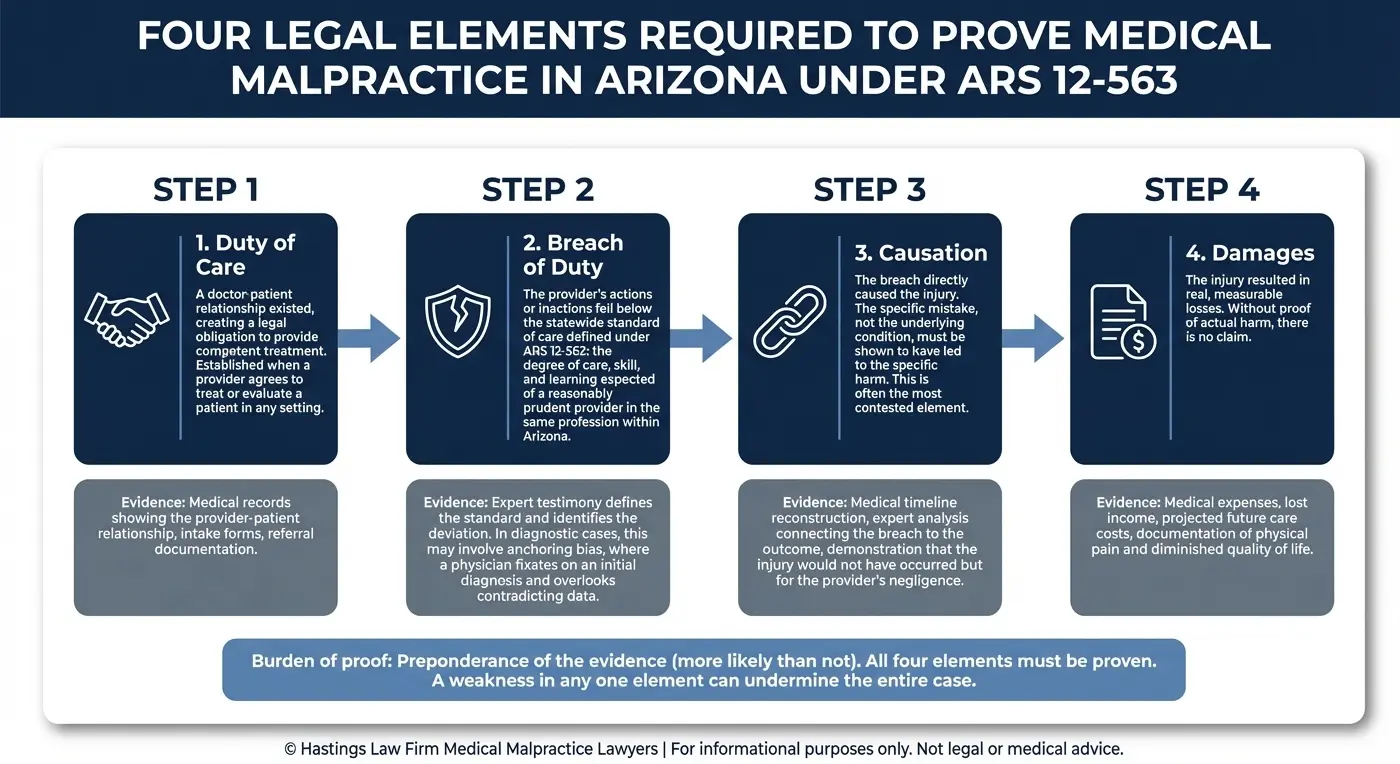
To win a malpractice claim, a plaintiff must prove four elements: duty of care, breach of duty, causation, and resulting damages. Each legal element must be supported by evidence to hold a healthcare provider accountable. A Phoenix medical negligence lawyer experienced in these cases knows how to connect the evidence to each element in a way that holds up under scrutiny from defense teams and insurance adjusters.
Here is what each element requires:
- Duty of care: A doctor-patient relationship existed, creating a legal obligation to provide competent treatment. This is typically established the moment a provider agrees to treat or evaluate a patient, whether in a hospital, clinic, or private practice setting.
- Breach of duty: The provider’s actions or inactions fell below the standard of care defined under ARS § 12-563, described above. In diagnostic cases, this can involve anchoring bias, where a physician fixates on an initial diagnosis and overlooks test results or symptoms that point in a different direction. We use expert testimony to define the standard for the jury and highlight the deviation.
- Causation: The breach directly caused the injury. It is not enough to show that a mistake was made; we must demonstrate that the mistake, rather than the underlying condition, led to the specific harm. This is often the most contested element in litigation.
- Damages: The injury resulted in real, measurable losses, whether medical expenses, lost income, physical pain, or diminished quality of life. Without proof of actual harm, there is no claim.
We build each case by reconstructing the medical timeline, analyzing medical records, consulting with qualified experts, and identifying exactly where the standard of care was violated. The burden of proof lies with the plaintiff. Unlike criminal cases, civil malpractice cases require a “preponderance of the evidence,” meaning it is more likely than not that negligence occurred. This structured approach allows us to present a clear chain of evidence from the provider’s error to the provider’s liability.
Recoverable Damages in a Phoenix Malpractice Lawsuit
Patients harmed by medical negligence can recover economic damages for financial losses and non-economic damages for intangible suffering, and notably, Arizona imposes no statutory cap on these damages in personal injury or wrongful death cases. Arizona law ensures that patients can seek full financial recovery for their injuries. Specifically, the state does not impose a statutory cap on general damages, which means compensation for medical negligence can reflect the true scope of harm.
Economic damages cover the measurable financial impact of the injury:
- Past and future medical bills, including surgeries, rehabilitation, and ongoing care
- Lost wages and diminished earning capacity
- Cost of assistive devices, home modifications, or long-term care
Non-economic damages address the personal toll that cannot be reduced to a receipt:
- Physical pain and suffering
- Loss of enjoyment of life
- Emotional distress and mental anguish
- Disfigurement or permanent disability
Arizona’s protection against damage caps is rooted in the Arizona Constitution, Article 2, Section 31, which states that no law shall limit the amount of damages recoverable for injury or death. This is a meaningful distinction from many other states that restrict what juries can award. In states with caps, a patient with catastrophic injuries might be limited to a set amount for their suffering, regardless of how severe it is. This legal protection ensures that individuals injured by healthcare providers are not limited by arbitrary caps on their suffering. For patients and families in Phoenix, it means a jury is free to assign a value in a verdict or settlement that truly reflects the harm suffered.
As Phoenix malpractice counsel, we work with medical and financial experts to document the full extent of your losses, both current and projected, so that no category of harm goes unaccounted for.

“Cases aren’t won by the lawyer with the fanciest tie, but by the lawyer who works the hardest and cares the most.”
– Tommy Hastings, founding attorneyA Phoenix Malpractice Law Firm That Gets Results
Hastings Law Firm was founded in 2005 by Tommy Hastings, a board certified personal injury attorney who has dedicated his entire career to representing patients and families harmed by medical negligence. Medical malpractice is all we do. We don’t split our attention across car accidents, slip-and-falls, or general personal injury. That exclusive focus shapes how we staff cases, how we prepare for trial, and the depth of medical knowledge we bring to every claim.
Our Phoenix office brings that same approach to patients and families across Arizona. The preparation and intensity behind every case we take on has earned us a reputation that defense attorneys and insurance carriers recognize, and it matters when you’re going up against hospitals and defense teams with unlimited resources.
Experienced & Dedicated Medical Injury Lawyers Near You
Patients and families across the Greater Phoenix area trust Hastings Law Firm because we combine deep medical knowledge with aggressive litigation strategy. Tommy has obtained millions of dollars in compensation for his clients, and the attorneys and medical professionals on our team bring that same standard to every case we take on.
Who Can Be Held Liable for Medical Negligence in Phoenix
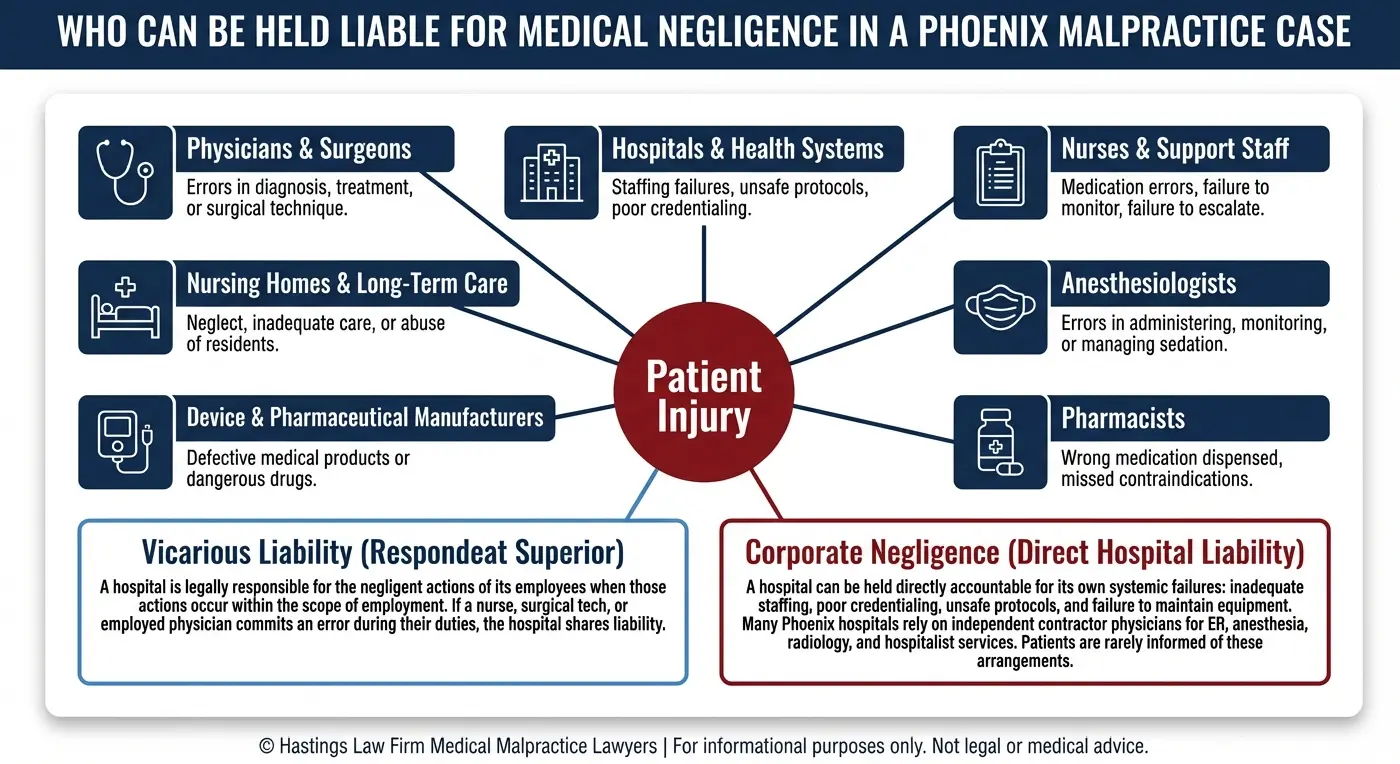
Liability for medical errors in Phoenix often extends beyond the treating physician to include hospitals, nurses, anesthesiologists, pharmacists, and even medical device or pharmaceutical manufacturers. Identifying every responsible party is a critical step when pursuing a claim against a healthcare provider or facility. Cases involving defective devices may also fall under medical product liability.
Vicarious liability applies when a hospital is legally responsible for the negligent actions of its employees. If a nurse administers the wrong medication or a surgical team member fails to follow protocol, the hospital that employs them may share in the liability.
Corporate negligence focuses on the institution itself. A hospital can be held directly accountable for systemic failures, such as inadequate staffing, poor credentialing of physicians, or unsafe internal protocols that contributed to patient harm. This is the core of hospital malpractice. In the Phoenix market, this theory is especially relevant because many Banner Health, HonorHealth, and Abrazo facilities rely heavily on independent contractor physicians for emergency medicine, anesthesiology, radiology, and hospitalist services. A patient may receive care at a facility bearing a major health system’s name without realizing the treating doctor has no employment relationship with that system.
In many cases, multiple defendants share fault. A surgeon may have committed the error, but the hospital may have failed to maintain equipment, enforce safety checks, or staff the unit appropriately. An anesthesia error, which involves mistakes in administering, monitoring, or managing sedation during a procedure, may implicate both the anesthesiologist and the facility. Emergency room triage, the process of prioritizing patients based on the severity of their condition, can also become a point of failure if delays in assessment lead to worsened outcomes.
Our team investigates the full chain of care to identify all parties whose actions or inactions contributed to the injury. We also handle cases involving negligence in long-term care settings, distinguishing clinical failures from nursing home abuse.
Arizona Statute of Limitations and the Discovery Rule
Arizona generally allows two years from the date of injury to file a medical malpractice lawsuit, though exceptions exist for undiscovered injuries. Missing these strict legal deadlines can result in the loss of your right to seek compensation. Missing this deadline almost always results in permanent loss of the right to seek compensation, regardless of how strong the evidence may be. Understanding these legal deadlines is critical for anyone pursuing a medical negligence claim in Arizona.
Under Arizona Revised Statute § 12-542, the standard limitations period is two years. However, the discovery rule can adjust when the clock starts. If an injury was not immediately apparent, the filing period may begin on the date the patient discovered (or reasonably should have discovered) the harm and its connection to the provider’s conduct.
There are also specific exceptions to be aware of:
- Minors: The statute of limitations may be tolled, or paused, until the child reaches 18 years of age, at which point the standard filing window begins. This ensures children are not penalized for their parents’ failure to file.
- Wrongful death: The two-year period typically runs from the date of death, not the date of the original negligent act.
Because these deadlines are strict and the exceptions are fact-specific, early consultation with a Phoenix medical malpractice lawyer is essential. Even if you are unsure whether your situation qualifies, having your case evaluated promptly protects your ability to take legal action if warranted.
Arizona Comparative Negligence Laws in Malpractice Litigation
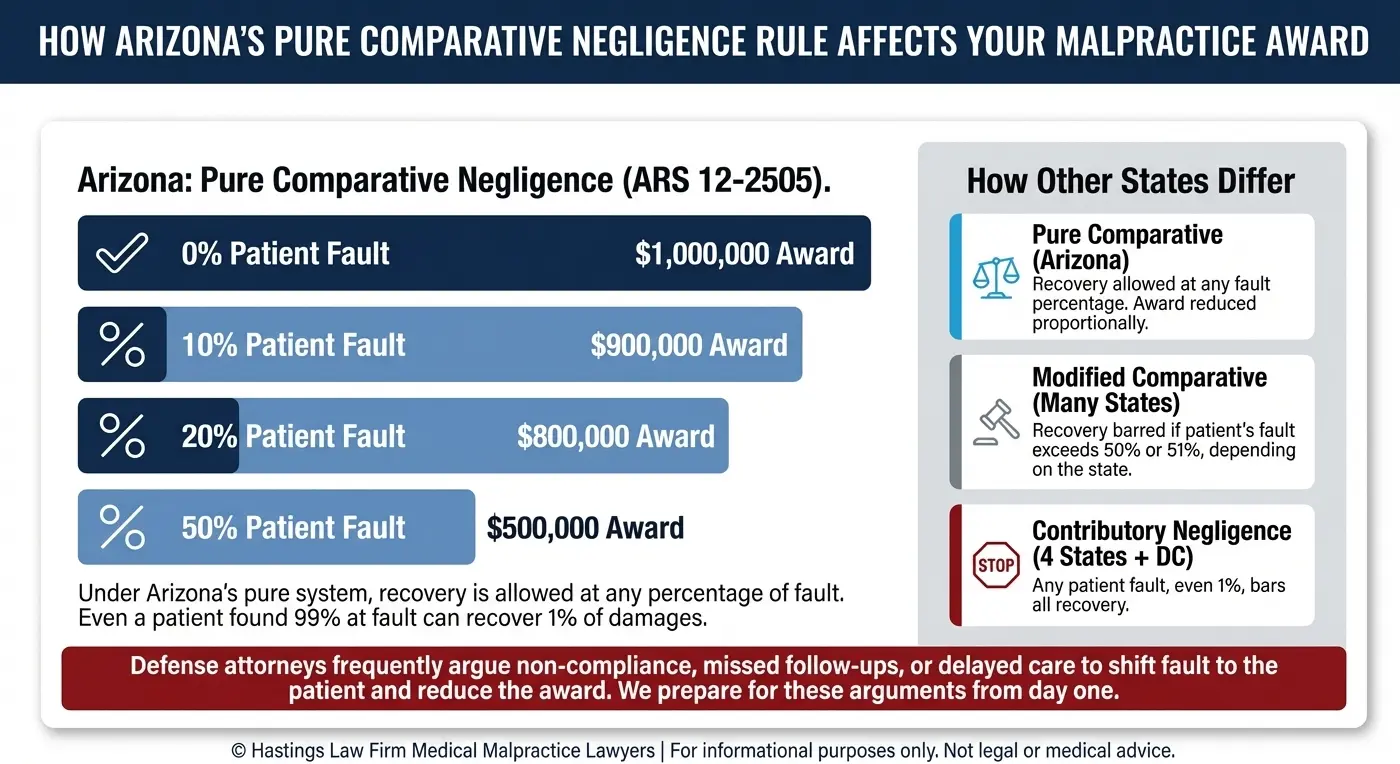
Arizona follows a pure comparative negligence rule, meaning a patient can still recover damages even if they were partially at fault, though compensation is reduced by their percentage of responsibility. This rule helps determine how compensation is shared when multiple parties are involved. Under this “pure” system, you can seek damages even if your own actions contributed more to the injury than the provider’s.
For example, if a jury returns a verdict determining that a patient’s total damages are $1,000,000 but assigns 20% fault to the patient for not following post-operative instructions, the final award would be reduced to $800,000. Unlike some states that bar recovery if the plaintiff’s fault exceeds a certain threshold, Arizona allows recovery at any percentage of fault. This proportional system ensures that justice is not all-or-nothing.
Defense attorneys frequently use this rule to shift blame toward the patient. Common arguments include claims of non-compliance with treatment plans, failure to attend follow-up appointments, or delay in seeking care. These arguments are often raised not because the patient truly caused the harm, but because reducing the patient’s compensation by even a small percentage can save the defendant millions.
We prepare for these arguments from the start. By reconstructing the timeline and documenting the patient’s actions alongside the provider’s obligations, we build a factual record that counters attempts to deflect accountability. We show that the patient’s actions were reasonable given the circumstances, minimizing any unfair reduction in the final award.
Where Medical Malpractice Lawsuits Are Filed in Phoenix
Medical malpractice cases arising from care in the Phoenix metro area are filed in Maricopa County Superior Court, the fourth-largest trial court system in the United States. The court serves over 4.7 million residents across the county, with more than 160 judicial officers handling civil, criminal, family, and probate matters.
Civil filings are submitted to the Clerk of Superior Court. The civil filing counter is located at 201 W. Jefferson Street in downtown Phoenix, and the main courthouse sits at 620 W. Jackson Street. Attorneys are required to file electronically under Arizona Supreme Court Administrative Order 2021-30. Self-represented litigants may e-file but are not required to do so.
Maricopa County operates a compulsory arbitration program for certain civil cases, but most medical malpractice claims exceed the jurisdictional dollar threshold and proceed directly to a judge or jury. If a case is routed to arbitration, either party may request a trial de novo, which is essentially a fresh trial, if they disagree with the arbitrator’s decision.
Appeals from Maricopa County Superior Court are heard by the Arizona Court of Appeals, Division One, which sits in Phoenix.
Our attorneys file and appear in Maricopa County Superior Court regularly. That familiarity with local procedural rules, scheduling expectations, and judge-specific practices affects how we prepare cases and manage timelines from the start.
Phoenix and Valley Communities We Serve
We represent patients and families harmed by medical negligence across the greater Phoenix metropolitan area from our Phoenix office.
Within Phoenix, we serve clients in Central Phoenix, North Phoenix, South Phoenix, Ahwatukee, Arcadia, Desert Ridge, Laveen, and the surrounding neighborhoods.
Across the East Valley, we represent patients and families in Scottsdale, Tempe, Mesa, Chandler, Gilbert, Queen Creek, Apache Junction, San Tan Valley, and Fountain Hills. In the West Valley, our clients come from Glendale, Peoria, Surprise, Goodyear, Avondale, Buckeye, Litchfield Park, and El Mirage. We also serve the North Valley communities of Paradise Valley, Cave Creek, Carefree, Anthem, and the surrounding areas.
Cases arising outside Maricopa County are filed in the appropriate county’s Superior Court, but the underlying Arizona medical liability standards remain the same. We represent clients throughout the state, not just the Phoenix metro.
Talk to a Phoenix Healthcare Malpractice Attorney About Your Case
If you or someone in your family was harmed by a healthcare provider or facility in Phoenix, Scottsdale, Tempe, Mesa, Chandler, Gilbert, Glendale, or anywhere in the Valley, we can help you understand what happened and whether negligence played a role. Your first conversation with our team is free, confidential, and carries no obligation. We’ll review the facts of your situation, explain your legal options, and give you an honest assessment of whether your case has merit. If we move forward together, you pay no attorney fees or costs unless we recover compensation on your behalf. Call or use the contact form on this page to schedule your free case review.
Phoenix Medical Injury Claim Questions


This content was researched and written by the Hastings Law Firm editorial team, which includes attorneys, medical professionals, and experienced researchers. Our writing is informed by internal knowledge and practical experience, and we cross-check critical details against authoritative sources cited throughout. Every piece undergoes human-led fact-checking and legal review. Because legal and medical information can change, if you spot an error, please contact us. Learn more about our content standards and review process on our editorial policy page.

Tommy Hastings, founder of Hastings Law Firm, is a board-certified personal injury trial lawyer (by the Texas Board of Legal Specialization) dedicated exclusively to healthcare injury cases. Since 2001, he has represented injured patients and families in litigation against major hospital systems, pharmaceutical companies, and negligent healthcare providers nationwide. He has handled numerous high-profile cases that have drawn national media attention and resulted in multi-million dollar recoveries.
