


Arizona Nurse Malpractice Lawyer
Nursing negligence can leave patients and families facing serious harm, confusing medical records, and uncertainty about who is responsible. In Arizona, these claims often turn on whether nursing care fell below the accepted standard and whether that lapse directly caused measurable injury. Liability may involve an individual nurse, a hospital, or other providers, especially when accounts conflict about orders, monitoring, and safety. Compensation can also be affected by insurance reimbursement claims that reduce what is ultimately received. If you or a loved one were harmed or worse due to nurse negligence in Arizona, contact Hastings Law Firm for a free, confidential case review.

Last Updated: July 27, 2026
Trusted Legal Representation for Nurse Negligence in Arizona
When a nurse’s error causes serious harm, the aftermath can feel overwhelming. You may be dealing with unexpected medical complications, mounting bills, and difficult questions about what went wrong and why. These concerns are valid, and you deserve clear answers.
Nursing negligence cases are medically and legally complex. They require a legal team that understands clinical protocols, hospital systems, and how to identify where care broke down. At Hastings Law Firm, our team includes in-house medical professionals and former defense attorneys who know how hospitals and their insurers respond to these claims. We prepare every case as if it is going to trial, because that preparation is what drives fair outcomes.
If you believe a nursing error injured you or someone you love, an experienced Arizona nurse malpractice lawyer can review your situation and explain your options. Contact us for a free, confidential case evaluation.

Defining Nursing Malpractice Under Arizona Law
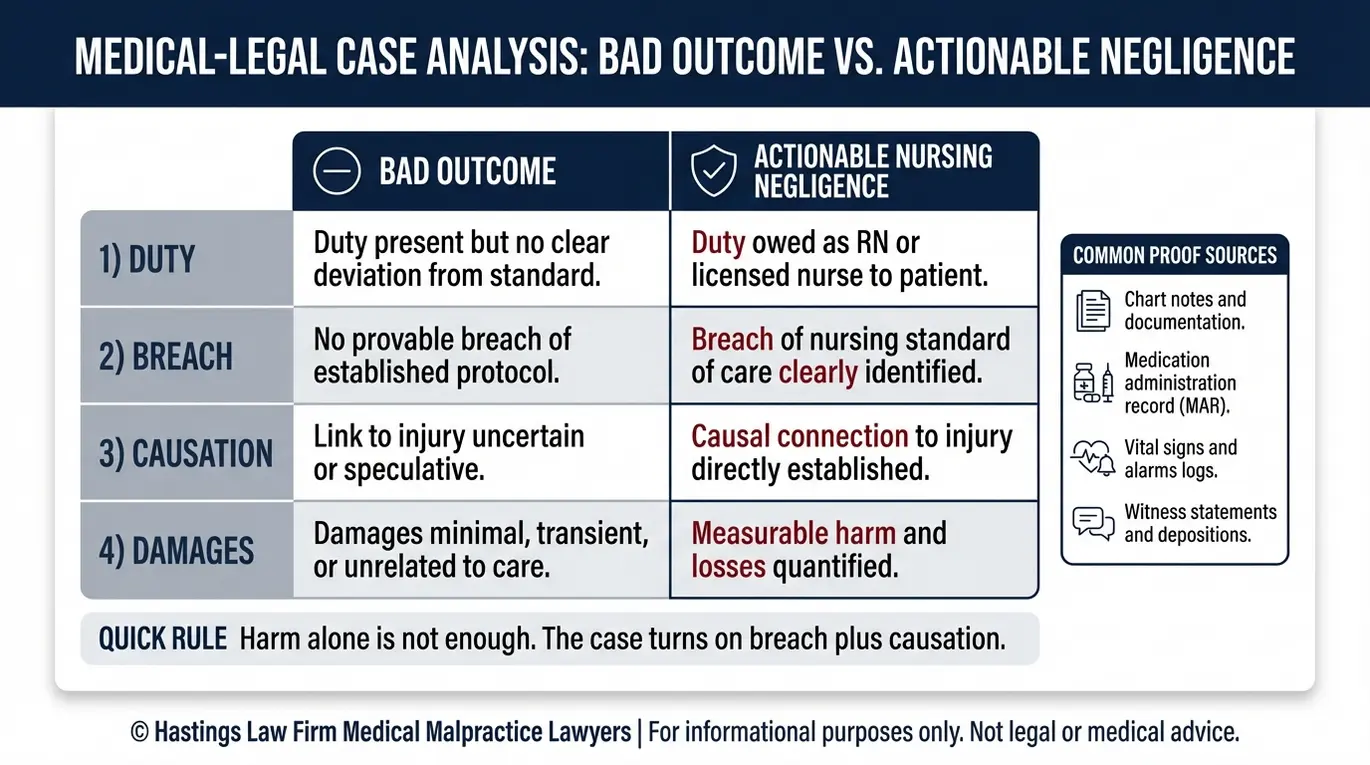
Nursing malpractice occurs when a nurse fails to adhere to the accepted standard of care, resulting in direct injury or harm to a patient. The standard of care refers to the level of care a reasonably prudent health care professional would provide under similar circumstances. It is a legal determination that a healthcare provider’s actions failed to meet professional expectations.
Nursing malpractice is not simply a bad outcome. It is a preventable harm rooted in a specific breach of professional duty. The Arizona State Board of Nursing and Arizona’s statutory framework establish the regulatory and legal standards that govern nursing practice. An RN is a licensed professional who has completed an accredited nursing program and passed the NCLEX-RN examination.
When an RN or other nursing professional falls below those expectations, and a patient is harmed as a result, a negligence claim may exist. A skilled malpractice lawyer in Arizona can help determine if these standards were violated. To bring a successful malpractice lawsuit in Arizona, we must establish four legal elements:
- Duty: The nurse owed a professional duty of care to the patient.
- Breach: The nurse’s actions or omissions fell below the accepted standard of care, constituting substandard care.
- Causation: The breach directly caused or contributed to the patient’s injury.
- Damages: The patient suffered measurable harm, whether physical, financial, or emotional.
Each element must be supported by evidence. A disappointing medical result, on its own, does not meet this threshold. The distinction matters because not every complication means something went wrong. A qualified nurse malpractice attorney evaluates the clinical facts to determine whether the care provided actually fell below what should have been done. That analysis is the foundation of every case an Arizona nursing negligence lawyer takes.
Liability for Nursing Errors and Hospital Negligence
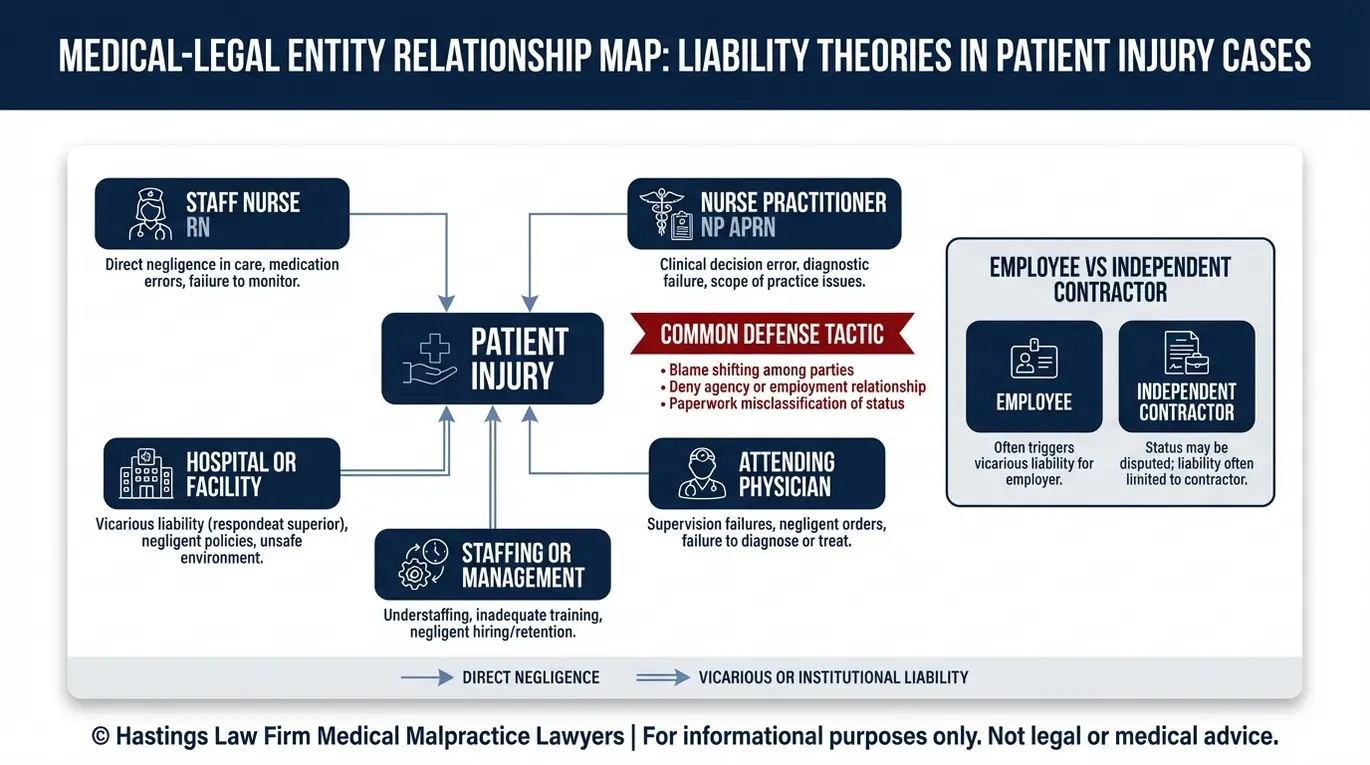
While nurses are individually licensed, hospitals are often held liable for their actions through vicarious liability, though conflicts often arise when doctors and nurses shift blame for patient injuries. Vicarious liability is a legal doctrine that holds employers responsible for the actions of employees while on the job. This responsibility ensures that institutions remain accountable for the staff they hire and supervise.
When a hospital-employed nurse makes a preventable mistake, the hospital itself can be named as a defendant due to hospital liability. But identifying who is truly responsible is rarely simple. In many cases, hospitals and doctors may provide conflicting accounts regarding responsibility. A hospital may argue that the attending physician, the doctor with primary responsibility for a patient’s care, gave the orders.
The physician may counter that the nursing staff failed to carry out those orders or neglected to report critical changes in the patient’s condition. This strategy of shifting responsibility is a common defense tactic, and it is one reason why having Arizona malpractice counsel with experience on the defense side is a helpful advantage.
Research from the Arizona Law Review on Independent Hospital Duty confirms that hospitals carry an independent obligation to ensure competent care within their facilities. According to the National Center for Biotechnology Information’s analysis of medical error reduction, systemic failures like inadequate nurse-to-patient ratios often contribute to individual errors. We investigate strictly for employer negligence and liability for nursing errors.
Understanding the liable parties is essential to building a complete claim when suing a nurse in Arizona:
| Party | Basis for Liability | Common Defense |
|---|---|---|
| Nurse | Direct negligence or incompetence in patient care | “I followed the doctor’s orders” |
| Hospital | Vicarious liability for employee actions; independent duty to staff safely | “The nurse acted outside protocol” |
| Attending Physician | Failure to supervise or issue proper orders | “The nurse didn’t notify me of changes” |
An independent contractor relationship can complicate things further. If the nurse was a temporary or agency worker rather than a direct employee, the hospital may try to avoid liability entirely. Our team investigates employment relationships, staffing records, and contracts to determine every party that may bear responsibility. An experienced nurse malpractice lawyer will ensure all liable parties are identified.
The Hastings Law Firm Difference
Results matter, but what truly sets us apart is how we achieve them. Every verdict, every settlement, and every Arizona courtroom victory comes from one guiding promise: To treat each client’s fight for justice as if it were our own.
This balance of skill, experience, and empathy reflects our core philosophy that justice should not only compensate the injured, but also make health care safer nationwide.

Common Types of Preventable Nursing Errors
The most frequent nursing errors involve medication mistakes, failure to monitor vital signs, and patient falls, often caused by understaffing or inadequate training. These errors are often tied to systemic issues rather than a single moment of carelessness. A nursing error attorney can help you manage these complex situations.
Here are the categories we see most often in Arizona nursing negligence cases:
Medication Errors
The Five Rights, a medication administration protocol requiring a nurse verify the right patient, drug, dose, route, and time, must be followed before giving any medication. When any one of these is wrong, the consequences can range from an adverse reaction to a fatal overdose. These errors may stem from distraction, fatigue, or confusion between similarly named drugs.
Monitoring Failures
Failure to monitor is a critical breach where a nurse misses or ignores clinical signs that a patient’s deteriorating condition was worsening. This includes not responding to alarm systems or failing to check vital signs like heart rate, blood pressure, and oxygen levels. In many cases, the medical records reveal a gap between when the decline began and when anyone acted. A medical malpractice lawyer knows how to spot these gaps.
Patient Falls and Safety Lapses
Dropping a patient during a transfer, failing to raise bed rails, or not assisting a high-risk patient to the bathroom can lead to serious injury. These incidents are often preventable with proper protocols and adequate staffing.
Surgical and Equipment Errors
Nurses assist in surgical settings and operate medical equipment daily. Errors in instrument counts, improper sterilization, or failure to flag a medical equipment failure can all result in serious patient harm.
An Arizona injury attorney examines the full clinical picture, including staffing logs, medical records, and nursing documentation, to identify exactly where the breakdown occurred. If you need a lawyer for nurse negligence, we are here to help.
Potential Dangers Associated with Nurse Practitioner Care
Patients face increased risk when treated by Nurse Practitioners without adequate physician supervision, as “mid-level” providers may lack the diagnostic depth required for complex medical conditions. Nurse practitioners are advanced practice nurses who often handle tasks traditionally managed by doctors.
A nurse practitioner is a type of advanced practice registered nurse (APRN) with graduate-level education and clinical training who can diagnose conditions, order tests, and prescribe medications. Their scope of practice is the legally defined range of activities an NP is authorized to perform. These regulations are governed by the Arizona Administrative Code Title 4, Chapter 19.
In Arizona, NPs can practice with significant autonomy, but that independence does not always match their depth of training relative to physicians. An NP negligence lawyer can determine if this line was crossed. One reason hospitals increasingly rely on nurse practitioners is the economic rationale, as NPs cost less to employ than physicians. While there is nothing inherently wrong with that model, it can become dangerous when NPs are placed in roles that exceed their training.
This creates significant supervision risks. When an NP’s clinical limitations lead to a missed or delayed diagnosis that a physician may have caught, we evaluate whether the facility provided adequate oversight and whether the NP was operating within the appropriate scope of practice. Nurse practitioner malpractice is a growing concern.
If you suspect an NP’s care caused harm to you or a family member, a malpractice lawyer for nurse practitioners can evaluate whether the provider was operating within appropriate bounds. If you are considering suing a nurse practitioner, contact us. An Arizona nurse malpractice lawyer can review your case.
Proving Negligence with Medical Experts and Evidence
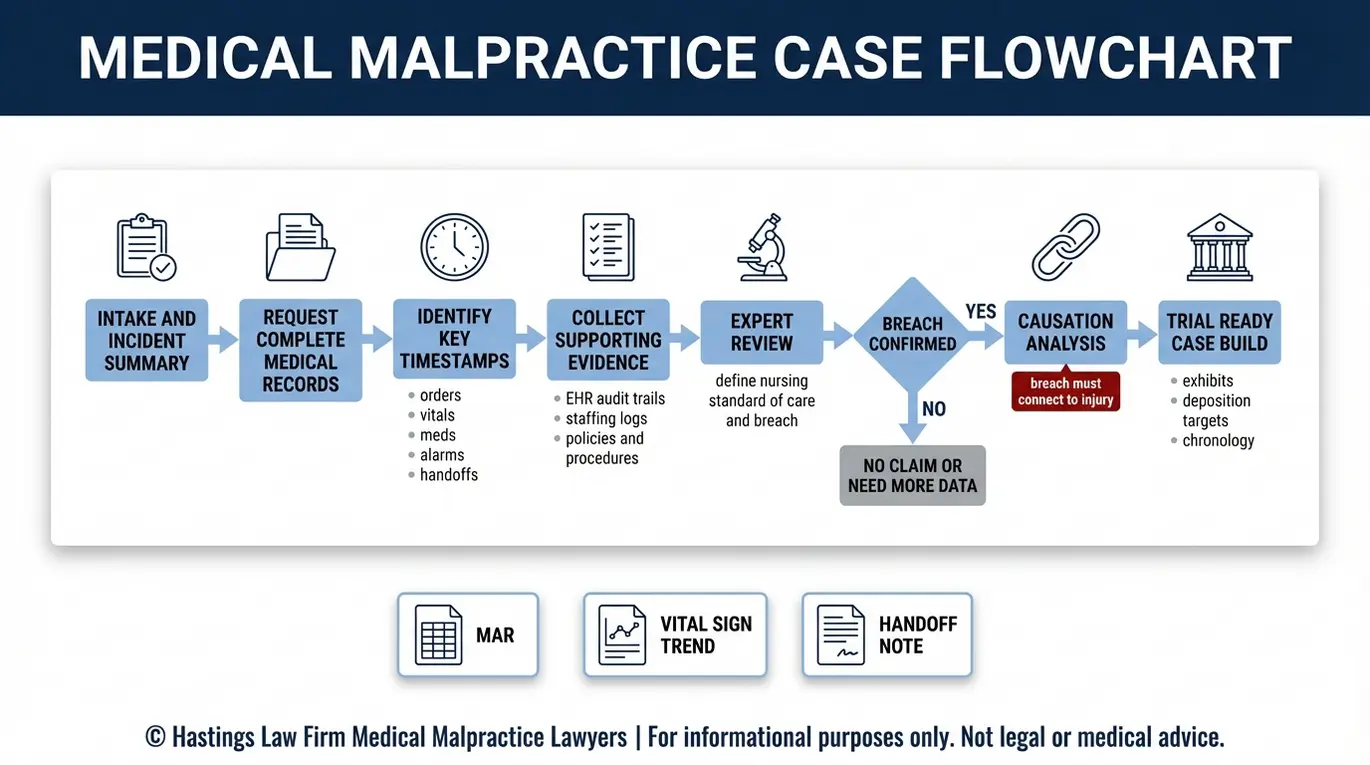
Successfully proving a nursing malpractice claim requires comprehensive medical record analysis and testimony from qualified expert witnesses who can attest to the specific breach of duty. This process requires converting medical facts into a legal narrative that clearly demonstrates where the error occurred. Arizona law requires that claims be supported by expert opinion early in the litigation process.
Without a credible expert, a case will not move forward. A medical negligence attorney ensures this step is handled correctly. At Hastings Law Firm, we investigate and build every case with the expectation that it will go before a jury. Our firm was founded by board-certified trial attorney Tommy Hastings to secure accountability and compensation for patients.
Here is how we build and prove a nursing negligence case:
- Obtain and preserve all medical records: We secure nursing notes, physician orders, lab results, and imaging studies.
- Analyze the audit trail: We review the audit trail, an electronic health record (EHR) metadata log that tracks every login, edit, and deletion made in a patient’s chart.
- Review staffing logs and hospital policies: We examine nurse-to-patient ratios, shift schedules, and internal protocols to identify systemic breakdowns.
- Retain qualified expert witnesses: Our national network of medical experts reviews the clinical facts and provides opinions on whether the standard of care was met.
- Prepare for trial from day one: That trial preparation signals to defense teams and insurance carriers that we will not accept less than fair value.
Our in-house nursing staff and board-certified patient advocates work alongside our malpractice evidence attorney to interpret clinical data and identify the evidence that matters most. A nursing lawsuit lawyer is essential for this process. An Arizona nurse malpractice lawyer from our team is ready to help you.
Compensation and Damages in Arizona Nursing Cases
Victims of nursing negligence in Arizona may recover compensation for economic losses like medical bills and lost wages, as well as non-economic damages for pain, suffering, and wrongful death. Economic Damages cover the financial costs directly tied to the injury, such as past and future medical care costs, rehabilitation, lost wages, and home modification costs.
Non-Economic Damages address the personal toll, including physical pain and suffering, emotional distress, and loss of enjoyment of life. The Arizona Constitution prohibits caps on damages for personal injury and wrongful death cases. There is no statutory ceiling on what a jury can award, which means your recovery is based on the actual impact of the harm.
Securing fair compensation for nursing error is our priority. One factor many families do not anticipate is subrogation, the legal right of an insurance company or government program to recover money it paid for your medical care out of your settlement. For example, Medicare’s Recovery Process allows the federal government to assert a lien against your award for benefits it paid on your behalf.
If these interests are not properly identified and negotiated, they can significantly reduce your final nurse negligence settlement. An Arizona nurse malpractice lawyer at our firm accounts for these liens from the start, so the compensation you receive reflects your actual needs. If you need an Arizona medical injury lawyer for damages in a malpractice case or general advice, we can help.
Contact the Arizona Nurse Malpractice Attorneys at Hastings Law Firm Today for Help
If you believe a nurse’s negligence caused harm to you or someone in your family, you do not have to face the medical and legal system alone. Hastings Law Firm is built for exactly these cases. Our team of attorneys, in-house medical professionals, and former defense counsel focuses exclusively on medical malpractice. We understand both the clinical details and the legal strategy these claims demand.
We take cases on a contingency fee basis, which means you pay no attorney fees or costs unless we secure a recovery on your behalf. There is no financial risk in reaching out to an Arizona Nurse Malpractice Lawyer. Time limits do apply to malpractice claims in Arizona, so the sooner you contact us, the sooner we can begin preserving evidence and evaluating your case.
Call Hastings Law Firm today or request a free, confidential case evaluation online. Let a dedicated Medical Malpractice Attorney help you get the answers and the accountability you deserve.
Frequently Asked Questions About Nurse Malpractice in Arizona


This content was researched and written by the Hastings Law Firm editorial team, which includes attorneys, medical professionals, and experienced researchers. Our writing is informed by internal knowledge and practical experience, and we cross-check critical details against authoritative sources cited throughout. Every piece undergoes human-led fact-checking and legal review. Because legal and medical information can change, if you spot an error, please contact us. Learn more about our content standards and review process on our editorial policy page.

Tommy Hastings, founder of Hastings Law Firm, is a board-certified personal injury trial lawyer dedicated exclusively to healthcare injury cases. Since 2001, he has represented injured patients and families in litigation against major hospital systems, pharmaceutical companies, and negligent healthcare providers nationwide. He has handled numerous high-profile cases that have drawn national media attention and resulted in multi-million dollar recoveries. He draws on that experience in his writing, helping readers understand how these cases work and what options may be available to them.
