


Arizona Surgical Error Lawyer
Surgical negligence can leave patients facing serious physical harm, emotional distress, and lasting uncertainty about what went wrong. Preventable operating room errors can involve wrong site procedures, retained instruments, anesthesia mistakes, or failures in post operative monitoring that allow complications to escalate. Arizona law also places specific limits on how long a claim can remain viable and may require early expert support, which can affect available options. If you or a loved one were harmed or worse due to surgical negligence in Phoenix, Arizona, contact Hastings Law Firm for a free, confidential case review.

Last Updated: July 27, 2026
Trusted Legal Representation for Surgical Negligence in Arizona
Surgery requires precision, trust, and accountability. When a preventable error occurs in the operating room, the physical and emotional consequences can be severe. These errors may include retained surgical instruments, anesthesia errors, or a procedure gone wrong. If you or a loved one has been harmed by a surgical mistake, you deserve honest answers about what happened and a clear understanding of your legal options.
As an Arizona surgical error lawyer team led by founder Tommy Hastings, a board-certified trial attorney, we focus exclusively on medical malpractice. Our team has the litigation experience to investigate your case thoroughly. Contact us for a free, confidential case evaluation so we can review what happened and explain your options.

Common Surgical Errors and “Never Events” We Litigate
Surgical errors range from technical mistakes like nicking an organ to “never events” such as operating on the wrong body part or leaving foreign objects inside a patient. As a surgical malpractice attorney in Arizona, our team handles cases involving the full spectrum of preventable operating room injuries.
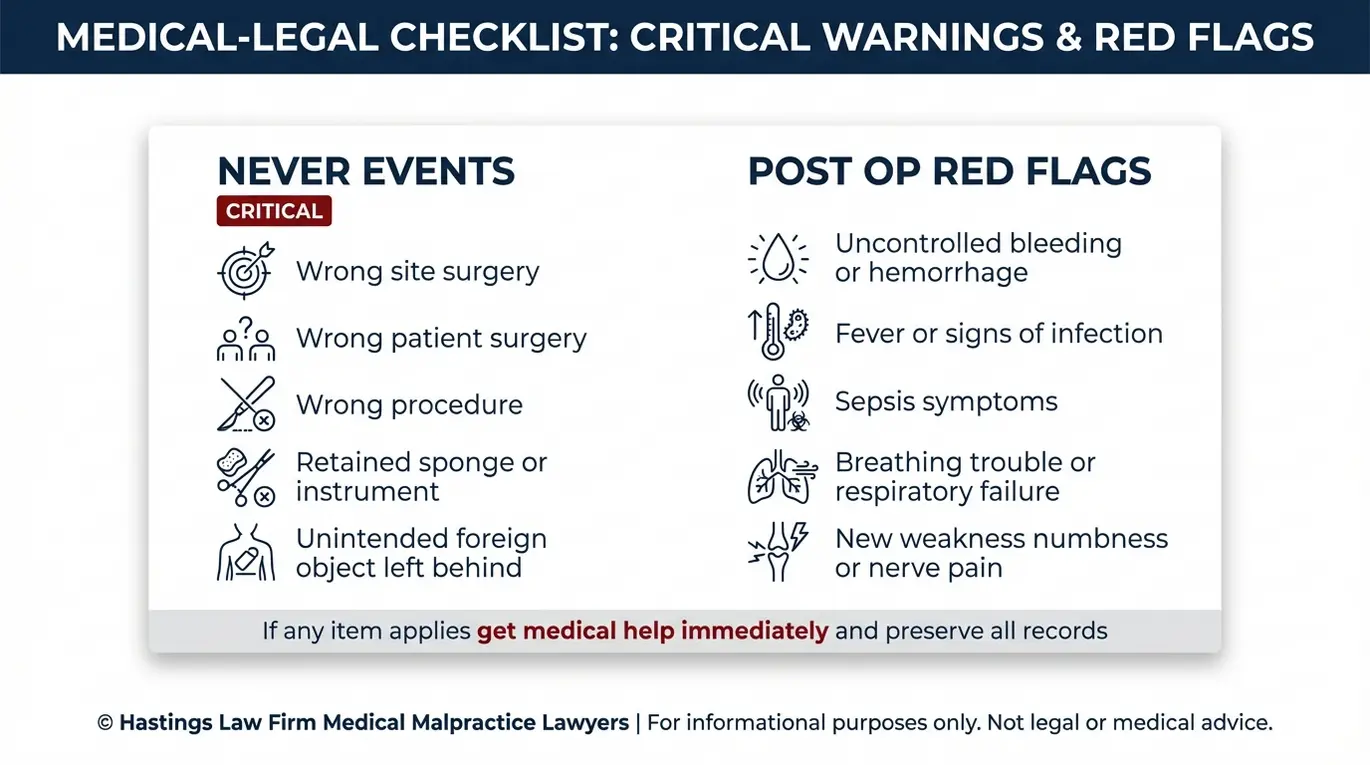
The term “never events” refers to errors so serious and so clearly preventable that they should never occur in a properly functioning surgical environment. The Agency for Healthcare Research and Quality (AHRQ) Patient Safety Network defines these as unambiguous, serious, and usually preventable adverse events. Common never events include:
- Wrong-site surgery, where a surgeon operates on the incorrect part of the body
- Wrong-patient surgery, where a procedure intended for one patient is performed on another
- Retained surgical instruments, such as sponges, needles, or clamps left inside the body after closure
- Surgical fires caused by the combination of an oxygen-rich environment and an ignition source like an electrocautery device (a tool that uses electrical current to cut tissue or stop bleeding)
Beyond never events, our surgical error attorneys also handle cases involving technical mistakes and failures of post-operative care. Organ perforation, where a surgeon accidentally punctures the bowel, bladder, or another structure, can lead to a severe post-surgical infection. Nerve damage during a procedure may result in chronic pain or loss of function. Anesthesia errors can cause brain injury, respiratory failure, or death.
Post-operative negligence is equally dangerous. After surgery, medical teams are responsible for monitoring patients for signs of hemorrhage, sepsis, and respiratory failure. Vanderbilt University Medical Center’s post-operative protocols outline the standard assessments expected during recovery.
When staff fail to follow these protocols, treatable complications can become catastrophic. Early detection of symptoms like fever or confusion is essential for preventing long-term harm.
Surgical Fires and Operating Room Hazards
Surgical fires are preventable incidents that occur during medical procedures and represent a distinct category of negligence. A surgical fire occurs when three elements come together during a procedure: an oxidizer (typically supplemental oxygen), a fuel source (such as surgical drapes or prep solutions), and an ignition source like an electrocautery device or laser.
The standard of care requires the surgical team to manage all three elements through coordinated communication and fire risk assessments before and during the procedure. When these precautions are not followed, the resulting burns and airway injuries can be devastating.
Proving Negligence: Standard of Care and Liability in the OR
To prove negligence, a plaintiff must demonstrate that the surgeon or staff deviated from the accepted medical standard of care, directly causing injury. The standard of care is the level of treatment a reasonably competent medical professional would have provided under similar circumstances, and establishing a breach requires detailed expert medical testimony.
One of the greatest challenges patients face is that they were unconscious or sedated during the event. You cannot be your own witness to what happened in the operating room. That is why our Phoenix surgical negligence law firm conducts a thorough reconstruction of every procedure.
We obtain the complete surgical record, anesthesia logs, nursing notes, and any available imaging. Our in-house medical staff, including nurse practitioners and board certified patient advocates, review this clinical data alongside outside experts to build a detailed timeline of what occurred.
A critical early step in any well-run operating room is the surgical time-out, a pre-incision verification process where the team confirms the correct patient, correct procedure, and correct surgical site. Research published through ERIC (Education Resources Information Center) has explored methods for detecting surgical adverse events through retrospective clinical data, reinforcing the importance of documentation review in identifying where breakdowns occur.
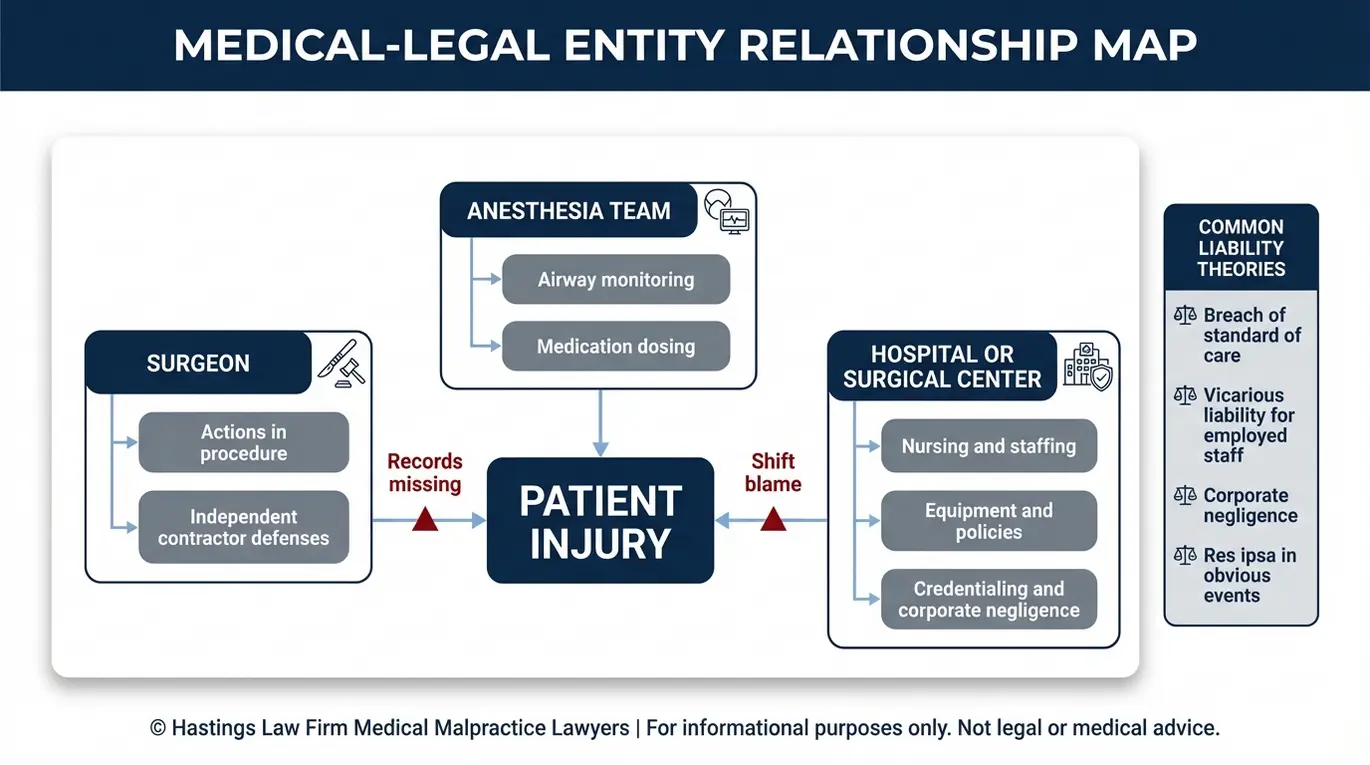
As a lawyer for surgical mistakes, we also investigate all potentially liable parties. The operating surgeon may bear individual responsibility, but hospitals and surgical centers can also be held accountable through hospital corporate negligence theories, particularly when errors involve inadequate staffing, faulty equipment, or the actions of employed nurses and anesthesiologists. Even when a surgeon is classified as an independent contractor, the facility may still share liability for systemic failures under its control.
Res Ipsa Loquitur in Surgical Cases
Res ipsa loquitur is a legal principle that can apply to Arizona surgical malpractice cases. In certain cases, the legal doctrine of *res ipsa loquitur*, a Latin phrase meaning “the thing speaks for itself,” allows an inference of negligence to be drawn without complex expert testimony. This doctrine applies when the injury is of a type that would not ordinarily occur without someone’s negligence, such as wrong-site surgery or a retained sponge. In these situations, the jury may infer that negligence occurred, which strengthens the patient’s position significantly.
The Hastings Law Firm Difference
Results matter, but what truly sets us apart is how we achieve them. Every verdict, every settlement, and every Arizona courtroom victory comes from one guiding promise: To treat each client’s fight for justice as if it were our own.
This balance of skill, experience, and empathy reflects our core philosophy that justice should not only compensate the injured, but also make health care safer nationwide.

Arizona Legal Requirements: Expert Affidavits and Deadlines
Arizona law requires medical malpractice plaintiffs to file a preliminary expert opinion affidavit certifying the merit of the claim and to file their lawsuit within a strict two-year statute of limitations.
Under A.R.S. § 12-2603, a plaintiff must serve a written affidavit containing a preliminary expert opinion with the initial disclosure statement early in the litigation. This affidavit must be signed by a qualified medical expert who confirms that the standard of care was breached and that the breach caused the patient’s injury. Failure to comply with this requirement can result in dismissal of the case. This is one reason why working with experienced surgical injury lawyers from the outset is so important; the expert review process must begin early.
The general deadline for filing a surgical malpractice lawsuit in Arizona is two years from the date the cause of action accrues. However, the discovery rule may extend this deadline in situations where the patient could not reasonably have known about the error at the time it occurred. This is particularly relevant in cases involving retained surgical instruments or slow-developing infections that do not produce symptoms until months later.
| Requirement | Details |
|---|---|
| Expert Affidavit (A.R.S. § 12-2603) | Must be served with initial disclosures early in litigation; signed by a qualified medical expert certifying a breach of the standard of care |
| Statute of Limitations | Two years from the date the cause of action accrues (general rule) |
| Discovery Rule Exception | Clock may start when the injury is discovered or reasonably should have been discovered |
Even if you believe the discovery rule may apply to your situation, waiting to consult with an attorney is risky. Evidence can degrade, and Arizona surgical malpractice laws impose strict procedural requirements that take time to satisfy.

Compensation for Victims of Surgical Negligence
Victims of surgical errors in Arizona can recover economic damages for medical bills and lost wages, as well as non-economic damages for pain, suffering, and loss of quality of life. The compensation available depends on the severity and long-term impact of the injury. These compensatory damages are designed to make the patient whole again.
Damages in surgical malpractice cases generally fall into two categories:
- Economic damages: Past and future medical care, corrective and reconstructive surgeries, rehabilitation costs, lost wages, and diminished earning capacity
- Non-economic damages: Physical pain, emotional distress, disfigurement, loss of enjoyment of life, and loss of companionship
In cases where a surgical error results in death, surviving families may pursue a wrongful death claim to recover funeral costs, loss of financial support, and the emotional devastation of losing a loved one. Arizona law recognizes that no amount of money can replace a family member, but it can provide financial stability during a difficult time.
Unlike many states, Arizona does not cap non-economic damages in medical malpractice cases. A jury is free to award compensation for surgical errors that reflects the true scope of harm the patient and family have endured.
Why Choose Hastings Law Firm for Your Arizona Surgical Injury Claim
Hastings Law Firm offers a trial-ready approach backed by a team of board-certified attorneys and medical professionals dedicated exclusively to medical malpractice. As an Arizona surgical error lawyer team, we prepare every case from day one as though it will go before a jury. That level of preparation signals to insurance carriers and defense attorneys that we will not accept less than fair value. We handle surgical mistake cases all across Arizona from our Phoenix offices.
Our team includes former defense attorneys who previously represented hospitals, giving us direct insight into the strategies the other side will use. As a dedicated surgical malpractice law firm in Phoenix, our in-house nurse consultants and board certified patient advocates analyze your medical records and work alongside nationally recognized experts to build the strongest possible case.
We operate on a contingency fee basis, which means you pay nothing upfront and owe no attorney fees unless we recover compensation for you. Our goal is to find the truth about what happened, hold the responsible parties accountable, and help you move forward with confidence.
Contact the Arizona Surgical Error Attorneys at Hastings Law Firm Today for Help
If you or a loved one suffered harm due to a surgical mistake, you do not have to face the hospital’s legal team alone. Our surgical malpractice law firm in Phoenix is ready to review your medical records, explain your rights under Arizona law, and pursue the accountability you deserve.
Every consultation is free and confidential. There is no fee unless we win. Call Hastings Law Firm today or complete our online form to take the first step toward understanding what happened and what comes next.
Frequently Asked Questions About Surgical Error in Arizona


This content was researched and written by the Hastings Law Firm editorial team, which includes attorneys, medical professionals, and experienced researchers. Our writing is informed by internal knowledge and practical experience, and we cross-check critical details against authoritative sources cited throughout. Every piece undergoes human-led fact-checking and legal review. Because legal and medical information can change, if you spot an error, please contact us. Learn more about our content standards and review process on our editorial policy page.

Tommy Hastings, founder of Hastings Law Firm, is a board-certified personal injury trial lawyer dedicated exclusively to healthcare injury cases. Since 2001, he has represented injured patients and families in litigation against major hospital systems, pharmaceutical companies, and negligent healthcare providers nationwide. He has handled numerous high-profile cases that have drawn national media attention and resulted in multi-million dollar recoveries. He draws on that experience in his writing, helping readers understand how these cases work and what options may be available to them.
