


Arizona Cardiothoracic Surgeon Malpractice Lawyer
Cardiothoracic surgery is high risk, but preventable mistakes during heart or chest procedures or in post operative ICU care can cause catastrophic harm. The discussion covers surgical errors, monitoring failures, and team liability involving surgeons, anesthesiologists, perfusionists, and hospitals. It also addresses informed consent concerns, record discrepancies between operative dictation and real time logs, and the lasting financial and personal impact of serious injury. If you or a loved one were harmed or worse due to cardiothoracic surgery negligence in Arizona, contact Hastings Law Firm for a free, confidential case review.

Last Updated: July 27, 2026
Trusted Legal Representation for Surgical Negligence in Arizona
When a heart or chest surgery results in a preventable injury, the consequences can reshape every part of your life and your family’s future. You trusted a surgeon with one of the most delicate procedures in medicine, and if something went wrong, you deserve honest answers about what happened and why.
Cardiothoracic surgery, the specialized field covering operations on the heart, lungs, and other structures within the chest, carries serious risks even under the best circumstances. But when those risks are made worse by a surgeon’s error or a team’s failure to follow accepted protocols, it may no longer be a complication. It may be negligence.
Founded by board-certified trial lawyer Tommy Hastings in 2005, Hastings Law Firm focuses exclusively on medical malpractice. Our team includes in-house medical professionals and former defense attorneys who previously worked for the hospital systems they now challenge. If you believe your surgery or post-operative care fell below the standard you were owed, we can review what happened and explain your options at no cost.

Common Errors in Open Heart and Thoracic Procedures
Cardiothoracic malpractice occurs when a surgeon deviates from the standard of care during procedures like coronary artery bypass grafting or valve replacement, resulting in preventable injuries such as nicked arteries, graft failure, or retained foreign objects. These cases require a detailed understanding of the specific procedure performed and what went wrong during it.
Different types of cardiac and thoracic operations carry different risks, and the errors we investigate tend to be procedure-specific.
Coronary Artery Bypass Grafting (CABG), a heart surgery procedure where a surgeon reroutes blood flow around blocked coronary arteries using a graft from another blood vessel, demands precision at every step. Errors in this procedure can include:
- Improper harvesting or attachment of the bypass graft, leading to early graft failure which can cause a sudden heart attack
- Damage to surrounding vessels or tissue during dissection
- Failure to identify the correct target artery, resulting in incomplete revascularization
Heart valve repair or replacement, where a damaged valve is either reconstructed or substituted with a prosthetic, presents its own set of risks:
- Selecting the wrong size prosthetic valve, causing persistent leaking or obstruction
- Improper suturing that leads to paravalvular leak, where blood flows around the valve instead of through it
- Failure to adequately test valve function before closing the chest
Aortic aneurysm and aortic dissection repair involves operating on the body’s largest artery under extreme time pressure. An aneurysm is a bulge in the artery wall, while a dissection is a tear in the inner layer of the artery. Common errors include:
- Misidentifying the extent of the dissection, leaving damaged tissue unrepaired
- Inadequate reinforcement of the graft site, increasing the risk of rupture
- Delayed recognition of malperfusion to the brain, kidneys, or limbs during the repair
Beyond procedure-specific failures, our cardiothoracic malpractice attorneys also investigate wrong-site surgery, where an operation is performed on the incorrect structure or side of the chest, and retained foreign objects, where sponges, needles, or surgical instruments are left inside the chest cavity after closure.
Surgical errors involving accidental puncturing of the heart wall or lungs during entry can lead to massive hemorrhage if not immediately repaired. Similarly, retained objects prevent proper healing and often necessitate a second, high-risk operation to remove them. These errors should never happen. Established safety protocols, including surgical counts and imaging verification, exist specifically to prevent them.
Each of these failures can lead to secondary surgeries, organ damage, prolonged hospitalization, or death. Identifying exactly where the breakdown occurred is the first step in building a case.

Liability of the Surgical Team and Perfusionists
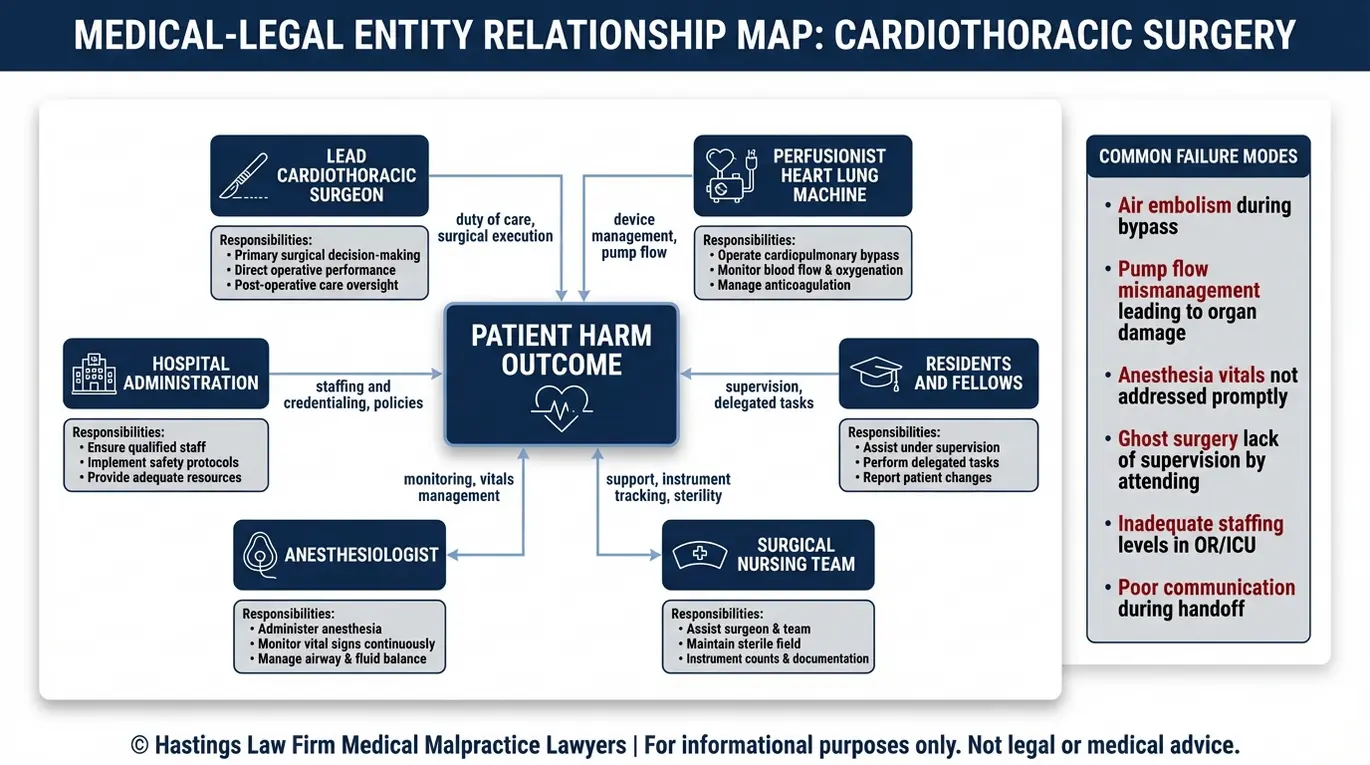
Liability in cardiac surgery often extends beyond the lead surgeon. It can include perfusionists managing the heart-lung machine, anesthesiologists, surgical residents, and the hospital itself for negligent staffing or supervision.
Cardiovascular surgery involves a coordinated team, and each member carries an independent duty of care to the patient. When our cardiac surgery negligence lawyer evaluates a potential case, we examine the actions and responsibilities of everyone involved:
- The lead surgeon is responsible for the overall procedure, including decision-making, technique, and oversight of assisting personnel.
- The anesthesiologist manages sedation, airway control, and hemodynamic stability throughout the operation. Anesthesia errors in managing blood pressure or oxygenation during deep sedation can cause organ damage within minutes.
- The perfusionist, a specialized technician who operates the heart-lung bypass machine, keeps blood oxygenated and circulating while the heart is stopped. Negligence by this team member can be catastrophic.
- Surgical residents and students may perform portions of the procedure in teaching hospital settings. “Ghost surgery,” where a trainee performs critical steps without adequate attending supervision and without the patient’s knowledge, raises serious questions about informed consent and institutional accountability.
- The hospital can be liable for inadequate staffing levels, failure to credential team members, or deficient safety protocols that fail to uphold the standard of care.
Role of the Perfusionist in Heart-Lung Bypass Management
The perfusionist’s role deserves specific attention because it involves risks found almost exclusively in cardiothoracic cases. Cardiopulmonary bypass (CPB), commonly called the heart-lung machine, temporarily takes over the heart’s pumping and the lungs’ oxygenation functions during surgery. As described in the National Center for Biotechnology Information’s overview of Cardiopulmonary Bypass, this process requires constant monitoring of blood flow, gas exchange, and anticoagulation levels.
Perfusionist errors can include pump failure, improper blood flow rates, or introduction of air into the circuit. An air embolism, a bubble of air that enters the bloodstream and blocks a blood vessel, can travel to the brain and cause a stroke, permanent brain damage, or death. Blood clots forming within the bypass circuit pose a similar threat. These injuries may not be apparent until the patient wakes from surgery, and even then, they can be misattributed to the inherent risks of the procedure rather than to operator error.
The Hastings Law Firm Difference
Results matter, but what truly sets us apart is how we achieve them. Every verdict, every settlement, and every Arizona courtroom victory comes from one guiding promise: To treat each client’s fight for justice as if it were our own.
This balance of skill, experience, and empathy reflects our core philosophy that justice should not only compensate the injured, but also make health care safer nationwide.

Negligence in the Cardiac ICU and Monitoring Failures
Post-operative malpractice involves the failure of ICU staff to adequately monitor vital signs, detect internal bleeding, or recognize symptoms of stroke and infection in the critical hours following surgery. Some of the most devastating outcomes in Arizona heart surgeon malpractice cases occur not in the operating room, but in the post-operative care and recovery period that follows.
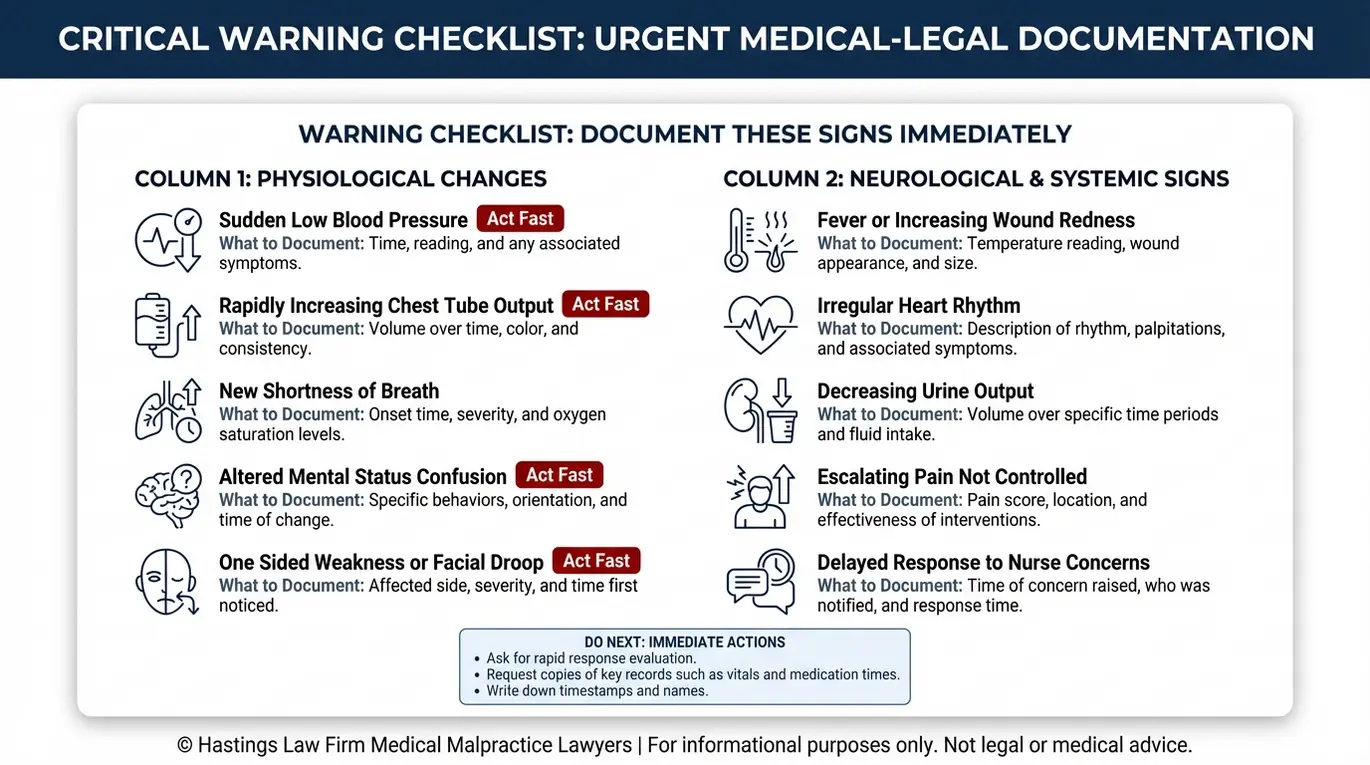
The first hours after cardiac surgery are often called the “golden hours” because complications like hemorrhage or cardiac tamponade, a life-threatening condition where fluid or blood collects around the heart and compresses it, can develop rapidly. When ICU teams fail to act on dropping blood pressure, rising chest tube output, or declining oxygen levels, a treatable emergency can become a fatal one.
Infection is another critical concern. Research published in the journal *Frontiers in Medicine* on mortality due to hospital-acquired infection after cardiac surgery highlights how post-surgical infections significantly increase the risk of death. Mediastinitis, a deep sternal wound infection that reaches the tissue between the lungs, is among the most dangerous. Failure to maintain sterile technique, delayed antibiotic administration, or inadequate wound monitoring can all allow this condition to take hold.
Stroke detection is equally time-sensitive. After cardiac surgery, patients may show neurological deficits, such as facial drooping, slurred speech, or one-sided weakness, that demand immediate evaluation. When nursing staff or physicians dismiss or fail to document these signs, treatment is delayed and the window for intervention closes. Post-operative medical malpractice often centers on these delays.
Proper ICU monitoring should detect post-operative warning signs, including:
- Sudden drops in blood pressure or hemoglobin levels suggesting internal bleeding
- Increased chest tube drainage beyond expected volumes
- New-onset confusion, agitation, or failure to follow commands after sedation is lifted
- Fever, redness, or drainage from the sternal incision
- Unexplained changes in heart rhythm or oxygen saturation
When these indicators are missed or ignored, the responsibility often falls on both the individual providers and the hospital that set the staffing and monitoring standards.
Proving Deviation From the Standard of Care
Arizona law sets specific requirements for medical malpractice claims. Under the Arizona Revised Statutes, a patient must demonstrate that the healthcare provider’s conduct failed to meet the standard of care and that this failure directly caused the injury. The standard of care is the level of care and skill that a reasonably competent healthcare professional would provide under similar circumstances.
A cardiothoracic surgeon malpractice lawyer must retain board-certified cardiothoracic surgeons willing to review the case and testify about what the standard of care required. These experts evaluate whether the surgical approach, technique, and post-operative management were appropriate given the patient’s specific condition. Because defense teams hire their own experts to argue the care was reasonable, the credibility and qualifications of each side’s expert witness often determine the outcome.
Informed consent is another area we examine closely. Informed consent means your doctor explained the risks and you agreed to the treatment with a clear understanding of what was involved. If the surgeon downplayed known risks, failed to disclose alternative treatments, or performed a procedure the patient did not authorize, this can form an independent basis for a claim.
Surgical Errors Obscured in Dictated Notes
One of the most important parts of our medical record review involves comparing dictated operative notes, the surgeon’s narrative account of what happened during the procedure, with the real-time records created by other team members. Surgeons frequently dictate these notes hours or even days after surgery. That gap creates an opportunity for errors or complications to be minimized or omitted entirely, a practice known as fraudulent charting.
Our team cross-references the dictated note against the anesthesia record, a continuous log maintained by the anesthesiologist that documents vitals, medications, and significant events throughout the operation. Discrepancies between these two records, such as a complication noted in the anesthesia log but absent from the surgeon’s dictation, can be powerful evidence. Nursing notes, perfusion records, and time-stamped lab results provide additional layers of verification. If you are wondering whether you have grounds to sue a heart surgeon in Arizona, this type of medical record forensics is central to how we build and evaluate every case.
Life-Altering Consequences and Financial Damages
Patients harmed by cardiac negligence can recover economic damages for lifetime medical care and lost wages, as well as non-economic damages for the profound pain, suffering, and loss of quality of life caused by the error. The injuries that result from cardiothoracic malpractice tend to be catastrophic.
Permanent brain damage from oxygen deprivation during bypass, for example, can require around-the-clock care, cognitive rehabilitation, and adaptive equipment for the rest of a person’s life. Heart failure caused by surgical error may necessitate ongoing management through pacemakers, stents, or repeated interventions, each carrying its own costs and risks.
Compensation for surgical errors typically includes:
- Economic damages: Past and future medical expenses, rehabilitation costs, home care needs, lost income, and diminished earning capacity
- Non-economic damages: Physical pain, emotional suffering, loss of enjoyment of life, and loss of consortium for spouses and family members
- Wrongful death damages: When a patient dies as a result of surgical negligence, surviving family members may pursue a claim for funeral expenses, loss of financial support, and loss of companionship
Arizona’s constitution prohibits caps on personal injury and wrongful death damages, which means juries can award the full amount they believe is justified by the evidence. This makes thorough case preparation and credible expert testimony even more critical.
Contact the Arizona Surgical Error Attorneys at Hastings Law Firm Today for Help
Hastings Law Firm represents patients and families who have been harmed by preventable surgical errors. Medical malpractice is all we do. Our legal team, which includes in-house nurse consultants and former defense attorneys, brings both medical insight and litigation experience to every case we accept.
If you or a loved one suffered a serious injury during or after cardiothoracic surgery, we want to help you understand what happened. We are trial-ready and investigate every case from day one as if it will go to a jury. As a dedicated Arizona cardiothoracic surgeon malpractice lawyer, we will review your medical records, consult with qualified experts, and give you an honest assessment of your case.
There is no fee for your initial consultation, and you pay nothing unless we recover compensation on your behalf. Contact us today to take that first step toward answers.

This content was researched and written by the Hastings Law Firm editorial team, which includes attorneys, medical professionals, and experienced researchers. Our writing is informed by internal knowledge and practical experience, and we cross-check critical details against authoritative sources cited throughout. Every piece undergoes human-led fact-checking and legal review. Because legal and medical information can change, if you spot an error, please contact us. Learn more about our content standards and review process on our editorial policy page.

Tommy Hastings, founder of Hastings Law Firm, is a board-certified personal injury trial lawyer dedicated exclusively to healthcare injury cases. Since 2001, he has represented injured patients and families in litigation against major hospital systems, pharmaceutical companies, and negligent healthcare providers nationwide. He has handled numerous high-profile cases that have drawn national media attention and resulted in multi-million dollar recoveries. He draws on that experience in his writing, helping readers understand how these cases work and what options may be available to them.
