


Arizona Failure To Diagnose Lawyer
A missed, delayed, or incorrect diagnosis can leave a patient without timely treatment and can lead to worsening outcomes that might have been avoided. These situations often involve warning signs that were not acted on, needed tests that were not ordered, or breakdowns in hospital systems that kept critical information from reaching the treating clinician. Responsibility may extend beyond a single doctor when labs, radiology, hospitals, or managed care policies contribute to the error. If you or a loved one were harmed or worse due to failure to diagnose in Arizona, contact Hastings Law Firm for a free, confidential case review.

Last Updated: July 27, 2026
Trusted Legal Representation for Diagnosis Failures in Arizona
When a doctor overlooks a serious medical condition, the consequences can change your life. A failure to diagnose occurs when a physician misses a condition that should have been caught. This is one of the most common forms of diagnostic error, which is a mistake in identifying a medical condition. You may be left wondering how something so critical was missed and whether you have any legal options.
If you or a loved one suffered harm because a doctor in Arizona failed to identify a treatable condition, you are not alone in feeling frustrated and unsure of what to do next. An experienced Arizona failure to diagnose lawyer can review your medical records and explain whether you have a viable claim. We offer a free, confidential case evaluation to help you understand what happened and what comes next.

Understanding Failure to Diagnose and Delayed Treatment Claims
A failure to diagnose claim arises when a physician acts negligently by missing a medical condition that a competent doctor would have identified, resulting in a delay in treatment and subsequent harm to the patient. A claim is a legal demand for compensation based on medical negligence. Our team at Hastings Law Firm includes experienced hospital nurses who help us analyze these cases from a clinical perspective. These specialists use their insider knowledge to identify when a physician deviated from protocol.
One of the central concepts in these cases is the differential diagnosis, a systematic process doctors use to evaluate a patient’s symptoms and narrow down possible conditions by ruling them out one at a time. According to MedlinePlus, this method is a fundamental diagnostic tool in clinical practice. When a physician skips steps in this process, fails to order appropriate tests, or dismisses symptoms too quickly, a diagnostic error can occur.
Arizona failure to diagnose lawyers generally evaluate three categories of diagnostic failure:
- Missed Diagnosis: The doctor concludes that nothing is wrong when a condition is actually present. The patient goes home without treatment, and the disease progresses.
- Misdiagnosis: The doctor identifies the wrong condition, meaning a patient with a dangerous illness like cancer receives treatment for something entirely different.
- Delayed Diagnosis: The doctor eventually reaches the correct diagnosis, but the delay in identifying the condition allows it to advance to a more dangerous stage.
Each of these categories can give rise to a medical malpractice claim if the diagnostic failure resulted from negligence rather than an unavoidable limitation of medicine.

Common Medical Conditions Misdiagnosed by Arizona Physicians
While any condition can be overlooked, diagnostic errors most frequently occur with conditions that require immediate intervention, such as heart attacks, strokes, infections, and aggressive cancers. A diagnostic error occurs when a medical professional fails to correctly identify a health condition.
In emergency settings, time-sensitive conditions are particularly vulnerable to misdiagnosis. A heart attack may be dismissed as heartburn or anxiety, especially in women and younger patients whose symptoms don’t follow the textbook presentation. Strokes can be misread as migraines or vertigo when a physician fails to order imaging, such as a magnetic resonance imaging (MRI) or a computed tomography (CT) scan, a specialized test that produces detailed cross-sectional images, quickly enough.
Oncology errors represent another significant area of concern. When a physician fails to order a biopsy, a tissue sample removed for laboratory analysis, after discovering a suspicious lump or abnormal imaging result, cancer may continue to grow undetected. By the time the correct diagnosis is made, treatment options can be far more limited. Infections like sepsis require rapid recognition; signs of systemic infection are often overlooked, leading to improper discharge. Similarly, a pulmonary embolism may be missed if a doctor fails to order necessary scans despite symptoms suggesting a clot.
As a failure to diagnose lawyer in Arizona, we see these cases regularly, and the pattern is often the same: warning signs were present, but follow-up testing was not ordered.
| Commonly Missed Condition | Common Diagnostic Error |
|---|---|
| Cancer | Abnormal lab results or imaging ignored; biopsy not ordered |
| Stroke | Symptoms dismissed as anxiety or migraine; delayed CT scan |
| Sepsis | Signs of systemic infection overlooked; improper discharge |
| Pulmonary Embolism | Failure to order a CT scan |
These errors often share a common thread: the information needed to make the correct diagnosis was available, but it was not acted on.
The Hastings Law Firm Difference
Results matter, but what truly sets us apart is how we achieve them. Every verdict, every settlement, and every Arizona courtroom victory comes from one guiding promise: To treat each client’s fight for justice as if it were our own.
This balance of skill, experience, and empathy reflects our core philosophy that justice should not only compensate the injured, but also make health care safer nationwide.

Proving Negligence and the Arizona Standard of Care
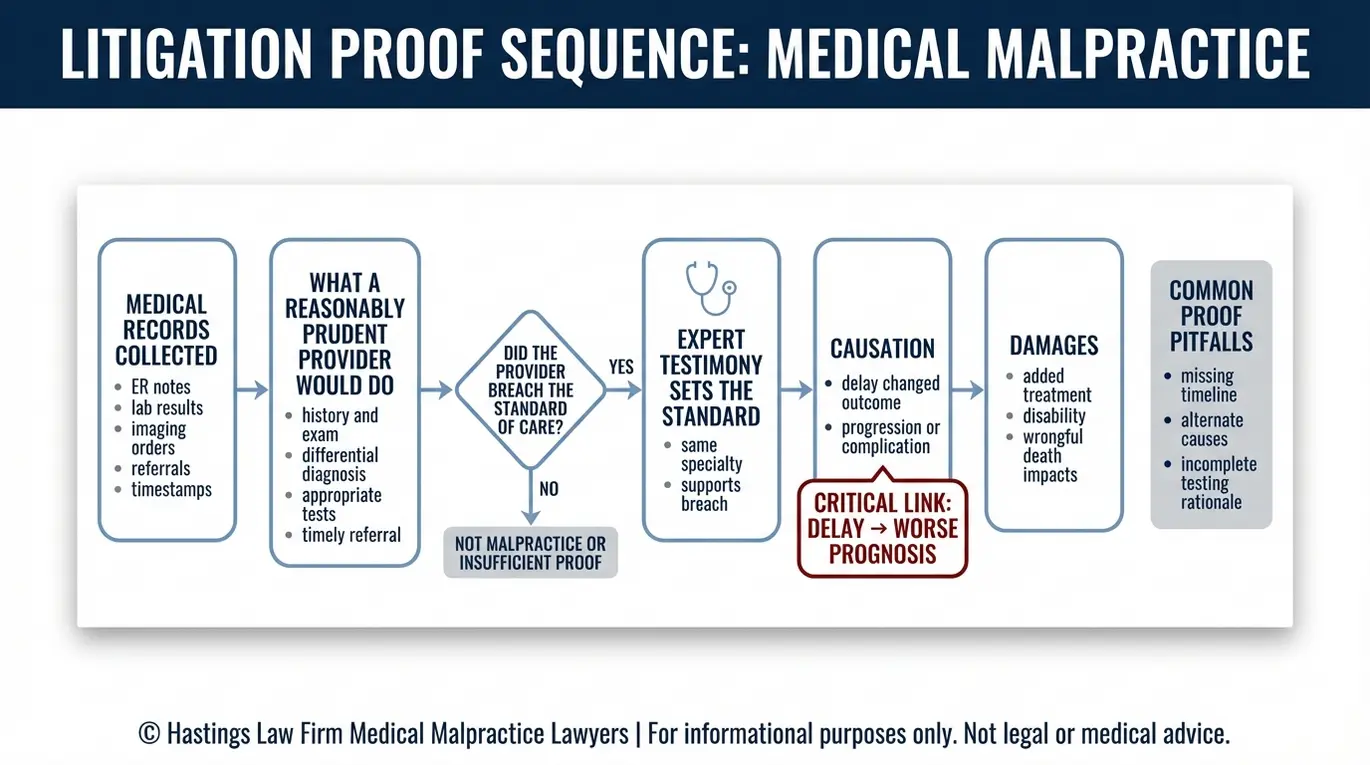
To win a claim, the plaintiff must prove that the doctor breached the accepted standard of care and that this specific breach directly caused a worsening of the patient’s prognosis or death. Prognosis is the likely development or expected outcome of a medical condition.
The standard of care refers to the level of treatment a reasonably competent physician in the same specialty would have provided under similar circumstances. For example, if a patient presents to an emergency room with chest pain and shortness of breath, the standard of care may require specific cardiac testing. This legal concept involves a breach of duty, where the provider fails to meet the standard. The question is not whether the doctor made a mistake in hindsight, but whether the doctor’s actions fell below what other qualified physicians would have done at that time.
Under Arizona Revised Statutes § 12-563, a patient bringing a medical malpractice claim must establish each required element of proof, including the applicable standard, the breach, and the causal connection between that breach and the resulting harm. An Arizona failure to diagnose attorney relies on an expert witness to establish this baseline, because only a qualified medical professional can speak to what the standard required in a given clinical scenario.
Causation, often called proximate cause, often makes these cases complex. It is not enough to show the doctor missed the diagnosis. You must also prove the delay actually changed the outcome. If cancer progressed from a treatable Stage 1 to an advanced Stage 4 during the period of delayed diagnosis, a situation where the correct identification is postponed, that progression becomes the measurable harm.
A missed diagnosis, where a doctor concludes nothing is wrong, must be directly linked to this progression. If the condition would have followed the same course regardless of earlier detection, causation may not be established. Working with a lawyer for failure to diagnose in Arizona who understands both the medical and legal dimensions of these cases helps ensure a thorough investigation. We work with qualified experts to reconstruct the clinical timeline and determine whether earlier diagnosis would have led to a different result.
How Equipment Failures Contribute to Diagnostic Errors
Diagnostic errors are not always caused by a physician’s clinical judgment alone. Internal hospital systems can also be a factor, such as when protocols for reporting urgent results are not followed. A malfunctioning MRI machine, a magnetic resonance imaging device that uses powerful magnets to create detailed images of organs and tissues, can produce unreliable results. When a critical lab value, a test result that falls outside the normal range and requires urgent attention, is not communicated between departments, the treating physician may never see it.
These breakdowns in hospital systems can contribute to liability when they prevent accurate and timely diagnosis. We examine medical records, internal communications, and equipment maintenance logs to determine whether hospital negligence and institutional failures played a role.
Liability for Diagnostic Errors in Hospitals and HMOs
Liability can extend beyond the individual doctor to include hospitals, labs, radiologists, and HMOs if their administrative policies or equipment failures contributed to the missed diagnosis. Liability is the legal responsibility of a healthcare provider for the harm caused to a patient. Since 2005, our firm has focused exclusively on medical malpractice, allowing us to understand the administrative policies that lead to these errors. Identifying every responsible party is an essential part of building a strong claim.
One challenge in these cases involves the legal distinction between hospital employees and independent contractors. Many physicians who treat patients inside a hospital are not technically employed by that facility. This distinction can affect whether the hospital itself is liable for the doctor’s actions.
A specialist referral occurs when a primary care doctor sends the patient to another provider for further evaluation. This can create questions about who bears responsibility when the referral is delayed or the specialist’s findings, including a radiology interpretation, the written analysis of imaging results by a radiologist, are not acted on.
According to information published by the Arizona Health Care Cost Containment System (AHCCCS), the state’s managed care framework creates layers of administrative complexity in how care is delivered and billed. We also investigate medical product liability if a diagnostic device was defective. We scrutinize whether HMO liability exists due to cost-cutting policies that denied access to necessary diagnostic tests.
Failure to diagnose attorneys Arizona families trust evaluate every potential source of liability, including:
- The primary care physician who missed or dismissed early symptoms
- The radiologist who misread imaging results
- The laboratory that contaminated or mishandled a diagnostic sample
- The hospital for systemic failures such as inadequate staffing or broken equipment
- The HMO or managed care plan that restricted access to necessary testing

Recoverable Damages in Arizona Diagnostic Error Lawsuits
Arizona victims can recover economic damages for medical bills and lost wages, as well as non-economic damages for pain and suffering, with no constitutional cap on the amount awarded. Non-economic damages refer to compensation for subjective losses like pain and emotional distress.
This is one of the most significant protections available to injured patients in the state. Under Article 2, Section 31 of the Arizona Constitution, the right to recover damages for death or personal injury cannot be limited by the legislature. Unlike many states that impose caps on non-economic damages in malpractice cases, Arizona protects a patient’s full right to recovery.
Damages in these cases generally fall into two categories of compensatory damages:
- Economic Damages: Reimburse specific financial losses, including past and future medical expenses, lost income, reduced earning capacity, and the cost of ongoing care.
- Non-Economic Damages: Address the personal toll, including physical pain, emotional suffering, loss of enjoyment of life, and the impact on relationships.
Because there is no cap, the compensation can fully reflect the magnitude of the loss, ensuring that patients are not shortchanged by arbitrary legal limits. In rare cases, punitive damages may also be available.
Arizona applies the “evil hand, evil mind” standard, which requires clear and convincing evidence that the defendant acted with a conscious disregard for the patient’s safety. While punitive damages are uncommon in diagnostic error cases, an experienced Arizona failure to diagnose lawyer can evaluate whether the facts support this additional claim. Our team also considers wrongful death damages when a delayed or missed diagnosis results in the death of a patient, allowing surviving family members to seek compensation.
How Our Arizona Diagnostic Error Attorneys Build Your Case
We apply a trial-ready philosophy from day one, working with board-certified trial lawyers and medical experts to reconstruct the timeline of care and determine where the standard was breached. Our founder, Tommy Hastings, is board-certified in Personal Injury Trial Law and uses this expertise to lead our investigative process.
Every case we accept is prepared as though it will go before a jury. This level of preparation sends a clear message to insurance carriers and defense counsel: we will not accept less than fair value. Our legal team includes former defense attorneys who understand how hospitals and their insurers respond to malpractice claims. We also have in-house medical staff who can analyze medical records and identify inconsistencies in charting and clinical decision-making. We meticulously review all medical records to find the missing link.
Our team conducts a thorough review, ensuring that every piece of evidence, from lab reports to nurse’s notes, is evaluated to build a compelling argument for the jury. We also maintain a national network of medical experts across specialties. These experts provide objective case reviews and, when needed, credible testimony about the standard of care. Their involvement strengthens every stage of the case, from the initial evaluation through trial.
As an Arizona failure to diagnose lawyer, we handle every case on a contingency fee basis. You pay no attorney fees or costs unless we recover compensation on your behalf. This structure removes the financial barrier that often prevents injured patients from pursuing the accountability they deserve.
Contact the Arizona Diagnosis Failure Attorneys at Hastings Law Firm Today for Help
Arizona law imposes strict deadlines for filing medical malpractice claims, and the evidence needed to prove a missed diagnosis can become harder to obtain over time. These deadlines, known as the statute of limitations, mean that waiting too long can prevent you from seeking justice. Acting early protects both your rights and the strength of your case.
At Hastings Law Firm, we understand that a diagnostic failure is more than a medical issue. It is a breach of the trust you placed in your healthcare provider. Our team is here to help you find the truth about what happened and to protect your family’s financial future.
If you or a loved one was harmed by a missed, delayed, or incorrect diagnosis in Arizona, contact our Phoenix office for a free, confidential case evaluation. There is no fee unless we recover compensation for you.
Frequently Asked Questions About Failure To Diagnose in Arizona


This content was researched and written by the Hastings Law Firm editorial team, which includes attorneys, medical professionals, and experienced researchers. Our writing is informed by internal knowledge and practical experience, and we cross-check critical details against authoritative sources cited throughout. Every piece undergoes human-led fact-checking and legal review. Because legal and medical information can change, if you spot an error, please contact us. Learn more about our content standards and review process on our editorial policy page.

Tommy Hastings, founder of Hastings Law Firm, is a board-certified personal injury trial lawyer dedicated exclusively to healthcare injury cases. Since 2001, he has represented injured patients and families in litigation against major hospital systems, pharmaceutical companies, and negligent healthcare providers nationwide. He has handled numerous high-profile cases that have drawn national media attention and resulted in multi-million dollar recoveries. He draws on that experience in his writing, helping readers understand how these cases work and what options may be available to them.
