


Arizona Hospital Malpractice Lawyer
Hospital negligence can leave patients facing unexpected complications, financial strain, and lasting emotional distress when care falls below accepted medical standards. In Arizona, these claims often involve questions about whether harm was caused by an individual provider, a hospital system failure, or both. Liability can also depend on whether the at fault clinician was a hospital employee or an independent contractor. Because medical malpractice differs from ordinary injury claims, early missteps can limit options before the facts are fully heard. If you or a loved one were harmed or worse due to hospital negligence in Arizona, contact Hastings Law Firm for a free, confidential case review.

Last Updated: September 28, 2026
Trusted Advocacy for Victims of Hospital Negligence in Arizona
When a hospital causes harm instead of healing, the emotional weight can feel as heavy as the physical injury itself. You may be dealing with unexpected medical complications, mounting bills, and the unsettling feeling that something went wrong during your care. Those concerns deserve to be taken seriously.
Hospital malpractice cases in Arizona involve large institutions with dedicated legal teams and risk management departments working to protect their interests. Having an experienced Arizona hospital malpractice lawyer on your side can make a meaningful difference in whether your voice is heard.
At Hastings Law Firm, our team focuses exclusively on medical malpractice. Founded by board-certified trial attorney Tommy Hastings, we have a mission to restore trust for patients who have been let down by the healthcare system. Contact us for a free, confidential case evaluation to learn about your options.

Defining Hospital Malpractice Under Arizona Law
Hospital malpractice occurs when a facility or its employees deviate from the accepted standard of care, directly causing injury or death to a patient. The standard of care refers to the level of treatment a reasonably competent healthcare professional or institution would provide under similar circumstances. In a hospital setting, this standard applies not just to individual doctors and nurses, but to the systems, protocols, and oversight the facility itself is responsible for maintaining.
Not every poor outcome in a hospital is malpractice. Medicine carries inherent risks, and even proper treatment can lead to complications. The legal distinction comes down to negligence.
A bad result after appropriate care is not the same as a bad result caused by a failure to follow accepted medical practices. As a top-rated hospital negligence attorney in Arizona, we evaluate whether the care provided fell below what the medical community would consider acceptable. A dedicated medical facility negligence lawyer can help distinguish between unfortunate complications and actionable errors.
A sentinel event is an unexpected occurrence involving death or serious harm that signals a breakdown in the care process. Alarm fatigue is a condition where hospital staff become desensitized to the constant sounds of clinical monitors and may miss or ignore critical alerts. Both point to deeper systemic problems within a hospital, and both factor into how we investigate potential negligence claims.
The burden of proof in medical malpractice rests with the patient. This means our team must demonstrate that the hospital or its licensed health care providers failed to meet the standard of care, and that this failure directly caused the injury.
Distinguishing Medical Malpractice from Premises Liability
An important distinction exists between hospital negligence and a standard premises liability claim. Premises liability involves general property safety, whereas medical malpractice concerns professional standards of care. If you slip on a wet floor in a hospital lobby, that is generally a premises liability matter.
But if you suffer an inpatient fall, a preventable drop occurring during a hospital stay, because a nurse failed to follow a fall prevention protocol, such as raising bed rails, activating bed alarms, or ordering a sitter for a high-risk patient, that is medical malpractice. The difference matters because medical malpractice claims in Arizona carry specific procedural requirements that premises liability claims do not. The category your injury falls into affects the legal strategy, the evidence needed, and the deadlines that apply.
Liability in Arizona Hospitals: Who is Accountable?
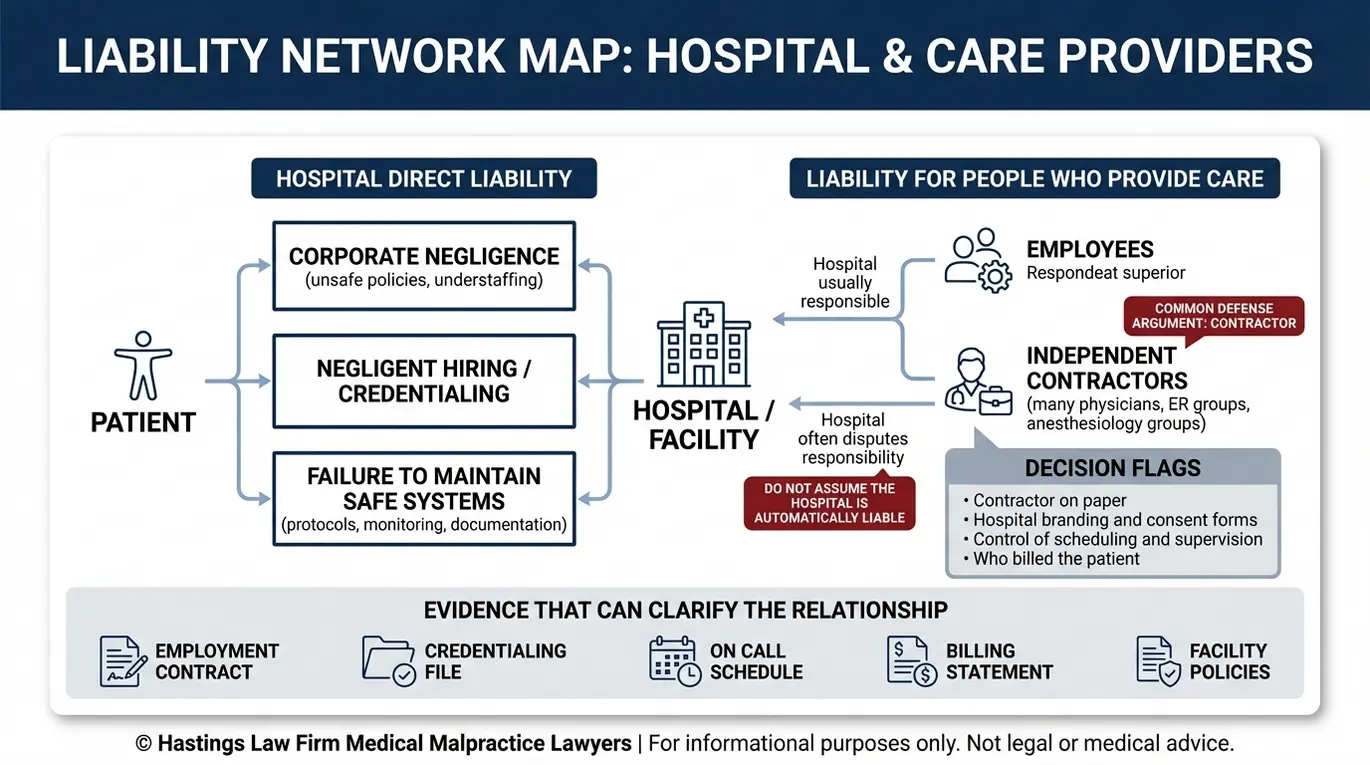
Liability often depends on whether the at-fault provider was a direct hospital employee or an independent contractor. In Arizona, hospital liability often involves complex employment relationships that determine who is financially responsible for an error. Employment classifications can affect whether a hospital is legally responsible for the actions of a medical provider.
Our legal team includes former defense attorneys who previously worked for the hospital systems our firm now handles. This experience provides a strategic advantage in identifying charting inconsistencies and anticipating defense tactics.
Here is how liability typically breaks down:
- Vicarious liability (Respondeat Superior): When a hospital employee, such as a nurse, technician, or staff physician, causes harm while performing their job duties, the hospital can be held legally responsible under a doctrine called vicarious liability. The principle is simple: the employer bears responsibility for the actions of its employees performed within the scope of their employment.
- Independent contractors: Many hospitals classify physicians, particularly emergency room doctors, anesthesiologists, and radiologists, as independent contractors rather than employees. When an error occurs, the hospital may argue it is not liable because the doctor was not technically on staff. This is a common defense tactic, and one our former defense attorneys know well. However, if the hospital held the doctor out as part of its team, a theory called apparent agency may still create liability.
- Corporate negligence: A hospital can be directly liable for its own institutional failures. This includes negligent hiring, inadequate credentialing and privileging, the process of verifying a doctor’s qualifications before granting them authority to practice at the facility, and dangerous staffing decisions. When a hospital maintains an unsafe nurse-to-patient ratio, or staffing ratio, and a patient is harmed as a result, the institution itself may bear direct responsibility. Corporate negligence claims essentially argue that the hospital failed to police its own safety standards, allowing incompetent providers to practice or failing to provide the necessary resources for safe patient care.
Identifying who is accountable is one of the most critical steps when suing a hospital in Arizona. Our team traces each provider’s relationship to the facility and evaluates every possible source of liability so that responsible parties are identified correctly under the law.
The Hastings Law Firm Difference
Results matter, but what truly sets us apart is how we achieve them. Every verdict, every settlement, and every Arizona courtroom victory comes from one guiding promise: To treat each client’s fight for justice as if it were our own.
This balance of skill, experience, and empathy reflects our core philosophy that justice should not only compensate the injured, but also make health care safer nationwide.

Common Types of Hospital Negligence in Arizona
Common hospital errors include surgical mistakes, medication administration failures, and administrative negligence such as understaffing. Under A.R.S. § 12-562, Arizona law sets forth the requirements and limitations governing medical malpractice actions, and the errors we see most frequently fall into several distinct categories. Consulting a medical negligence attorney is crucial when these preventable errors occur.
Medication Errors
These include administering the wrong dosage, giving medication to the wrong patient, or failing to check for dangerous drug interactions. In many hospitals, barcode scanning systems are supposed to prevent these mistakes, but technology only works when staff follow the protocol. When staff bypass safety checks due to time pressure or equipment failure, patients suffer. Wrong-drug and wrong-dose errors remain among the most preventable yet persistent forms of hospital negligence.
Surgical Errors
Wrong-site surgery, a procedure performed on the incorrect body part, and retained surgical items, instruments or sponges left inside a patient after an operation, are errors that should never occur. These are sometimes called “never events” because established safety checklists exist specifically to prevent them.
Systemic and Administrative Failures
Some of the most damaging hospital errors stem not from a single provider’s mistake, but from institutional breakdowns. Alarm fatigue, where staff become desensitized to the constant beeping of monitors and fail to respond to genuine emergencies, is a growing concern in hospitals nationwide. Chronic understaffing creates conditions where even competent nurses cannot safely manage their patient loads.
The Joint Commission classifies the most serious hospital failures as sentinel events, requiring the facility to conduct a root-cause analysis to identify what went wrong. These internal reviews can become important evidence in a hospital malpractice case.
| Type of Error | Specific Examples |
|---|---|
| Medication Errors | Wrong dosage, wrong patient, barcode scanning failures, drug interaction oversight |
| Surgical Errors | Wrong-site surgery, retained surgical items, anesthesia mistakes |
| Systemic Failures | Alarm fatigue, inadequate staffing, failure to follow safety protocols |
| Diagnostic Errors | Misdiagnosis, failure to diagnose, delayed diagnosis of critical conditions |
An experienced Arizona hospital malpractice lawyer will investigate both the individual error and the institutional conditions that allowed it to happen.
Arizona Hospitals Where Negligence Claims Arise
Hospitals in the Phoenix and Tucson metro areas are covered by our Phoenix hospital malpractice lawyers and Tucson hospital malpractice lawyers pages. Outside those two metros, a regional hospital owes its patients the same standard of care as any hospital in Phoenix or Tucson.
In northern Arizona, the hospital below has a dedicated page covering the claims that arise there.
- Flagstaff Medical Center is a Level I trauma center serving northern Arizona with a Level III-A NICU, where emergency and trauma errors, labor, delivery, and newborn intensive care errors, and spine and orthopedic surgery errors arise.
Proving Negligence: The Affidavit of Merit Requirement
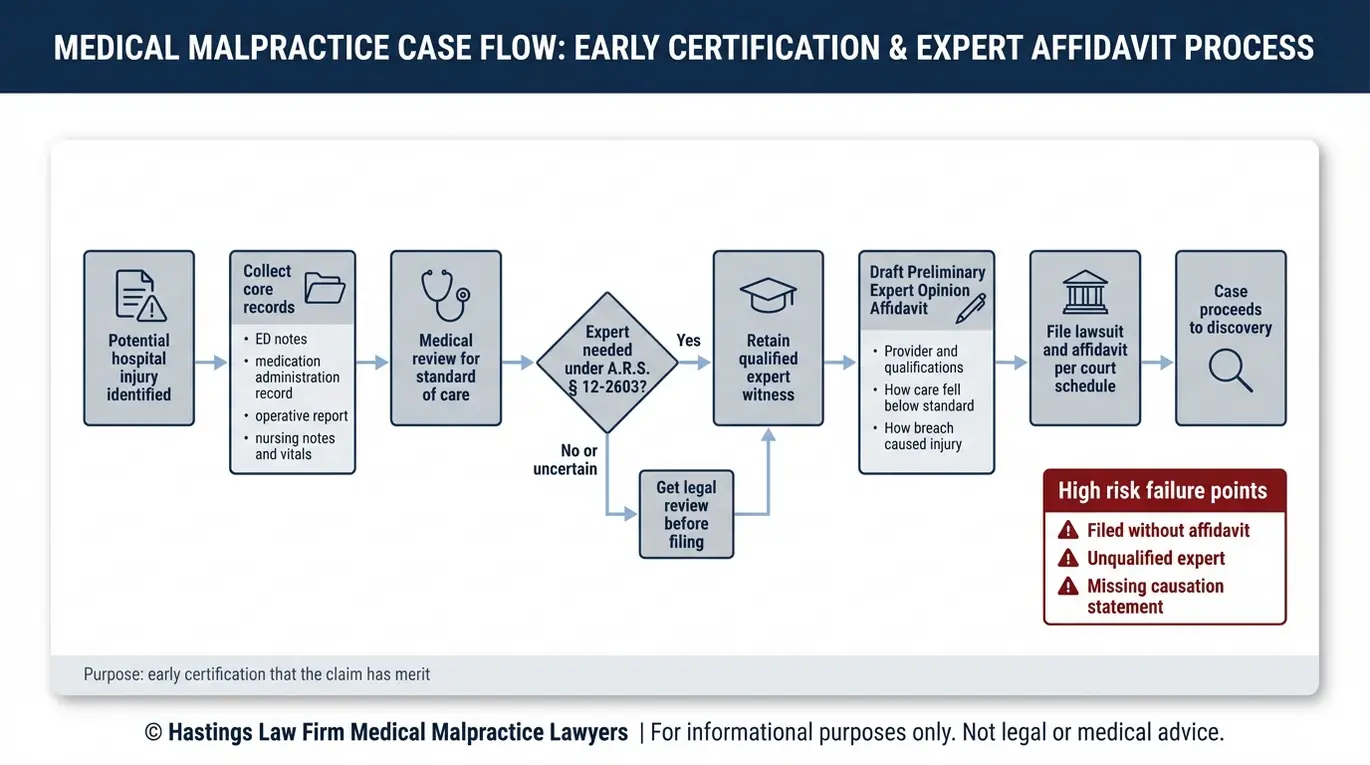
Arizona law requires a Preliminary Expert Opinion Affidavit to be filed early in litigation to certify the claim has merit. This requirement, established under A.R.S. § 12-2603, is one of the procedural rules that makes medical malpractice cases fundamentally different from other injury claims, and one of the primary reasons you need a specialized Arizona hospital malpractice lawyer handling your case. The discovery rule may affect when this affidavit is due, particularly in cases where the injury was latently discovered, adding another layer of complexity to the timeline.
The affidavit of merit (sometimes called a certificate of merit) must be signed by a qualified medical expert witness who has reviewed the facts and is prepared to confirm that the hospital’s care fell below the accepted standard. Without this document, your case can be dismissed before it ever reaches a jury.
Here is how the process generally works:
- Step 1: Medical record collection and review. Our in-house medical staff, including nurse practitioners and board-certified patient advocates, gather and analyze all relevant records from the hospital stay.
- Step 2: Expert identification and consultation. We connect with a qualified expert in the relevant medical specialty through our national network of top-tier medical professionals. Finding the right expert is critical because Arizona law requires the witness to practice in the same specialty as the defendant provider, and if the defendant is board certified, the expert must also be board certified in that specialty.
- Step 3: Expert opinion and affidavit preparation. If the expert confirms that the standard of care was breached and that the breach caused the injury, they prepare and sign the affidavit of merit Arizona statutes require.
- Step 4: Filing with the court. The affidavit is submitted within the timeframe required by Arizona law.
General practice attorneys who handle malpractice cases only occasionally may not fully appreciate how strictly Arizona courts enforce this requirement. Missing the deadline or failing to secure a properly qualified expert can end a valid claim before the evidence is ever heard. Our medical-legal team provides the necessary resources to meet these strict requirements.
Compensation for Victims of Arizona Hospital Errors
Patients harmed by hospital negligence can recover economic damages for medical bills and lost wages, as well as non-economic damages for pain and suffering. The type and amount of compensation available depends on the specific harm caused and its long-term impact on the patient’s life. Understanding available damages in medical malpractice is vital for securing fair hospital injury compensation.
Economic damages cover the financial losses that can be calculated with documentation. These include:
- Past and future medical expenses, including surgeries, rehabilitation, and ongoing care
- Lost wages and lost earning capacity
- Home modifications or assistive equipment
- Cost of in-home care or long-term facility care
Non-economic damages address the losses that do not come with a receipt but are no less real:
- Physical pain and suffering
- Emotional distress
- Loss of enjoyment of life, such as the inability to participate in hobbies or family activities
- Loss of consortium (the impact on a spouse or family relationship)
One significant advantage for patients in Arizona is that the state has no constitutional cap on damages in medical malpractice cases. Unlike many other states that impose artificial limits on what a jury can award, Arizona’s constitution protects the right to full compensation. This means juries can evaluate the evidence and award damages that truly reflect the harm done, without an arbitrary ceiling. Punitive damages, intended to punish egregious conduct, are rarer but possible if the hospital’s actions showed an evil mind or willful disregard for patient safety.
In wrongful death cases, surviving family members may pursue a claim for the losses they have suffered, including loss of financial support, loss of companionship, and funeral expenses. These cases carry their own legal requirements, and an Arizona hospital malpractice lawyer can help families understand their rights during an incredibly difficult time.
Every settlement or verdict we pursue is built on a detailed accounting of both economic and non-economic harm, supported by medical evidence and expert testimony.
Critical Deadlines: Statute of Limitations and Notice of Claims
The standard statute of limitations for medical malpractice in Arizona is two years, but claims against public hospitals have a strict 180-day notice deadline that can catch families off guard if they are unaware of it.
The Two-Year Rule (A.R.S. § 12-542)
Under Arizona law, you generally have two years from the date of the injury to file a medical malpractice lawsuit. This is the standard statute of limitations medical malpractice AZ laws enforce. Once that window closes, the court will almost certainly refuse to hear the case, regardless of how strong the evidence may be.
The Discovery Rule and Tolling
In some situations, the injury caused by hospital negligence is not immediately apparent. The discovery rule prevents the legal clock from running before a patient could reasonably know an error occurred. Tolling provisions may also pause the tolling provisions in specific circumstances, such as when the patient is a minor or mentally incapacitated.
The 180-Day Notice of Claim for Public Hospitals
Public hospitals are government-owned facilities, which triggers specific administrative requirements under state law. Before you can file a lawsuit against a public hospital, you must submit a formal Notice of Claim Arizona requires within 180 days after the cause of action accrues. Failure to meet this deadline can permanently bar your claim.
Key deadlines to remember:
- Private hospitals: Two-year statute of limitations from date of injury or discovery
- Public hospitals: 180-day Notice of Claim requirement before any lawsuit can proceed
- Discovery rule cases: The clock may start later, but legal counsel should evaluate this as early as possible
These deadlines are among the reasons we urge anyone who suspects hospital negligence to consult an Arizona hospital malpractice lawyer promptly. Time lost cannot be recovered.

Steps to Take Following a Hospital Injury in Arizona
Secure your medical records immediately, do not sign any settlement offers from hospital risk management, and consult a specialized attorney before making any decisions about your case.
If you believe you or a loved one was harmed by hospital negligence, the following hospital negligence steps can help protect your rights:
- Do not discuss the error with hospital administrators or risk managers. These individuals may seem supportive, but their role is to protect the hospital. Anything you say can be used to minimize or defend against a future claim.
- Request a complete copy of your medical records. Ask for your full chart, including nursing notes, physician orders, medication administration records, and any incident reports. Having copies early helps preserve evidence before records can be amended or supplemented. Your records may include data from systems like bar-code medication administration (BCMA), a technology hospitals use to verify medications at the bedside. If a root-cause analysis (RCA), the hospital’s own internal investigation into what went wrong, was conducted, that can become valuable evidence as well.
- Do not sign any documents from the hospital’s legal or risk management team. Early settlement offers or release forms may seem helpful, but they are typically designed to limit the hospital’s exposure.
- Contact a board-certified Arizona hospital malpractice lawyer. Speak with a lawyer who handles hospital negligence cases before engaging with insurance companies or hospital representatives. To get medical malpractice help, contact us as soon as possible. The earlier we can begin our investigation, the stronger your position.
Contact the Arizona Hospital Malpractice Attorneys at Hastings Law Firm Today for Help
Hospitals have legal departments, insurance carriers, and risk management teams working to protect their interests from the moment something goes wrong. You deserve a team that is equally prepared to protect yours.
At Hastings Law Firm, we focus exclusively on medical malpractice. Our team of hospital lawyers in Phoenix includes former defense attorneys who understand hospital defense strategies from the inside, in-house medical professionals who can analyze clinical records with trained eyes, and a national network of expert witnesses ready to support your case. Every claim we accept is prepared from day one as if it will go to trial, because that preparation is what drives fair results at every stage.
Tommy Hastings is board-certified in Personal Injury Trial Law and a 2025 inductee into the American Board of Trial Advocates (ABOTA). Our firm works to secure full compensation for patients and families harmed by medical negligence. We operate on a contingency fee basis, which means you pay no attorney fees or costs unless we secure a recovery for you.
If you or a loved one was injured by hospital negligence in Arizona, contact our team for a free, confidential case evaluation. We can review what happened, answer your questions, and help you understand your options.
Frequently Asked Questions About Hospital Malpractice in Arizona


This content was researched and written by the Hastings Law Firm editorial team, which includes attorneys, medical professionals, and experienced researchers. Our writing is informed by internal knowledge and practical experience, and we cross-check critical details against authoritative sources cited throughout. Every piece undergoes human-led fact-checking and legal review. Because legal and medical information can change, if you spot an error, please contact us. Learn more about our content standards and review process on our editorial policy page.

Tommy Hastings, founder of Hastings Law Firm, is a board-certified personal injury trial lawyer (by the Texas Board of Legal Specialization) dedicated exclusively to healthcare injury cases. Since 2001, he has represented injured patients and families in litigation against major hospital systems, pharmaceutical companies, and negligent healthcare providers nationwide. He has handled numerous high-profile cases that have drawn national media attention and resulted in multi-million dollar recoveries.
