


Arizona Doctor Malpractice Lawyer
Physician negligence can leave patients and families facing pain, uncertainty, and lasting consequences when medical care falls below accepted standards. Understanding how the standard of care is evaluated, how causation is disputed, and how liability can extend beyond an individual doctor can help clarify what happened and why it matters. Arizona rules also affect compensation, expert support, and the time limits that can restrict options if action is delayed. If you or a loved one were harmed or worse due to doctor malpractice in Arizona, contact Hastings Law Firm for a free, confidential case review.

Last Updated: July 27, 2026
Trial-Ready Physician Negligence Attorneys in Arizona
When a doctor’s mistake changes your life or the life of someone you love, the confusion and frustration can be overwhelming. You trusted a medical professional with your health, and that trust was broken. It’s natural to feel unsure about what happened, whether anyone will believe you, and what you can actually do about it.
You deserve answers, and you have every right to ask the hard questions. At Hastings Law Firm, we focus exclusively on medical malpractice. Our firm was founded by board-certified trial lawyer Tommy Hastings, who has over two decades of experience helping families work through these complex medical failures. As an experienced Arizona doctor malpractice lawyer team, we prepare every case as if it’s going to trial, because that level of preparation is what gets results.
If you believe a doctor’s negligence caused you or a family member harm, we’re here to listen. Contact us for a free, confidential case evaluation to learn where you stand.

Understanding Doctor Malpractice and the Standard of Care
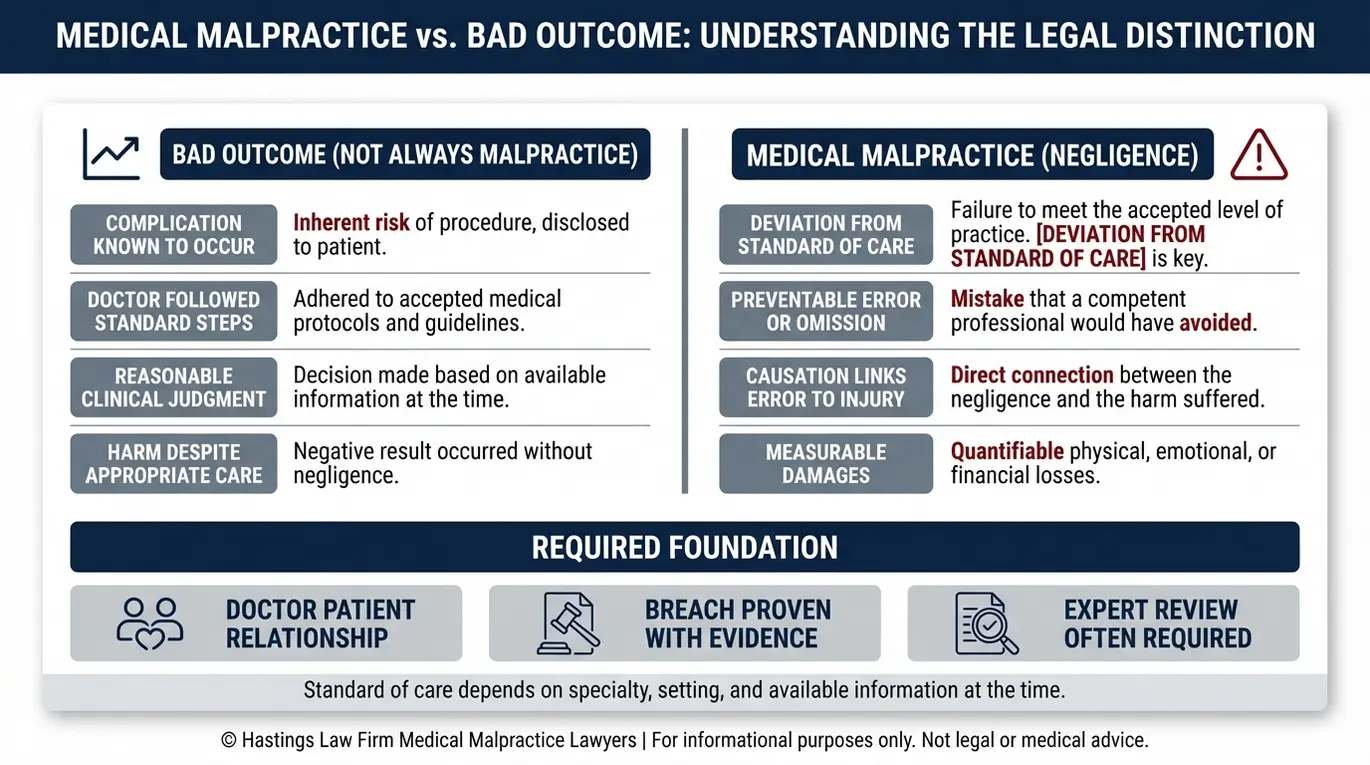
Doctor malpractice occurs when a physician deviates from the accepted medical standard of care, causing preventable harm to a patient. The standard of care represents the clinical benchmark for all medical treatment. This distinction matters, and understanding it is the first step toward knowing whether you have a case.
The standard of care is the level of treatment a reasonably competent physician in the same specialty would provide. Every doctor must meet this standard. While some cases involve subtle judgment calls, others involve clear errors like wrong-site surgery, a procedure performed on the incorrect body part, or a retained surgical item (RSI), an object left inside a patient’s body. If a cardiologist overlooks warning signs or a surgeon skips a checklist, these actions may fall below acceptable limits.
A bad result alone does not equal medical negligence. Surgery carries risks, and not every complication signals a breach. The critical question is whether the physician acted as a qualified peer would have. We evaluate this by examining medical records and clinical decisions.
The doctor-patient relationship creates the physician’s duty of care. Without it, there is no obligation to meet a standard. This relationship typically forms once a healthcare provider agrees to evaluate or treat you.
Research from the Office of Inspector General found that roughly one in four Medicare patients experienced harm during a hospital stay in October 2018. Many adverse events were preventable. If you suspect your care fell short, Arizona doctor malpractice attorneys can help determine whether a breach of the standard of care occurred.
Legal Distinction Between Medical and Ordinary Negligence
There is a legal difference between medical negligence and ordinary negligence. In everyday cases, like car accidents, juries use common sense to determine reasonableness. Medical decisions, however, require specialized knowledge.
A jury cannot simply decide that a surgeon made a mistake. Instead, expert testimony is required to prove a breach. A qualified expert must explain the standard and how the physician failed. This higher burden of proof is why working with a lawyer for doctor malpractice matters.
Proving Negligence Against a Physician
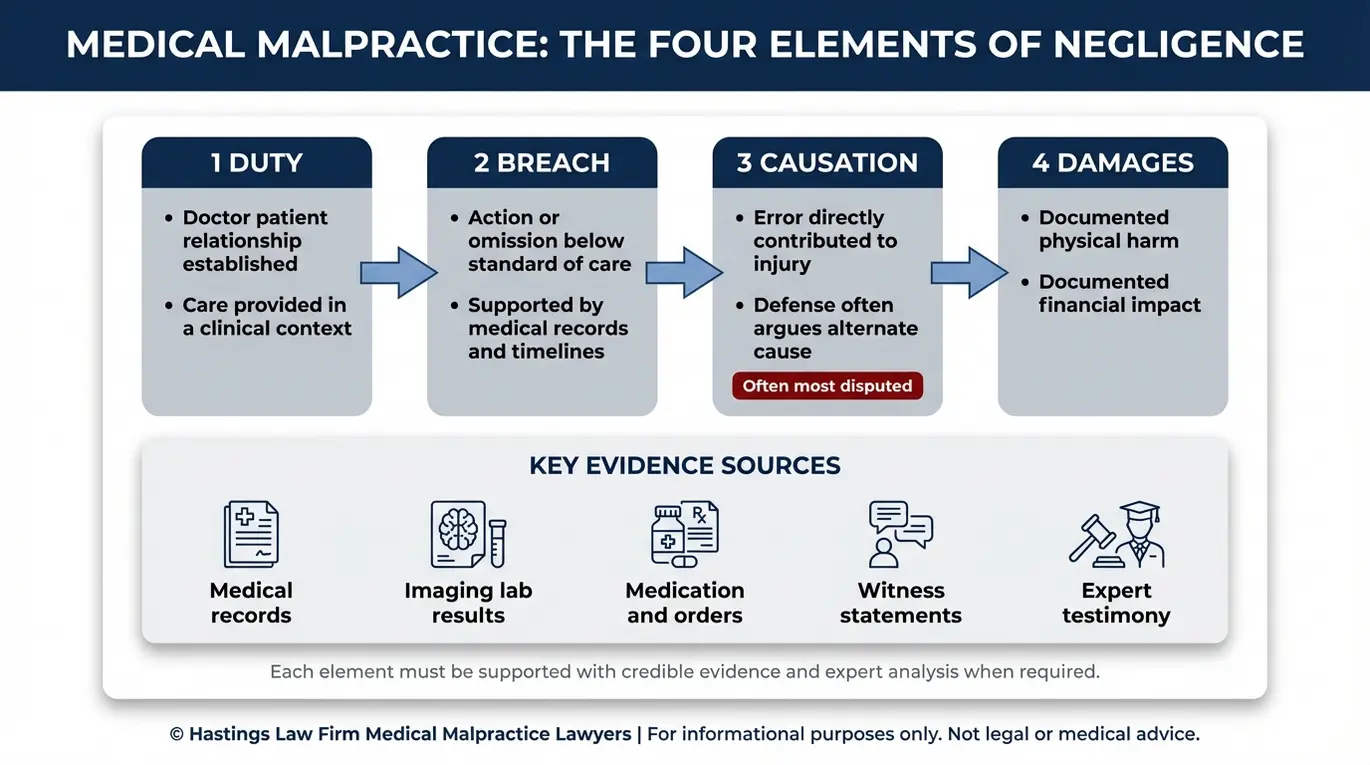
To prove negligence, a plaintiff must demonstrate duty of care, breach of duty, direct causation, and actual damages. Building a claim requires establishing these specific legal requirements to ensure the case is trial-ready.
Here is what must be established:
- Duty of care: A doctor-patient relationship existed, meaning the physician accepted responsibility for your treatment.
- Breach of duty: The doctor failed to meet the accepted standard of care. This might include ignoring diagnostic test results, failing to order appropriate imaging, or not following up on concerning symptoms.
- Causation: The physician’s specific error directly caused your injury. This is often the most contested element, because the defense will argue the harm would have happened regardless.
- Damages: You suffered real, measurable harm. This includes not just your current medical bills but also the long-term impact on your quality of life.
Causation often presents the toughest hurdle for many cases. It is not enough to show the doctor made a mistake. You must also show that the mistake, rather than the underlying condition, led to the injury.
A misdiagnosis, the failure to correctly identify a medical condition, or a delayed diagnosis, where a correct diagnosis comes too late for effective treatment, can both cause significant harm. Proving the link between the delay and the outcome requires careful medical analysis.
We build this proof through a detailed review of your medical records and clinical timelines. As an Arizona doctor negligence lawyer team, we work alongside in-house nurses and board-certified patient advocates to reconstruct what happened at every stage of your care.
The Hastings Law Firm Difference
Results matter, but what truly sets us apart is how we achieve them. Every verdict, every settlement, and every Arizona courtroom victory comes from one guiding promise: To treat each client’s fight for justice as if it were our own.
This balance of skill, experience, and empathy reflects our core philosophy that justice should not only compensate the injured, but also make health care safer nationwide.

Common Types of Doctor Malpractice Cases We Handle
Common malpractice claims include diagnostic errors, surgical mistakes, medication failures, and birth injuries caused by physician negligence. Malpractice can occur in many forms, from mistakes in the operating room to errors in the pharmacy.
Diagnostic errors are among the most frequent. A failure to diagnose, where a physician misses a condition entirely, can allow cancer, heart disease, or stroke to progress unchecked. Misdiagnosis, where the wrong condition is identified and treated, can expose patients to unnecessary procedures while the real problem worsens.
Surgical errors range from wrong-site surgery to retained surgical items. These errors are often preventable through standard safety protocols.
Medication errors include prescribing the wrong drug, ordering an incorrect dosage, or failing to account for known drug interactions. These mistakes can cause organ damage, allergic reactions, or worse.
Birth injuries can result from a physician’s failure to monitor fetal distress, respond to complications during labor, or perform a timely intervention. These cases often involve lifelong consequences for the child and family.
Anesthesia errors, where an anesthesiologist administers too much sedation, fails to monitor a patient’s airway, or overlooks a documented allergy, can lead to brain injury or death.
The table below outlines how liability often aligns with the type of physician involved:
| Type of Error | Physician Typically Liable |
|---|---|
| Missed or delayed cancer diagnosis | Primary care doctor, radiologist, or oncologist |
| Wrong-site surgery | Surgeon and surgical team |
| Anesthesia complication | Anesthesiologist or nurse anesthetist |
| Medication/dosage error | Prescribing physician or pharmacist |
| Birth injury during delivery | Obstetrician or attending physician |
| Emergency room mistake | Emergency medicine physician |
If you are considering suing a doctor in Arizona because an error harmed you, a physician malpractice attorney can review your medical records and help determine who is responsible. Arizona patients can also request facility records through the Arizona Department of Health Services Public Record Request User Guide.
Identifying Liability Beyond the Doctor
Liability may extend beyond the individual doctor to include medical groups, hospitals, or private practices under vicarious liability doctrines. Identifying every responsible party is essential to building a complete case.
When a doctor is employed by a hospital or health system, the institution may share legal responsibility for that physician’s negligence. This principle, known as vicarious liability, holds an employer accountable for the actions of its employees performed within the scope of their job. If a hospital-employed surgeon makes an error during a procedure, the hospital itself may be liable for institutional negligence.
The analysis changes when a physician operates as an independent contractor. Many doctors who treat patients inside a hospital are not actually employed by that facility. In those situations, the hospital may argue it has no responsibility for the doctor’s conduct. We investigate employment agreements, credentialing and privileging records (the process by which a hospital verifies a doctor’s qualifications and grants permission to practice there), and staffing arrangements to determine the true relationship with the medical practice or hospital.
Insurance companies also shape how these cases unfold. Physicians carry malpractice insurance, and their insurer will aggressively defend claims. We understand the tactics these carriers use, because several of our attorneys previously defended hospitals and doctors before joining our firm.
You can research a facility’s compliance history through the Arizona Department of Health Services Licensing Services Statement of Deficiencies Search, which may reveal patterns of concern.
Arizona Comparative Negligence and NPDB Reports
Arizona follows a pure comparative negligence rule. This means you can recover compensation even if you are partially at fault for your injury. Your award would be reduced by your percentage of responsibility, but you are not barred from recovery.
We also perform a background check on a physician’s history through the National Practitioner Data Bank (NPDB), a federal repository that tracks malpractice payments and adverse actions against licensed healthcare providers. NPDB reports can reveal prior offenses, settlements, or disciplinary actions that may be relevant to your case and help establish a pattern of conduct.
Recovering Damages for Medical Errors in Arizona
Patients harmed by physician negligence may recover economic damages for medical bills and lost wages, and non-economic damages for pain and suffering, with no constitutional cap on compensation in Arizona. Compensation for doctor negligence covers financial losses directly tied to the injury.
Economic damages include:
- Past and future medical bills, including surgeries, rehabilitation, and ongoing care
- Lost wages from missed work during recovery
- Reduced earning capacity if the injury limits your ability to work long-term
- Future medical care costs for conditions requiring lifelong treatment
Non-economic damages address the personal impact of the injury:
- Physical pain and suffering
- Emotional distress and mental anguish
- Loss of enjoyment of life
- Loss of companionship or consortium for family members
In wrongful death cases, surviving family members may seek compensation for funeral expenses, lost financial support, and the grief of losing a loved one.
One of the most significant advantages for patients in Arizona is that the state constitution prohibits caps on personal injury and wrongful death damages. Unlike many states that limit non-economic recovery, Arizona allows juries to award the full amount they believe is fair. An Arizona doctor malpractice lawyer can help you understand the full scope of what your case may be worth.
Understanding Subrogation and Liens
If your health insurance paid for treatment related to your injury, your insurer may have a legal right to be repaid from any settlement or verdict you receive. This legal right to health insurance repayment is called subrogation. It allows an insurance company to reclaim costs they paid for care resulting from a physician’s error.
Identifying and negotiating these liens is an important part of maximizing your net recovery. We review settlement proceeds and negotiate liens to ensure that amounts are accurate and that you keep as much of your compensation as possible.
The Role of Expert Witnesses in Physician Claims
Expert witnesses are legally required to define the standard of care and testify that the defendant doctor’s actions breached that standard. In Arizona, expert testimony is the foundation of any medical negligence claim.
Courts require the expert to practice in the same medical specialty as the doctor being sued. Medical expert testimony from a peer ensures the evaluation reflects the specific training and clinical expectations of that field. A neurosurgeon’s care, for example, should be evaluated by another neurosurgeon, not a family medicine doctor.
Arizona also requires a preliminary expert opinion affidavit, similar to an affidavit of merit, confirming that a qualified expert has reviewed the case and believes the standard of care was breached. This requirement exists to screen out claims that lack medical support before they consume court resources. A valid affidavit must be filed within a specific timeframe, emphasizing the need for prompt legal action.
At Hastings Law Firm, we maintain a national network of top-tier medical experts across every specialty. These experts review records, identify where care fell short, and provide testimony that clearly explains complex medical failures to a jury. Our experts not only identify errors but also counter defense claims that an injury was unavoidable. This strategic approach strengthens your position during settlement negotiations or trial.
Arizona Statute of Limitations for Claims Against Doctors
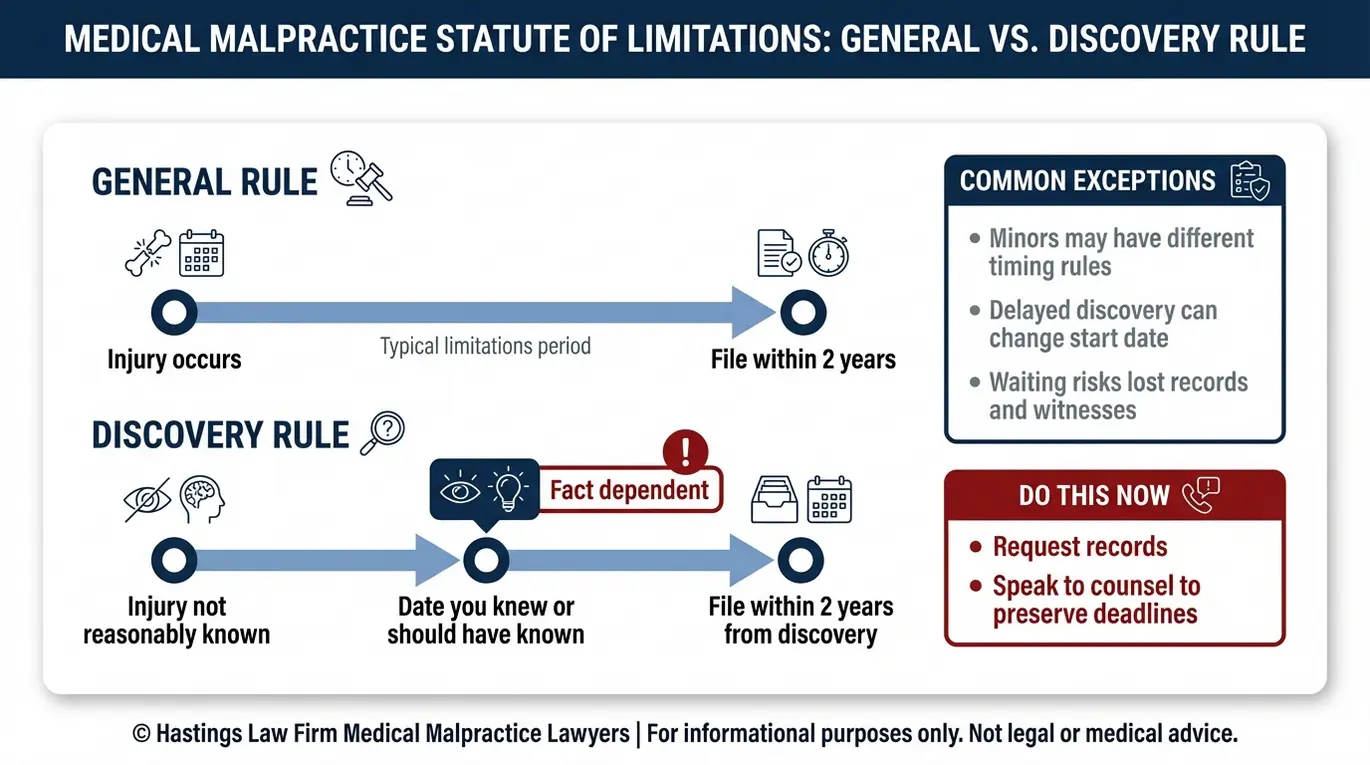
In Arizona, the statute of limitations for medical malpractice is generally two years from the date of the injury or discovery of the error. Legal deadlines in Arizona, known as the statute of limitations, strictly control when you can file a claim.
Under Arizona Revised Statutes § 12-542, the standard two-year limit applies. For most cases, the clock starts on the date the injury occurred. But when the injury is not immediately apparent, Arizona applies the discovery rule, which starts the deadline when the patient knew, or reasonably should have known, that the injury was caused by medical negligence.
There are exceptions for minors. Children generally have until their 18th birthday, plus the standard limitations period, to file a claim. These timelines can be complex, and specific facts may alter the calculation.
Because deadlines are strict under Title 12 of the Arizona Revised Statutes, consulting with an attorney early protects your right to pursue a claim. A statute of limitations for doctor malpractice analysis is one of the first things we evaluate during a case review.
Contact the Arizona Doctor Malpractice Attorneys at Hastings Law Firm Today for Help
You placed your trust in a physician, and if that trust was violated through negligence, you have the right to seek answers and accountability. At Hastings Law Firm, our mission is to restore that trust by standing beside patients who have been harmed and making sure their voices are heard. We handle doctor malpractice cases all across Arizona from our Phoenix offices.
Our team of attorneys, former defense lawyers, in-house nurses, and patient advocates is built specifically for cases like yours. We handle medical malpractice and nothing else. Every case is prepared for trial from day one, giving us the strongest possible position whether we are negotiating a settlement or presenting your case to a jury.
There is no fee unless we recover compensation for you. Contact an Arizona doctor malpractice attorney at Hastings Law Firm for a free, confidential case evaluation. Let us review what happened and explain your options.
Frequently Asked Questions About Doctor Malpractice in Arizona


This content was researched and written by the Hastings Law Firm editorial team, which includes attorneys, medical professionals, and experienced researchers. Our writing is informed by internal knowledge and practical experience, and we cross-check critical details against authoritative sources cited throughout. Every piece undergoes human-led fact-checking and legal review. Because legal and medical information can change, if you spot an error, please contact us. Learn more about our content standards and review process on our editorial policy page.

Tommy Hastings, founder of Hastings Law Firm, is a board-certified personal injury trial lawyer dedicated exclusively to healthcare injury cases. Since 2001, he has represented injured patients and families in litigation against major hospital systems, pharmaceutical companies, and negligent healthcare providers nationwide. He has handled numerous high-profile cases that have drawn national media attention and resulted in multi-million dollar recoveries. He draws on that experience in his writing, helping readers understand how these cases work and what options may be available to them.
