


Arizona Medical Misdiagnosis Lawyer
A wrong, missed, or delayed diagnosis can leave a patient facing worsening illness, unnecessary treatment, and lasting harm that could have been avoided with timely evaluation and appropriate testing. Diagnostic errors often involve missed warning signs, incomplete workups, or breakdowns in clinical reasoning, and the most serious outcomes can be life changing or worse. Understanding how standard of care, causation, and damages are evaluated can help clarify what happened and what accountability may look like. If you or a loved one were harmed or worse due to medical misdiagnosis in Arizona, contact Hastings Law Firm for a free, confidential case review.

Last Updated: September 19, 2026
Trusted Legal Representation for Wrong Medical Diagnosis Claims in Arizona
When a doctor gets your diagnosis wrong, the consequences can be severe and life-altering. You may be dealing with a condition that has progressed because it was not caught in time, or you may have undergone treatment you never actually needed. Either way, the confusion and frustration that follow a diagnostic error are completely understandable.
If you or a loved one has been harmed by a misdiagnosis, delayed diagnosis, or failure to diagnose a serious condition, you deserve clear answers about what went wrong and whether you have a legal claim. An experienced Arizona medical misdiagnosis lawyer can review your medical records, consult with qualified experts, and help you understand your options.
Hastings Law Firm focuses exclusively on medical malpractice. We can evaluate what happened and explain whether you have a path forward. Contact us for a free, confidential case evaluation.

Common Types of Medical Misdiagnosis in Arizona
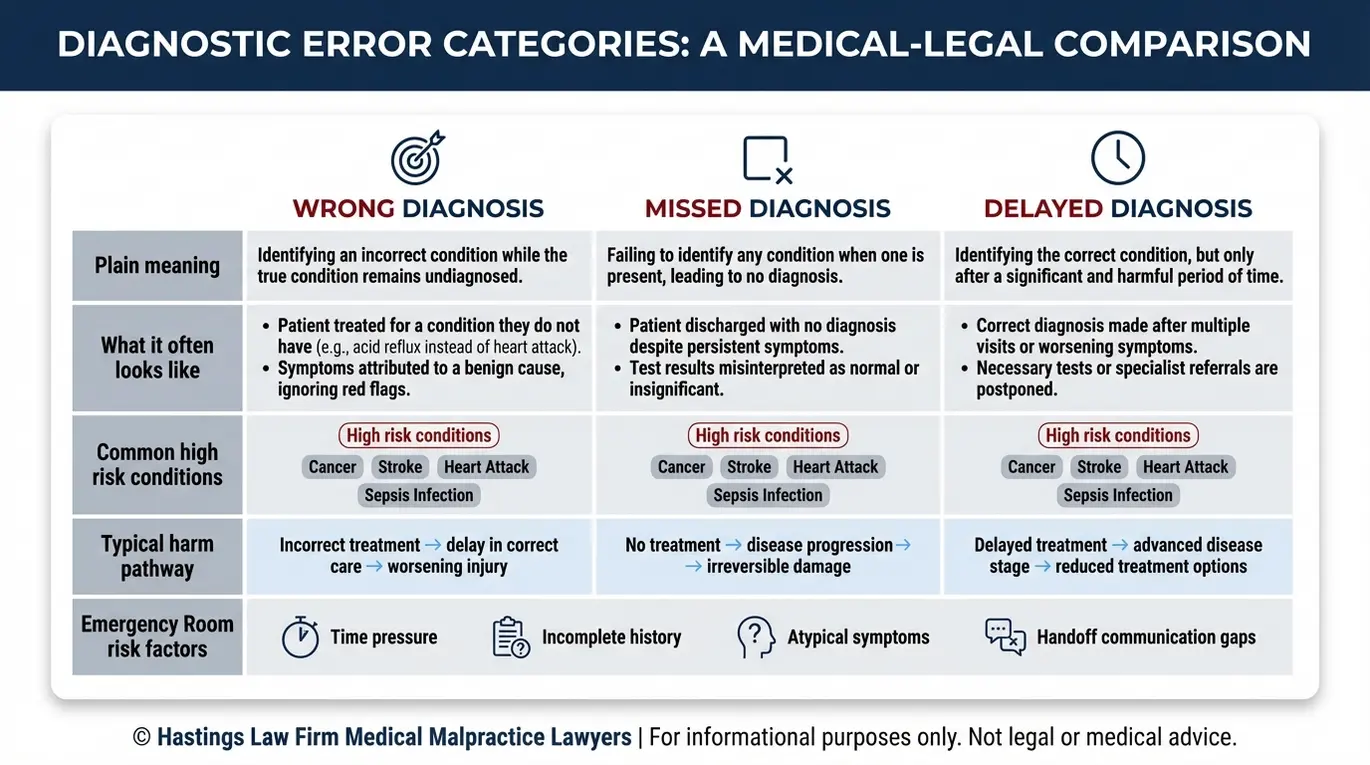
Medical misdiagnosis occurs when a healthcare provider fails to accurately identify a patient’s condition, leading to incorrect treatment, delayed care, or no treatment at all. These errors generally fall into three main categories:
- Wrong Diagnosis: An error where the doctor identifies a condition, but it is the wrong one, leading to unnecessary treatment while the actual illness goes unchecked.
- Missed Diagnosis: A situation where the doctor erroneously concludes nothing is wrong, allowing a serious condition to worsen without intervention.
- Delayed Diagnosis: The correct condition is eventually identified, but not until significant time has passed. By then, treatment options may be more limited or the prognosis far worse.
Certain conditions carry high diagnostic stakes. Cancer, stroke, heart attack, and sepsis are among the most commonly misdiagnosed serious illnesses. In each of these, even a short delay can mean the difference between a treatable condition and a fatal one.
Emergency room mistakes deserve particular attention. The fast-paced, high-pressure environment of an ER can lead to shortcuts in evaluation. When physicians are managing many patients simultaneously, critical symptoms can be overlooked. Arizona medical misdiagnosis lawyers frequently see cases where ER providers failed to order appropriate testing or discharged patients too quickly.
Understanding the Differential Diagnosis Failure
At the core of many diagnostic error cases is a breakdown in the differential diagnosis process. This is the method doctors use to identify an illness by considering and ruling out various possibilities based on symptoms.
Negligence often arises when a doctor skips this process or fails to include a probable serious condition. One common reason is anchoring bias, a cognitive tendency where a physician locks onto an early impression and stops considering other possibilities.
Establishing Liability and the Standard of Care for Diagnosis
To prove malpractice, we must demonstrate that a competent doctor in the same field would have correctly diagnosed the condition under similar circumstances. Establishing liability means proving who is legally responsible for the harm caused.
The standard of care refers to the level of treatment a reasonably skilled physician in the same specialty would provide. In diagnostic testing, this means ordering appropriate labs, imaging, or specialist consultations when warranted. A failure to follow these accepted practices can constitute medical negligence.
Medicine involves uncertainty, so a diagnostic error alone is not automatically malpractice. The question is whether the doctor’s actions fell below the standard of care and directly caused harm.
Causation is often the most contested element. We must show that delayed diagnosis, the failure to identify a condition in a timely manner, led to specific injury. For example, if delay allowed cancer to advance from Stage 1 to Stage 4, that progression is the direct harm. Medical records from the Arizona Department of Health Services and other sources help establish a timeline.
Red-flag symptoms, clinical signs that should prompt urgent investigation, are central to these cases. If a provider ignored documented warning signs, it supports a claim. Here is what we evaluate:
- The patient’s reported symptoms and when they were documented.
- Whether appropriate diagnostic tests were ordered and interpreted correctly.
- Whether the provider referred the patient to a specialist when indicated.
- Whether the diagnostic timeline shows unreasonable gaps between presentation and diagnosis.
- Whether the misdiagnosis or delay directly caused the patient’s condition to worsen.
As your Arizona medical misdiagnosis lawyer, we work with qualified experts to assess these factors. Our role as attorneys for misdiagnosis in Arizona is to connect the clinical facts to the legal standard.

The Hastings Law Firm Difference
Results matter, but what truly sets us apart is how we achieve them. Every verdict, every settlement, and every Arizona courtroom victory comes from one guiding promise: To treat each client’s fight for justice as if it were our own.
This balance of skill, experience, and empathy reflects our core philosophy that justice should not only compensate the injured, but also make health care safer nationwide.

How We Prove Your Misdiagnosis Claim
We utilize a comprehensive investigation process involving medical record analysis and expert testimony to build a case that can withstand a jury trial. Every case we accept follows a structured approach designed to uncover exactly what went wrong.
The Investigation. Our in-house medical team gathers all relevant records, including physician notes and imaging. Under federal law, you have the right to access your own health information, and the U.S. Department of Health and Human Services’ HIPAA guidance outlines those protections. We look for specific failures like a false-negative test result, a test that incorrectly indicates no disease is present, or radiology misinterpretation, an imaging study read incorrectly.
Expert Review. Through our national expert network, we retain specialists in the same field as the treating physician to provide expert testimony. These specialists provide objective opinions on whether the standard of care was met. Their testimony is essential to establishing credibility before a jury.
Trial Preparation. As an Arizona medical misdiagnosis attorney, our approach is built around being trial-ready from the start. This strengthens our position during settlement discussions. Whether you need a lawyer for misdiagnosis to negotiate a resolution or present your case at trial, our preparation remains rigorous.

Compensation Available for Victims of Diagnostic Errors
Victims may recover damages for medical bills, lost income, pain and suffering, and in cases involving intentional or egregious misconduct, punitive damages. The type and amount of compensation depends on the severity of the harm and its impact on your life.
Economic Damages
Economic Damages cover the financial losses tied directly to the misdiagnosis. These damages are meant to reimburse specific financial outlays caused by medical negligence, including:
- Past and future medical expenses, including surgeries, medications, rehabilitation, and ongoing care.
- Lost wages from time missed at work during treatment and recovery.
- Lost earning capacity if the injury permanently affects your ability to work.
Non-Economic Damages
Non-Economic Damages address the personal toll of the injury, such as pain and emotional distress. Unlike many states that impose arbitrary caps on these awards, the Arizona Constitution prohibits caps on non-economic damages in personal injury cases. This means a jury can award compensation based on the actual severity of the harm you experienced.
Wrongful Death
A wrongful death claim is a legal action seeking compensation for the loss of a loved one. When a diagnostic error leads to the death of a patient, surviving family members may pursue this claim for funeral costs, lost financial support, and profound personal loss.
Our medical misdiagnosis lawyer in Arizona evaluates every category of damages relevant to your case. As your Arizona misdiagnosis legal team, we document the full scope of harm so that nothing is overlooked.
Why Choose Hastings Law Firm for Your Arizona Claim
We are a dedicated medical malpractice firm with board-certified leadership and a proven record of holding negligent healthcare providers accountable. Unlike general personal injury practices, Hastings Law Firm does *only* medical malpractice. Every attorney and staff member is focused on this single area of law.
Our firm is led by Tommy Hastings, a board-certified trial lawyer recognized as a leading authority. Board certification in Personal Injury Trial Law is achieved by fewer than 2% of Texas attorneys.
Our team also includes former defense attorneys and experienced hospital nurses, giving us insight into how the other side builds its case. Combined with our in-house medical staff, this allows us to anticipate defense strategies.
When you work with an Arizona medical misdiagnosis lawyer at Hastings Law Firm, you pay no attorney fees or costs unless we recover compensation for you.
Contact the Arizona Misdiagnosis Attorneys at Hastings Law Firm Today for Help
A misdiagnosis can change the course of your life. Whether you are dealing with a condition that was caught too late, treatment you received for the wrong illness, or the loss of someone you love, you deserve to know what happened and whether it should have been prevented. We handle medical diagnostic failure cases all across Arizona from our Phoenix offices.
Hastings Law Firm is here to listen, investigate, and pursue the truth on your behalf. Our team of medical and legal professionals will review your records, consult with qualified experts, and give you an honest assessment of your case.
Time matters. Arizona law sets strict deadlines for filing a medical malpractice claim, so reaching out sooner gives us the best opportunity to preserve evidence and protect your rights.
Contact our Arizona medical misdiagnosis lawyer team today for a free, confidential case evaluation. There is no fee unless we win.
Frequently Asked Questions About Medical Misdiagnosis in Arizona


This content was researched and written by the Hastings Law Firm editorial team, which includes attorneys, medical professionals, and experienced researchers. Our writing is informed by internal knowledge and practical experience, and we cross-check critical details against authoritative sources cited throughout. Every piece undergoes human-led fact-checking and legal review. Because legal and medical information can change, if you spot an error, please contact us. Learn more about our content standards and review process on our editorial policy page.

Tommy Hastings, founder of Hastings Law Firm, is a board-certified personal injury trial lawyer dedicated exclusively to healthcare injury cases. Since 2001, he has represented injured patients and families in litigation against major hospital systems, pharmaceutical companies, and negligent healthcare providers nationwide. He has handled numerous high-profile cases that have drawn national media attention and resulted in multi-million dollar recoveries. He draws on that experience in his writing, helping readers understand how these cases work and what options may be available to them.
