


Arizona Breast Cancer Misdiagnosis Lawyer
A delayed or missed breast cancer diagnosis can mean a more advanced disease, harsher treatment, and the loss of options that earlier detection might have provided. These situations often involve breakdowns in imaging interpretation, follow up, biopsy decisions, pathology review, or communication between departments. The impact can be physical, emotional, and financial, especially when a delay affects staging and prognosis. Arizona also recognizes loss of chance claims tied to reduced survival probability from diagnostic delay. If you or a loved one were harmed or worse due to a delayed breast cancer diagnosis in Arizona, contact Hastings Law Firm for a free, confidential case review.

Last Updated: July 27, 2026
Trusted Arizona Medical Attorneys for Delayed Breast Cancer Diagnosis Claims
When a doctor misses or delays a breast cancer diagnosis, the consequences can change the course of your life. You may be facing a more advanced stage of cancer, more aggressive treatment, or the loss of options that early detection would have provided. That experience can leave you feeling confused, angry, and unsure of what to do next.
You deserve answers, and you deserve to know whether the care you received met the standard your medical team owed you. As an Arizona breast cancer misdiagnosis lawyer, Hastings Law Firm has over 20 years of experience focusing exclusively on medical malpractice. Our team, led by board-certified founder Tommy Hastings, includes former defense attorneys and in-house medical professionals prepared to review your case thoroughly.
If you suspect your diagnosis was missed or delayed, contact us for a free, confidential evaluation. We can explain your options and help you understand what happened.

Understanding Breast Cancer Misdiagnosis in Arizona Healthcare
Breast cancer misdiagnosis occurs when a healthcare provider fails to identify cancer at an early, treatable stage due to negligence, such as misreading a mammogram, dismissing symptoms, or failing to order a biopsy. Not every unfavorable outcome is malpractice. The distinction lies in whether the provider’s actions fell below the accepted standard of care, meaning the level of treatment a reasonably competent medical professional would have provided under the same circumstances.
According to the National Library of Medicine’s summary on diagnostic errors, failures in the diagnostic process are among the most common sources of malpractice claims. In breast cancer cases specifically, errors often stem from breakdowns at multiple points in the diagnostic chain. Our firm investigates these medical records to determine where the failure occurred.
Common errors that may lead to a failure to diagnose or a delayed diagnosis include:
- Misread imaging: A radiologist, the physician who interprets medical images like mammograms and ultrasounds, may incorrectly categorize a suspicious mass as benign.
- Failure to follow up on symptoms: A provider may dismiss a palpable lump found during a clinical breast exam without ordering further testing.
- Pathology errors: A pathologist, the specialist who examines tissue samples under a microscope, may misinterpret biopsy results, leading to a false-negative finding.
- Failure to order a biopsy: Even when imaging raises concerns, some providers delay or skip biopsy recommendations.
- Systemic failures: Understaffing, inadequate hospital protocols, or poor communication between departments can allow abnormal results to fall through the cracks. In many cases, the physician never receives the critical pathology report due to a breakdown in the electronic records system.
Each of these breakdowns can cost a patient months or even years of earlier treatment, and each one may constitute actionable medical negligence.
The Impact of Age and Cognitive Bias on Diagnosis
Younger women face a particular risk of a missed breast cancer diagnosis. Providers may attribute breast lumps or changes to common conditions like mastitis, an inflammation of breast tissue typically associated with breastfeeding, or assume that a patient’s age makes cancer unlikely. This type of reasoning can lead to dangerous delays. Younger patients often lack routine screening history, making the reliance on clinical exams and symptom reporting even more critical for early detection.
One well-documented factor is anchoring bias, a cognitive pattern where a doctor forms an initial impression, such as a benign diagnosis, and then unconsciously filters new evidence to support that original conclusion. When a follow-up scan shows changes or a lump persists, a provider influenced by anchoring bias may still resist ordering a biopsy or referral to an oncologist. An oncologist is a doctor who specializes in the diagnosis and treatment of cancer.
An Arizona breast cancer misdiagnosis lawyer evaluates whether cognitive biases or age bias contributed to a diagnostic failure. Our team reviews the full timeline of care, from initial presentation through every follow-up, to identify where the standard of care was breached.
Diagnostic Standards and Tools for Early Detection
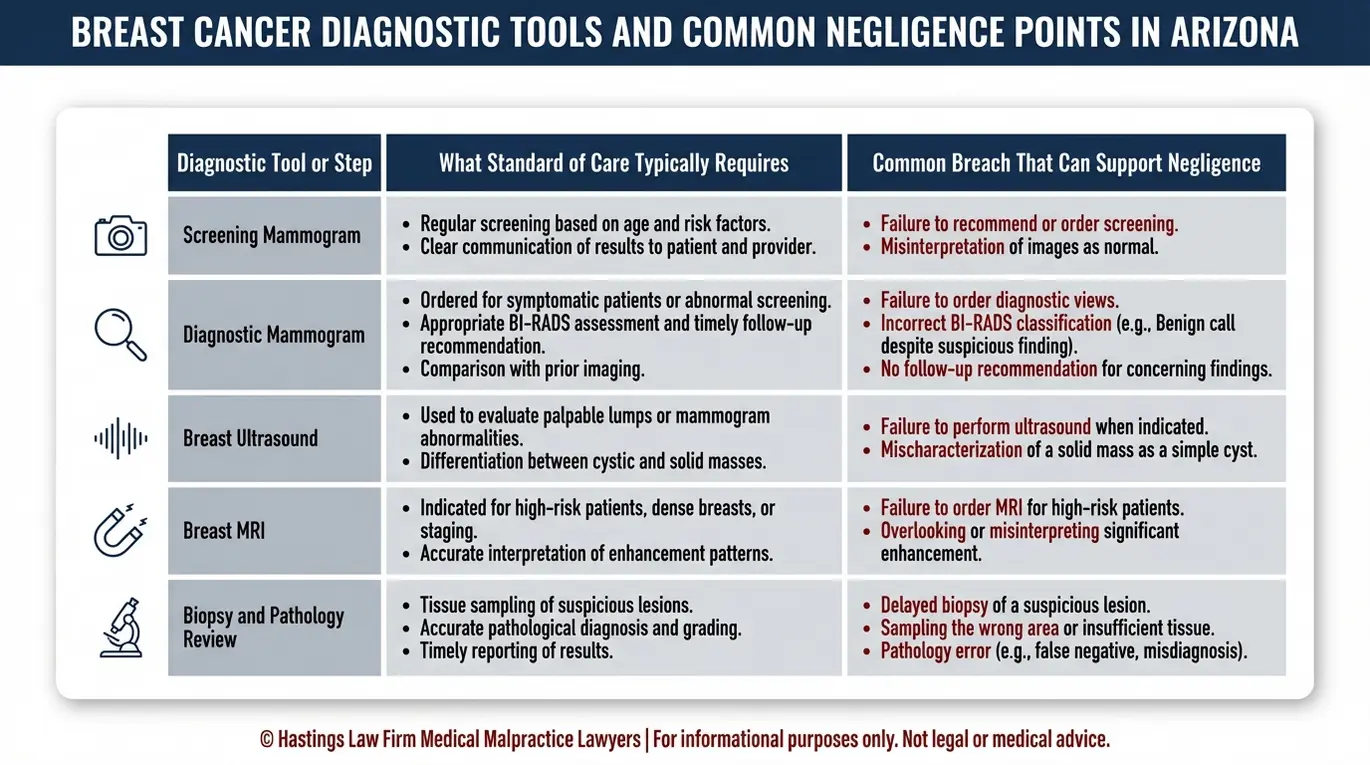
The standard of care dictates that physicians must use appropriate diagnostic tools, such as diagnostic mammograms, ultrasounds, and biopsies, when a patient presents with symptoms; failure to utilize these tools constitutes negligence.
When a patient reports a lump or a screening mammogram shows an abnormality, a clear diagnostic pathway should follow. Physicians should promptly order a diagnostic mammogram, a targeted imaging study that provides more detailed views than a routine screening. If the mammogram is inconclusive, an ultrasound or MRI may be needed. When imaging suggests a suspicious mass, the standard of care typically requires a biopsy to obtain tissue samples for examination.
Radiologists classify mammogram findings using the Breast Imaging Reporting and Data System (BI-RADS), a standardized scoring system that ranks findings from 0 (incomplete) to 6 (known malignancy). Errors in BI-RADS classification, such as downgrading a suspicious finding to a lower category, can directly delay diagnosis and treatment. Misclassification prevents patients from receiving the urgent follow-up care they need, allowing the cancer to grow unchecked.
The National Library of Medicine’s clinical guidance on evaluating a new palpable breast mass reinforces that any new lump warrants prompt workup regardless of the patient’s age or risk profile. Deviation from this standard is exactly what an Arizona breast cancer lawyer investigates. Managing these technical requirements is challenging. A review of the medical records must verify not only that a test was performed, but that it was interpreted correctly according to the strict guidelines of the American College of Radiology.
The table below outlines key diagnostic tools and the types of negligent errors that may occur with each:
| Diagnostic Tool | Common Negligent Error |
|---|---|
| Screening Mammogram | Failing to flag an abnormality or recommend follow-up imaging |
| Diagnostic Mammogram | Miscategorizing a suspicious mass with an incorrect BI-RADS score |
| Ultrasound | Failing to order an ultrasound when a mammogram is inconclusive |
| MRI | Not ordering an MRI for high-risk patients with dense breast tissue |
| Biopsy | Delaying or failing to recommend a biopsy when imaging is suspicious |
| Pathology Review | Misinterpreting tissue samples, resulting in a false-negative report |
The Hastings Law Firm Difference
Results matter, but what truly sets us apart is how we achieve them. Every verdict, every settlement, and every Arizona courtroom victory comes from one guiding promise: To treat each client’s fight for justice as if it were our own.
This balance of skill, experience, and empathy reflects our core philosophy that justice should not only compensate the injured, but also make health care safer nationwide.

The Legal Reality of Loss of Chance in Arizona
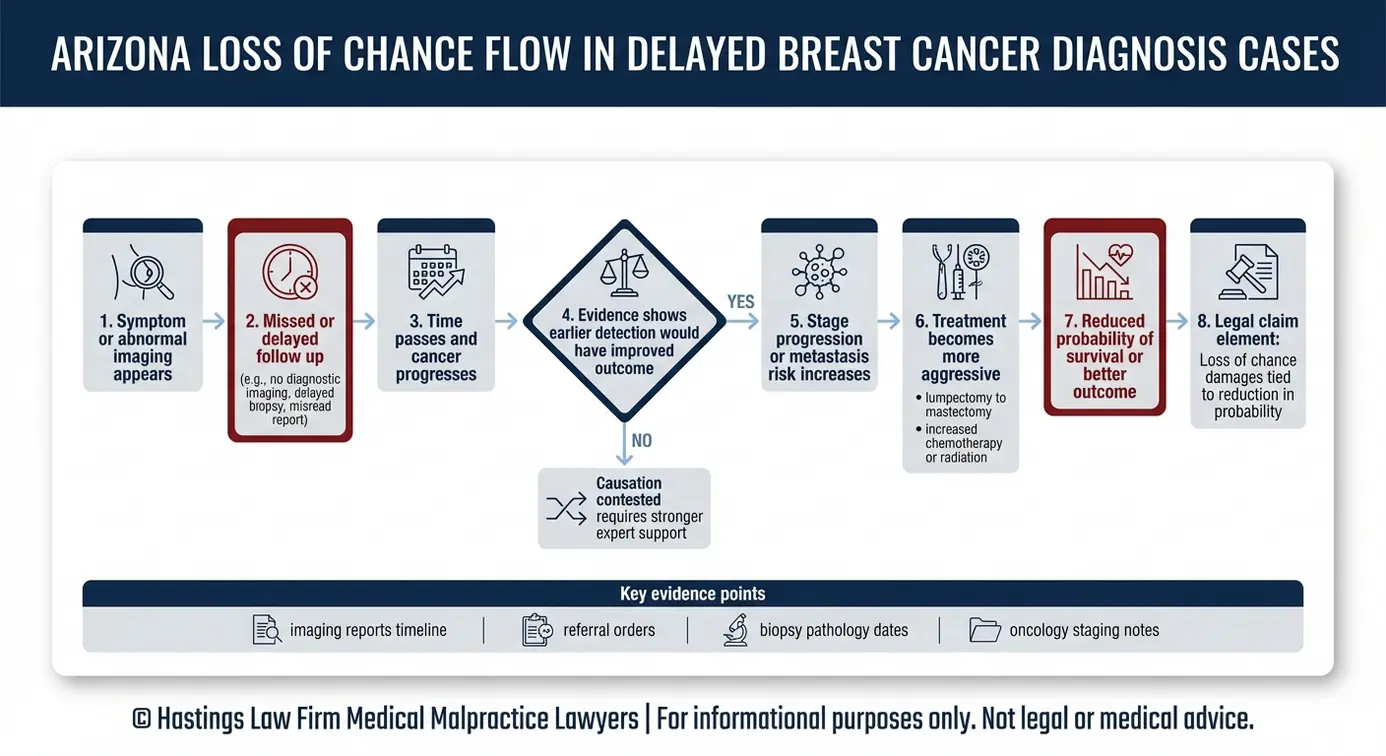
Under the “Loss of Chance” doctrine, Arizona patients can pursue a claim for the reduction in their survival probability caused by a delayed diagnosis, even if the original chance of survival was less than 50%.
This legal theory is especially relevant in breast cancer cases. When a diagnosis is delayed, patients face a higher risk of metastasis, the spread of cancer from the original tumor to other parts of the body. Oncologists rely on breast cancer staging, a classification system ranging from Stage I, where the cancer is small and localized, through Stage IV, where it has spread to distant organs like the lungs, liver, or bones. A delay of months or years can push a patient from an early, highly treatable stage into advanced disease that requires far more aggressive intervention.
The difference in treatment between an early and late diagnosis is often dramatic. A patient diagnosed at Stage I may need only a lumpectomy, a limited surgery to remove the tumor. A patient whose cancer has advanced due to a missed diagnosis may face a full mastectomy, extended chemotherapy, radiation, or a combination of all three. The physical, emotional, and financial toll of that progression is significant.
A Stage I diagnosis offers a five-year survival rate of nearly 99%, often requiring minimal intervention. By contrast, a Stage IV diagnosis drops that survival rate dramatically, forcing patients to endure systemic therapies that ravage the body simply to extend life, rather than cure the disease.
The Math of Negligence
Loss of Chance addresses a challenge that arises in many breast cancer malpractice cases: proving causation. Causation is the legal link showing that the healthcare provider’s error directly caused the patient’s harm. Defense attorneys often argue that cancer is inherently unpredictable and that the patient may not have survived even with an earlier diagnosis. Loss of Chance counters this argument directly.
Here is how it works in practice: if a patient had a 70% chance of five-year survival at the time the cancer should have been caught, and that probability dropped to 30% by the time of the actual diagnosis, the delay caused a 40% reduction in survival odds. The University of Missouri School of Law’s analysis of Loss of Chance in medical malpractice explains how courts have recognized this reduction as a compensable injury. Establishing liability requires proving that this statistical drop in survival was a direct result of the provider’s negligence.
As an attorney for breast cancer misdiagnosis in Arizona, our team works with oncology experts to reconstruct the likely staging at the time of the missed diagnosis, compare it to the staging at actual diagnosis, and quantify the lost survival probability. This analysis forms the foundation of causation in delayed diagnosis claims. Courts in Arizona acknowledge that destroying a patient’s opportunity for a better outcome is a distinct harm that warrants financial recovery.
Compensation and Damages for Delayed Treatment
Patients harmed by a breast cancer misdiagnosis in Arizona may recover damages for medical expenses, lost wages, and pain and suffering, with no state constitutional cap on the amount of compensation awarded for personal injury.
The Arizona Constitution, Article 2, Section 31 expressly prohibits any law that would limit the amount of damages recoverable for death or personal injury. This means Arizona juries have full authority to award compensation that reflects the true scope of harm caused by a diagnostic failure. Arizona law recognizes that the impact of a missed diagnosis extends far beyond the immediate medical bills. The financial devastation can destabilize a family’s future, while the physical and emotional trauma can permanently alter a patient’s quality of life. Our legal system aims to make patients whole by addressing every category of loss.
Damages in these cases generally fall into two categories:
Economic damages cover the measurable financial losses tied to the misdiagnosis:
- Past and future medical bills often exceed simple treatment costs. They encompass surgery, chemotherapy, radiation, ongoing monitoring, and palliative care required for advanced disease.
- Lost income and diminished earning capacity are also recoverable if the aggressive treatment regimen or physical debility prevents you from returning to your previous employment.
- Costs of home care, rehabilitation, or accommodations needed during recovery. Families often face hidden costs as well, such as travel expenses for specialized treatment centers or modifications to the home to accommodate physical limitations.
Non-economic damages account for the personal toll of the injury:
- Physical pain and suffering caused by advanced-stage treatment.
- Emotional distress, anxiety, and depression frequently accompany a worsened prognosis, as patients must cope with the knowledge that earlier action could have altered their path.
- Loss of enjoyment of life and the inability to participate in daily activities.
- Disfigurement can result from an unnecessary mastectomy, which is the surgical removal of one or both breasts. A lumpectomy, a less invasive procedure that removes only the tumor, may have been sufficient if the cancer was caught earlier.
Wrongful death damages may apply if a loved one dies as a result of a delayed diagnosis. Surviving family members may seek compensation for funeral and burial costs, loss of the patient’s expected income, and loss of companionship and guidance. Arizona law provides specific rights for spouses, children, and other dependents in these claims.
A lawyer for misdiagnosis claims can evaluate the full scope of your losses and build a case that accounts for both current and future harm.

How Hastings Law Firm Overcomes Defense Tactics
We counter aggressive hospital defense teams by preparing every case for trial from day one and drawing on the experience of former defense attorneys who now work on our side.
Hospitals and their insurers do not settle breast cancer misdiagnosis cases fairly unless they believe the plaintiff’s legal team is genuinely prepared to present the case to a jury. That is why our trial-ready approach is built into every stage of our process. From the initial records review through expert retention and deposition strategy, we build the case as if it is going to trial.
This posture changes how defense counsel evaluates the risk of proceeding, and it often leads to stronger outcomes before a courtroom is ever involved. We do not accept inadequate settlement offers that fail to cover your long-term needs. By demonstrating our willingness to go to court, we force insurance companies to calculate the risk of a verdict rather than the convenience of a quick closure.
Arizona’s One Expert Rule adds a layer of strategic importance to case preparation. The state presumptively limits each side to one retained expert witness per issue, such as one for standard of care and one for causation. Selecting the right oncologist or radiologist expert is not just important; it can define the strength of your entire case. Our national expert network allows us to identify and retain medical professionals whose credentials and testimony align precisely with the facts. This careful selection prevents the defense from undermining our claims with technicalities and ensures the jury hears a clear, authoritative perspective on the medical errors involved.
Our team also includes former defense attorneys who previously represented hospitals in medical malpractice litigation. Their insight into defense tactics helps us anticipate arguments before they are raised and build a case that directly addresses them. As an Arizona breast cancer misdiagnosis lawyer, we manage your case on a contingency fee basis. You pay no attorney fees or costs unless we secure a recovery on your behalf.
Contact the Arizona Misdiagnosis Attorneys at Hastings Law Firm Today for Help
A delayed breast cancer diagnosis can take away time, treatment options, and peace of mind. If you or a loved one received a late or missed diagnosis, you do not have to sort through what happened alone.
At Hastings Law Firm, we listen, we believe you, and we are ready to help. Our team of medical malpractice attorneys, in-house nurses, and former defense lawyers will review your medical records, identify where the standard of care may have been breached, and explain what legal options are available to you.
Reach out to our Arizona breast cancer misdiagnosis lawyer team today for a free, confidential case evaluation. There is no fee unless we win.
Frequently Asked Questions About Breast Cancer Misdiagnosis in Arizona


This content was researched and written by the Hastings Law Firm editorial team, which includes attorneys, medical professionals, and experienced researchers. Our writing is informed by internal knowledge and practical experience, and we cross-check critical details against authoritative sources cited throughout. Every piece undergoes human-led fact-checking and legal review. Because legal and medical information can change, if you spot an error, please contact us. Learn more about our content standards and review process on our editorial policy page.

Tommy Hastings, founder of Hastings Law Firm, is a board-certified personal injury trial lawyer dedicated exclusively to healthcare injury cases. Since 2001, he has represented injured patients and families in litigation against major hospital systems, pharmaceutical companies, and negligent healthcare providers nationwide. He has handled numerous high-profile cases that have drawn national media attention and resulted in multi-million dollar recoveries. He draws on that experience in his writing, helping readers understand how these cases work and what options may be available to them.
