


Arizona Cancer Misdiagnosis Lawyer
A delayed or missed cancer diagnosis can change treatment options and outcomes, especially when screening is not ordered, test results are misread, or critical findings are not communicated. Some delays stem from individual mistakes, while others involve system breakdowns such as EHR routing problems that keep abnormal results from reaching the right clinician or the patient. Proving malpractice often turns on whether the standard of care was breached and whether the delay caused measurable harm such as disease progression or reduced survival. If you or a loved one were harmed or worse due to delayed cancer diagnosis in Arizona, contact Hastings Law Firm for a free, confidential case review.

Last Updated: July 27, 2026
Trusted Arizona Medical Attorneys for Delayed Cancer Diagnosis Claims
Learning that your cancer could have been caught sooner is a deeply unsettling experience. You may be dealing with more aggressive treatment, a worse prognosis, or the grief of losing a loved one, all while wondering whether a doctor’s error changed everything. Those feelings are valid, and you deserve honest answers about what happened.
If you need a dedicated Arizona Cancer Misdiagnosis Lawyer, Hastings Law Firm focuses exclusively on medical malpractice. Founded by board-certified trial attorney Tommy Hastings, our firm operates with a team of legal and medical professionals. Our staff, including in-house nurse consultants and former defense attorneys, work together to determine whether a delayed or missed diagnosis fell below the standard of care. If you or a family member suspect that a cancer diagnosis was delayed or missed due to negligence, we offer a free, confidential case evaluation to review what happened and explain your options.

Common Medical Errors Leading to Delayed Cancer Diagnosis
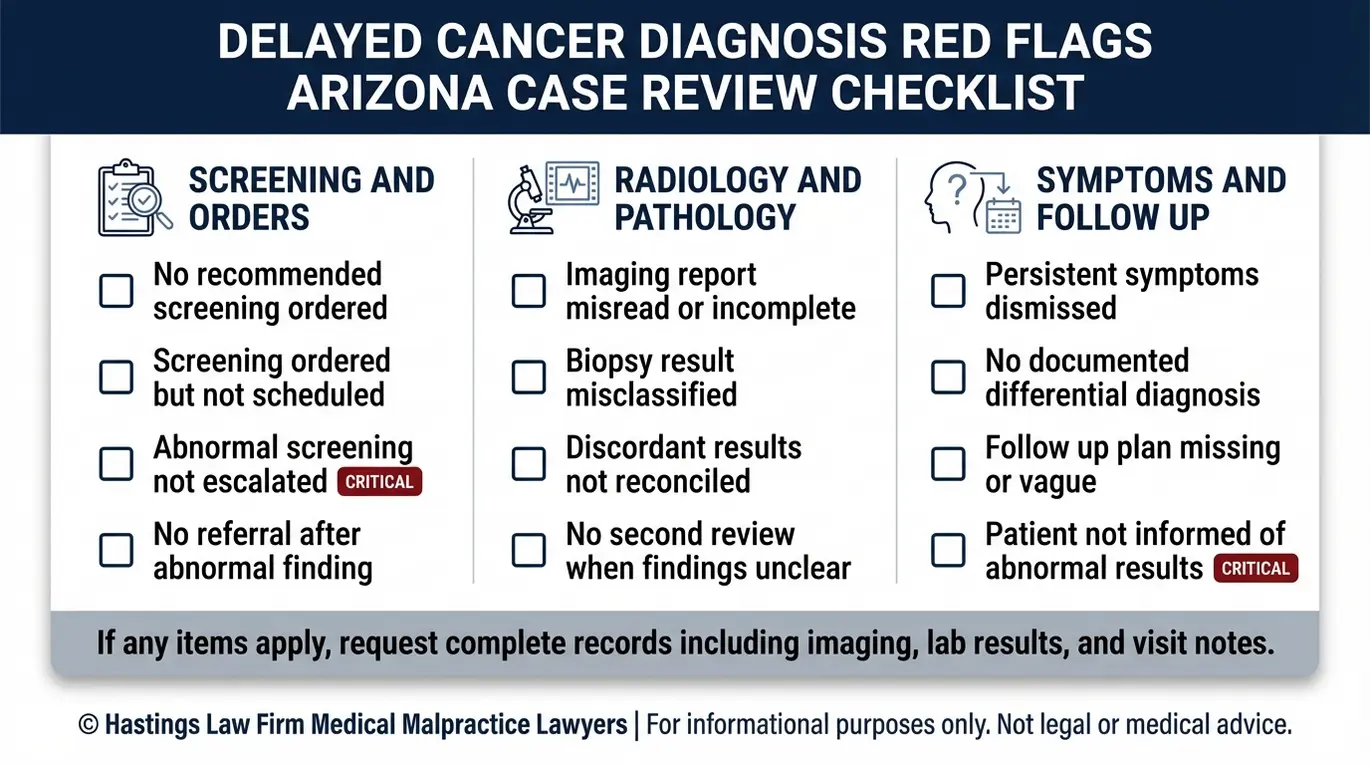
A delayed cancer diagnosis often occurs when physicians fail to order appropriate screening tests, misinterpret radiology or pathology results, or dismiss patient complaints as minor ailments. These errors involve failures in the diagnostic process that prevent timely treatment. They can allow cancer to progress from an early, treatable stage to one requiring far more aggressive intervention.
Screening Failures
Established guidelines from organizations like the American Lung Association’s USPSTF Lung Cancer Screening Recommendation Toolkit outline when patients should receive routine cancer screenings, which are preventive tests used to detect cancer before symptoms appear. When a physician fails to recommend a mammogram, colonoscopy, or low-dose CT scan for a patient who meets the criteria, the window for early detection can close.
Interpretation and Communication Errors
Even when the right tests are ordered, errors in reading X-rays, MRIs, or biopsy results (the laboratory analysis of tissue samples removed from the body) can lead to a missed finding. An NCBI Bookshelf executive summary on diagnostic errors documents how misinterpretation of pathology slides and imaging tests remains a significant source of diagnostic failure.
Beyond individual physician errors, a cancer misdiagnosis attorney in Arizona often uncovers systemic failures. These are institutional errors, such as hospital protocol breakdowns, rather than a single doctor’s mistake.
A radiologist may flag a suspicious finding, but the result never reaches the patient because of an error in the electronic health record (EHR) audit trail, a digital log that tracks every access point and edit to patient data.
Medical negligence often involves a breach of the duty of care regarding critical test results notification, the process by which abnormal findings are communicated back to the ordering physician and patient. In these cases, liability may extend beyond a single doctor to the facility itself.
Common failures we investigate include:
- Failing to order age-appropriate or risk-appropriate screenings
- Misreading or overlooking abnormalities on imaging or lab results
- Dismissing persistent symptoms without referral to an oncologist
- Losing or failing to communicate critical test results to the patient
- EHR routing errors where flagged findings are never reviewed
When Does a Missed Cancer Diagnosis Qualify as Malpractice in Arizona?
A missed diagnosis becomes malpractice in Arizona when the physician breaches the accepted medical standard of care, meaning a competent doctor in the same field would have correctly diagnosed the condition under similar circumstances. Not every diagnostic error meets this threshold.
The medical standard of care refers to the level of skill and treatment that a reasonably competent professional would provide. Under Arizona Revised Statutes § 12-563, a patient must prove that the healthcare provider failed to exercise the degree of care, skill, and learning expected of a reasonable, prudent health care provider in the profession or class to which the provider belongs within the state, acting in the same or similar circumstances.
There is a meaningful difference between an honest miss, such as a biopsy that returns negative with no other clinical indicators, and negligence, such as ignoring a visible mass on imaging or failing to follow up on an abnormal lab result. This breach creates liability for the harm caused.
Arizona cancer misdiagnosis lawyers must also establish causation. This means showing that the delay specifically caused harm, not just that an error occurred. If the cancer progressed to a more advanced stage, a concept measured by cancer staging (the TNM system that classifies tumor size, lymph node involvement, and whether metastasis, or spread to distant organs, has occurred), because of the missed diagnosis, that progression is the injury. A lawyer for misdiagnosed cancer will work with medical experts to connect the delay directly to the worsened outcome.

The Hastings Law Firm Difference
Results matter, but what truly sets us apart is how we achieve them. Every verdict, every settlement, and every Arizona courtroom victory comes from one guiding promise: To treat each client’s fight for justice as if it were our own.
This balance of skill, experience, and empathy reflects our core philosophy that justice should not only compensate the injured, but also make health care safer nationwide.

How Our Arizona Cancer Misdiagnosis Lawyers Prove Negligence
We prove negligence by securing expert testimony to establish the breach of care and using forensic evidence preservation to show how the delay negatively altered the patient’s prognosis. This process requires clear evidence of how a medical error changed a patient’s health outcome. Proving medical negligence means showing that a healthcare provider’s actions fell below the accepted standard of care and directly harmed the patient. We use expert testimony from medical specialists to confirm that the provider failed to follow accepted protocols.
The Investigation
Our team begins by obtaining the full medical record, including the audit trail of the electronic health record. The HealthIT.gov standard for auditing actions on health information describes how EHR systems log every access point, edit, and order. These logs can reveal whether a critical result was viewed, ignored, or never routed to the right provider. Our in-house nursing staff reviews these records alongside the clinical timeline to identify gaps.
Expert Review and Timeline Reconstruction
We then send pathology slides, which are the preserved tissue samples mounted on glass for microscopic examination, and original DICOM imaging files, the standard digital format for medical images like CTs and MRIs, to independent specialists for re-evaluation. An attorney for delayed cancer diagnosis must demonstrate what a qualified expert would have seen and done at the time of the original review.
From there, our Arizona cancer misdiagnosis lawyer team reconstructs a detailed timeline mapping the “treatable window,” the period when earlier detection would have meant less invasive treatment or a better survival rate, against the date the cancer was actually diagnosed. This timeline, supported by expert witness testimony, establishes causation by showing how the delay allowed metastasis or advanced cancer staging to occur. We also re-examine imaging tests to pinpoint the missed opportunity.
Key evidence we work to secure and preserve includes:
- Complete medical records and EHR audit trails
- Original pathology slides and imaging files
- Independent expert re-reads of radiology and biopsy materials
- Documentation of symptoms reported and follow-up recommendations made (or missed)
- Communication logs between providers

Compensation for Patients of Cancer Misdiagnosis in Arizona
Victims may recover compensation for medical bills, lost wages, and non-economic damages like pain and suffering, specifically accounting for the escalation of treatment required due to the diagnostic delay. This non-economic damages category accounts for the physical and emotional distress caused by the error.
Economic Damages
When cancer is caught late, treatment often becomes significantly more aggressive and expensive. A patient who might have needed only a lumpectomy and monitoring if diagnosed early could instead face a mastectomy followed by months of chemotherapy and radiation.
Arizona cancer misdiagnosis attorneys pursue the difference in cost between what treatment should have been and what it became because of the delay. This concept, known as treatment escalation, captures the additional surgeries, hospital stays, medications, and lost income directly tied to the progression of the disease. We work to ensure all financial losses are covered.
| Early Diagnosis Treatment | Late Diagnosis Treatment |
|---|---|
| Localized surgery (e.g., lumpectomy) | Extensive surgery (e.g., mastectomy) |
| Short-term monitoring | Chemotherapy and/or radiation |
| Shorter recovery, earlier return to work | Extended leave, potential disability |
| Higher survival rate | Reduced survival rate, possible palliative care |
Non-Economic and Wrongful Death Damages
Beyond financial losses, a cancer malpractice lawyer also pursues compensation for pain, suffering, reduced quality of life, and shortened life expectancy. The Arizona Constitution protects a patient’s right to seek full and fair damages, including these non-economic harms. When a delayed diagnosis results in death, surviving family members may bring a wrongful death claim to recover for their loss, including funeral costs, loss of companionship, and the financial support the patient would have provided. Palliative care costs, the specialized medical care focused on comfort and quality of life for patients with serious illness, may also be included in the damage calculation.
Contact the Arizona Misdiagnosis Attorneys at Hastings Law Firm Today for Help
Time matters in cancer cases, both for your health and for your legal rights. Evidence like pathology slides and imaging files can degrade, and Arizona’s statute of limitations sets a firm deadline for filing a claim.
Hastings Law Firm offers a free, no-obligation case evaluation led by our patient advocates and medical staff. We review your records, consult with independent experts, and give you an honest assessment of whether negligence occurred. Our firm works on a contingency fee basis, which means you pay no attorney fees or costs unless we recover compensation for you.
If you believe a delayed or missed cancer diagnosis caused you or a loved one harm, contact us. We are here to help you find answers and hold the responsible parties accountable.
Frequently Asked Questions About Cancer Misdiagnosis in Arizona


This content was researched and written by the Hastings Law Firm editorial team, which includes attorneys, medical professionals, and experienced researchers. Our writing is informed by internal knowledge and practical experience, and we cross-check critical details against authoritative sources cited throughout. Every piece undergoes human-led fact-checking and legal review. Because legal and medical information can change, if you spot an error, please contact us. Learn more about our content standards and review process on our editorial policy page.

Tommy Hastings, founder of Hastings Law Firm, is a board-certified personal injury trial lawyer dedicated exclusively to healthcare injury cases. Since 2001, he has represented injured patients and families in litigation against major hospital systems, pharmaceutical companies, and negligent healthcare providers nationwide. He has handled numerous high-profile cases that have drawn national media attention and resulted in multi-million dollar recoveries. He draws on that experience in his writing, helping readers understand how these cases work and what options may be available to them.
