


Arizona Bladder Cancer Misdiagnosis Lawyer
A delayed or missed bladder cancer diagnosis can turn a treatable condition into a far more serious illness with aggressive treatment needs and life threatening consequences. Misdiagnosis often happens when blood in the urine is attributed to a routine infection without follow up testing, or when symptoms are dismissed due to bias or communication failures. Understanding how hematuria should be evaluated and where breakdowns occur can clarify why harm happens and what accountability may involve. If you or a loved one were harmed or worse due to bladder cancer misdiagnosis in Arizona, contact Hastings Law Firm for a free, confidential case review.

Last Updated: July 27, 2026
Trusted Arizona Medical Attorneys for Delayed Bladder Cancer Diagnosis Claims
When bladder cancer is missed or diagnosed late, the consequences can change the course of a patient’s life. What may have been a treatable condition can progress to a stage that demands aggressive treatment, or worse, becomes terminal. If you or someone you love received a delayed or incorrect diagnosis, you may be dealing with anger, confusion, and a deep sense of betrayal by the medical professionals you trusted.
At Hastings Law Firm, we focus exclusively on medical malpractice. Founded by board-certified trial attorney Tommy Hastings, our firm is trial-ready from day one. Our team of attorneys, in-house nurses, and medical consultants, including former hospital defense counsel, understands both the clinical and legal sides of these cases. As an experienced Arizona bladder cancer misdiagnosis lawyer team, we are prepared to investigate what happened, identify where the standard of care broke down, and pursue accountability on your behalf.
If something feels wrong about the care you received, we can review your situation and explain your options in a free, confidential consultation.

Common Causes of Bladder Cancer Misdiagnosis
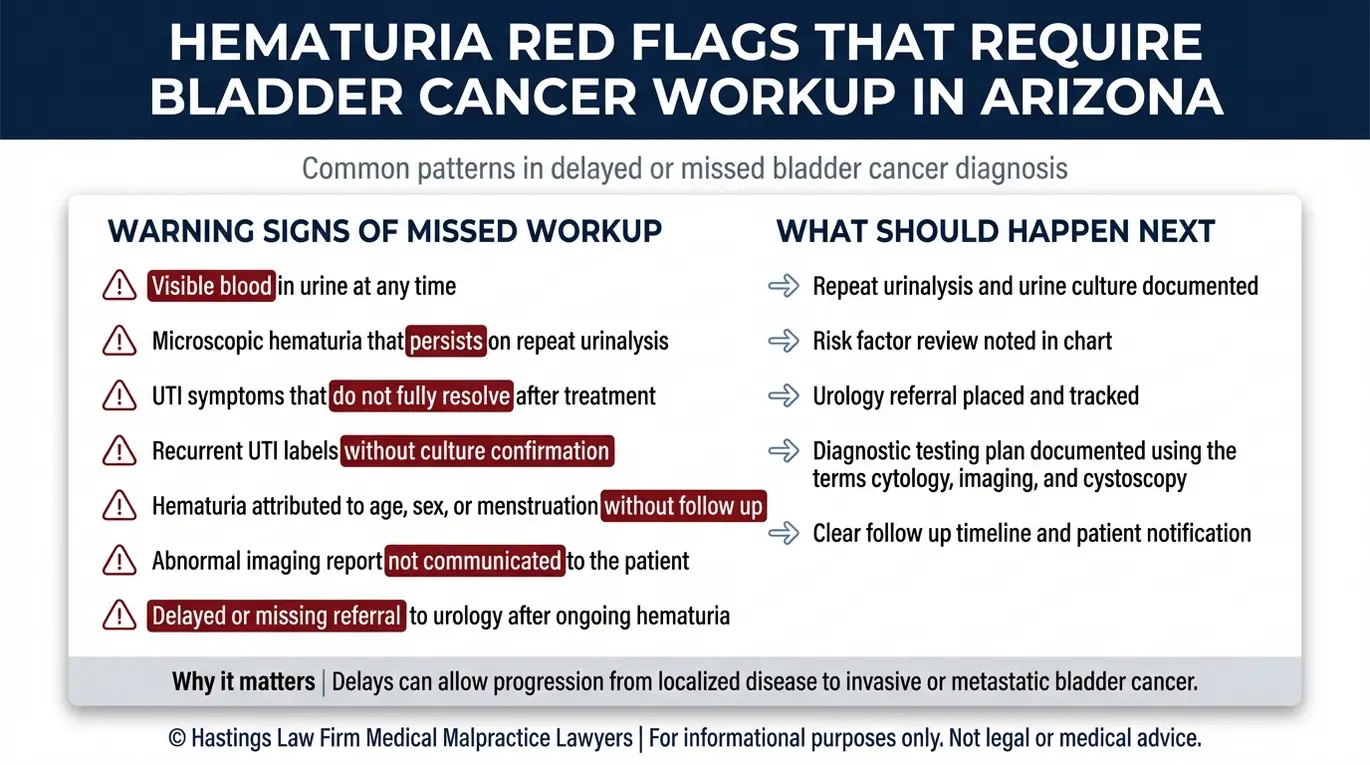
Bladder cancer misdiagnosis most frequently occurs when physicians fail to investigate the underlying cause of hematuria (blood in the urine), assuming it is a common urinary tract infection (UTI) or cystitis without ordering follow-up testing. Instead of pursuing necessary diagnostics, the cancer grows unchecked.
The “UTI Trap”
This pattern is one of the most common we see. A patient presents with painful urination and blood in the urine. The doctor prescribes antibiotics and sends the patient home. If symptoms return weeks or months later, the cycle may repeat without anyone ordering the diagnostic work needed to rule out cancer. Each round of antibiotics treats a problem that may not exist while the actual condition advances. This delayed diagnosis can lead to metastasis if the cancer spreads beyond the bladder.
Symptom Dismissal and Diagnostic Bias
Age and gender bias can make things worse. Research published through PubMed Central on sex disparities in bladder cancer diagnosis has documented that sex disparities in bladder cancer diagnosis mean women are more likely to experience significant delays. Their symptoms are often attributed to common gynecological or urinary conditions. Older patients may also face dismissal when providers attribute symptoms to age-related changes rather than investigating further.
Systemic Communication Failures
A wrong diagnosis does not always start with a single doctor’s mistake. Lost lab results, delayed referrals between a primary care physician and a urology specialist, or a lack of follow-up protocols within a medical system can all contribute. When test results fall through the cracks, no one may realize the patient still needs answers. A bladder cancer misdiagnosis attorney can investigate these breakdowns to determine if medical negligence occurred.
Conditions commonly confused with bladder cancer include:
- Urinary tract infections (UTIs)
- Interstitial cystitis (chronic bladder inflammation)
- Kidney stones
- Benign prostatic hyperplasia (enlarged prostate in men)
- Bladder or kidney infections
When any of these diagnoses is made without confirming it through appropriate testing, there is a risk that bladder cancer is being overlooked. If you believe your condition was mishandled, a lawyer for missed bladder cancer can help evaluate your legal options.
The Critical Role of Hematuria in Diagnosis
Hematuria, whether visible to the naked eye (gross hematuria) or detectable only under a microscope (microscopic hematuria), is the single most important warning sign for bladder cancer. The standard of care generally requires that any unexplained blood in the urine, especially in patients over 35 or those with risk factors like smoking, be treated as a potential indicator of malignancy, until proven otherwise.
A simple urinalysis, or urine test, can detect blood in the urine, but it cannot determine the cause. That is why the presence of hematuria should trigger a more thorough diagnostic workup. When a physician fails to take that next step, months of treatable disease progression may be lost. An Arizona bladder cancer misdiagnosis lawyer can help determine whether that failure to act fell below the accepted standard of medical care.
Establishing Negligence and the Standard of Care for Hematuria
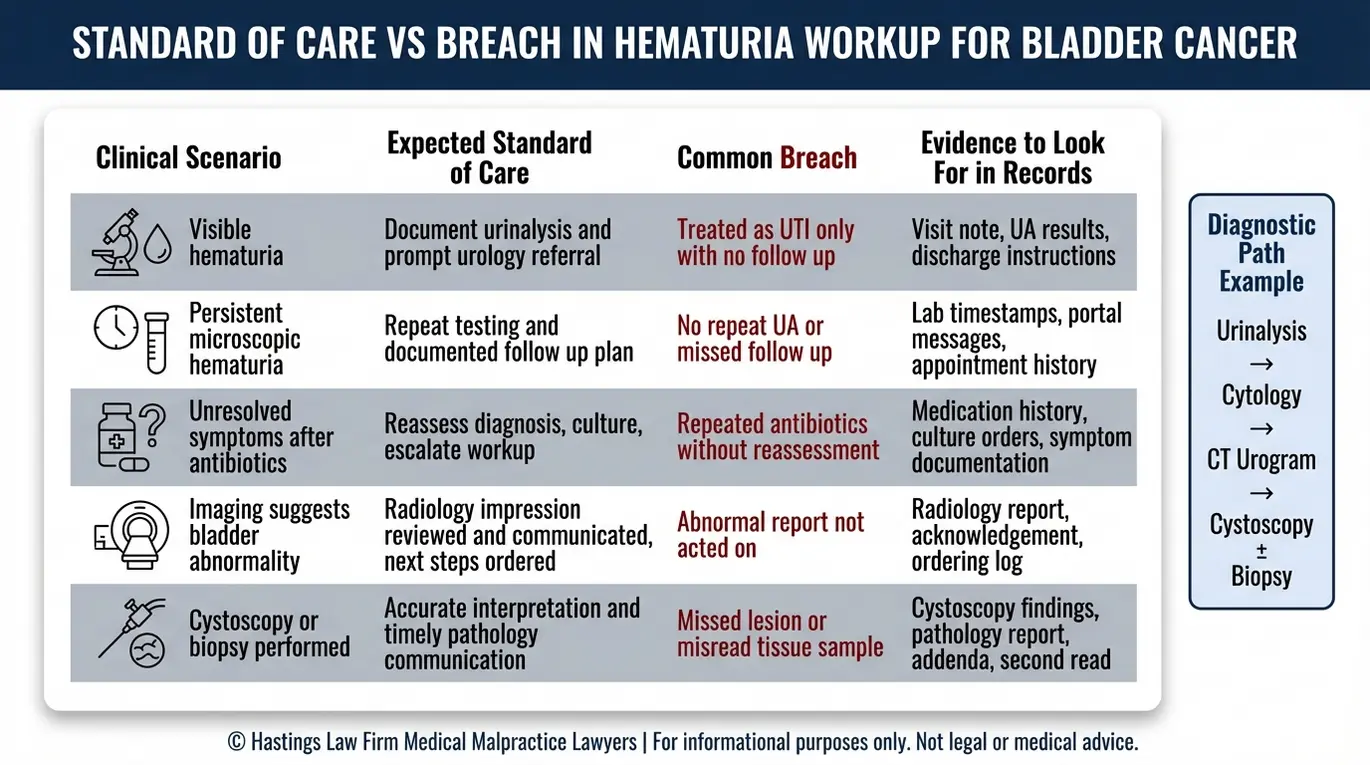
To prove negligence, we must demonstrate that a reasonably competent physician would have ordered specific diagnostic tests, such as a cystoscopy or biopsy, given the patient’s symptoms and risk factors. A cystoscopy, a procedure where a thin camera is inserted into the bladder to visually inspect its lining, is often the definitive way to confirm cancer. Proving the standard of care involves showing what a competent doctor should have done under similar circumstances.
The Expected Diagnostic Path
When a patient presents with unexplained hematuria, the structured series of steps for a diagnosis typically includes several tests. These start with an initial urinalysis, followed by urine cytology to check for abnormal cells, a CT urogram, which is a specialized imaging scan that provides detailed pictures of the urinary tract, and then a cystoscopy for direct visual examination of the bladder wall. According to a PubMed study on bladder cancer diagnosis with CT urography, while CT imaging is a valuable diagnostic tool, it carries known rates of false-positive and false-negative results, which is why clinical guidelines call for multiple complementary tests.
Failure to Refer
A general practitioner who encounters persistent or recurrent hematuria has a responsibility to refer the patient to a urology specialist when symptoms do not resolve. A failure to refer, or a significant delay in doing so, can form the basis of a negligence claim if the cancer progresses during that gap. We examine whether a timely referral could have led to an earlier diagnosis and more effective treatment.
Radiology and Pathology Errors
In some bladder cancer cases, the right test was ordered, but the results were misinterpreted. A radiologist may fail to identify a tumor on imaging, or a pathologist may misread a tissue sample, or biopsy. A tissue sample is analyzed by pathologists to look for cancerous cells, and any error in this review can lead to a missed diagnosis.
Under Arizona Revised Statutes § 12-562, a medical malpractice action requires proof that the provider’s conduct fell below the accepted standard of care and that this failure directly caused harm. Proving negligence involves a detailed reconstruction of the medical timeline. As an Arizona bladder cancer misdiagnosis lawyer acting as your misdiagnosis legal counsel, our role is to build that proof through testimony from qualified expert witnesses.
| Diagnostic Step | Standard Care Response | Negligent Care Response |
|---|---|---|
| Patient reports blood in urine | Order urinalysis; investigate cause | Prescribe antibiotics without testing |
| Urinalysis confirms hematuria | Order urine cytology and CT urogram | Attribute to UTI; schedule no follow-up |
| Imaging results inconclusive | Refer to urologist for cystoscopy | Accept negative result without further action |
| Symptoms persist after treatment | Escalate workup; repeat imaging or biopsy | Repeat same treatment; dismiss patient concerns |
| Abnormal cells found on cytology | Arrange urgent cystoscopy and biopsy | Delay referral or lose results in system |
The Hastings Law Firm Difference
Results matter, but what truly sets us apart is how we achieve them. Every verdict, every settlement, and every Arizona courtroom victory comes from one guiding promise: To treat each client’s fight for justice as if it were our own.
This balance of skill, experience, and empathy reflects our core philosophy that justice should not only compensate the injured, but also make health care safer nationwide.

Compensation for the Consequences of Delayed Diagnosis
Damages in these cases are calculated based on the progression of the disease during the delay, covering medical costs for more aggressive treatment, lost income, and the “loss of chance” for a cure or survival. Legal damages are the monetary awards intended to compensate a patient for the losses they experienced due to medical errors.
How Delay Changes the Prognosis
When bladder cancer is caught early, it is often confined to the inner lining of the bladder and can be treated with a minor surgical procedure. A diagnostic delay can allow the cancer to become muscle-invasive bladder cancer (MIBC), meaning it has grown into the deeper muscle wall, or to metastasize, spreading to distant organs like the lungs, liver, or bones. Data from the National Cancer Institute’s SEER Cancer Stat Facts for Bladder Cancer shows a stark difference in survival rates between localized and distant-stage disease.
A patient who might have needed only a local resection may now face radical surgery, chemotherapy, radiation, or a combination of all three. The physical, emotional, and financial toll of that escalation is at the center of every damages claim.
Compensation in these cases covers both economic damages and non-economic damages, including:
- Medical expenses: Costs of surgery, chemotherapy, radiation, hospital stays, and ongoing cancer care
- Lost wages and earning capacity: Income lost during treatment and any long-term inability to work
- Pain and suffering: Physical pain from aggressive treatment and the emotional distress of a worsened prognosis
- Loss of enjoyment of life: The impact on daily activities, relationships, and independence
- Wrongful death damages: If the delayed diagnosis contributed to a patient’s death, surviving family members may pursue a separate claim for their losses
Misdiagnosis attorneys in Arizona evaluate these damages by comparing the patient’s likely outcome with a timely diagnosis against their actual outcome after the delay.
Determining Liability in Arizona Medical Malpractice Cases
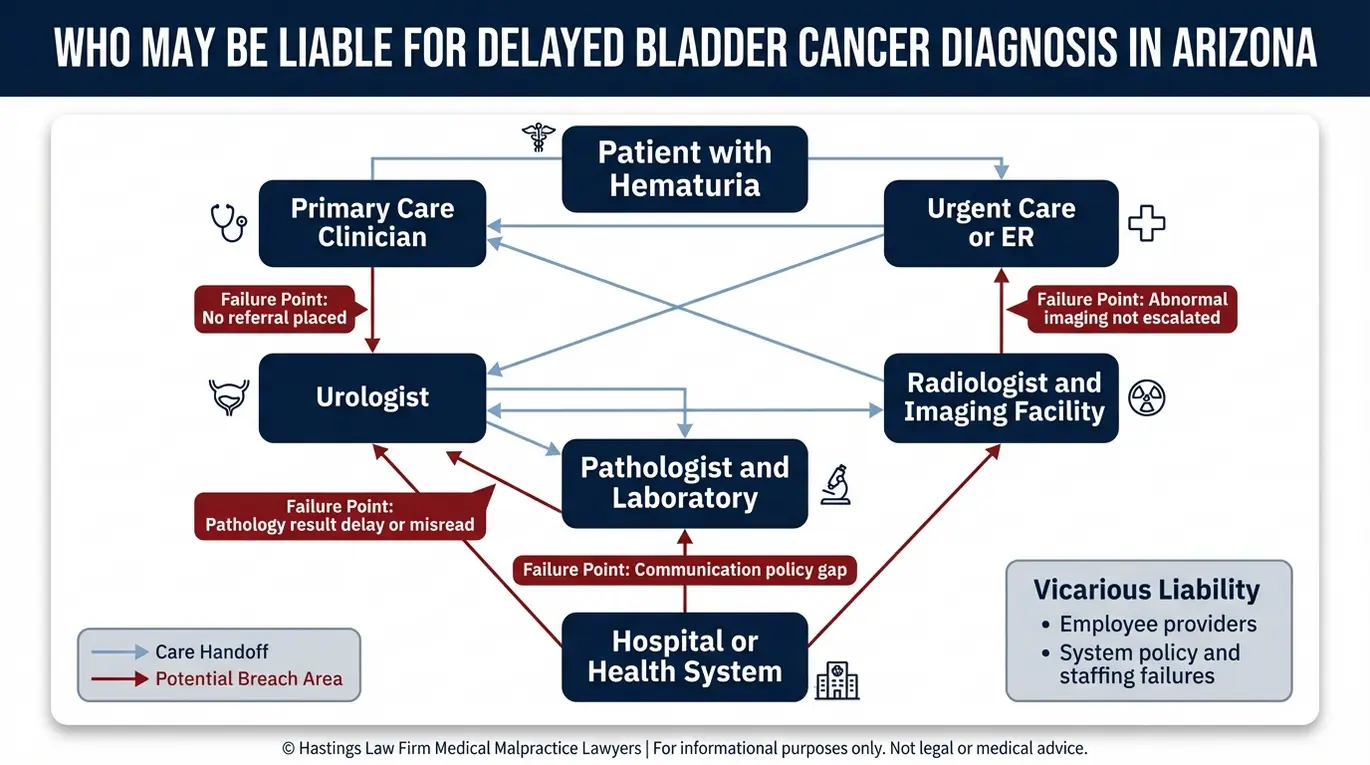
Liability often extends beyond the primary care physician to include radiologists who misread scans, laboratories that mishandled samples, or hospital systems that failed to enforce communication protocols. In medical malpractice cases, liability refers to the legal responsibility a healthcare provider has for damages caused by substandard care.
Multiple Defendants
In a delayed bladder cancer diagnosis case, several parties may share responsibility. A primary care doctor, a radiologist, a pathologist, a urologist, and the hospital or clinic itself can all be held accountable depending on where the breakdown occurred. Identifying every at-fault party is important because it expands the available insurance coverage and reflects the full scope of what went wrong.
Vicarious Liability
Hospitals and healthcare systems can also bear liability for the actions of their employed staff or for hospital negligence arising from system errors, such as inadequate staffing, missing follow-up protocols, or failures in their electronic records systems that allowed critical results to go unreviewed. This concept, known as vicarious liability, means an employer is responsible for the mistakes of its employees while they are on the job. An Arizona bladder cancer lawyer examines the full chain of care to determine where each responsibility lies.
Contact the Arizona Misdiagnosis Attorneys at Hastings Law Firm Today for Help
No amount of money can undo the harm caused by a missed or delayed bladder cancer diagnosis. But holding negligent providers accountable can provide the financial stability needed to cover treatment costs, replace lost income, and protect your family’s future. It can also help prevent the same failures from happening to someone else.
At Hastings Law Firm, our in-house medical staff and former defense attorneys know how to investigate these cases from the inside out. Led by Tommy Hastings, who has over two decades of experience and is recognized as a leading authority in medical malpractice, we prepare every case as if it is going to trial. We do not collect a fee unless we recover compensation for you.
If you believe bladder cancer was missed or diagnosed late because a medical provider’s failure, contact our Arizona bladder cancer misdiagnosis lawyer team for a free, confidential case evaluation. We are here to listen, review your medical records, and help you understand your legal options.
Frequently Asked Questions About Bladder Cancer Misdiagnosis in Arizona


This content was researched and written by the Hastings Law Firm editorial team, which includes attorneys, medical professionals, and experienced researchers. Our writing is informed by internal knowledge and practical experience, and we cross-check critical details against authoritative sources cited throughout. Every piece undergoes human-led fact-checking and legal review. Because legal and medical information can change, if you spot an error, please contact us. Learn more about our content standards and review process on our editorial policy page.

Tommy Hastings, founder of Hastings Law Firm, is a board-certified personal injury trial lawyer dedicated exclusively to healthcare injury cases. Since 2001, he has represented injured patients and families in litigation against major hospital systems, pharmaceutical companies, and negligent healthcare providers nationwide. He has handled numerous high-profile cases that have drawn national media attention and resulted in multi-million dollar recoveries. He draws on that experience in his writing, helping readers understand how these cases work and what options may be available to them.
