


Arizona Kidney Cancer Misdiagnosis Lawyer
A delayed kidney cancer diagnosis can lead to more advanced disease, more aggressive treatment, and a reduced chance of survival. Missed warning signs, overlooked imaging findings, and breakdowns in follow up can allow a renal tumor to grow and spread before it is identified. These situations often raise concerns about whether the care met the expected medical standard and whether the delay caused additional harm. If you or a loved one were harmed or worse due to kidney cancer misdiagnosis in Arizona, contact Hastings Law Firm for a free, confidential case review.

Last Updated: July 27, 2026
Trusted Arizona Medical Attorneys for Delayed Kidney Cancer Diagnosis Claims
When a doctor overlooks or delays a kidney cancer diagnosis, the consequences can change the course of your life. A renal mass, which is an abnormal growth on or in the kidney, may be treatable when caught early. But when warning signs are missed or test results are not properly followed up, the window for effective treatment narrows quickly.
If you or a loved one suffered harm because kidney cancer was not identified in time, you deserve to know whether medical negligence played a role. As an Arizona kidney cancer misdiagnosis lawyer, Tommy Hastings founded Hastings Law Firm in 2005 to focus exclusively on medical malpractice cases. Our team of attorneys, nurse consultants, and medical experts is ready to review your records, identify what went wrong, and explain your legal options. The consultation is free, and you pay nothing unless we recover compensation on your behalf.

Common Medical Errors Leading to Missed Kidney Cancer
Kidney cancer is often missed when doctors dismiss early symptoms like hematuria, which is blood in the urine, as a urinary tract infection or fail to order follow-up imaging for incidental findings on CT scans. Hematuria is a primary warning sign physicians often overlook or misidentify as a minor infection.
According to the National Center for Biotechnology Information’s clinical summary on renal cell carcinoma, kidney cancer frequently presents with nonspecific symptoms that overlap with far less serious conditions. A primary care physician may attribute flank pain to a pulled muscle or persistent blood in the urine to kidney stones. They may treat the patient for a UTI without a confirmatory urinalysis, which is a laboratory urine test, or the necessary imaging.
Another common failure involves incidental findings, which are abnormalities detected on scans ordered for an unrelated reason. A radiologist may note a suspicious renal mass, which is an abnormal growth requiring follow-up, on a CT scan, but the ordering physician may not act on the finding. In high-volume practices, these results can fall through the cracks entirely.
Errors in reading diagnostic imaging also contribute to missed renal cancer diagnoses. If a radiologist misinterprets a CT scan or MRI, a growing tumor may go undetected until it causes severe symptoms.
Red flags and tests that may be overlooked in kidney cancer cases:
- Persistent or recurring hematuria attributed only to a UTI without further workup
- Flank or abdominal pain dismissed as musculoskeletal
- Unexplained weight loss or fatigue not investigated further
- Incidental renal mass noted on imaging but never followed up
- Failure to order a CT scan, MRI, or ultrasound when symptoms warrant it
- Incomplete or inaccurate radiology interpretation
If any of these scenarios sound familiar, a delayed diagnosis lawyer in Arizona can help determine whether the failure to diagnose kidney cancer in your case meets the threshold for medical malpractice for cancer error.

Proving Negligence and The Standard of Care for Renal Tumors
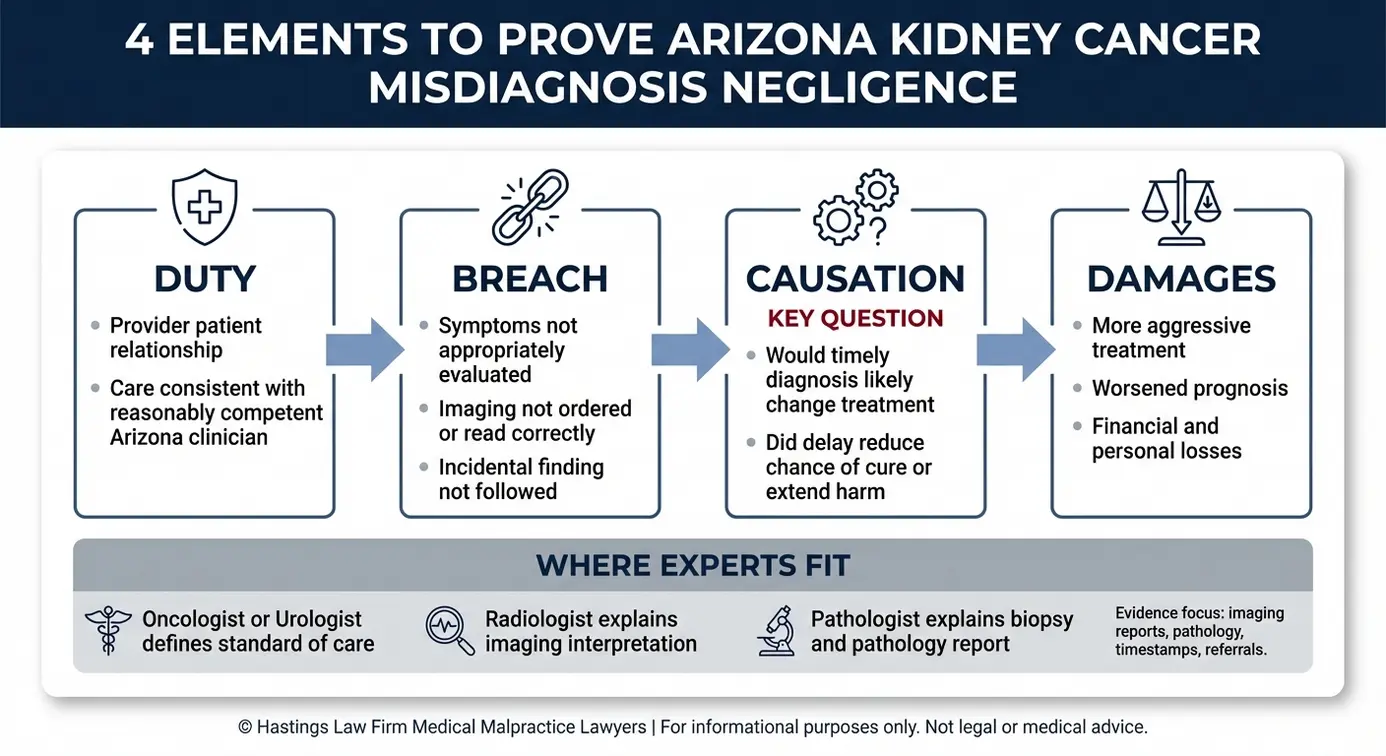
To prove negligence, a lawyer must demonstrate that a reasonably competent physician in Arizona would have ordered specific testing or identified the tumor earlier given the patient’s symptoms. This is the foundation of every delayed diagnosis case.
Arizona medical malpractice claims require four legal elements: duty, breach, causation, and damages. The treating physician owed you a duty of care. If they failed to meet the standard of care for kidney cancer detection, that may constitute a breach of duty. The standard of care is the level of medical attention a reasonably competent doctor would provide under similar circumstances. To succeed in proving medical negligence, your Arizona kidney cancer malpractice lawyer must also show that the delay directly caused you additional harm, such as progression to a more advanced stage.
Renal cell carcinoma (RCC) is the most common form of kidney cancer. The standard of care generally requires that physicians investigate symptoms like blood in the urine, flank pain, or an abnormal mass with appropriate imaging and, when indicated, a biopsy. A pathology report, which is the laboratory analysis of tissue samples reviewed by pathologists, or doctors who study disease in tissue, can confirm whether a tumor is malignant. When a doctor fails to order these steps in the presence of clear warning signs, liability for the missed diagnosis may follow. Suing a doctor for delayed diagnosis requires establishing these deviations clearly.
Under Arizona Revised Statutes § 12-563, the injured patient must prove through expert testimony that the healthcare provider failed to exercise that degree of care, skill, and learning expected of a reasonable, prudent health care provider in the same profession or class, acting in the same or similar circumstances. This is why qualified expert witnesses, typically oncologists or urologists, are essential. They establish what should have happened and explain how the deviation from that standard led to harm.
Systemic Causes of Diagnostic Errors
Not every missed diagnosis stems from an individual doctor’s oversight. Diagnostic errors often involve the entire facility’s failure to communicate test results or manage patient data. In some cases, systemic failures within a healthcare facility contribute to a delayed kidney cancer diagnosis. Hospital negligence such as understaffing can lead to critical information being lost. High-volume radiology errors may occur when departments process hundreds of scans per day, increasing the likelihood of a false-negative imaging interpretation, meaning a scan is read as normal when a tumor is actually present.
Hospital understaffing, poor communication between departments, and inadequate follow-up protocols can also allow critical findings to go unaddressed. When we investigate these claims, we examine the systems and workflows surrounding the missed diagnosis, not just the actions of a single provider.
The Hastings Law Firm Difference
Results matter, but what truly sets us apart is how we achieve them. Every verdict, every settlement, and every Arizona courtroom victory comes from one guiding promise: To treat each client’s fight for justice as if it were our own.
This balance of skill, experience, and empathy reflects our core philosophy that justice should not only compensate the injured, but also make health care safer nationwide.

Consequences of Delayed Diagnosis and Disease Progression
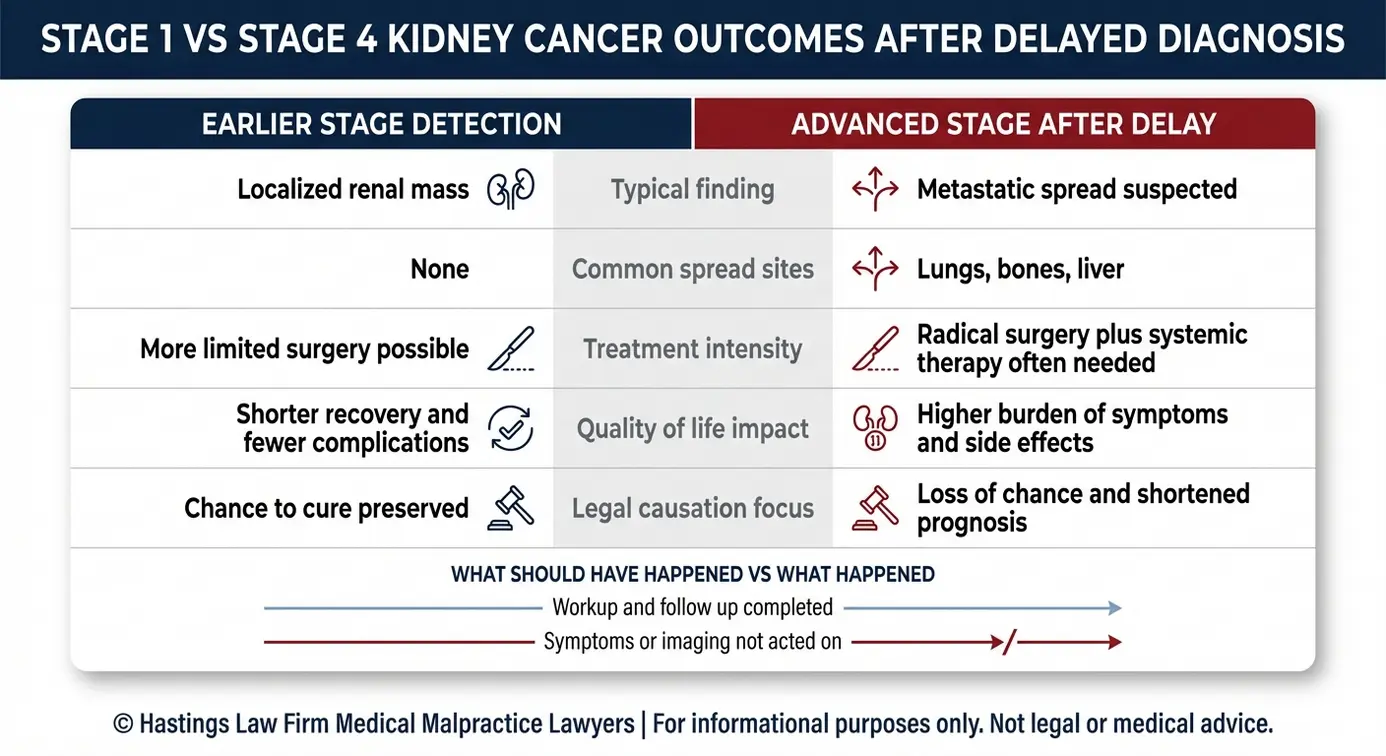
A delayed diagnosis allows kidney cancer to metastasize, meaning it spreads to distant organs like the lungs, bones, or liver, significantly reducing the patient’s survival rate and requiring more aggressive, debilitating treatments. Timing is critical, as identifying a renal tumor before it spreads often determines the available treatment options.
According to the NCCN Clinical Practice Guidelines for Kidney Cancer published in the Journal of the National Comprehensive Cancer Network, early-stage renal cell carcinoma is often treated with a partial nephrectomy, a procedure that removes only the tumor and preserves the rest of the kidney. At this stage, long-term survival rates are favorable.
When diagnosis is delayed and the cancer advances, treatment may require a radical nephrectomy along with immunotherapy. Cancer staging, the classification of a tumor’s size and spread, directly affects prognosis:
| Factor | Localized | Distant (Metastatic) |
|---|---|---|
| 5-Year Survival Rate | Approximately 93% | Approximately 19% |
| Typical Treatment | Partial nephrectomy | Radical nephrectomy + immunotherapy |
| Quality of Life Impact | Often minimal long-term effects | Significant physical and emotional burden |
This contrast illustrates why timing matters so much in cancer detection. In a metastatic kidney cancer lawsuit, an Arizona medical negligence attorney examines whether an earlier diagnosis would have given the patient a better chance at survival or a less harmful course of treatment. This concept, often called “loss of chance,” means the delay reduced the likelihood of a positive outcome. It is central to proving the harm caused by delay. A lawyer for advanced kidney cancer can help you pursue a reduced life expectancy claim if the metastasis significantly altered your outcome.
Recovering Compensation for Advanced Stage Kidney Cancer
Victims of kidney cancer misdiagnosis can recover economic damages for medical bills and lost wages, as well as non-economic damages for pain, suffering, and the emotional trauma of a shortened life expectancy. These claims account for both the financial and personal cost of a diagnostic failure.
As noted in the NCI Congressional Justification FY 2026 from the National Cancer Institute, the cost of cancer care continues to rise, placing an enormous burden on patients and families. Compensation for cancer misdiagnosis is designed to provide future financial security for you and your loved ones.
Recoverable damages in a settlement for medical error may include:
- Past and future medical expenses, including surgery such as radical nephrectomy, which is the complete removal of the kidney, and immunotherapy (immune checkpoint inhibitors)
- Damages for delayed treatment covering lost wages and reduced earning capacity because of treatment or disability
- Pain and suffering from the disease itself and from more aggressive treatments that could have been avoided
- Emotional distress experienced by the patient and family
- Loss of consortium, reflecting the impact on close relationships
- Wrongful death damages if a loved one has passed away because of the delayed diagnosis
Every case is different. A wrongful death lawyer in Arizona can help surviving family members understand what compensation may be available and how to move forward with a claim.
Contact the Arizona Misdiagnosis Attorneys at Hastings Law Firm Today for Help
You are not just a case file to us. Our founder, Tommy Hastings, is board-certified in Personal Injury Trial Law, a distinction held by fewer than 2% of attorneys. Our team includes former defense attorneys and experienced hospital nurses who understand how hospitals and insurers approach these cases. We also use in-house medical professionals who can interpret your records and identify where the standard of care was not met.
If you believe a doctor’s failure to diagnose kidney cancer caused you or your family member additional harm, we encourage you to reach out. There are no upfront costs. We work on a contingency fee basis, which means you owe us nothing unless we secure a recovery.
Time limits do apply to these claims under Arizona law, so taking the first step sooner gives us the best opportunity to preserve evidence and build a strong case. Contact an Arizona kidney cancer misdiagnosis lawyer at Hastings Law Firm for a free, confidential case evaluation.
Frequently Asked Questions About Kidney Cancer Misdiagnosis in Arizona


This content was researched and written by the Hastings Law Firm editorial team, which includes attorneys, medical professionals, and experienced researchers. Our writing is informed by internal knowledge and practical experience, and we cross-check critical details against authoritative sources cited throughout. Every piece undergoes human-led fact-checking and legal review. Because legal and medical information can change, if you spot an error, please contact us. Learn more about our content standards and review process on our editorial policy page.

Tommy Hastings, founder of Hastings Law Firm, is a board-certified personal injury trial lawyer dedicated exclusively to healthcare injury cases. Since 2001, he has represented injured patients and families in litigation against major hospital systems, pharmaceutical companies, and negligent healthcare providers nationwide. He has handled numerous high-profile cases that have drawn national media attention and resulted in multi-million dollar recoveries. He draws on that experience in his writing, helping readers understand how these cases work and what options may be available to them.
