


Arizona Aortic Dissection Misdiagnosis Lawyer
An aortic dissection is a time sensitive emergency that can be missed in the emergency room when critical symptoms are dismissed or advanced imaging is not ordered. A delayed diagnosis can allow the tear to progress quickly, leading to catastrophic injury, fatal outcomes, and profound loss for families. The condition is often mistaken for less dangerous problems, and implicit bias in triage can increase the risk of misdiagnosis for some patients. If you or a loved one were harmed or worse due to aortic dissection misdiagnosis in Arizona, contact Hastings Law Firm for a free, confidential case review.

Last Updated: July 27, 2026
Trusted Arizona Medical Attorneys for Aortic Dissection Negligence Claims
Losing a loved one or facing a catastrophic medical crisis because a doctor missed the signs of an aortic dissection is devastating. You trusted the emergency room to get the diagnosis right, and now you’re left with questions, grief, and a sense that someone should have caught this sooner. That instinct deserves to be taken seriously.
Aortic dissection is one of the most time-sensitive emergencies in medicine. When an ER team fails to order the right imaging or dismisses critical symptoms, the consequences can be fatal within hours. If you believe a diagnostic failure contributed to your family’s loss or injury, an Arizona Aortic Dissection Misdiagnosis Lawyer at Hastings Law Firm can help. Founded by board-certified trial attorney Tommy Hastings, our firm helps you understand what went wrong and whether negligence played a role.
Our legal and medical team, which includes former defense attorneys and experienced hospital nurses, reviews cases like these every day. We invite you to contact us for a free, confidential case evaluation so we can examine your records and explain your options.

What Is an Aortic Dissection and Why Is It Missed?
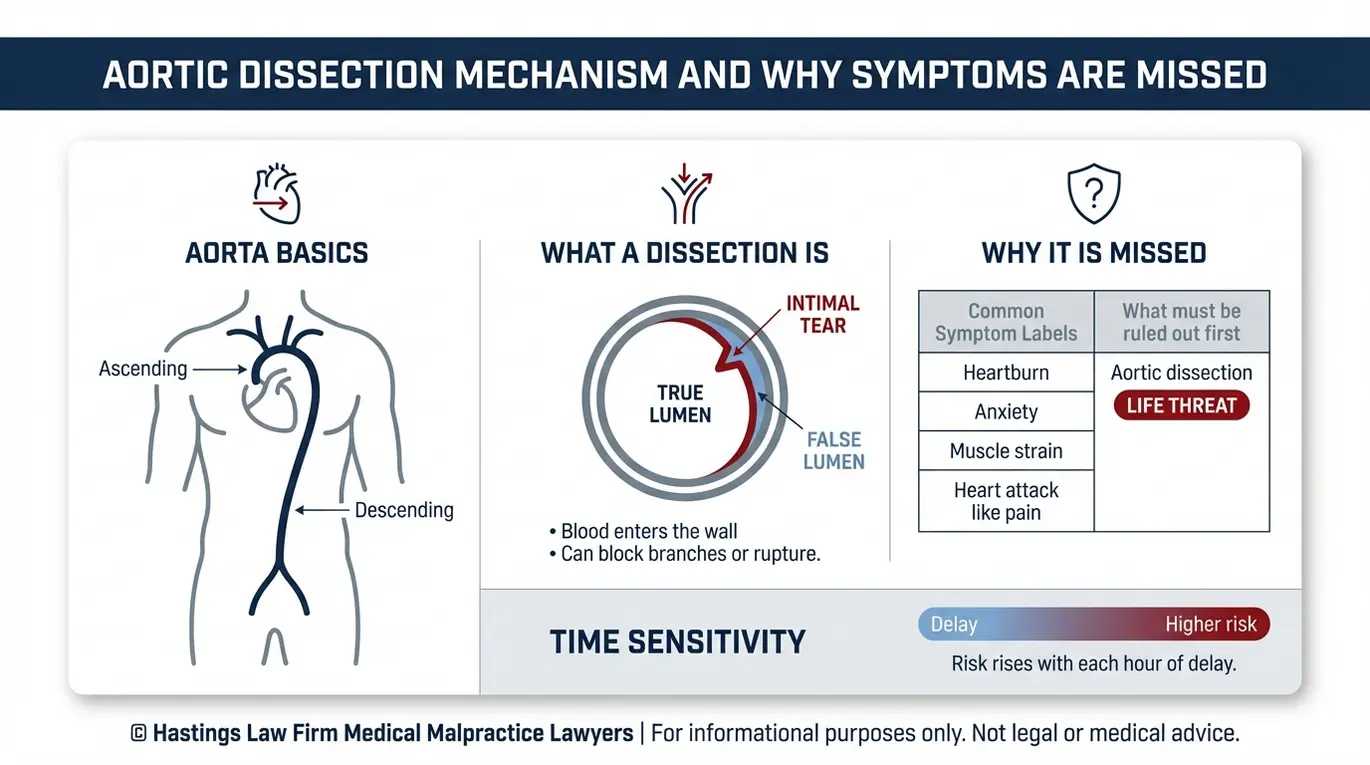
An aortic dissection is a life-threatening condition in which the inner layer of the aorta, the body’s largest artery, tears open. Blood forces its way between the layers of the vessel wall, sometimes complicating a pre-existing aortic aneurysm. Without rapid treatment, the aorta can rupture. This condition is frequently missed because its symptoms closely mimic less dangerous problems like heart attacks, acid reflux, or musculoskeletal pain.
The aorta runs from the heart down through the chest and abdomen. A Stanford Type A dissection involves the ascending aorta and demands emergency surgery. A Stanford Type B dissection affects the descending aorta and is sometimes managed with medication.
The urgency cannot be overstated. Research published by Oxford Academic on mortality after acute Type A aortic dissection confirms that mortality increases significantly with every hour treatment is delayed. A failure to diagnose aortic dissection within the first few hours can mean the difference between life and death.
The standard of care requires physicians to use a differential diagnosis approach, ruling out the most dangerous conditions first when a patient arrives at an ER with acute chest pain. A radiologist or ER physician should not anchor on a benign diagnosis without excluding dissection.
The Danger of Implicit Bias in Triage
Diagnostic errors regarding aortic dissection do not affect all patients equally. This condition occurs when the main artery’s inner layer tears, yet studies consistently show that younger patients and women are more likely to be misdiagnosed because they do not match an assumed profile. This implicit bias in triage can lead ER staff to skip critical assessments. When a provider’s preconceptions override clinical evidence, the result is a breach of the standard of care that can prove fatal.
Recognizing Critical Symptoms the ER Should Not Miss
Emergency rooms are expected to rule out aortic dissection when a patient presents with sudden, severe chest or back pain described as “tearing” or “ripping,” pulse deficits between extremities, or significant blood pressure differences between arms. These are red-flag presentations that should trigger immediate advanced imaging for a suspected aortic dissection.
Here are the symptoms and signs that should prompt an ER team to investigate for a dissection:
- Sudden, severe pain: Often described as a “tearing” or “riping” sensation in the chest that radiates to the back or between the shoulder blades. The onset is typically abrupt and maximal from the start, which distinguishes it from the gradual build of cardiac chest pain.
- Abdominal pain: Dissections extending into the descending aorta can cause severe abdominal pain that may be confused with gastrointestinal conditions.
- Syncope: Fainting or near-fainting episodes can occur when the dissection affects blood flow to the brain.
- Shortness of breath: Difficulty breathing may develop if blood leaks into the space around the heart or lungs.
- Neurological symptoms: Stroke-like signs, numbness, or weakness in the extremities can appear if the dissection compromises blood supply to the brain or spinal cord.
- Pulse deficit and inter-arm blood pressure differential: A pulse deficit occurs when the pulse is weaker or absent in one limb compared to the other. Checking blood pressure in both arms is a simple bedside test. A significant difference, sometimes called an inter-arm blood pressure differential, is a hallmark indicator of aortic dissection that is too often skipped during triage.
Any combination of these symptoms should put aortic dissection at the top of the differential. When ER staff fail to recognize these patterns, patients can be discharged or left waiting while the tear progresses.
The Hastings Law Firm Difference
Results matter, but what truly sets us apart is how we achieve them. Every verdict, every settlement, and every Arizona courtroom victory comes from one guiding promise: To treat each client’s fight for justice as if it were our own.
This balance of skill, experience, and empathy reflects our core philosophy that justice should not only compensate the injured, but also make health care safer nationwide.

How Arizona Emergency Rooms Fail to Diagnose Aortic Dissection
Malpractice in aortic dissection cases most commonly occurs when an ER physician fails to order a CT angiogram (CTA), a specialized scan that uses contrast dye to produce detailed images of the aorta’s structure, or a transesophageal echocardiogram (TEE), an ultrasound probe guided down the esophagus to visualize the heart and aorta in real time. These are the gold-standard diagnostic tools, and skipping them causes a delayed diagnosis that is a serious departure from the standard of care.
Arizona ER wait times and overcrowding can compound the problem. Data tracked through the CMS Timely and Effective Care dataset shows measurable variation in how quickly hospitals deliver diagnostic imaging and treatment. For a condition where every hour matters, long waits in the ER lobby while a dissection silently progresses can turn a survivable event into a fatal one.
The failures we investigate in these cases typically fall into identifiable patterns:
| Standard of Care | Negligent Action |
|---|---|
| Order a CT angiogram or TEE when symptoms suggest dissection | Discharge the patient with no advanced imaging |
| Interpret imaging carefully for signs of intimal tear or flap | Radiologist misreads or overlooks subtle findings on X-ray or CT |
| Prioritize triage for acute chest pain with red-flag features | Patient left in waiting area during high-volume periods |
| Apply differential diagnosis to rule out life threats | Physician anchors on “acid reflux” or “musculoskeletal pain” without excluding dissection |
If you suspect that an ER’s failure to image or properly evaluate your loved one led to a preventable death or catastrophic injury, an Arizona aortic dissection malpractice lawyer at our firm can examine the medical records and identify where the breakdown occurred. As a misdiagnosis attorney in Arizona, we know exactly what evidence to look for and how to build a case around these failures.

Proving Negligence: The Standard of Care for Chest Pain
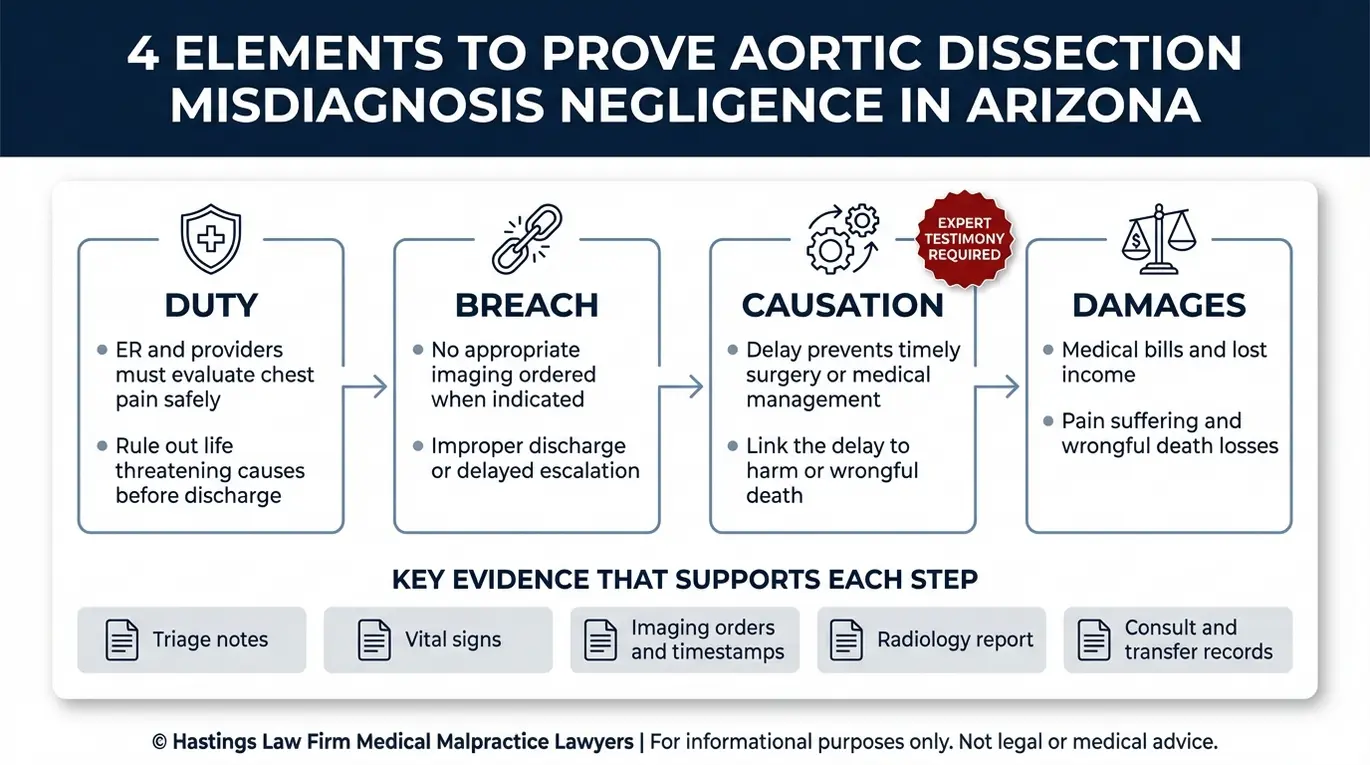
To prove negligence, we must show that a reasonably prudent physician facing the same symptoms would have ordered diagnostic imaging to rule out an aortic dissection, and that the failure to do so caused or contributed to the patient’s injury or death.
We build each case around four elements of proof:
- Duty of care: Every ER physician has a legal obligation to evaluate patients thoroughly and rule out life-threatening conditions before discharge. This duty is non-negotiable.
- Breach of that duty: We establish breach by demonstrating that the physician did not order the standard test, a CTA or TEE, despite symptoms that warranted it. We also examine whether the differential diagnosis, a structured rule-out approach where doctors eliminate the most dangerous possibilities first, was properly applied. One critical finding our experts look for is the intimal flap, the telltale sign of a torn aortic lining visible on imaging that may have been present but overlooked.
- Causation: This is often the most contested element. We work with vascular surgeons and emergency medicine specialists to demonstrate that timely diagnosis would have led to surgical repair and a meaningful chance of survival. In fatal cases, this is sometimes framed as a “lost chance” analysis.
- Damages: We document the full scope of harm, including medical costs, lost income, pain and suffering, and wrongful death losses.
An experienced aortic dissection lawyer understands that establishing liability for medical malpractice in these cases lives or dies on expert testimony. Our firm works with top-tier vascular surgeons and board-certified ER physicians from across the country who can credibly explain to a jury what should have been done and when.
Compensation for Aortic Dissection Misdiagnosis in Arizona
Patients and families affected by a missed aortic dissection may recover both economic and non-economic damages, and in wrongful death cases, surviving family members can seek compensation for the profound personal losses they’ve endured.
Arizona law, including Article 2, Section 31 of the Arizona Constitution, protects the right to recover full damages for death or personal injuries caused by another’s negligence. The categories of compensation available in these cases generally include:
- Past and future medical expenses: Emergency surgery, ICU stays, rehabilitation, cardiac monitoring, and ongoing care related to the dissection or its complications.
- Lost income and earning capacity: Wages lost during recovery, or the full lifetime earning potential of a family member who did not survive.
- Pain and suffering: Physical pain from the dissection itself, failed or delayed surgeries, and the emotional distress of knowing the diagnosis was missed.
- Mental anguish: The psychological toll on patients who survived with catastrophic injury, or on families who watched a loved one deteriorate.
- Loss of consortium and companionship: In wrongful death claims, surviving spouses, children, and parents can seek compensation for the loss of their loved one’s presence, guidance, and support.
- Punitive damages: In rare cases involving gross negligence, Arizona courts may award punitive damages intended to deter egregious medical conduct.
Because aortic dissections carry such a high fatality rate, many of these cases involve wrongful death claims. Whether through a settlement or a jury award, our team works closely with families to document every dimension of their loss. An Arizona Aortic Dissection Misdiagnosis Lawyer can help you understand your rights.
Contact the Arizona Misdiagnosis Attorneys at Hastings Law Firm Today for Help
Aortic dissections are survivable when diagnosed promptly. When basic medical diligence fails, the outcome is often preventable death or irreversible harm. If your family is living with that reality, you deserve answers about what happened and whether the standard of care was met.
Hastings Law Firm represents families across Arizona who have been affected by diagnostic failures in emergency rooms and hospitals. Our team is led by Tommy Hastings, who is an inductee into the American Board of Trial Advocates, an organization for elite trial lawyers. Our team of attorneys, in-house nurse consultants, and nationally recognized medical experts will review your records and give you an honest assessment of your case.
There is no fee unless we recover compensation for you. Contact us today for a free, confidential case evaluation with a medical malpractice attorney who understands these cases. Let us help you find the truth and hold the right people accountable.
Frequently Asked Questions About Aortic Dissection Misdiagnosis in Arizona


This content was researched and written by the Hastings Law Firm editorial team, which includes attorneys, medical professionals, and experienced researchers. Our writing is informed by internal knowledge and practical experience, and we cross-check critical details against authoritative sources cited throughout. Every piece undergoes human-led fact-checking and legal review. Because legal and medical information can change, if you spot an error, please contact us. Learn more about our content standards and review process on our editorial policy page.

Tommy Hastings, founder of Hastings Law Firm, is a board-certified personal injury trial lawyer dedicated exclusively to healthcare injury cases. Since 2001, he has represented injured patients and families in litigation against major hospital systems, pharmaceutical companies, and negligent healthcare providers nationwide. He has handled numerous high-profile cases that have drawn national media attention and resulted in multi-million dollar recoveries. He draws on that experience in his writing, helping readers understand how these cases work and what options may be available to them.
