


Arizona Blood Clot Misdiagnosis Lawyer
A missed or delayed diagnosis of a blood clot can turn manageable symptoms into a life threatening emergency, especially when a clot travels to the lungs. These cases often involve warning signs that were not taken seriously, risk factors that were not properly considered, or testing that was not ordered when it should have been. The result can be intense suffering, lasting complications, or fatal outcomes. If you or a loved one were harmed or worse due to a failure to diagnose blood clots in Phoenix, Arizona, contact Hastings Law Firm for a free, confidential case review.

Last Updated: July 27, 2026
Trusted Arizona Medical Attorneys for Failure to Diagnose Blood Clot Claims
When a doctor overlooks the signs of a blood clot, the consequences can be sudden and severe. What starts as treatable leg pain or swelling can escalate into a life-threatening emergency if the clot travels to the lungs. If you or a loved one suffered serious harm because a blood clot was missed, dismissed, or misdiagnosed, you may be dealing with more than a medical crisis. You may be dealing with medical negligence.
At Hastings Law Firm, our team of attorneys, in-house nurses, and medical consultants focuses exclusively on medical malpractice cases. We understand how blood clot injuries happen, and we know how to investigate whether the care you received fell below the standard you deserved. As an experienced Arizona Blood Clot Misdiagnosis Lawyer team, we are prepared to review what happened and explain your legal options.
Contact our Phoenix office for a free, confidential case evaluation. There is no fee unless we recover compensation for you.

Understanding Deep Vein Thrombosis and Pulmonary Embolism Risks
Deep Vein Thrombosis (DVT) is a blood clot forming in deep veins, usually the legs, which becomes medical malpractice when a physician fails to identify obvious risk factors or symptoms, allowing the clot to travel to the lungs (Pulmonary Embolism). Deep vein thrombosis (DVT) occurs when blood thickens and clumps together in a vein deep within the body. This condition is serious because the clot can block blood flow to vital organs. If a piece of this clot breaks off, it is called an embolus.
It travels through the bloodstream to the heart and then into the lungs, where it can block an artery. This blockage, known as a pulmonary embolism (PE), prevents oxygen from reaching the blood and can be fatal within minutes.
According to the Centers for Disease Control and Prevention, venous thromboembolism affects up to 900,000 Americans each year, and sudden death is the first symptom in roughly 25% of PE cases. These numbers reflect a condition that is both common and dangerous, yet often preventable with timely diagnosis.
The standard of care requires physicians to screen patients for known risk factors during evaluation. A thorough patient history can reveal warning signs that should prompt further testing. When those warning signs are ignored, the window for safe treatment narrows quickly. Doctors must be careful because clots can form from changes in blood flow, vessel injury, or hypercoagulability (a high tendency for blood to clot).
High-risk categories that require heightened monitoring include:
- Recent surgery: Especially orthopedic procedures like hip or knee replacement, which can release tissue debris and limit movement during recovery.
- Prolonged immobility: Extended bed rest due to illness or long-distance travel slows blood circulation, allowing clots to form in the legs.
- Active cancer or a history of cancer treatment: Malignancies and chemotherapy can release substances that cause blood to clot more easily.
- Use of hormone therapy or oral contraceptives: Estrogen-containing medications can significantly increase clotting risk in certain patients.
- Known clotting disorders or a family history of blood clots: Genetic predispositions like Factor V Leiden require aggressive monitoring.
- Obesity: Excess weight increases pressure in the pelvic veins, slowing return blood flow.
- Pregnancy or recent childbirth: The weight of the baby and hormonal changes stress the venous system.
- Prior history of DVT or PE: The strongest predictor of recurrence is a previous clot.
Any of these factors should raise a doctor’s level of caution. When a patient presents with leg pain, swelling, or shortness of breath alongside one or more risk factors, the standard of care generally requires objective diagnostic testing, not just reassurance that nothing is wrong.

How Arizona Doctors Miss Signs of DVT and Pulmonary Embolisms
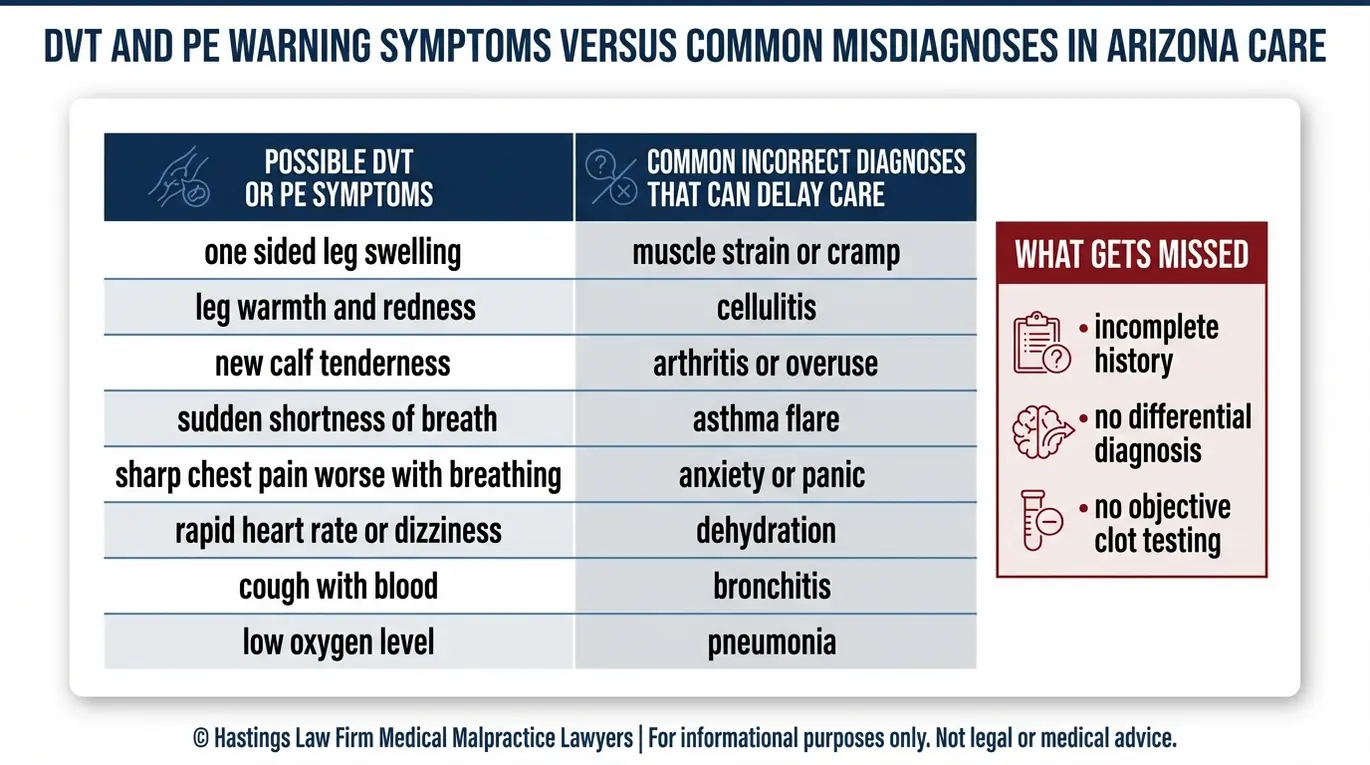
Misdiagnosis often occurs when doctors dismiss unilateral leg pain as a cramp or muscle strain, or attribute chest pain to anxiety or pneumonia, failing to rule out life-threatening clots through differential diagnosis.
Patients with DVT often present with recognizable symptoms: swelling in one leg, warmth or redness in the affected area, and pain that worsens when standing or walking. PE symptoms can include sudden shortness of breath, sharp chest pain, rapid heartbeat, and lightheadedness. These signs, particularly when combined with known risk factors, should trigger a clinical evaluation for venous thromboembolism (VTE), the umbrella term that covers both DVT and PE. A failure to diagnose DVT frequently happens in emergency rooms and urgent care centers where providers are under pressure and may rush through the physical exam.
This delayed diagnosis can result in severe complications. Patients forced to endure untreated clots experience significant pain and suffering as the condition worsens. Diagnostic errors happen with troubling frequency.
According to the CDC’s clinical guidance on deep vein thrombosis and pulmonary embolism, symptoms of DVT and PE often overlap with less serious conditions. This is why physicians must use differential diagnosis to systematically exclude dangerous possibilities before settling on a benign explanation.
| DVT/PE Symptom | Common Incorrect Diagnosis |
|---|---|
| Unilateral leg swelling and pain | Muscle strain or cellulitis |
| Chest pain with shortness of breath | Anxiety or panic attack |
| Rapid heart rate and dizziness | Dehydration or cardiac arrhythmia |
| Calf tenderness and warmth | Minor sprain or bruise |
| Sudden onset pleuritic chest pain (pain while breathing) | Pneumonia or musculoskeletal pain |
When a physician fails to order objective testing such as a CT pulmonary angiogram (CTPA), a specialized imaging scan used to detect clots in the lungs, the diagnosis can be delayed by hours or even days. That delay can mean the difference between a treatable condition and a fatal one.
Cognitive Bias in Diagnostic Failures
One pattern we frequently examine in these cases is anchoring bias, a cognitive error where a physician latches onto an initial, often less serious diagnosis and then interprets all subsequent evidence through that lens. For example, if a doctor decides early in an exam that a patient’s leg pain is muscular, they may unconsciously dismiss additional signs pointing to DVT, such as uneven swelling or elevated heart rate.
Anchoring bias does not excuse medical negligence. The standard of care requires physicians to reconsider their initial impression when symptoms persist, worsen, or do not fit the working diagnosis. When a doctor fails to do that, it can form the basis of a malpractice claim.
The Hastings Law Firm Difference
Results matter, but what truly sets us apart is how we achieve them. Every verdict, every settlement, and every Arizona courtroom victory comes from one guiding promise: To treat each client’s fight for justice as if it were our own.
This balance of skill, experience, and empathy reflects our core philosophy that justice should not only compensate the injured, but also make health care safer nationwide.

The Standard of Care: Essential Tests for Diagnosing Clots
The standard of care requires physicians to order objective testing—such as a D-dimer blood test or Doppler ultrasound—whenever a patient presents with symptoms consistent with DVT, rather than relying solely on a physical exam.
Physical examination alone cannot reliably confirm or exclude a blood clot. Studies have consistently shown that clinical assessment without diagnostic testing misses a significant percentage of DVTs and PEs. That is why accepted medical practice calls for a structured diagnostic approach. If a clot is confirmed, anticoagulant medications are typically prescribed immediately to prevent growth and migration. However, you cannot treat what you do not find.
The typical testing hierarchy includes:
- D-dimer blood test: A D-dimer test is a blood screening that measures a protein fragment produced when blood clots dissolve. This test is highly sensitive but not specific; a negative result is powerful evidence against a clot in low-risk patients, but a positive result requires confirmation as other factors can elevate D-dimer levels.
- Doppler/duplex ultrasound: This non-invasive imaging test, known as a Doppler or duplex ultrasound, uses sound waves to visualize blood flow in the veins and detect blockages. The technician applies pressure to the veins with a probe; if the vein does not compress, a clot is likely present. It is the standard confirmatory test for suspected DVT in the legs.
- CT angiogram: For suspected pulmonary embolism, a CT pulmonary angiogram provides detailed images of the arteries in the lungs and can identify clots with high accuracy. This test involves injecting contrast dye to map the veins and arteries and is considered the gold standard for PE diagnosis.
- Chest X-ray and electrocardiogram (EKG): While neither test can definitively diagnose a PE, both help exclude other conditions like pneumonia or heart attacks and can reveal indirect signs of a clot in the lungs.
When a physician sends a symptomatic patient home without ordering any of these tests, that decision may represent a breach of the standard of care. Our in-house medical team reviews the clinical timeline carefully to determine whether the appropriate diagnostic steps were taken, and whether a timely diagnosis would have changed the outcome.
Proving Liability in Arizona DVT Malpractice Claims
Liability is established by proving the four elements of malpractice: a doctor-patient relationship existed, the provider breached the standard of care by failing to diagnose or treat the clot, this breach directly caused the injury or death, and damages resulted.
Under Arizona law, a medical malpractice claim requires the injured party to demonstrate each of these elements through expert testimony and supporting evidence. Arizona Revised Statutes § 12-563 specifically addresses the standard of care and causation elements, requiring proof that the provider failed to exercise the degree of care expected of a reasonable, prudent provider and that this failure was a proximate cause of the injury. We retain a qualified expert witness to review medical records and testify regarding the breach of duty. Their testimony is important to explain how the doctor’s actions deviated from accepted norms.
Causation is often the most contested element. Causation involves showing that the doctor’s specific error was what actually led to the patient’s harm. The defense will argue that the outcome would have been the same regardless of when the diagnosis was made.
To counter this, we work with qualified medical experts who can establish that earlier intervention would have prevented the clot from migrating or causing permanent damage. Administering anticoagulant therapy even a few hours sooner can significantly change a patient’s prognosis.
Liability sources in blood clot cases can extend beyond a single physician. Hospital nursing staff may have failed to report changes in vital signs or escalating symptoms. An emergency department may have discharged a patient without adequate follow-up instructions.
Our team examines every link in the chain of care to identify where the breakdown occurred and who is responsible. In tragic cases where the failure to treat leads to loss of life, we pursue wrongful death claims on behalf of the surviving family. If the negligence was particularly reckless, punitive damages might be sought to address the negligence.
Defense teams in medical malpractice cases often deploy aggressive strategies, including retaining multiple experts to contradict your claim. As an Arizona Blood Clot Misdiagnosis Lawyer team, we prepare every case from day one as if it will go to a jury. Our legal team includes former defense counsel who understand these tactics from the inside, allowing us to anticipate and counter them before they gain traction.

Recoverable Damages for Preventable Clotting Injuries
Victims of untreated blood clots can recover economic damages for medical bills and lost wages, as well as non-economic damages for pain, suffering, and loss of quality of life due to complications like Post-Thrombotic Syndrome.
Economic damages cover the financial losses tied directly to the injury:
- Past and future medical expenses, including hospitalization, surgery, rehabilitation, and the cost of lifelong anticoagulant medications (blood thinners), which are prescription drugs used to prevent new clots from forming.
- Lost wages and diminished earning capacity if the injury prevents you from returning to work.
- Home care, assistive devices, and ongoing monitoring required for long-term recovery.
Non-economic damages address the personal toll of the injury:
- Physical pain and suffering caused by the embolus or necessary emergency surgeries.
- Mental anguish, anxiety, and depression following the traumatic event.
- Loss of enjoyment of life, particularly for patients diagnosed with Post-Thrombotic Syndrome (PTS), a chronic condition involving persistent leg swelling, pain, and skin changes that can develop after a DVT. This condition can severely limit mobility and daily activities.
- Loss of consortium, which compensates a spouse or partner for the loss of companionship and support.
Arizona’s Constitution prohibits caps on damages for personal injury and wrongful death claims. This means a jury can award the full value of your losses without an arbitrary limit, a protection that does not exist in many other states.
Wrongful Death vs. Survival Actions
When a pulmonary embolism is fatal, families may pursue two distinct types of claims. A wrongful death action compensates the family for their own losses, including loss of consortium, lost financial support, and funeral expenses.
A survival action, by contrast, recovers damages for the suffering the patient experienced before death. In PE cases where death is not instantaneous, the survival action can account for significant pain and distress. A DVT malpractice lawyer in Arizona can help your family understand which claims apply and how to pursue both.
Contact the Arizona Healthcare Malpractice Attorneys at Hastings Law Firm Today for Help
Most blood clot injuries are preventable with basic medical diligence. A proper history, appropriate testing, and timely treatment are all that stand between a routine diagnosis and a catastrophic outcome. When those steps are skipped, patients and families deserve answers.
At Hastings Law Firm, we dedicate our entire practice to medical malpractice. Our team includes in-house nurses, board-certified patient advocates, and former defense attorneys who know how hospitals and insurers approach these cases. We investigate what happened, identify where the standard of care was breached, and build cases designed to hold the responsible parties accountable.
If you believe a doctor failed to diagnose a blood clot that caused serious injury or the death of a loved one, our Arizona Blood Clot Misdiagnosis Lawyer team is ready to help. Founder Tommy Hastings is Board Certified in Personal Injury Trial Law by the Texas Board of Legal Specialization, a distinction held by less than 2% of attorneys. Contact our Phoenix office today for a free, confidential case evaluation. You pay no fees unless we win.
Frequently Asked Questions About Failure to Diagnose Blood Clots in Arizona


This content was researched and written by the Hastings Law Firm editorial team, which includes attorneys, medical professionals, and experienced researchers. Our writing is informed by internal knowledge and practical experience, and we cross-check critical details against authoritative sources cited throughout. Every piece undergoes human-led fact-checking and legal review. Because legal and medical information can change, if you spot an error, please contact us. Learn more about our content standards and review process on our editorial policy page.

Tommy Hastings, founder of Hastings Law Firm, is a board-certified personal injury trial lawyer dedicated exclusively to healthcare injury cases. Since 2001, he has represented injured patients and families in litigation against major hospital systems, pharmaceutical companies, and negligent healthcare providers nationwide. He has handled numerous high-profile cases that have drawn national media attention and resulted in multi-million dollar recoveries. He draws on that experience in his writing, helping readers understand how these cases work and what options may be available to them.
