


Arizona Testicular Cancer Misdiagnosis Lawyer
A delayed testicular cancer diagnosis can turn a highly treatable condition into advanced disease that requires harsher treatment and can lead to life threatening consequences. Missed imaging, misread results, delayed specialist referral, and poor follow up on lab work are recurring ways the diagnostic process can break down. These errors can affect prognosis, fertility, and long term quality of life while adding significant physical and emotional strain. If you or a loved one were harmed or worse due to delayed testicular cancer diagnosis in Arizona, contact Hastings Law Firm for a free, confidential case review.

Last Updated: July 27, 2026
Trusted Arizona Medical Attorneys for Delayed Testicular Cancer Diagnosis Claims
When a doctor overlooks or delays a testicular cancer diagnosis, the consequences can be life-altering. What may have been treatable with a single surgery can escalate into aggressive chemotherapy, widespread cancer, or worse. If you believe a medical provider failed to catch your cancer in time, you are not wrong for questioning what happened.
As an Arizona testicular cancer misdiagnosis lawyer, Hastings Law Firm focuses exclusively on medical malpractice. Founded by board-certified trial attorney Tommy Hastings, our team includes in-house medical professionals and former defense attorneys who know how to identify where the standard of care broke down. We can review what happened, explain your legal options, and help you understand whether the delay in your diagnosis was preventable. Contact us for a free, confidential case evaluation.

How Arizona Doctors Miss or Delay Testicular Cancer Diagnoses
Doctors often miss testicular cancer by failing to order a scrotal ultrasound when a patient presents with a lump, pain, or swelling. Delays also occur when physicians misinterpret test results, fail to refer the patient to a urologist, or dismiss symptoms as a minor infection without proper follow-up. A scrotal ultrasound is an imaging test used to view the internal structures of the scrotum, and it is the primary tool for detecting malignancy, which means the mass is cancerous.
Testicular cancer is one of the most treatable cancers when caught early. Yet diagnostic errors still occur at an alarming rate. A 2024 study published in PubMed highlights recurring patterns of malpractice in testicular cancer cases, many of which stem from basic oversights during routine visits. In many instances, the patient does everything right by reporting the symptom, but the system fails to respond with the appropriate urgency.
The failure to diagnose testicular cancer often traces back to one or more of these common negligent errors:
- Dismissing a lump without imaging. A physician feels a mass during a physical exam but labels it a benign cyst, never ordering a scrotal ultrasound to confirm. Palpation alone is often insufficient to distinguish between a fluid-filled cyst and a solid tumor, making imaging essential for any palpable abnormality. Imaging provides a clear view of the mass that a physical touch cannot.
- Misreading or skipping the ultrasound. A scrotal ultrasound is ordered but the results are misinterpreted by a radiologist who fails to identify the mass, or the imaging is never ordered at all despite clear symptoms. Technical errors or poor image quality can also lead to a “false negative” report that reassures the patient falsely. Errors in reading scans can lead to a dangerous false sense of security.
- Delayed referral to a urologist. A primary care doctor treats the patient with antibiotics or a “wait and see” approach for weeks or months before sending them to a specialist. This “gatekeeping” delay allows the cancer to grow unchecked while the patient believes they are being treated for a minor ailment. Treatment delays allow the condition to worsen while the patient believes they are safe.
- Lost or miscommunicated lab results. Abnormal tumor markers, blood tests that measure substances like alpha-fetoprotein (AFP), beta-human chorionic gonadotropin (β-hCG), and lactate dehydrogenase (LDH), go unreported or are never reviewed by the ordering physician. Some doctors also mistakenly rule out cancer because tumor markers are normal, failing to realize that not all testicular cancers secrete these markers. A failure to follow up on tests breaks the chain of diagnostic safety.
Each of these breakdowns can violate the standard of care, which is the level of treatment a reasonably competent doctor in the same specialty would have provided. As a testicular cancer misdiagnosis lawyer in Arizona, we investigate each step of your diagnostic timeline to identify where negligence occurred and who is responsible.
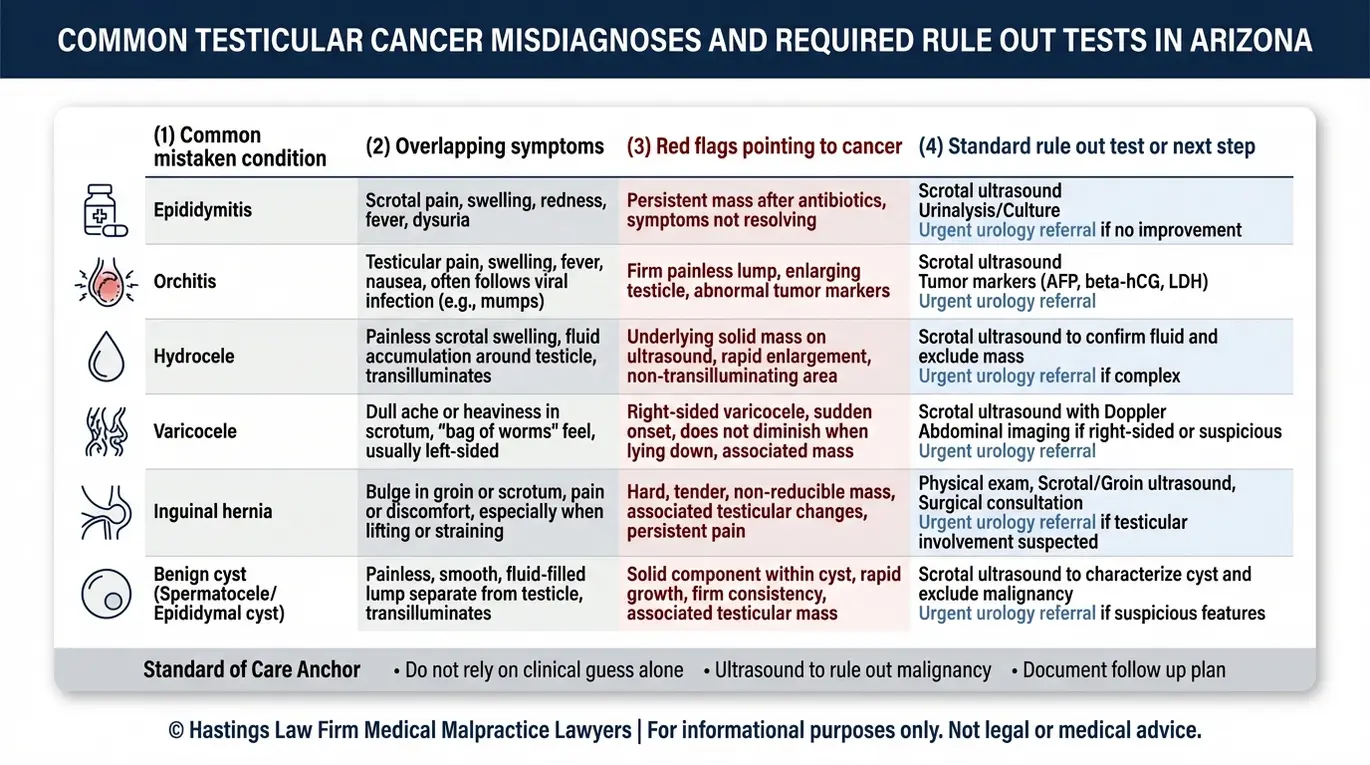
Conditions Commonly Mistaken for Testicular Cancer by Physicians
Physicians frequently misdiagnose testicular cancer as benign conditions such as epididymitis, orchitis, or hydroceles. Orchitis is an inflammation of the testicle that can cause swelling and pain. This error crosses the line into malpractice when the doctor relies solely on a clinical guess, or a diagnosis made without testing, rather than ordering an ultrasound to rule out malignancy definitively.
Many of these conditions share overlapping symptoms with testicular cancer, including swelling, heaviness, or dull pain. That similarity is exactly why the standard of care requires imaging, not assumptions.
Epididymitis, an inflammation of the coiled tube at the back of the testicle, is one of the most common misdiagnoses. According to the CDC’s STI Treatment Guidelines on Epididymitis, the condition is typically caused by infection and treated with antibiotics. The problem arises when a doctor prescribes a course of antibiotics and never schedules a follow-up ultrasound to confirm the mass has resolved. If the underlying cause was cancer and not infection, weeks of antibiotic treatment accomplish nothing while the tumor grows.
Hydroceles, which are fluid collections around the testicle, can also mask an underlying tumor. On a basic physical exam, the fluid buildup can make it difficult to feel a solid mass beneath. Without a scrotal ultrasound, a physician may attribute the swelling entirely to fluid and miss the tumor entirely. Transillumination, which involves shining a light through the scrotum, is often used to diagnose hydroceles, but it is not foolproof and cannot rule out a cancer hiding within the fluid.
Varicoceles, enlarged veins within the scrotum, are another frequent source of confusion. Often described as feeling like a “bag of worms,” varicoceles are typically benign. However, a physician cannot simply assume a scrotal irregularity is a varicocele without proper evaluation. If a tumor is present alongside the varicocele, or if the mass is misidentified as a vein, the cancer diagnosis will be missed.
Inguinal hernias present another diagnostic trap. A hernia in the groin area can cause swelling and discomfort that mimics a testicular mass. If a doctor assumes the symptoms point to a hernia and moves toward hernia repair without imaging the testicle, a cancer diagnosis can be delayed by months.
The table below outlines how these conditions compare and what testing is required to rule out cancer:
| Condition | Overlapping Symptoms | Key Difference from Cancer | Required Rule-Out Test |
|---|---|---|---|
| Epididymitis / Orchitis | Swelling, pain, tenderness | Usually responds to antibiotics; fever may be present | Scrotal ultrasound if symptoms persist after treatment |
| Hydrocele | Painless swelling, heaviness | Transilluminates (light passes through fluid) | Scrotal ultrasound to check for solid mass |
| Varicocele | Dull ache, swelling | Often described as “bag of worms” texture | Scrotal ultrasound to evaluate underlying tissue |
| Inguinal Hernia | Groin/scrotal swelling, discomfort | Worsens with straining; may be reducible | Scrotal ultrasound and physical exam differentiation |
Under Arizona Revised Statutes § 12-2603, a medical malpractice claim requires a preliminary expert opinion confirming that the healthcare provider failed to meet the accepted standard of care. An Arizona testicular cancer malpractice attorney can connect you with qualified medical experts who can evaluate whether your doctor’s failure to order proper imaging fell below that standard.
The Hastings Law Firm Difference
Results matter, but what truly sets us apart is how we achieve them. Every verdict, every settlement, and every Arizona courtroom victory comes from one guiding promise: To treat each client’s fight for justice as if it were our own.
This balance of skill, experience, and empathy reflects our core philosophy that justice should not only compensate the injured, but also make health care safer nationwide.

Proving Liability for Testicular Cancer Misdiagnosis in Arizona
To prove liability, we must show that a competent doctor in the same specialty would have diagnosed the cancer sooner under similar circumstances. This means establishing that the standard of care was breached, such as failing to order an ultrasound, and that the breach directly caused the cancer to progress to a more advanced stage.
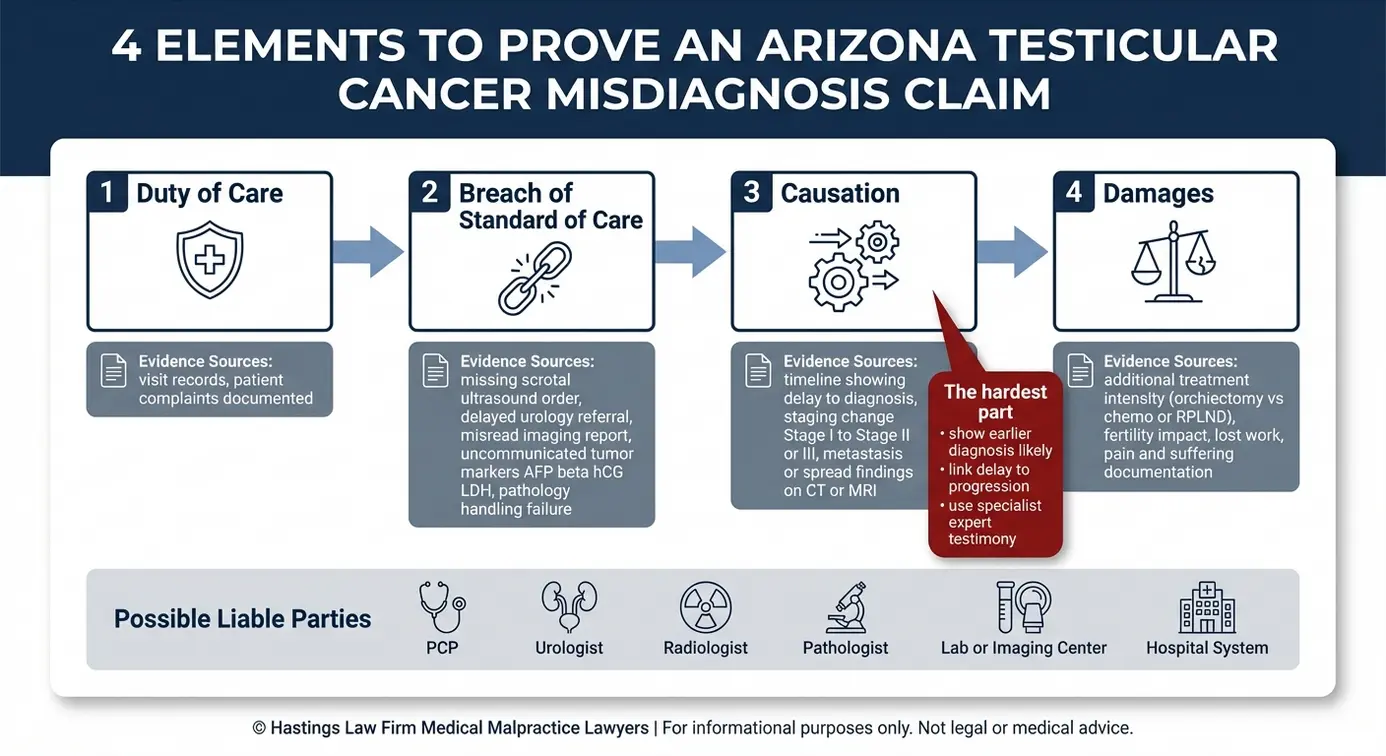
Medical malpractice cases in Arizona rest on four connected elements. Each one must be supported by evidence, and our legal and medical team works together to build the proof.
Duty of care is the starting point. Once a doctor-patient relationship exists, the physician has an obligation to evaluate, diagnose, and treat the patient with the same skill and attention that a reasonably competent provider in the same field would use. This element is rarely disputed, as the relationship is established as soon as the doctor agrees to see the patient.
Breach of duty is where most testicular cancer misdiagnosis cases are decided. We examine the medical records to identify specific actions, or failures to act, that fell below the accepted standard. Did the doctor skip a scrotal ultrasound?
Were tumor markers like LDH ordered but never followed up on? Was a testicular biopsy, a tissue sample taken from the testicle and examined under a microscope, recommended but never performed? A pathology report, the laboratory analysis of that tissue, may also reveal errors if results were misread or delayed. Identifying the breach often requires comparing the doctor’s actions against national clinical guidelines.
Causation is often the most challenging element. It is not enough to show the doctor made a mistake. We must prove that the delay in diagnosis allowed the cancer to advance to a worse stage than it would have been at the time the diagnosis should have been made.
This requires us to retain a qualified expert witness, typically an oncologist, radiologist, or pathologist, to compare the patient’s actual outcome to what the outcome likely would have been with timely detection. We must demonstrate that the negligence deprived the patient of a significantly better chance of recovery or cure.
Damages tie everything together. The harm must be measurable: additional surgeries, harsher treatment protocols, emotional suffering, lost income, or in the worst cases, a shortened life expectancy. If the cancer had been caught at Stage I, the damages might have been minimal; because it advanced to Stage III, the damages are substantial.
As an Arizona testicular cancer misdiagnosis lawyer, we identify every potentially liable party. That may include the primary care physician who dismissed the symptoms, the radiologist who misread the scan, or the laboratory that lost critical results. A lawyer for delayed cancer diagnosis examines the full chain of care to determine where and how the system failed.
The Impact of Delays Over 53 Days on Survival and Treatment
Research into diagnostic timelines has identified a critical threshold: delays exceeding 53 days from symptom onset to diagnosis significantly increase the risk of metastasis, which is the spread of cancer from the testicle to other parts of the body such as the lymph nodes, lungs, or brain.
When testicular cancer is caught early and remains localized, treatment may involve only an orchiectomy, the surgical removal of the affected testicle. Most patients recover relatively quickly, and survival rates at Stage I are extremely high.
But when a misdiagnosis pushes the timeline past that 53-day window, the clinical picture changes, significantly worsening the patient’s prognosis. A prognosis refers to the likely course and outcome of a disease.
Advanced-stage cancer often requires systemic chemotherapy, radiation therapy, or retroperitoneal lymph node dissection (RPLND), a major surgery to remove lymph nodes from the back of the abdomen. Each of these treatments carries serious side effects, longer recovery periods, and a greater risk of long-term complications, including infertility. Advanced-stage cancer requires more invasive interventions than early-stage localized tumors.
This is why diagnostic delays matter so much in these cases. The difference between a timely diagnosis and a delayed one can be the difference between a straightforward surgery and months of aggressive treatment with lasting physical and emotional consequences.
Compensation Available for Delayed Testicular Cancer Diagnosis in Arizona
Patients harmed by a delayed diagnosis can recover economic damages for additional medical costs and lost wages, as well as non-economic damages for pain, suffering, and the loss of reproductive function. In cases where the patient passes away, families may pursue wrongful death compensation.
Arizona law provides strong protections for injured patients. Under Article 2, Section 31 of the Arizona Constitution, the right to recover damages for personal injury cannot be limited or abolished by the legislature. Unlike many states that impose arbitrary caps on non-economic damages, Arizona’s constitutional provision allows juries to award the full value of the harm caused.
The types of damages available in a testicular cancer misdiagnosis case typically include:
- Aggravated treatment costs. This covers the financial difference between the treatment you should have needed (such as a straightforward orchiectomy, the surgical removal of the affected testicle) and the treatment the delay actually forced you to endure (chemotherapy, radiation, or RPLND surgery). The National Cancer Institute’s Testicular Cancer Treatment guidelines outline how treatment complexity increases with staging, directly tying delayed diagnosis to higher medical bills.
- Lost income and earning capacity. This includes wages lost during extended treatment, such as time off for chemotherapy rounds and surgery recovery. It also covers diminished future earning ability if the delay caused lasting disability that prevents you from returning to your previous career.
- Fertility loss. Removal of a testicle or systemic chemotherapy can impair or eliminate a patient’s ability to have children. Compensation may reflect the substantial cost of fertility preservation, such as sperm banking, assisted reproduction technologies, and the deep personal toll of that loss.
- Pain and suffering. The physical pain of additional surgeries and treatments is significant, but so is the mental anguish. Damages can be awarded for the anxiety of living with a more advanced cancer diagnosis, the fear of recurrence, and the emotional weight of knowing it could have been caught sooner.
- Loss of consortium. A spouse or partner may have a separate claim for the negative impact the injury and treatment have had on the relationship and companionship.
- Wrongful death. If a loved one passed away because of a delayed testicular cancer diagnosis, surviving family members can seek compensation for funeral expenses, lost financial support, and the loss of companionship.
A testicular cancer misdiagnosis attorney in Arizona can help calculate the full scope of your losses. As a lawyer for misdiagnosed cancer cases, we work with medical and financial experts to document every category of harm so that nothing is overlooked.
Arizona Statute of Limitations for Testicular Cancer Lawsuits
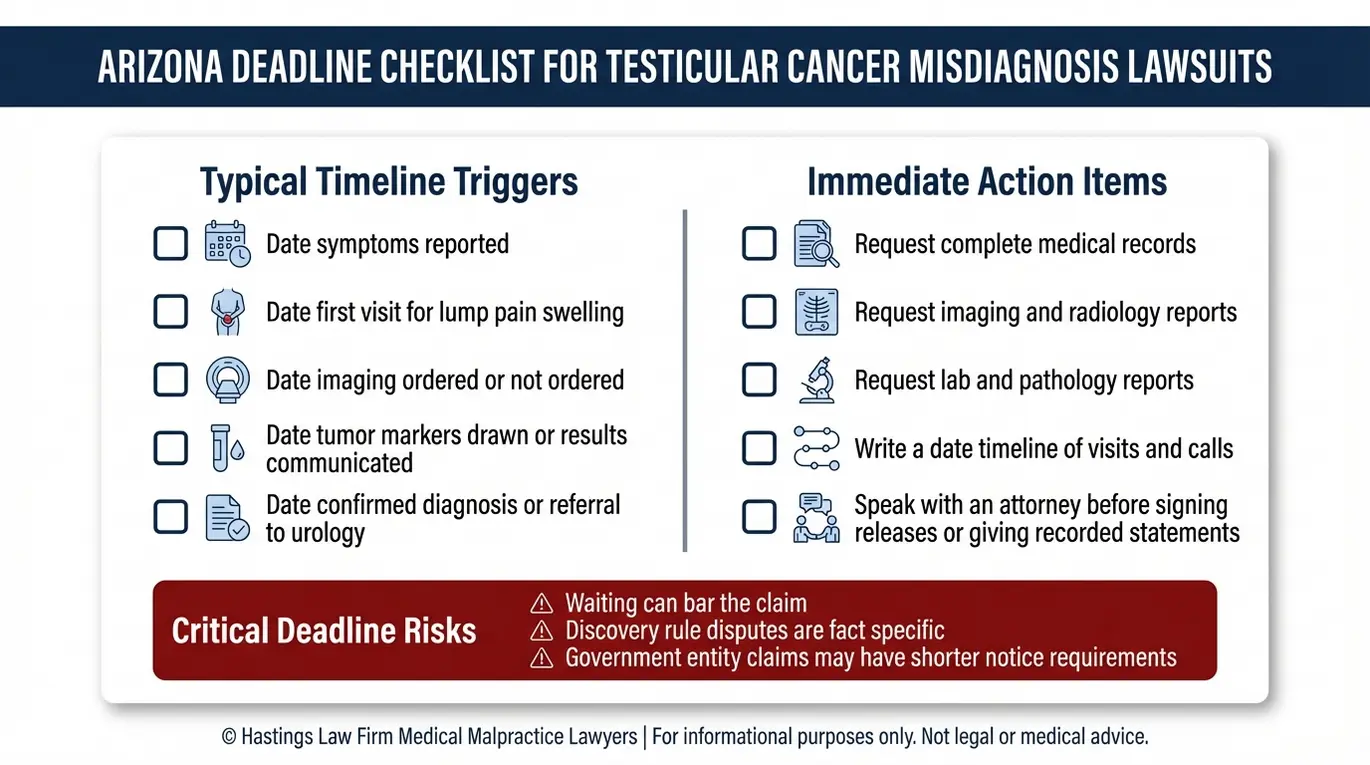
In Arizona, the statute of limitations for medical malpractice is generally two years from the date the injury occurred or when it was discovered. Strict exceptions apply, and waiting too long can permanently bar your claim, making immediate legal consultation vital.
The two-year rule applies to most cases. Under Arizona law, you have two years to file a medical malpractice lawsuit. But the question of when that clock starts ticking is not always obvious, especially in misdiagnosis cases where the “injury” (the progression of cancer) happens silently over time.
The discovery rule addresses this directly. In many delayed diagnosis situations, the patient does not learn about the misdiagnosis on the day the error occurred.
You may not discover that your cancer was missed until months or even years later, when a second opinion or worsening symptoms finally reveal the truth. Arizona’s discovery rule allows the two-year period to begin when you knew, or reasonably should have known, that a medical error may have caused your harm. However, this is not an indefinite extension, and proving when you “should have known” requires careful legal argument.
Claims involving government hospitals carry a much shorter deadline. If your care was provided at a county, state, or municipal facility, strict filing deadlines apply.
WARNING: If you were treated at a public entity, such as a county hospital or a state-run clinic, you must file a Notice of Claim within 180 days of the injury. This applies to institutions operated by entities like Maricopa County, and the Notice of Claims Form from Maricopa County outlines the specific requirements. Missing this window can result in your case being dismissed entirely, regardless of how strong the evidence is.
Cases involving minors may have different tolling rules that extend the filing deadline. Generally, the statute of limitations for a minor does not begin to run until they turn 18. However, this area of law is complex, and parents should not delay seeking legal advice for their children.
An Arizona testicular cancer misdiagnosis lawyer can evaluate your timeline and make sure your claim is filed before any deadline passes. The sooner you reach out, the more time we have to investigate and preserve critical evidence.
Contact the Arizona Misdiagnosis Attorneys at Hastings Law Firm Today for Help
If a delayed diagnosis has affected your health or the future of someone you love, you deserve answers. Hastings Law Firm focuses exclusively on medical malpractice, bringing board-certified expertise, in-house medical professionals, and a national network of specialists to every case we accept.
As an Arizona testicular cancer misdiagnosis lawyer, we prepare every case as if it is going to trial. That level of preparation is what allows us to hold negligent providers accountable and pursue the full compensation our clients deserve.
We work on a contingency fee basis, which means you pay no attorney fees or costs unless we recover for you. Contact us today for a free, confidential case evaluation. Let us review your records, explain what we find, and help you understand your options and how medical malpractice litigation works.
Frequently Asked Questions About Testicular Cancer Misdiagnosis in Arizona


This content was researched and written by the Hastings Law Firm editorial team, which includes attorneys, medical professionals, and experienced researchers. Our writing is informed by internal knowledge and practical experience, and we cross-check critical details against authoritative sources cited throughout. Every piece undergoes human-led fact-checking and legal review. Because legal and medical information can change, if you spot an error, please contact us. Learn more about our content standards and review process on our editorial policy page.

Tommy Hastings, founder of Hastings Law Firm, is a board-certified personal injury trial lawyer dedicated exclusively to healthcare injury cases. Since 2001, he has represented injured patients and families in litigation against major hospital systems, pharmaceutical companies, and negligent healthcare providers nationwide. He has handled numerous high-profile cases that have drawn national media attention and resulted in multi-million dollar recoveries. He draws on that experience in his writing, helping readers understand how these cases work and what options may be available to them.
