


Arizona Skin Cancer Misdiagnosis Lawyer
A delayed or missed melanoma diagnosis can change treatment options and long term outlook, especially when warning signs were overlooked or test results were mishandled. Missed biopsies, pathology errors, lack of referral, and administrative breakdowns can allow skin cancer to progress into a life threatening condition and lead to more aggressive care, higher costs, and lasting harm. Understanding how these errors happen and how delay affects staging can clarify what went wrong. If you or a loved one were harmed or worse due to a delayed or missed melanoma diagnosis in Arizona, contact Hastings Law Firm for a free, confidential case review.
Last Updated: July 27, 2026
Trusted Arizona Medical Attorneys for Delayed Melanoma Diagnosis Claims
A skin cancer diagnosis that comes too late can feel like a profound betrayal. You trusted your doctor to take your concerns seriously, to look closely, and to act when something looked wrong. If that trust was broken and your melanoma or other skin cancer was missed, misdiagnosed, or delayed, you are not alone in questioning what happened and what comes next.
At Hastings Law Firm, we focus exclusively on medical malpractice. Our team of attorneys, nurse consultants, and medical staff understands both the medicine behind your case and the legal strategy needed to hold negligent providers accountable. Founded by Tommy Hastings, a board-certified trial lawyer with over 20 years of experience, our firm is dedicated to representing those harmed by healthcare errors.
If you or a loved one experienced a delayed or missed skin cancer diagnosis in Arizona, an Arizona skin cancer misdiagnosis lawyer at our firm can review your medical records, explain what should have happened, and help you understand your options. Contact our Phoenix office for a free, confidential case evaluation. There is no fee unless we recover compensation for you.

Common Types of Skin Cancer Misdiagnosis Claims
Skin cancer misdiagnosis claims typically involve failure to biopsy a suspicious lesion, misinterpreting pathology results, or failing to refer a patient to a dermatologist, leading to a delay in treatment and worsened prognosis. Any of these errors can allow the cancer to progress to a more dangerous stage, transforming a treatable condition into a life-threatening one.
These claims vary in how the breakdown occurs, but they tend to fall into several recognizable patterns:
- Failure to biopsy: A doctor examines a suspicious mole or lesion and dismisses it as benign without ordering a punch biopsy, a procedure that removes a small cylinder of tissue for lab analysis. This is one of the most common failures we see in skin cancer cases.
- Pathology errors: The biopsy is performed correctly, but a lab technician or pathologist misreads the tissue slide, returning a false negative that tells the patient nothing is wrong.
- Failure to refer: A primary care physician notices a concerning mole or skin change but does not send the patient to a dermatologist for further evaluation. The lesion continues to grow unchecked because the general practitioner lacked the specialized expertise to identify the risk.
- Administrative errors: Lab results are lost, misfiled, or never communicated to the patient. A positive finding sits in a chart while the cancer advances. This administrative oversight is a clear failure to diagnose that can be just as damaging as a clinical error.
Patients have a legal right to access their own medical records under 45 CFR § 164.524. Requesting copies of your records, pathology reports, and referral documentation is often the first step to understanding whether a misdiagnosis occurred.
If any of these failures contributed to a delayed diagnosis, a skin cancer malpractice attorney can evaluate whether the standard of care was breached and whether that breach caused you measurable harm.
Why Doctors Miss or Delay Melanoma Diagnoses
Doctors often miss melanoma diagnoses due to rushing through skin exams, lacking proper training in dermoscopy, or dismissing patient concerns about changing moles as cosmetic issues rather than medical threats.
Many patients describe a similar experience. They pointed out a mole or skin change, and their doctor glanced at it briefly before reassuring them it was nothing to worry about. That reassurance can feel authoritative in the moment. Years of conditioning teach us to trust medical professionals without question, and many patients feel uncomfortable pushing back, even when something feels wrong.
This is sometimes called the “White Coat Effect,” and it can discourage patients from advocating for themselves during the very appointments where advocacy matters most, whether it is with a primary care physician or a dermatologist. Dermoscopy is a skin examination method using high-magnification lenses to see skin structures. From a clinical standpoint, common factors behind missed diagnoses include:
- Inadequate screening time: Rushed appointments that do not allow for a full-body skin exam. When a provider spends only a few minutes with a patient, they are more likely to miss subtle irregularities that require careful observation.
- Reliance on naked-eye exams: Skipping dermoscopy, a non-invasive technique that uses a specialized magnifying instrument to examine skin structures not visible to the unaided eye. Dermoscopy significantly improves the accuracy of melanoma detection.
- Dismissal of patient-reported changes: Treating evolving moles or new growths as cosmetic concerns rather than ordering diagnostic testing.
If your concerns were dismissed and your diagnosis was delayed, a delayed melanoma diagnosis lawyer can help determine whether the care you received fell below the accepted standard.
Pathology Malpractice and False Negatives
Sometimes the doctor orders the right test, but the lab makes the mistake. Pathology is the laboratory analysis of tissue samples to diagnose disease. A false negative pathology result, an error where a tissue sample is analyzed and incorrectly reported as non-cancerous, gives the patient and their doctor a misleading “all clear.”
One frequent cause is an inadequate sample size due to poor biopsy technique. A shave biopsy, which removes only the top layers of skin, may not capture enough tissue to detect melanoma that has started growing deeper. Compared to a punch biopsy, which takes a deeper, cylindrical sample, a shave biopsy carries a higher risk of missing the cancer entirely or providing an insufficient sample for accurate analysis.
Our team investigates the potential for a pathology lab error in every case we evaluate. We review the biopsy method used, the adequacy of the tissue sample, and whether the pathologist followed accepted diagnostic protocols.
The Hastings Law Firm Difference
Results matter, but what truly sets us apart is how we achieve them. Every verdict, every settlement, and every Arizona courtroom victory comes from one guiding promise: To treat each client’s fight for justice as if it were our own.
This balance of skill, experience, and empathy reflects our core philosophy that justice should not only compensate the injured, but also make health care safer nationwide.

The ABCDE Rule and Medical Negligence
The ABCDE rule serves as the clinical standard for identifying potential melanoma; a doctor’s failure to recognize Asymmetry, Border irregularity, Color variation, Diameter, or Evolving traits constitutes a breach of the standard of care.
The ABCDE rule, the clinical standard for identifying potential melanoma, stands for five characteristics that distinguish potentially dangerous skin growths from harmless ones. The Skin Cancer Foundation’s melanoma warning signs guide outlines these criteria in detail:
| Letter | Sign | What to Look For |
|---|---|---|
| A | Asymmetry | One half of the mole does not match the other half |
| B | Border | Edges are irregular, ragged, or scalloped |
| C | Color | Multiple shades of brown, black, red, white, or blue within the same lesion |
| D | Diameter | Larger than 6mm (roughly the size of a pencil eraser) |
| E | Evolving | The mole is changing in size, shape, color, or texture over time |
The “E,” evolving, is often the most critical missed sign. A mole that is growing, darkening, or changing shape warrants immediate evaluation. When a patient reports these changes and the doctor does not act, that inaction can form the basis of a negligence claim.
The ABCDEs are not obscure criteria. They are taught in medical school and reinforced throughout a physician’s career. A doctor who overlooks them during a skin exam may have failed to meet the level of care that a reasonably competent peer would have provided under the same circumstances.

Understanding Melanoma Stages and the Impact of Delay
The stage of melanoma at diagnosis dictates survival rates; a delay that allows cancer to progress from Stage I (localized) to Stage IV (metastasis) significantly reduces life expectancy and increases the severity of required treatments.
Melanoma staging, which ranges from Stage 0 through Stage IV, reflects how far the cancer has spread:
| Stage | Description | 5-Year Relative Survival Rate |
|---|---|---|
| Stage 0 (In Situ) | Cancer is confined to the outer layer of skin (epidermis) | ~99% |
| Stage I to II (Localized) | Cancer has grown deeper into the skin but has not spread to lymph nodes | ~99% (localized) |
| Stage III (Regional) | Cancer has spread to nearby lymph nodes or skin | ~76% (regional) |
| Stage IV (Distant) | Cancer has metastasized to distant organs such as the brain, lungs, or liver | ~35% (distant) |
*Source: SEER Cancer Stat Facts: Melanoma of the Skin*
The National Cancer Institute’s melanoma treatment guide explains how treatment becomes increasingly aggressive at higher stages, moving from simple excision to immunotherapy, radiation, or systemic chemotherapy.
This progression is the foundation of a legal theory called “Loss of Chance.” The argument is simple: if a doctor had diagnosed the melanoma when it should have been caught, the patient’s survival probability would have been significantly higher. The delay reduced that probability, and the patient is entitled to compensation for the chance that was lost.
Clark’s Level Depth vs. Melanoma Stage
While staging describes how far cancer has spread, Clark’s Level and Breslow thickness measure how deep the cancer has penetrated into the layers of skin. Clark’s Level describes the specific layers of skin the cancer has invaded, using a classification of depth on a scale of I through V. Breslow thickness, a precise millimeter measurement of tumor depth, further quantifies the risk.
Greater depth means a higher risk of metastasis. When diagnosis is delayed, the cancer has more time to grow deeper, worsening both the Clark’s Level and the Breslow thickness. These measurements directly affect prognosis and are key evidence in establishing how a diagnostic delay changed the course of the disease.
Physiologic Progression of Undiagnosed Melanoma
When skin cancer is not treated early, it does not stay in the skin. It can invade the lymphatic system and bloodstream, spreading to the brain, lungs, and liver. This process of metastasis is what transforms a highly treatable early-stage cancer into a life-threatening condition.
This physiologic progression is the direct causation link in a malpractice lawsuit. Our medical team traces the timeline from when the cancer should have been caught to when it was actually diagnosed, documenting how the disease advanced during that gap. An Arizona melanoma lawyer uses this evidence to establish that the delay, not just the cancer itself, caused the patient’s worsened outcome.

Proving Medical Negligence in Arizona Skin Cancer Cases
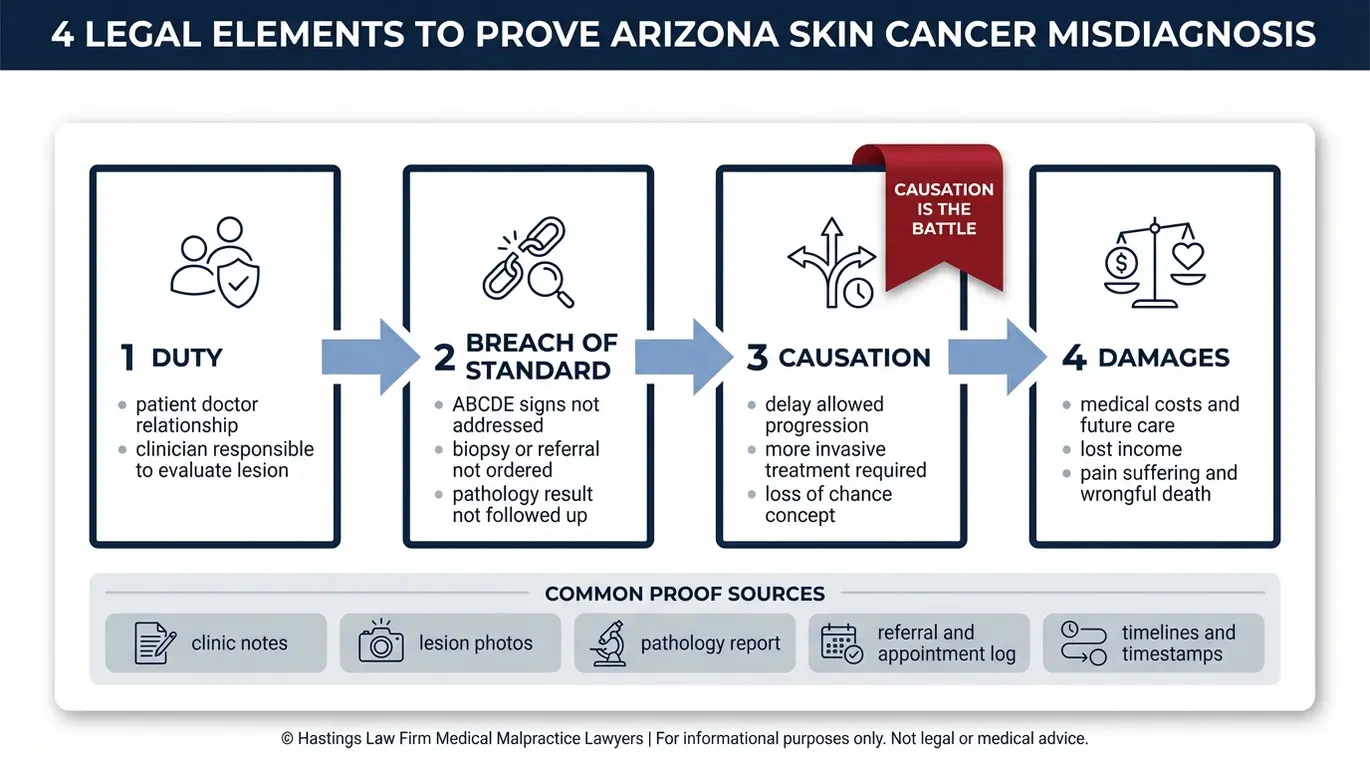
Proving negligence requires establishing that a doctor-patient relationship existed, the doctor breached the standard of care by missing signs a competent peer would have caught, and that breach directly caused the cancer to advance or the patient to suffer harm.
Arizona medical malpractice claims follow four legal elements, and each must be supported by evidence:
- Duty: The doctor had an established responsibility to screen, evaluate, and follow up on your skin concerns. This duty exists from the moment a doctor-patient relationship is formed.
- Breach: The doctor failed to meet the standard of care. This could mean ignoring the ABCDE criteria, skipping a biopsy, or failing to refer you to a specialist when clinical guidelines called for it.
- Causation: The breach directly caused the cancer to advance, requiring more aggressive treatment or resulting in a worse prognosis. This is distinct from simply having cancer; the question is whether the delay made the outcome worse.
- Damages: You suffered quantifiable losses, including medical expenses, lost income, pain, or loss of life. These damages must be directly tied to the negligence.
Under A.R.S. § 12-2604, expert witnesses in Arizona medical malpractice cases must be qualified professionals who practice in the same specialty as the defendant. This means proving your case requires testimony from medical experts who can credibly explain what the standard of care required and how the doctor fell short.
As an Arizona skin cancer misdiagnosis lawyer, Hastings Law Firm builds each case with expert testimony from our national network of specialists, paired with a detailed reconstruction of your medical timeline. Our in-house medical staff, including nurse practitioners and board-certified patient advocates, reviews your records and identifies where the breakdown occurred. Our legal team includes former defense attorneys who understand how hospitals defend malpractice claims. This preparation begins early because we approach every case as if it will go to trial.
Compensation for Victims of Melanoma Misdiagnosis
Victims of delayed melanoma diagnosis in Arizona may recover damages for medical bills, lost income, pain and suffering, and in tragic cases, wrongful death benefits for the surviving family.
Research published in the Medical Expenditure Panel Survey analysis (2012–2018) highlights the significant economic burden of skin cancer treatment in the United States. This data shows how a delayed diagnosis can multiply treatment costs substantially.
Damages in skin cancer misdiagnosis cases generally fall into these categories:
- Economic damages: Past and future medical costs, including surgery, immunotherapy, chemotherapy, and ongoing monitoring. Lost wages and reduced earning capacity are also included if you are unable to return to work.
- Non-economic damages: Pain and suffering, emotional distress, disfigurement from surgical procedures, and loss of consortium. These damages compensate for the subjective impact of the negligence on your quality of life and relationships.
- Wrongful death: If the delayed diagnosis resulted in the patient’s death, surviving family members may pursue a wrongful death claim for their losses.
- Punitive damages: Rare, but possible in cases involving gross negligence where the provider’s conduct was especially reckless.
Patients of delayed melanoma diagnosis in Arizona may recover economic damages for their ongoing care needs. These damages cover both current expenses and the expected costs of future treatments that would not have been necessary with an early diagnosis.
Arizona HMO Liability Limits
Pursuing a skin cancer lawsuit settlement against a managed care organization or HMO in Arizona involves additional legal challenges. HMOs may argue they are not directly liable for the medical decisions of their contracted physicians, which requires specific legal strategies to establish accountability. Hastings Law Firm has experience handling these claims and understands how to identify the responsible parties, whether that is the individual provider, the lab, the medical group, or the managed care entity itself.
Arizona Statute of Limitations for Medical Malpractice
In Arizona, the statute of limitations for medical malpractice is generally two years from the date the injury occurred or was discovered, but strict exceptions apply that can shorten or extend this window.
Under A.R.S. § 12-542, you typically have two years to file a claim. Arizona also recognizes the “discovery rule,” which means the clock may start when you knew or reasonably should have known about the misdiagnosis, not necessarily when the original error occurred. Understanding the medical malpractice time limits in Arizona is necessary because missing this deadline can permanently bar you from seeking compensation.
Do not assume you have time to wait. Medical records can be altered or lost, and witness memories fade. If you suspect your skin cancer was missed or delayed, speak with an attorney as soon as possible to protect your right to file a claim. Even if you are unsure about your timeline, an Arizona skin cancer misdiagnosis lawyer can evaluate whether your claim still falls within the filing deadline.
Contact the Arizona Misdiagnosis Attorneys at Hastings Law Firm Today for Help
A missed skin cancer diagnosis cannot be undone. But holding the responsible provider accountable can provide the financial security you need for treatment, recovery, and your family’s future.
Hastings Law Firm works on a contingency fee basis, which means you pay no attorney fees or costs unless we recover compensation for you. Our team of attorneys, nurses, and medical staff will review your records, consult with qualified specialists, and give you an honest assessment of your case.
If you or a loved one experienced a delayed or missed melanoma diagnosis in Arizona, contact our Phoenix office for a free case evaluation. Let us help you find the answers you deserve.
Call Hastings Law Firm or fill out our online contact form to get started.
Frequently Asked Questions About Skin Cancer Misdiagnosis in Arizona


This content was researched and written by the Hastings Law Firm editorial team, which includes attorneys, medical professionals, and experienced researchers. Our writing is informed by internal knowledge and practical experience, and we cross-check critical details against authoritative sources cited throughout. Every piece undergoes human-led fact-checking and legal review. Because legal and medical information can change, if you spot an error, please contact us. Learn more about our content standards and review process on our editorial policy page.

Tommy Hastings, founder of Hastings Law Firm, is a board-certified personal injury trial lawyer dedicated exclusively to healthcare injury cases. Since 2001, he has represented injured patients and families in litigation against major hospital systems, pharmaceutical companies, and negligent healthcare providers nationwide. He has handled numerous high-profile cases that have drawn national media attention and resulted in multi-million dollar recoveries. He draws on that experience in his writing, helping readers understand how these cases work and what options may be available to them.
