


Arizona Prostate Cancer Misdiagnosis Lawyer
A delayed or missed prostate cancer diagnosis can change treatment options and long term outlook, especially when test results are overlooked or follow up is delayed. These situations often involve screening gaps, misread imaging or biopsy findings, or referral delays that allow disease progression. Not every poor outcome is negligence, but the key issue is whether a reasonably competent physician would have acted sooner under similar circumstances. If you or a loved one were harmed or worse due to a delayed or missed prostate cancer diagnosis in Phoenix, Arizona, contact Hastings Law Firm for a free, confidential case review.

Last Updated: July 27, 2026
Trusted Arizona Medical Attorneys for Delayed Prostate Cancer Diagnosis Claims
When prostate cancer is caught early, survival rates are among the highest of any cancer. But when a doctor fails to order the right tests, misreads results, or delays a referral, a treatable condition can become a life-threatening one. If you or a loved one experienced a delayed or missed prostate cancer diagnosis due to a medical provider’s error, you deserve to know whether negligence caused your condition to worsen.
At Hastings Law Firm, founded by board-certified trial attorney Tommy Hastings, our legal and medical teams work together to investigate these cases from the inside out. Our in-house nurse consultants and former defense attorneys identify where the standard of care broke down and build a case to hold responsible parties accountable. We have focused exclusively on medical malpractice litigation since 2005. As an Arizona prostate cancer misdiagnosis lawyer team, we focus solely on medical malpractice and charge no fees unless we recover compensation for you.
Contact our Phoenix office today for a free, confidential case evaluation. We can review what happened and explain your options.

Understanding Failure to Diagnose and Delayed Diagnosis of Prostate Cancer
Medical malpractice in prostate cancer cases occurs when a doctor deviates from the accepted standard of care by overlooking symptoms, skipping recommended screening, or misinterpreting test results, allowing disease progression to a stage that could have been prevented with timely action.
Not every unfavorable outcome means a doctor was negligent. Prostate cancer can be difficult to detect, and medicine involves inherent uncertainty. The legal question is whether a reasonably competent physician, facing the same clinical picture, would have acted differently and caught the cancer sooner. An Arizona prostate cancer misdiagnosis lawyer can analyze these facts to determine if actionable negligence occurred.
The distinction matters because prostate cancer has a well-documented treatment window. Delayed diagnosis refers to a situation where cancer is found, but the delay in finding it led to a worse prognosis. According to the National Cancer Institute’s SEER Program, the five-year relative survival rate for prostate cancer diagnosed at a localized or regional stage is greater than 99%. Once the cancer reaches metastatic prostate cancer, a stage where it has spread beyond the prostate to bones, lymph nodes, or other organs, that number drops sharply.
Cancer staging, often described using the TNM system (Tumor size and extent, Node involvement, Metastasis), determines how far the disease has progressed and directly shapes treatment options. Malpractice claims often arise from the gap between early detection and late-stage diagnosis. A prostate cancer misdiagnosis attorney in Arizona investigates whether the delay moved a patient from a curable stage to one requiring aggressive chemotherapy, radiation therapy, or palliative care. The question is: did the failure to act in time cause real, measurable harm?
To better understand how these cases differ, here is a breakdown of three commonly confused terms:
| Classification | What It Means | Example |
|---|---|---|
| Failure to Diagnose | The doctor never identified the cancer despite available evidence. | A physician never orders a PSA test for a high-risk patient who presents with urinary symptoms. |
| Delayed Diagnosis | The cancer was eventually identified, but an unreasonable delay allowed it to progress. | Elevated PSA levels are noted but not followed up on for over a year, during which the cancer advances. |
| Misdiagnosis | The doctor diagnosed a different, incorrect condition instead of cancer. | A rising PSA is attributed solely to benign prostatic hyperplasia (BPH) without further investigation. |
Each of these scenarios can form the basis of a medical negligence claim if the error fell below the standard of care and caused the patient harm. An experienced lawyer for prostate cancer misdiagnosis can help determine which category applies and how the delay affected the course of the disease.

Common Medical Errors Leading to Missed Prostate Cancer
Common errors include failing to order a prostate-specific antigen (PSA) test, a blood test that measures a protein produced by the prostate, for patients with known risk factors; dismissing elevated PSA levels as benign conditions; or misreading biopsy results that should have triggered immediate treatment.
These errors can occur at multiple points along the diagnostic pathway. Diagnostic errors often occur when doctors fail to follow established screening protocols for men at higher risk. According to the National Cancer Institute’s Prostate Cancer Screening guidelines, screening decisions should account for age, family history, race, and individual risk factors. When providers ignore these guidelines, the consequences can be severe, and patients may need legal help for missed cancer.
Here are the most common categories of medical error we evaluate in these cases:
- Screening failures: Not ordering a PSA test or a digital rectal exam (DRE), a physical examination where the doctor checks the prostate for abnormalities through the rectum, for men who meet age or risk-factor thresholds.
- Follow-up failures: Noting an elevated or rising PSA but failing to order repeat testing, imaging, or a referral to a urologist for further evaluation.
- Testing errors: Improperly performed biopsies, mislabeled specimens, or lost lab samples that prevent accurate diagnosis.
- Interpretive errors: A radiologist failing to identify a suspicious lesion on imaging, or a pathologist misgrading the severity of a tissue sample.
A single missed PSA result might seem minor in isolation. But PSA velocity, the rate at which PSA levels rise over time, is one of the strongest indicators that something beyond a benign condition may be developing. When a physician sees a climbing PSA trend and does not act on it, the window for early intervention narrows.
Referral delays are another frequent issue. A primary care physician may not have the specialized training to interpret borderline results, but they have a clear duty to send the patient to a urologist who does. When that referral does not happen, the patient loses time they cannot get back.
An Arizona prostate cancer lawyer can investigate whether each provider in the chain met their individual obligations. Because misdiagnosis cases often involve multiple doctors and facilities, identifying every point of failure is essential to building a complete claim.
Radiologist and Pathologist Liability in Cancer Cases
Liability in Arizona prostate cancer cases often extends beyond the primary doctor to the specialists who interpret diagnostic data. A radiologist reviewing a multiparametric prostate MRI (mpMRI), an advanced imaging technique that combines multiple MRI sequences to detect and characterize prostate lesions, may fail to flag a suspicious area. A pathologist examining biopsy tissue may assign an inaccurate Gleason score, which is a grading system that measures how aggressive prostate cancer cells appear under a microscope.
These interpretive errors can change the entire trajectory of a patient’s care. An undergraded Gleason score may lead to a “watch and wait” approach when immediate treatment was needed. A missed lesion on imaging may mean a biopsy is never ordered at all.
Our team includes medical professionals who understand how to read these reports and identify where the interpretation deviated from what the clinical evidence actually showed. When a misdiagnosis attorney reviews these cases, every specialist in the diagnostic chain is evaluated for potential negligence.
The Hastings Law Firm Difference
Results matter, but what truly sets us apart is how we achieve them. Every verdict, every settlement, and every Arizona courtroom victory comes from one guiding promise: To treat each client’s fight for justice as if it were our own.
This balance of skill, experience, and empathy reflects our core philosophy that justice should not only compensate the injured, but also make health care safer nationwide.

Proving Negligence and The Standard of Care in Arizona
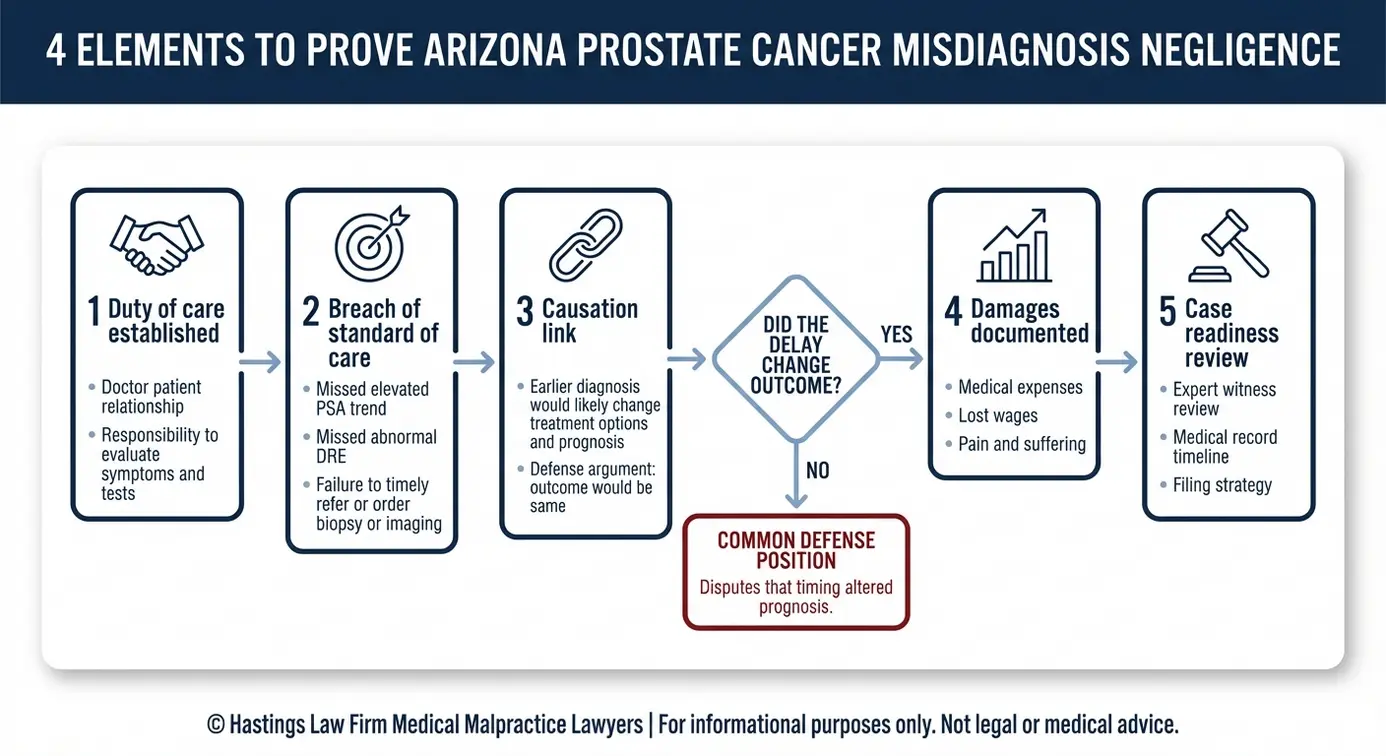
To prove negligence in a prostate cancer misdiagnosis case, a patient must show that a reasonably competent doctor would have diagnosed the cancer earlier under similar circumstances and that the delay caused significant harm.
Under Arizona law, a medical malpractice claim requires proof of four elements. A.R.S. § 12-563 codifies the requirements that the provider breached the standard of care and that the breach was a proximate cause of the injury, while Arizona case law recognizes the additional elements of duty and damages. Together, these elements serve as the legal roadmap for showing a doctor was negligent. Each element builds on the one before it, and all four must be established to win a medical malpractice lawsuit:
Duty of care. The first step is confirming that a doctor-patient relationship existed. Once a physician agrees to evaluate or treat you, they owe you a duty of care consistent with accepted medical standards.
Breach of that duty. The next question is whether the provider’s actions fell below what a competent physician in the same specialty would have done. To establish whether the standard of care was breached, we investigate every detail of your medical history. This often involves examining whether the doctor ordered appropriate screening or referred the patient for a prostate biopsy (core needle biopsy) when clinical indicators warranted one.
Causation. This is frequently the most contested element. The patient must demonstrate the connection: but for the doctor’s failure, the cancer would have been caught at an earlier, more treatable stage. Defense attorneys often argue the delay did not change the outcome, claiming the cancer would have progressed regardless. Our team counters this by working with oncology and urology experts to establish that earlier diagnosis would have made a meaningful difference.
Damages. The patient must show that the delay resulted in actual harm. This harm can include more aggressive treatment, reduced survival odds, greater physical suffering, or death.
Arizona law also requires an expert opinion early in the process. A qualified expert witness, typically a physician in the same specialty as the defendant, must review the case and confirm that the standard of care was breached. This expert review supports the Affidavit of merit required to proceed. A standard of care attorney at our firm coordinates this as part of case preparation, often before a lawsuit is even filed.
Recoverable Damages for Prostate Cancer Misdiagnosis
Patients harmed by a missed or delayed prostate cancer diagnosis can recover compensation for cancer misdiagnosis to cover increased medical costs, lost earning capacity, pain and suffering, and in some cases, the loss of a chance for a cure or longer survival.
The specific damages depend on how the delay affected the patient’s health, finances, and quality of life. Here are the categories we evaluate in these cases:
- Economic damages: These cover the financial losses directly tied to the misdiagnosis. They include the cost of more aggressive treatments like chemotherapy and radiation therapy that may not have been necessary with an earlier diagnosis. They also include future medical expenses, lost wages during treatment, and reduced earning capacity if the patient can no longer work at the same level.
- Non-economic damages: A delayed cancer diagnosis causes harm that goes beyond medical bills. Patients may endure significant physical pain from advanced-stage treatments, emotional distress from learning the cancer could have been caught sooner, and a lasting reduction in their quality of life. Arizona allows compensation for all of these harms.
- Wrongful death damages: When a patient passes away because of a missed diagnosis, surviving family members may file a wrongful death claim. This can include compensation for funeral and burial expenses, loss of the deceased’s future income, and the loss of companionship.
Because prostate cancer misdiagnosis cases involve years of medical records and expert projections, building an accurate damages picture requires both legal skill and medical knowledge. Our in-house medical staff and national network of experts help us calculate the true scope of what the delay cost. As an Arizona prostate cancer misdiagnosis lawyer team, we prepare every damages case with rigor to document the full value of your loss.
Arizona Statute of Limitations for Medical Malpractice
In Arizona, medical malpractice claims must generally be filed within two years from the date the injury occurred or was discovered, though specific exceptions can affect that timeline. The statute of limitations is the legal deadline for filing a case.
The two-year rule. Under A.R.S. § 12-542, you have two years to file a medical malpractice lawsuit. For many types of injuries, the clock starts on the date the negligent act happened. Cancer misdiagnosis cases are different because the harm caused by a missed diagnosis may not become apparent for months or even years.
The discovery rule. Arizona recognizes that patients cannot file claims for injuries they do not yet know about. The discovery rule pauses the statute of limitations until the patient knew, or reasonably should have known, that the misdiagnosis occurred. In prostate cancer cases, this often means the clock starts when a second doctor identifies the cancer and the patient learns it should have been caught earlier. The Arizona Court of Appeals has addressed how this rule applies in medical negligence cases.
Why timing still matters. Even with the discovery rule, Arizona imposes limits on how long a claim can remain viable. Waiting to consult an attorney can result in lost evidence and faded medical records. Once the two-year filing deadline passes, the right to seek compensation is gone permanently.
Do not wait to explore your legal options. If you suspect your prostate cancer was missed or diagnosed late, contact an Arizona prostate cancer misdiagnosis lawyer as soon as possible. Early action preserves evidence and protects your right to file.

Contact the Arizona Misdiagnosis Attorneys at Hastings Law Firm Today for Help
A delayed prostate cancer diagnosis is not simply bad luck. When a doctor had the information and the opportunity to catch the disease earlier and failed to act, that is a violation of trust, and it may be medical malpractice.
At Hastings Law Firm, we understand the weight of what you are carrying. Many of our clients come to us after feeling dismissed by the healthcare system. Our team of attorneys, nurse consultants, and medical experts exists to find the answers you have not been given and to hold the right people accountable.
We charge no attorney fees or costs unless we recover compensation for you.
Contact our Phoenix medical law firm today to schedule a free, confidential case evaluation with our dedicated legal team. Call us or fill out our online form to take the first step.
Frequently Asked Questions About Prostate Cancer Misdiagnosis in Arizona


This content was researched and written by the Hastings Law Firm editorial team, which includes attorneys, medical professionals, and experienced researchers. Our writing is informed by internal knowledge and practical experience, and we cross-check critical details against authoritative sources cited throughout. Every piece undergoes human-led fact-checking and legal review. Because legal and medical information can change, if you spot an error, please contact us. Learn more about our content standards and review process on our editorial policy page.

Tommy Hastings, founder of Hastings Law Firm, is a board-certified personal injury trial lawyer dedicated exclusively to healthcare injury cases. Since 2001, he has represented injured patients and families in litigation against major hospital systems, pharmaceutical companies, and negligent healthcare providers nationwide. He has handled numerous high-profile cases that have drawn national media attention and resulted in multi-million dollar recoveries. He draws on that experience in his writing, helping readers understand how these cases work and what options may be available to them.
