


Arizona Lymphoma Misdiagnosis Lawyer
A delayed lymphoma diagnosis can change the course of treatment and leave a patient facing more aggressive care, higher costs, and a worse prognosis. These situations often involve missed warning signs, breakdowns in communication, or testing and pathology errors that keep critical information from reaching the right provider in time. Understanding how diagnostic decisions are evaluated against the standard of care can clarify why some delays are preventable and why accountability matters. If you or a loved one were harmed or worse due to delayed lymphoma diagnosis in Arizona, contact Hastings Law Firm for a free, confidential case review.

Last Updated: July 27, 2026
Trusted Arizona Medical Attorneys for Delayed Lymphoma Diagnosis Claims
When a doctor misses or delays a lymphoma diagnosis, the consequences can be life-altering. A cancer that may have been treatable at an early stage can advance to the point where treatment options narrow and outcomes worsen. If you or a loved one is dealing with the aftermath of a missed or delayed lymphoma diagnosis, the weight of that experience is something we take seriously.
At Hastings Law Firm, we focus exclusively on medical malpractice. Founded by board-certified trial attorney Tommy Hastings, we investigate diagnostic failures to determine whether your care fell below the standard you deserved. As an experienced Arizona lymphoma misdiagnosis lawyer team, we understand both the medical science behind these cancers and the legal framework needed to hold negligent providers accountable.
If you believe a diagnostic error changed the course of your cancer, contact us for a free, confidential case evaluation. We can review what happened and explain your options.

Did a Doctor Fail to Diagnose Your Lymphoma in Time?
A failure to diagnose lymphoma occurs when a medical professional overlooks cancer symptoms or neglects to order appropriate testing, breaching the accepted standard of care and allowing the disease to progress unchecked. Not every missed diagnosis amounts to medical negligence, but when a competent doctor in the same situation would have caught the warning signs and acted, a legal claim may exist.
Early detection is critical for both Hodgkin lymphoma (HL), a cancer characterized by the presence of abnormal cells called Reed-Sternberg cells, which are derived from B lymphocytes, and Non-Hodgkin lymphoma (NHL), a broader group of blood cancers that develop in the lymphatic system. According to the SEER Explorer Application, survival rates for lymphoma drop significantly when the cancer is diagnosed at a later stage. A delay of even a few months can mean the difference between localized and advanced disease.
The law does not expect doctors to be perfect. It does expect them to be competent. A lymphoma misdiagnosis lawyer evaluates whether your physician met that baseline, or whether their failure set you on a more difficult path than necessary.
Common Causes of Delayed Lymphoma Diagnosis
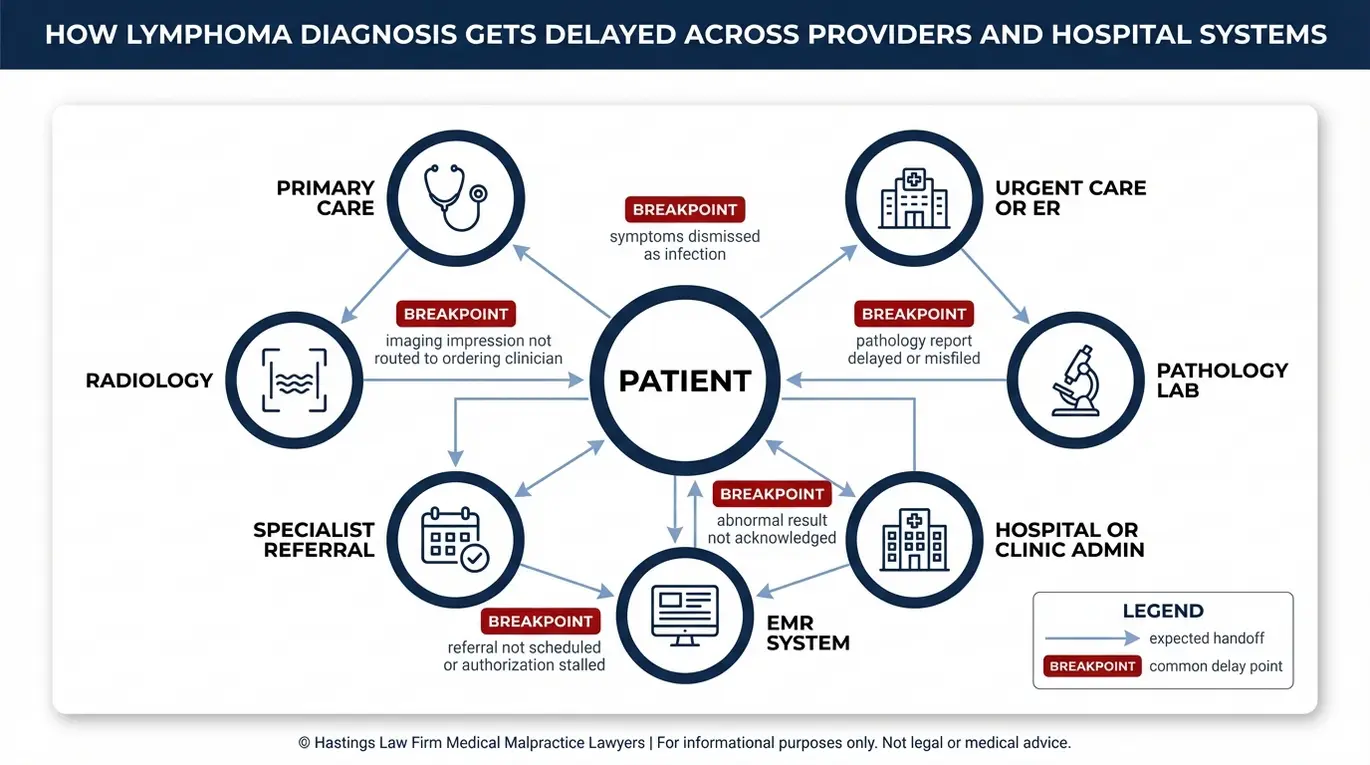
Delayed diagnoses often result from systemic failures, including communication errors between providers, mishandled lab results, or a physician dismissing early symptoms as minor illnesses. Systemic failures refer to breakdowns in the way a hospital or clinic manages information and care protocols. These are not always the fault of one person; sometimes the breakdown happens across an entire system of care.
The most common causes we investigate include:
- Dismissal of symptoms: A doctor attributing swollen lymph nodes, fatigue, or unexplained weight loss to a routine infection or the flu, with no follow-up testing ordered when symptoms persist.
- Communication breakdowns: A radiologist identifies a suspicious mass on imaging, but the finding never reaches the primary care physician who ordered the scan. The patient is never told.
- Electronic Medical Records (EMR) failures: Lost pathology reports, misfiled test results, or alerts buried in a digital system that no one reviews. These system errors can delay a diagnosis by weeks or months.
- Understaffing and time pressure: Overloaded clinics where providers rush through appointments, skip screening protocols, or fail to document follow-up plans.
Research published through Improving Diagnosis in Health Care identifies diagnostic error as a significant patient safety concern. Communication and system-level failures contribute heavily to missed and delayed cancer diagnoses. When we investigate these cases, we trace the chain of information from the first symptom report through every provider, lab, and record system involved to determine where the process broke down.
The Hastings Law Firm Difference
Results matter, but what truly sets us apart is how we achieve them. Every verdict, every settlement, and every Arizona courtroom victory comes from one guiding promise: To treat each client’s fight for justice as if it were our own.
This balance of skill, experience, and empathy reflects our core philosophy that justice should not only compensate the injured, but also make health care safer nationwide.

Recognizing Symptoms and Diagnostic Testing Failures
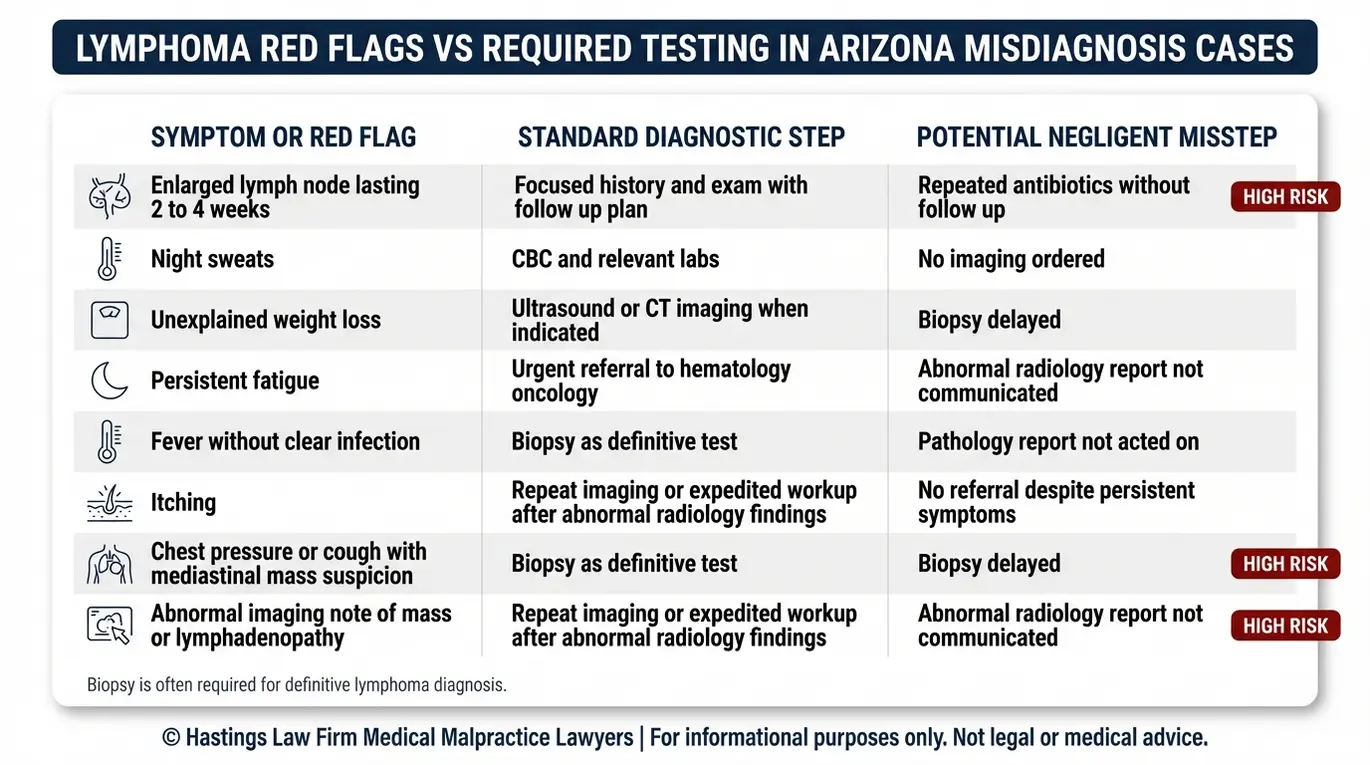
Medical malpractice may exist if a doctor ignores persistent symptoms like swollen lymph nodes or chronic fatigue and fails to order a biopsy or imaging study to rule out cancer. Diagnostic testing refers to the imaging and lab work used to find the cause of symptoms. Certain symptoms should prompt immediate investigation, and a physician who overlooks them may be falling below the standard of care.
The American Cancer Society’s guide on Hodgkin Lymphoma signs and symptoms identifies several red flags that warrant diagnostic follow-up. According to the National Cancer Institute’s Hodgkin Lymphoma Treatment guidelines, timely biopsy and staging are essential for appropriate treatment planning.
| Symptom | Standard Diagnostic Test | Potentially Negligent Response |
|---|---|---|
| Enlarged, painless lymph node | Biopsy (excisional or CT-guided) | Prescribing antibiotics without follow-up |
| Persistent night sweats | CBC, imaging (CT/MRI) | Attributing to stress or menopause without workup |
| Unexplained weight loss (>10%) | PET/CT scan, bloodwork | Recommending dietary changes only |
| Chronic, unexplained fatigue | Complete blood panel, imaging | Diagnosing depression without further testing |
A biopsy remains the only way to definitively diagnose lymphoma. An excisional lymph node biopsy, where a surgeon removes an entire lymph node for examination, provides the most reliable tissue sample. A fine-needle aspiration (FNA), a procedure using a thin needle to extract a small cell sample, is sometimes performed first but may not collect enough tissue to confirm a lymphoma diagnosis. When an Arizona lymphoma lawyer reviews your case, one of the first things we examine is whether appropriate diagnostic testing was ordered, and how quickly.
False Negatives and Pathology Errors
A false negative, where a pathologist misreads a tissue sample and reports it as non-cancerous when cancer cells are present, means the patient is told they are cancer-free, and treatment never begins. These errors can stem from inadequate tissue samples, improper staining techniques, or a pathologist’s failure to order immunophenotyping (flow cytometry), a laboratory method that uses antibodies to identify specific cell types and confirm whether abnormal lymphocytes are cancerous.
When a pathology report comes back negative but symptoms persist, the standard of care typically calls for repeat testing or a referral. A misdiagnosis at the pathology level can cause months of lost time, during which the cancer may spread.
The Standard of Care in Lymphoma Detection
The standard of care requires a physician to act as a reasonably prudent doctor would under similar circumstances, which includes following established clinical guidelines for screening, testing, and referral when cancer is suspected. In the context of lymphoma, this means a doctor who sees persistent, unexplained symptoms should be thinking about malignancy as a possibility, not ruling it out prematurely.
Objective benchmarks help define what “reasonable” looks like. Clinical protocols from organizations such as the National Comprehensive Cancer Network outline when biopsies, imaging, and specialist referrals should be ordered based on symptoms. Research reviewed through PSNet’s integrative review on interventions to improve timely cancer diagnosis highlights how adherence to established clinical guidelines reduces the risk of delay.
A deviation from these protocols is the foundation of a malpractice claim. As a misdiagnosis attorney in Arizona, we work with oncologists and other specialists to compare what your doctor did against what the guidelines required. If there is a gap between the two, and that gap caused harm, the basis for a case begins to take shape.
Proving Malpractice for Delayed Lymphoma Treatment
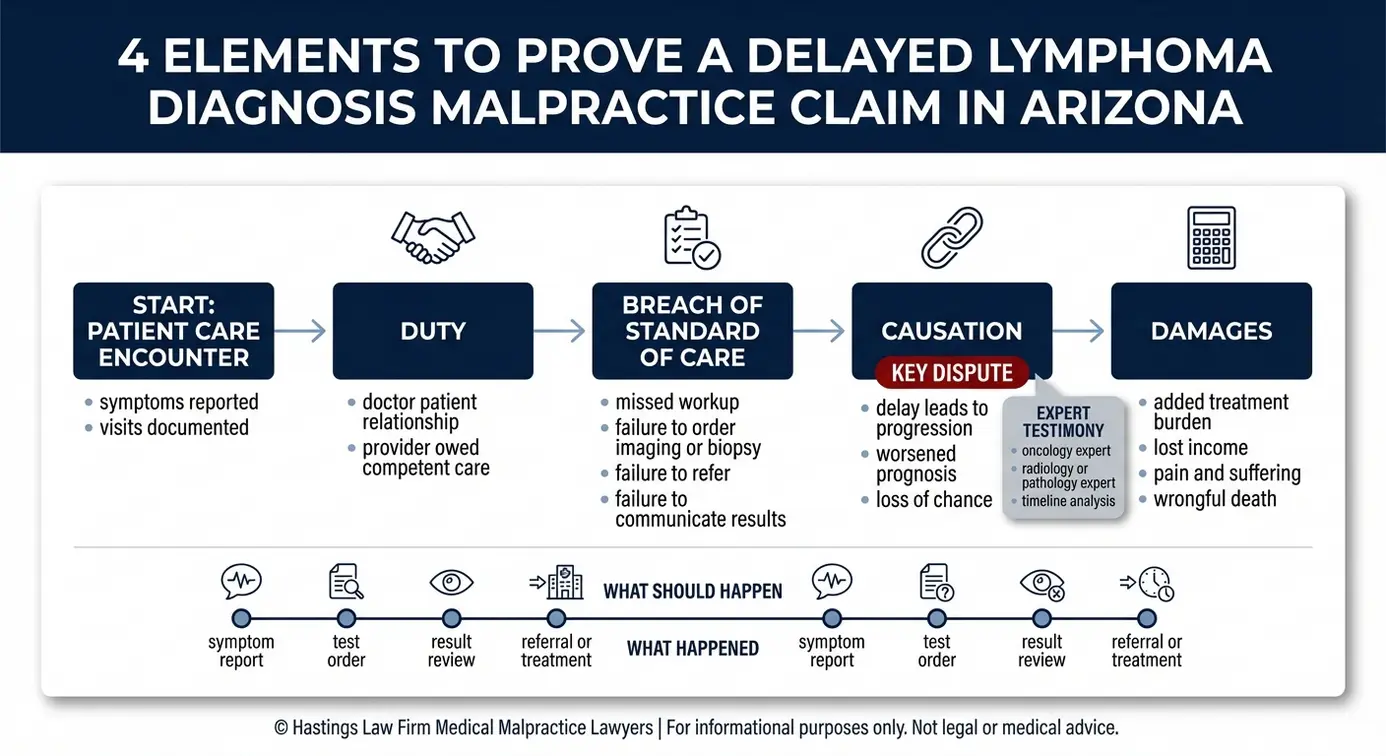
To prove malpractice, you must demonstrate that a doctor-patient relationship existed, the doctor breached the standard of care, that breach directly caused a worsened prognosis or injury, and that you suffered quantifiable harm as a result. These are the four legal elements that every delayed diagnosis lawyer must establish to prove liability and satisfy the burden of proof.
Here is how each element works:
- Duty: A doctor-patient relationship existed, creating a legal obligation to provide competent care. This is usually the simplest element to prove.
- Breach: The physician made a specific error, such as failing to order a biopsy, ignoring imaging results, or not referring you to an oncologist when symptoms warranted it.
- Causation: The delay directly contributed to the cancer’s progression. For example, if the cancer advanced from Stage I to Stage III during the period of delay, we must connect that advancement to the diagnostic failure. This connection establishes proximate cause. Expert testimony about the Ann Arbor staging system is essential to your case. This system classifies lymphoma based on the location of affected lymph nodes and organs. A PET/CT scan, an imaging study that combines metabolic and structural data to map cancer activity throughout the body, often provides critical evidence about disease progression.
- Damages: You suffered quantifiable harm as a result, whether that means more aggressive treatment, higher medical costs, reduced quality of life, or a worse long-term prognosis.
Arizona law under A.R.S. § 12-2603 requires a Preliminary Expert Opinion Affidavit during the early stages of a medical malpractice lawsuit. This means a qualified medical expert must certify that the care you received fell below the accepted standard and caused your injury. Our team handles every aspect of securing and coordinating this expert testimony.
Overcoming the Inevitable Harm Defense
One of the most common defense strategies in delayed cancer diagnosis cases is arguing that the patient would have faced the same outcome regardless of when the diagnosis was made. This “inevitable harm” defense attempts to break the causation link.
We counter this by working with oncology experts who analyze survival data, staging timelines, and treatment response rates. If the evidence shows that earlier detection would have offered a meaningfully better chance of remission, less invasive treatment, or longer survival, the defense argument loses its foundation. This causation rebuttal is critical. Expert testimony grounded in clinical data is the most effective way to establish that the delay changed the trajectory of the disease, allowing metastasis or advanced progression.
Recoverable Damages for Cancer Misdiagnosis in Arizona
Patients harmed by lymphoma misdiagnosis in Arizona may recover damages for additional medical costs, lost income, pain and suffering, and the loss of chance for a better outcome. The National Cancer Institute’s guide on managing cancer costs illustrates just how quickly expenses escalate when a cancer diagnosis is delayed and more aggressive treatment becomes necessary.
Recoverable damages in these cases generally fall into three categories:
- Economic damages: Past and future medical bills, including chemotherapy, radiation, surgery, and ongoing monitoring that may have been avoidable or less extensive with a timely diagnosis. Economic damages also include lost wages and diminished earning capacity.
- Non-economic damages: Pain, suffering, emotional distress, anxiety related to a worsened prognosis, and the loss of enjoyment of life. These damages reflect the personal toll that a diagnostic failure takes on you and your family.
- Wrongful death damages: If a loved one passed away because of a delayed lymphoma diagnosis, surviving family members may pursue compensation for funeral expenses, loss of companionship, lost financial support, and the suffering endured before death.
An Arizona lymphoma misdiagnosis lawyer at our firm evaluates the full scope of harm, not just current bills, but the long-term financial and personal impact of the delay.
Contact the Arizona Misdiagnosis Attorneys at Hastings Law Firm Today for Help
You do not have to face the medical system alone. If a diagnostic failure changed the course of your cancer treatment, or if you lost a family member because of a delayed lymphoma diagnosis, our team is ready to listen and investigate.
Hastings Law Firm operates on a contingency fee basis, which means you pay no attorney fees or costs unless we secure a recovery for you. Every case begins with a free, confidential evaluation led by our medical-legal team, including in-house nurse consultants and board-certified patient advocates who understand both the medicine and the law.
We know something went wrong. Let us help you find out exactly what happened and whether you have a case. Contact us today to start the conversation.
Frequently Asked Questions About Lymphoma Misdiagnosis in Arizona


This content was researched and written by the Hastings Law Firm editorial team, which includes attorneys, medical professionals, and experienced researchers. Our writing is informed by internal knowledge and practical experience, and we cross-check critical details against authoritative sources cited throughout. Every piece undergoes human-led fact-checking and legal review. Because legal and medical information can change, if you spot an error, please contact us. Learn more about our content standards and review process on our editorial policy page.

Tommy Hastings, founder of Hastings Law Firm, is a board-certified personal injury trial lawyer dedicated exclusively to healthcare injury cases. Since 2001, he has represented injured patients and families in litigation against major hospital systems, pharmaceutical companies, and negligent healthcare providers nationwide. He has handled numerous high-profile cases that have drawn national media attention and resulted in multi-million dollar recoveries. He draws on that experience in his writing, helping readers understand how these cases work and what options may be available to them.
