


Arizona Thyroid Cancer Misdiagnosis Lawyer
A delayed or incorrect thyroid cancer diagnosis can lead to more advanced disease, more aggressive treatment, and lasting physical and emotional strain. Errors may happen when symptoms are dismissed, imaging is not ordered, or biopsy and pathology results are misread, and the harm can grow as time passes. Some patients also face unnecessary surgery after a false positive result. Understanding how these breakdowns occur can help clarify why accountability matters after a serious medical mistake. If you or a loved one were harmed or worse due to thyroid cancer misdiagnosis in Arizona, contact Hastings Law Firm for a free, confidential case review.

Last Updated: July 27, 2026
Trusted Arizona Medical Attorneys for Delayed Thyroid Cancer Diagnosis
When thyroid cancer is missed or diagnosed too late, the consequences can change the entire course of your life. You may be facing treatments that could have been avoided, or learning that your condition has advanced beyond what it should have. That kind of experience can leave you feeling overwhelmed and unsure of who to trust.
At Hastings Law Firm, we focus exclusively on medical malpractice. Our legal team, which includes in-house nurse consultants and former defense attorneys, understands both the medicine and the legal strategy these cases demand. As a dedicated Arizona thyroid cancer misdiagnosis lawyer, we are prepared to investigate what happened and hold the responsible parties accountable.
If you believe your thyroid cancer was missed or delayed, we can review your medical records and explain your options. The consultation is free, and you pay no fees unless we recover compensation on your behalf.

Common Errors Leading to Thyroid Cancer Misdiagnosis
Thyroid cancer misdiagnosis typically occurs when medical providers fail to order necessary ultrasounds for palpable nodules, misinterpret biopsy results, or dismiss patient complaints as benign conditions. These errors result in a delayed diagnosis that can hold back treatment by months or even years, allowing the cancer to spread.
In many cases, the specific diagnostic tests and process break down at one or more critical steps. A thyroid ultrasound, a non-invasive imaging test used to evaluate the size, shape, and composition of thyroid nodules, may never be ordered despite clear clinical indications. When imaging is performed, a radiologist may fail to identify suspicious characteristics or miss signs that the cancer has spread to nearby lymph nodes.
Another common failure involves fine needle aspiration (FNA), a procedure where a thin needle is used to extract a small tissue sample from a thyroid nodule for laboratory analysis. A study published in PubMed Central on clinicopathological characteristics of thyroid cancer misdiagnosed by fine needle aspiration documented how errors in FNA interpretation can lead to false negative results, where malignant cells are incorrectly classified as benign. When that happens, a patient may be told nothing is wrong while their cancer continues to grow.
Our Arizona thyroid cancer misdiagnosis attorneys look for specific red flags when reviewing these cases:
- A doctor dismissed symptoms like persistent hoarseness, difficulty swallowing, or a visible neck mass as a minor throat infection or thyroid inflammation
- No ultrasound was ordered after a nodule was detected during a physical exam
- An FNA biopsy was performed but the tissue sample was inadequate or misread
- Radiology reports failed to note irregular nodule borders, microcalcifications, or lymph node involvement
- Follow-up imaging or repeat biopsy was not scheduled after inconclusive results
Each of these breakdowns can represent a point where a timely diagnosis should have been made but was not.
Unnecessary Thyroidectomy Due to Pathology Errors
Misdiagnosis does not always mean cancer was missed. In some cases, the opposite occurs. A pathologist may incorrectly classify benign thyroid cells as cancerous, producing a false positive, a test result that wrongly indicates disease is present. This error can lead to an unnecessary thyroidectomy, the surgical removal of part or all of the thyroid gland.
Patients who undergo this surgery when it was not medically needed face a lifetime of hormone replacement therapy and the physical risks of any major operation. These cases raise serious questions about the pathologist’s adherence to accepted diagnostic standards, and they can form the basis of a medical malpractice claim.

Proving Negligence: The Standard of Care for Thyroid Diagnosis
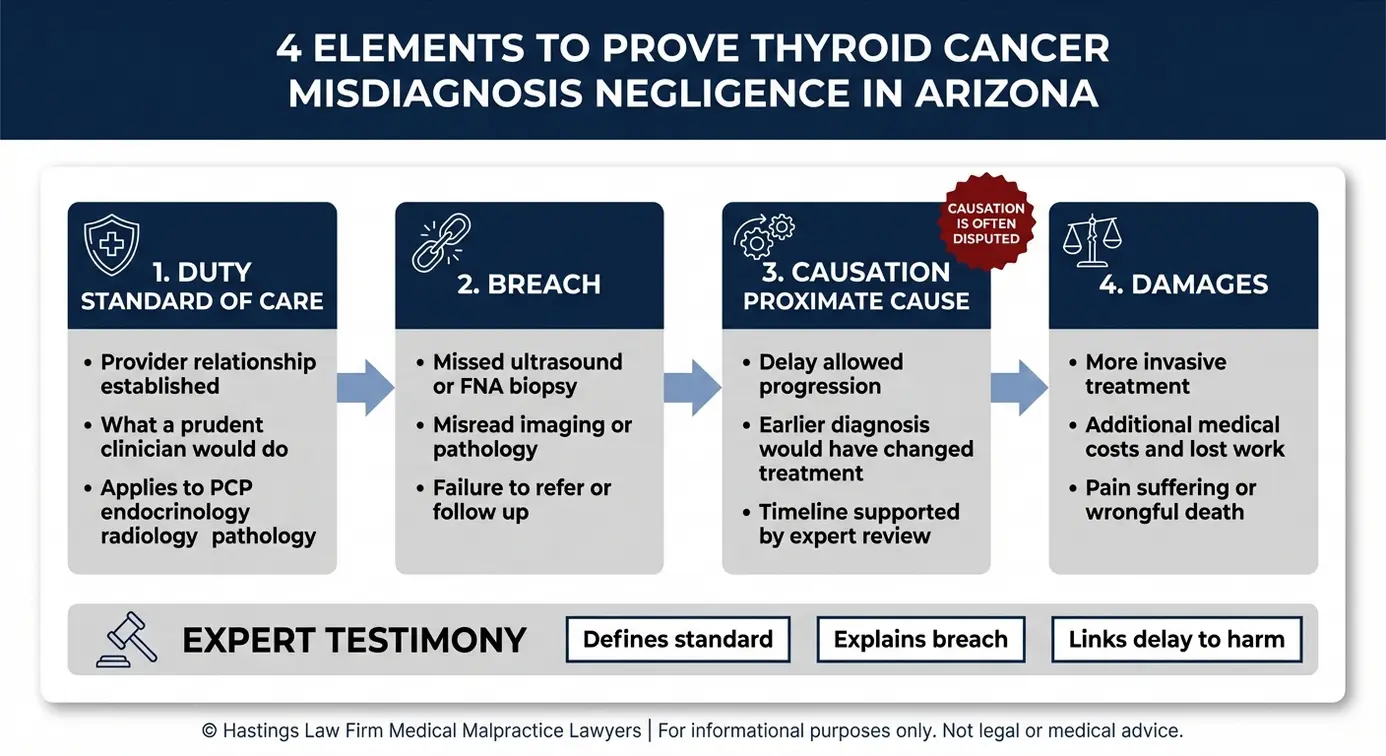
To prove negligence in Arizona, a plaintiff must demonstrate that the physician deviated from the accepted medical standard of care, directly causing the cancer to progress to a less treatable stage. This is the foundation of every medical malpractice claim involving a missed or delayed thyroid cancer diagnosis.
The standard of care refers to the level of treatment a reasonably competent doctor in the same specialty would have provided under similar circumstances. For a primary care physician, that may mean ordering an ultrasound after discovering a thyroid nodule, an abnormal growth of cells within the thyroid gland. For an endocrinologist or radiologist, the standard may require recommending an FNA biopsy when imaging shows suspicious features. A false negative, a result that incorrectly shows no disease, does not automatically mean negligence occurred, but the circumstances surrounding that result matter.
As a firm focusing exclusively on medical malpractice, we understand that establishing this breach involves a detailed analysis of the timeline. We must show that a prudent doctor would have acted differently, such as ordering a biopsy sooner or following up on ambiguous test results immediately. Once we identify where the standard was breached, the next step is establishing causation. Under Arizona Revised Statutes § 12-563, the patient must prove that the breach was the proximate cause of the harm. In a delayed diagnosis case, this means showing that the delay allowed the cancer to advance, requiring more aggressive treatment or reducing the chance of a favorable outcome.
The law requires expert testimony to establish both the breach and the connection between that breach and the patient’s injuries. A lawyer for thyroid cancer errors in Arizona must work with qualified specialists, such as oncologists, endocrinologists, or pathologists, who can explain what should have been done differently and how the delay affected the patient’s prognosis. At Hastings Law Firm, we maintain a national network of medical experts who provide the credible, detailed testimony these cases require.
The Hastings Law Firm Difference
Results matter, but what truly sets us apart is how we achieve them. Every verdict, every settlement, and every Arizona courtroom victory comes from one guiding promise: To treat each client’s fight for justice as if it were our own.
This balance of skill, experience, and empathy reflects our core philosophy that justice should not only compensate the injured, but also make health care safer nationwide.

Identifying Liable Parties in Arizona Thyroid Cancer Cases
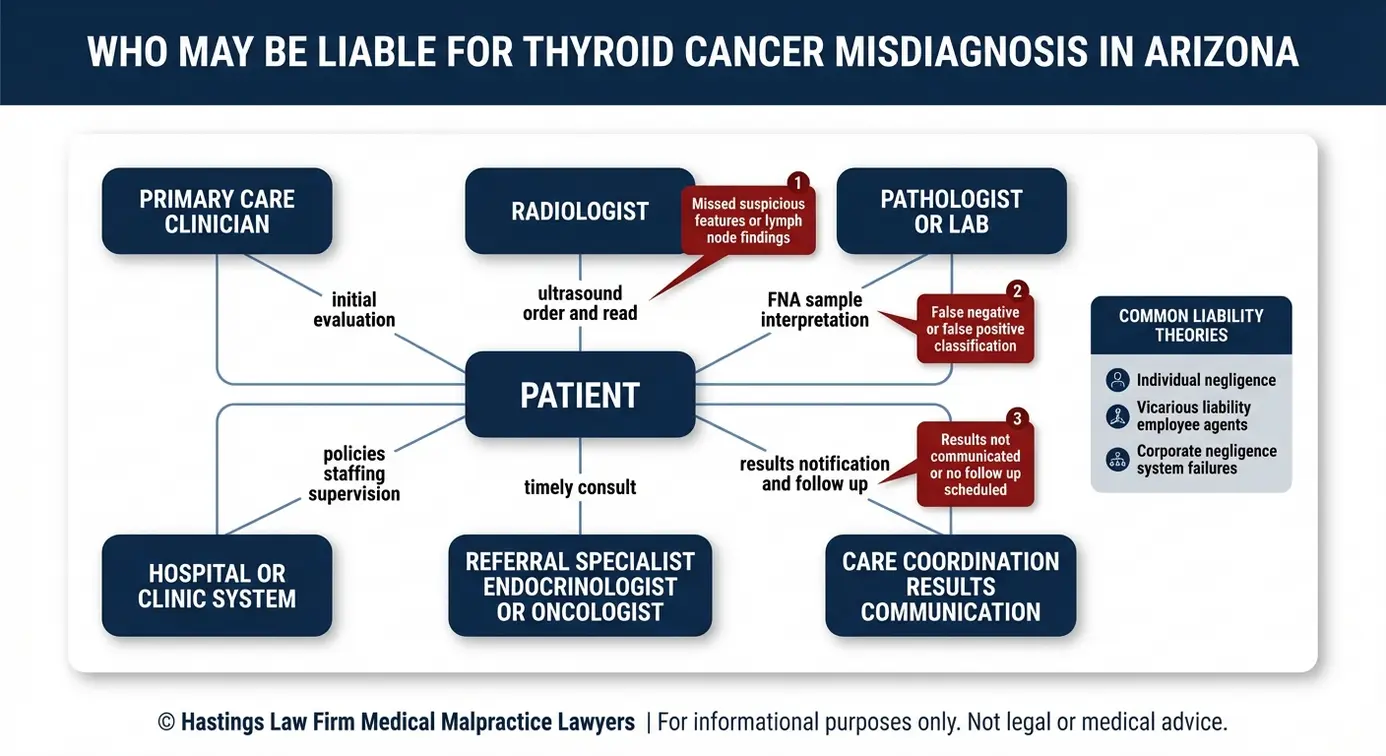
Liability often extends beyond the primary care physician to include radiologists who misread scans, pathologists who misinterpret tissue samples, and the hospital systems that employ them. An experienced Arizona thyroid cancer misdiagnosis lawyer will investigate every provider who touched the diagnostic process.
Thyroid cancer diagnosis involves multiple handoffs between specialists, and an error at any stage can cause harm. Liability often extends beyond the primary care physician or oncologist to include radiologists who misread scans.
Identifying liable parties requires a careful review of the medical records, imaging studies, lab reports, and internal communications. Under federal privacy law, patients have the right to access their own health information, as outlined by the U.S. Department of Health and Human Services’ guidance on individuals’ rights under HIPAA. Obtaining these records is often one of the first steps in building a case.
Potential liable parties in an Arizona thyroid cancer case may include:
- Radiologists who failed to identify signs of malignancy or lymph node involvement, the spread of cancer cells to lymph nodes near the thyroid, on ultrasound or other imaging
- Pathologists who misclassified biopsy samples, whether producing a false negative that delayed treatment or a false positive that led to unnecessary surgery
- Primary care physicians who failed to refer the patient for appropriate diagnostic testing despite clinical warning signs
- Hospitals and clinics that may bear responsibility for hospital negligence and systemic failures, such as understaffing, poor communication of test results, or inadequate follow-up protocols
As your thyroid misdiagnosis counsel, we trace the diagnostic timeline from the first reported symptom to the eventual correct diagnosis, identifying each point where the process failed.
The Impact of Delay: Progression and Aggressive Treatment
A delayed diagnosis can allow thyroid cancer to metastasize, transforming a highly treatable condition into a life-threatening illness requiring aggressive radiation, chemotherapy, or radical surgery. This process, known as metastasis, means the cancer spreads from the thyroid to other parts of the body, such as the lungs or bones.
Data from the National Cancer Institute’s SEER Explorer illustrates the difference that early detection makes:
| Factor | Timely Diagnosis (Localized) | Delayed Diagnosis (Distant/Metastatic) |
|---|---|---|
| Typical Stage at Detection | Stage I or II | Stage III or IV |
| Treatment Approach | Partial thyroidectomy, monitoring | Radical surgery, radiation, chemotherapy |
| 5-Year Survival Rate | Near 100% | Significantly reduced |
| Physical Burden | Minimal to moderate | Severe, long-term side effects |
When diagnosis is delayed, patients may face radical neck dissection, radioactive iodine (RAI) therapy, a treatment that uses radioactive iodine to destroy remaining thyroid tissue and cancer cells after surgery, or external radiation. These treatments carry serious side effects that a timely diagnosis could have prevented. These advanced treatments not only increase the physical burden but also significantly inflate the economic damages a patient incurs.
Arizona also recognizes a legal principle that can apply in these situations. As discussed by the Arizona Bar Foundation’s analysis of Arizona’s Loss of a Chance doctrine, a patient may seek compensation for the reduced probability of survival or cure caused by a provider’s negligence. This process, known as metastasis, can significantly alter a patient’s prognosis. Lawyers for missed cancer diagnosis use this doctrine when the delay meaningfully changed the patient’s statistical outcome, even if a full cure was never certain.
Recoverable Damages for Misdiagnosis Victims in Arizona
Patients harmed by cancer misdiagnosis in Arizona may recover compensation for medical bills, lost wages, pain and suffering, and in tragic cases, wrongful death damages for the family. The specific damages depend on how the misdiagnosis affected the patient’s health, finances, and quality of life.
Economic damages cover the measurable financial losses tied to the misdiagnosis:
- Past and future medical costs, including surgeries, chemotherapy, radiation, and ongoing monitoring
- Lost wages and reduced earning capacity if the patient can no longer work or must reduce their hours
- Costs of home care, rehabilitation, or assistive services
Non-economic damages address the personal toll of the misdiagnosis:
- Physical pain and suffering caused by advanced-stage treatment that could have been avoided
- Emotional distress, anxiety, and depression related to a worsened prognosis. This includes the profound loss of stability and the anxiety of facing a shortened life expectancy
- Loss of enjoyment of life and the ability to participate in daily activities
Wrongful death damages may be available to surviving family members when a delayed or missed thyroid cancer diagnosis contributes to the patient’s death. These claims can include compensation for funeral expenses, loss of financial support, and the loss of companionship and guidance. Families often face significant financial strain after losing a provider, and these damages aim to stabilize their future.
An experienced Arizona thyroid cancer malpractice attorney can evaluate the full scope of your losses and work with medical and financial experts to document both current and future damages.
Contact the Arizona Misdiagnosis Attorneys at Hastings Law Firm Today for Help
If you or someone you love received a delayed or incorrect thyroid cancer diagnosis, you do not have to carry this burden alone. At Hastings Law Firm, our team of attorneys, nurse consultants, and medical experts investigates every case with the goal of uncovering what went wrong and who is responsible.
Our founder, Tommy Hastings, is a board-certified trial lawyer who has dedicated his career to helping patients affected by medical errors. We prepare every case as if it will go to trial. That level of preparation signals to hospitals and their insurers that we will not accept less than fair compensation for the harm you have suffered.
Our Phoenix office is available to serve patients throughout Arizona, and our national network allows us to handle complex cases wherever they arise. As your Arizona thyroid cancer misdiagnosis lawyer, we are ready to listen, investigate, and pursue the free, confidential case evaluation you deserve.
Contact us today to understand your options. You pay no attorney fees unless we recover compensation for you.
Frequently Asked Questions About Thyroid Cancer Misdiagnosis in Arizona


This content was researched and written by the Hastings Law Firm editorial team, which includes attorneys, medical professionals, and experienced researchers. Our writing is informed by internal knowledge and practical experience, and we cross-check critical details against authoritative sources cited throughout. Every piece undergoes human-led fact-checking and legal review. Because legal and medical information can change, if you spot an error, please contact us. Learn more about our content standards and review process on our editorial policy page.

Tommy Hastings, founder of Hastings Law Firm, is a board-certified personal injury trial lawyer dedicated exclusively to healthcare injury cases. Since 2001, he has represented injured patients and families in litigation against major hospital systems, pharmaceutical companies, and negligent healthcare providers nationwide. He has handled numerous high-profile cases that have drawn national media attention and resulted in multi-million dollar recoveries. He draws on that experience in his writing, helping readers understand how these cases work and what options may be available to them.
