


Arizona Leukemia Misdiagnosis Lawyer
A delayed or missed leukemia diagnosis can leave a patient facing a more advanced disease, harsher treatment, and a reduced chance of survival. These situations often involve missed warning signs, incomplete testing, or a failure to follow up on abnormal results. In Arizona, symptom overlap with Valley Fever can add to the risk of diagnostic error when cancer is not ruled out. Understanding how diagnostic failures happen can help families make sense of what went wrong and what the consequences mean. If you or a loved one were harmed or worse due to leukemia misdiagnosis in Arizona, contact Hastings Law Firm for a free, confidential case review.

Last Updated: July 27, 2026
Compassionate Arizona Medical Attorneys for Delayed Leukemia Diagnosis Claims
When leukemia is missed or misdiagnosed, the consequences can change the course of a life. If you or someone you love received a delayed or incorrect leukemia diagnosis, you may be dealing with a more advanced disease, harsher treatments, and questions that no one seems willing to answer. You deserve to know what happened and whether the care you received fell short.
At Hastings Law Firm, we focus exclusively on medical malpractice. Founded by Tommy Hastings, a board-certified trial attorney, our team of lawyers, in-house nurse consultants, and medical experts has the experience to evaluate whether a diagnostic failure caused real harm. As Arizona leukemia misdiagnosis lawyers, we can review your medical records, explain your legal options, and help you understand what should have been done differently.
Contact us for a free, confidential case evaluation. There is no fee unless we recover compensation for you.

Understanding Leukemia Misdiagnosis and Delayed Diagnosis Claims
A leukemia misdiagnosis claim arises when a healthcare professional fails to identify, test for, or correctly interpret signs of blood cancer, deviating from the accepted standard of care and directly resulting in a worsened prognosis or death. These medical malpractice claims fall into two broad categories, and understanding the difference matters for building a strong case.
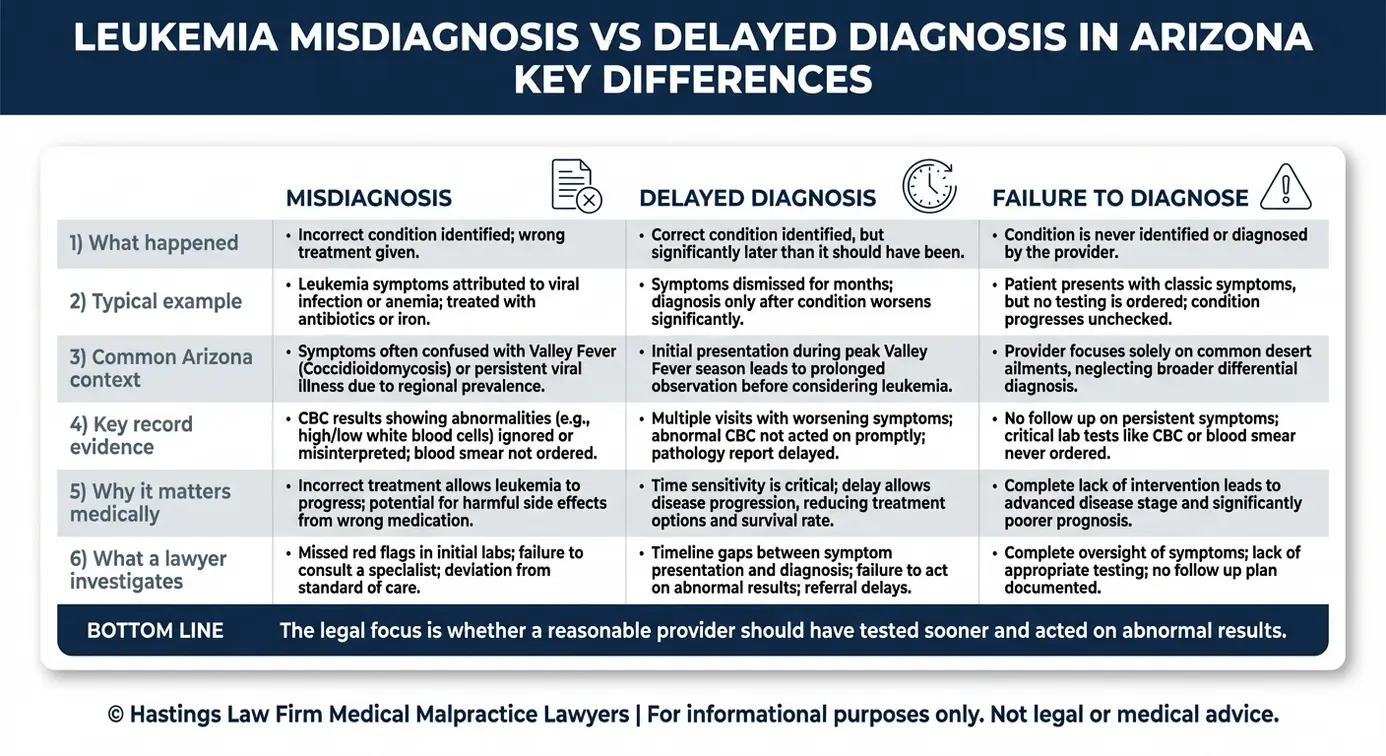
A complete misdiagnosis occurs when a doctor diagnoses the wrong condition entirely. Leukemia is a cancer of the blood and bone marrow that results in the overproduction of abnormal white blood cells. A patient presenting with fatigue, unexplained bruising, and recurrent fevers may be told they have an infection or a viral illness, when blood work would have revealed the cancer.
A delayed diagnosis means the doctor eventually identifies the cancer, but only after a critical window of time has passed, allowing the disease to progress. This distinction is especially relevant in Arizona. The state has a high incidence of Coccidioidomycosis, commonly known as Valley Fever, a fungal infection that shares symptoms with leukemia, including fatigue, fever, night sweats, and weight loss.
As the Arizona Department of Health Services has highlighted, Valley Fever awareness is a public health priority in the state. But when a doctor attributes persistent symptoms to Valley Fever without ordering further blood work to rule out cancer, a treatable condition can become a terminal one. When an Arizona leukemia misdiagnosis lawyer investigates these cases, the central question is whether earlier action would have changed the outcome.
The types of diagnostic failures we evaluate include:
- Misdiagnosis: The doctor diagnosed a different condition entirely, such as an infection, anemia, or Valley Fever.
- Delayed diagnosis: The correct diagnosis was eventually made, but only after the cancer had advanced to a later stage.
- Failure to diagnose: The doctor never identified the leukemia at all, and it was only discovered by another provider or after the patient’s condition became critical.
If your search for an Arizona delayed cancer diagnosis lawyer has led you here, the next step is understanding whether the provider met the expected standard of care.
Did the Doctor Violate the Standard of Care for Leukemia Detection?
Malpractice occurs when a physician fails to act as a reasonably competent doctor would under similar circumstances, such as not ordering a Complete Blood Count (CBC), a routine blood test that measures the types and numbers of cells in your blood, when a patient presents with classic leukemia symptoms.
Every doctor has a duty of care to investigate when symptoms are persistent and unexplained. Persistent fatigue, recurring infections, and unintentional weight loss should prompt testing. When a physician stops at a surface-level diagnosis without looking deeper, that can represent a breach of the standard of care.
According to the Initial Diagnostic Workup of Acute Leukemia guideline endorsed by the College of American Pathologists and American Society of Hematology, the expected diagnostic tests for suspected leukemia typically include:
- Complete Blood Count (CBC): The first-line screening test that can reveal abnormal white blood cell counts.
- Peripheral blood smear: A microscopic examination of a blood sample that allows a pathologist to evaluate the shape and appearance of blood cells.
- Flow cytometry: A laboratory technique that identifies specific cell types, helping to classify the type of leukemia.
- Bone marrow biopsy: A procedure to collect and examine bone marrow tissue, considered the definitive test for confirming a leukemia diagnosis.
In Arizona, the overlap between Valley Fever and leukemia symptoms creates risk. A failure to diagnose leukemia lawyer will evaluate whether the physician relied on a Coccidioidomycosis diagnosis without ruling out malignancy. Ignoring abnormal results or failing to order a CBC can form the basis of a negligence claim.
Under Arizona Revised Statutes § 12-542, patients generally have two years from the date the injury was discovered to file a lawsuit. An Arizona leukemia misdiagnosis lawyer can help determine when that clock started and whether your claim falls within the filing deadline.

The Hastings Law Firm Difference
Results matter, but what truly sets us apart is how we achieve them. Every verdict, every settlement, and every Arizona courtroom victory comes from one guiding promise: To treat each client’s fight for justice as if it were our own.
This balance of skill, experience, and empathy reflects our core philosophy that justice should not only compensate the injured, but also make health care safer nationwide.

Common Causes of Diagnostic Errors in Arizona Hospitals
Diagnostic errors often stem from systemic failures, including laboratory communication breakdowns, physician dismissal of patient complaints, or failure to follow up on abnormal blood work results. Our team includes former defense attorneys who understand how hospital systems attempt to explain away these errors. As a report from the National Academies of Sciences, Engineering, and Medicine on Improving Diagnosis in Health Care found, diagnostic errors affect an estimated 12 million U.S. adults each year.
The type of leukemia involved often determines how much a delay mattered.
| Leukemia Type | Progression | Common Diagnostic Errors |
|---|---|---|
| AML (Acute Myeloid Leukemia) | Rapid; weeks to months | Symptoms attributed to infection; CBC not ordered |
| ALL (Acute Lymphoblastic Leukemia) | Rapid; common in children | Dismissed as childhood illness or growing pains |
| CML (Chronic Myeloid Leukemia) | Slower; months to years | Abnormal CBC results not followed up |
| CLL (Chronic Lymphocytic Leukemia) | Slowest; may be incidental | Elevated white count noted but not investigated |
Errors in radiology or pathology can also cause missed diagnoses. A pathology report, the written analysis from a laboratory specialist, may contain errors if slides are misread. A false negative, a test result that incorrectly shows no disease, gives false reassurance, while a false positive leads to harmful unnecessary treatment.
Communication failures occur when a specialist flags an abnormal finding, but the primary doctor never reviews the report. These breakdowns leave a trail in the medical records. As cancer misdiagnosis lawyers, our team knows where to look for them.
An Arizona leukemia misdiagnosis lawyer examines every link to identify who may be liable.
Proving Negligence in Leukemia Cases: The Evidence We Need
To prove negligence, we must demonstrate four elements: a doctor-patient relationship existed, the doctor breached the standard of care, that breach directly caused the leukemia to advance, and specific damages resulted from the delay. Each element requires concrete evidence, and our medical-legal team focuses on building that evidence from the first day.
Step 1: Establishing the doctor-patient relationship. This is typically straightforward. Medical records, billing statements, and appointment logs confirm that the provider had a duty of care to the patient.
Step 2: Identifying the breach. We compare what the doctor did against what a reasonably competent physician would have done. Our in-house nursing staff and national network of oncology experts review the records to pinpoint where the care deviated and establish a breach of duty, whether it was a failure to order a bone marrow biopsy (a procedure where a small sample of bone marrow tissue is extracted and examined to confirm or rule out leukemia) or a failure to follow up on abnormal lab results.
Step 3: Proving causation. This is often the most challenging element in a leukemia lawsuit because we must establish that an earlier diagnosis would have led to a meaningfully better outcome. This is a concept sometimes called “loss of chance,” where a delay in care deprives a patient of the opportunity for a better recovery or survival. Our experts provide expert testimony to analyze the staging of the cancer at the time of the missed diagnosis compared to the stage at actual diagnosis. Flow cytometry results, which classify the specific type and behavior of abnormal cells, are often central to this analysis.
Step 4: Documenting damages. We calculate liability, the legal responsibility for medical negligence, and the full scope of harm, including additional medical costs, lost income, pain, and reduced life expectancy.
Gathering the complete medical record is essential. Under the U.S. Department of Health and Human Services HIPAA Right of Access rule, patients have the right to obtain copies of their health information. As an Arizona leukemia misdiagnosis lawyer, we handle this process and build a detailed timeline that reveals exactly what was known and what should have happened next.
An attorney for missed diagnosis cases understands that proving medical malpractice requires more than showing a bad outcome. It requires showing that the outcome was preventable.

Compensation for Advanced Stage Leukemia and Wrongful Death
Patients harmed by leukemia misdiagnosis may recover economic damages for medical bills and lost wages, as well as non-economic damages for pain, suffering, and reduced life expectancy caused by the delay.
Economic damages can include:
- The cost of more aggressive treatments, such as bone marrow transplants, that may not have been necessary with an earlier diagnosis
- Lost income and diminished earning capacity
- Past and future medical expenses related to the advanced disease
Non-economic damages may cover:
- Physical pain and emotional suffering
- Loss of consortium, the impact on the patient’s relationship with their spouse or family
- Loss of chance of survival or remission
In wrongful death cases, surviving family members may seek compensation for funeral expenses, loss of financial support, and the profound loss of companionship. A wrongful death lawyer for leukemia cases can help families understand what recovery may be available under Arizona law.
Every case involving damages for leukemia misdiagnosis is different. The value of a settlement or verdict depends on the specific medical facts, the degree of delay, and the impact on the patient’s life and family.
Contact the Arizona Misdiagnosis Attorneys at Hastings Law Firm Today for Help
We cannot undo a diagnostic failure. But we can work to uncover what happened, hold the responsible parties accountable, and help secure your family’s financial future.
At Hastings Law Firm, our team of attorneys, former defense lawyers, and in-house medical professionals focuses entirely on medical malpractice. We prepare every case as though it will go to trial, and that preparation allows us to negotiate from a position of strength.
If you are searching for an Arizona leukemia misdiagnosis lawyer, we encourage you to reach out. Our consultations are free and confidential. We can review your legal options to determine the best path forward, and you pay no attorney fees unless we recover compensation on your behalf.
Call us today or complete our online form to schedule a risk-free case evaluation. Let us help you find the answers you deserve.
Frequently Asked Questions About Leukemia Misdiagnosis in Arizona


This content was researched and written by the Hastings Law Firm editorial team, which includes attorneys, medical professionals, and experienced researchers. Our writing is informed by internal knowledge and practical experience, and we cross-check critical details against authoritative sources cited throughout. Every piece undergoes human-led fact-checking and legal review. Because legal and medical information can change, if you spot an error, please contact us. Learn more about our content standards and review process on our editorial policy page.

Tommy Hastings, founder of Hastings Law Firm, is a board-certified personal injury trial lawyer dedicated exclusively to healthcare injury cases. Since 2001, he has represented injured patients and families in litigation against major hospital systems, pharmaceutical companies, and negligent healthcare providers nationwide. He has handled numerous high-profile cases that have drawn national media attention and resulted in multi-million dollar recoveries. He draws on that experience in his writing, helping readers understand how these cases work and what options may be available to them.
