


Arizona Ovarian Cancer Misdiagnosis Lawyer
A delayed ovarian cancer diagnosis can leave patients feeling dismissed while a serious condition progresses. When persistent symptoms are not recognized or appropriate testing is not ordered, the disease may advance to a less treatable stage and lead to life threatening consequences. Missed findings on imaging, lab errors, and breakdowns in communication across providers can also contribute to harmful delays. Understanding how diagnostic failures happen and why timing matters can help families make informed decisions after a late diagnosis. If you or a loved one were harmed or worse due to delayed ovarian cancer diagnosis in Arizona, contact Hastings Law Firm for a free, confidential case review.

Last Updated: July 27, 2026
Compassionate Arizona Medical Attorneys for Delayed Ovarian Cancer Diagnosis Claims
When symptoms are repeatedly dismissed or attributed to something less serious, the experience can feel isolating. Many people describe medical gaslighting, a pattern where a healthcare provider minimizes legitimate concerns, leaving a patient without answers while a serious condition potentially progresses.
If you or a loved one received a late or missed ovarian cancer diagnosis, you may have legal options. An Arizona ovarian cancer misdiagnosis lawyer at Hastings Law Firm, founded by board-certified trial attorney Tommy Hastings, can review your medical records, evaluate what happened, and explain whether the care you received fell below the accepted medical standard.
Our firm focuses exclusively on medical malpractice. We understand both the medical science and the emotional weight behind these cases. A free, confidential case evaluation is a good place to start. There is no fee unless we recover compensation for you.

Understanding Delayed Diagnosis of Ovarian Cancer in Arizona
Delayed diagnosis of ovarian cancer occurs when a physician fails to order appropriate testing or misinterprets symptoms despite clinical evidence suggesting malignancy, allowing the disease to advance to a less treatable stage. In cancer cases, timing changes everything. A failure to diagnose ovarian cancer early can mean the difference between a treatable condition and a life-threatening one.
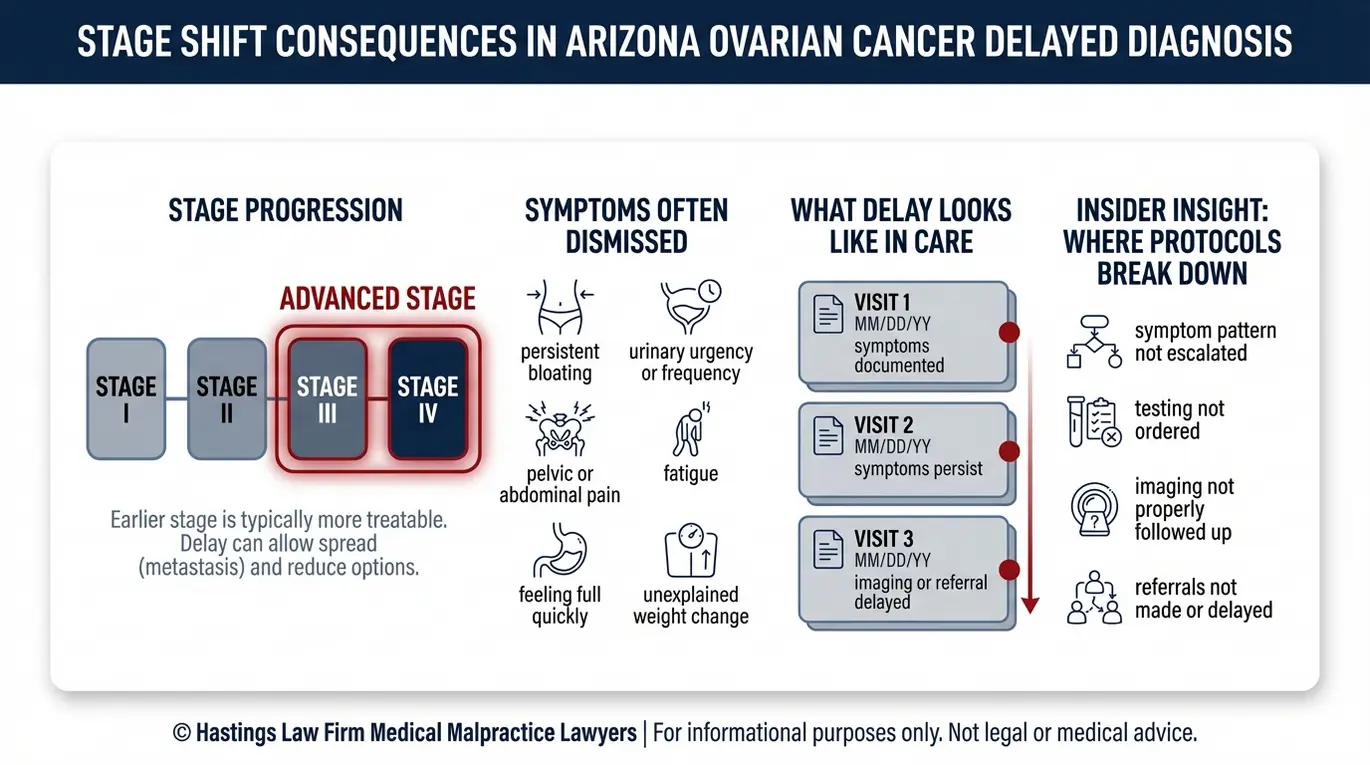
Ovarian cancer staging, a system describing how far the disease has spread at the time of detection, directly correlates with survival odds. Key statistics highlight the importance of early detection:
- Stage I: The cancer is confined to one or both ovaries and carries a five-year survival rate above 90%.
- Stage III or IV: The cancer has undergone metastasis, meaning it has spread beyond the ovaries to distant organs like the liver, lungs, or lymph nodes, causing survival rates to drop dramatically.
Ovarian cancer is sometimes called the “Silent Killer,” but that label is misleading. Research and clinical data show that many patients do present symptoms well before diagnosis. Those symptoms are simply not recognized or investigated properly because no universal screening test exists for the general population. This lack of routine screening makes clinical vigilance even more critical. According to data published by the Arizona Department of Health Services, ovarian cancer continues to affect Arizona women at rates that demand clinical vigilance.
Common early warning signs include:
- Persistent bloating that does not resolve
- Pelvic or abdominal pain lasting more than two weeks
- Difficulty eating or feeling full quickly
- Urinary urgency or increased frequency
These symptoms are often present months before a cancer misdiagnosis or delayed diagnosis is finally corrected. When a physician does not pursue further testing in the face of persistent complaints, the consequences can be devastating. For patients and families dealing with a worsened prognosis due to a diagnostic failure, speaking with an Arizona ovarian cancer misdiagnosis lawyer can help clarify whether medical malpractice may have occurred.
Common Medical Errors Leading to Missed Ovarian Cancer
Doctors frequently attribute early warning signs of ovarian cancer to benign conditions like irritable bowel syndrome or urinary tract infections, failing to order decisive imaging or blood work. This pattern of misdiagnosis represents one of the most common diagnostic errors in gynecologic oncology.
Our team uses insider insight from former defense attorneys and hospital nurses to examine these cases for charting inconsistencies. We evaluate whether a provider failed to follow protocols that could have led to an earlier discovery of the malignancy.
Conditions Often Confused with Ovarian Cancer
Ovarian cancer is a malignancy where symptoms often mimic less serious digestive or gynecological issues. The core problem is symptom overlap. Ovarian cancer symptoms closely mimic those of several non-cancerous conditions, and without a deliberate effort to rule out malignancy, a physician may settle on a less alarming explanation. An adnexal mass, which is any growth or lump found near the uterus, ovaries, or fallopian tubes, can be mistakenly identified as a simple cyst and left unmonitored.
According to the National Ovarian Cancer Coalition, the symptoms most commonly reported by ovarian cancer patients are the same ones frequently attributed to far less serious diagnoses. A study published by PubMed Central on symptoms in women with high-risk early-stage ovarian cancer confirms that most patients experience identifiable symptoms well before their eventual diagnosis.
The table below illustrates how common symptoms are often mislabeled:
| Patient Symptom | Common Misdiagnosis | Test That Should Have Been Ordered |
|---|---|---|
| Persistent bloating | IBS or dietary issues | CA-125 blood test, Transvaginal Ultrasound |
| Chronic pelvic pain | Endometriosis or ovarian cysts | Transvaginal Ultrasound (TVUS), CT scan |
| Urinary frequency/urgency | Urinary tract infection | Pelvic imaging, CA-125 |
| Feeling full quickly | Gastric disorder | CT scan or MRI if mass suspected |
| Unexplained weight change | Stress or hormonal shifts | CA-125, imaging, biopsy referral |
To investigate these symptoms properly, doctors rely on specific tools. The CA-125 blood test, a screening tool that measures a protein often elevated in women with ovarian cancer, is a primary indicator. A transvaginal ultrasound (TVUS), which uses sound waves to create images of the ovaries and surrounding structures, can identify physical abnormalities. While neither test is perfect on its own, together they give a physician meaningful information to either confirm or rule out cancer. If these initial tests suggest a problem, a biopsy is typically required to confirm the diagnosis.
Radiology errors also contribute to missed diagnoses. A CT scan or MRI may reveal a suspicious mass, but if the radiologist misreads the image or fails to flag the finding, the opportunity for early treatment can slip away. An Arizona ovarian cancer misdiagnosis lawyer examines these exact failures when evaluating a case.
The Hastings Law Firm Difference
Results matter, but what truly sets us apart is how we achieve them. Every verdict, every settlement, and every Arizona courtroom victory comes from one guiding promise: To treat each client’s fight for justice as if it were our own.
This balance of skill, experience, and empathy reflects our core philosophy that justice should not only compensate the injured, but also make health care safer nationwide.

Proving Malpractice and the Standard of Care
To prove malpractice in Arizona, a patient must demonstrate that a reasonably competent physician in the same specialty would have ordered testing or diagnosed the cancer earlier under similar circumstances. Proving malpractice involves demonstrating a breach of medical standards. This is the foundation of every medical malpractice claim, and it requires more than just showing a bad outcome.
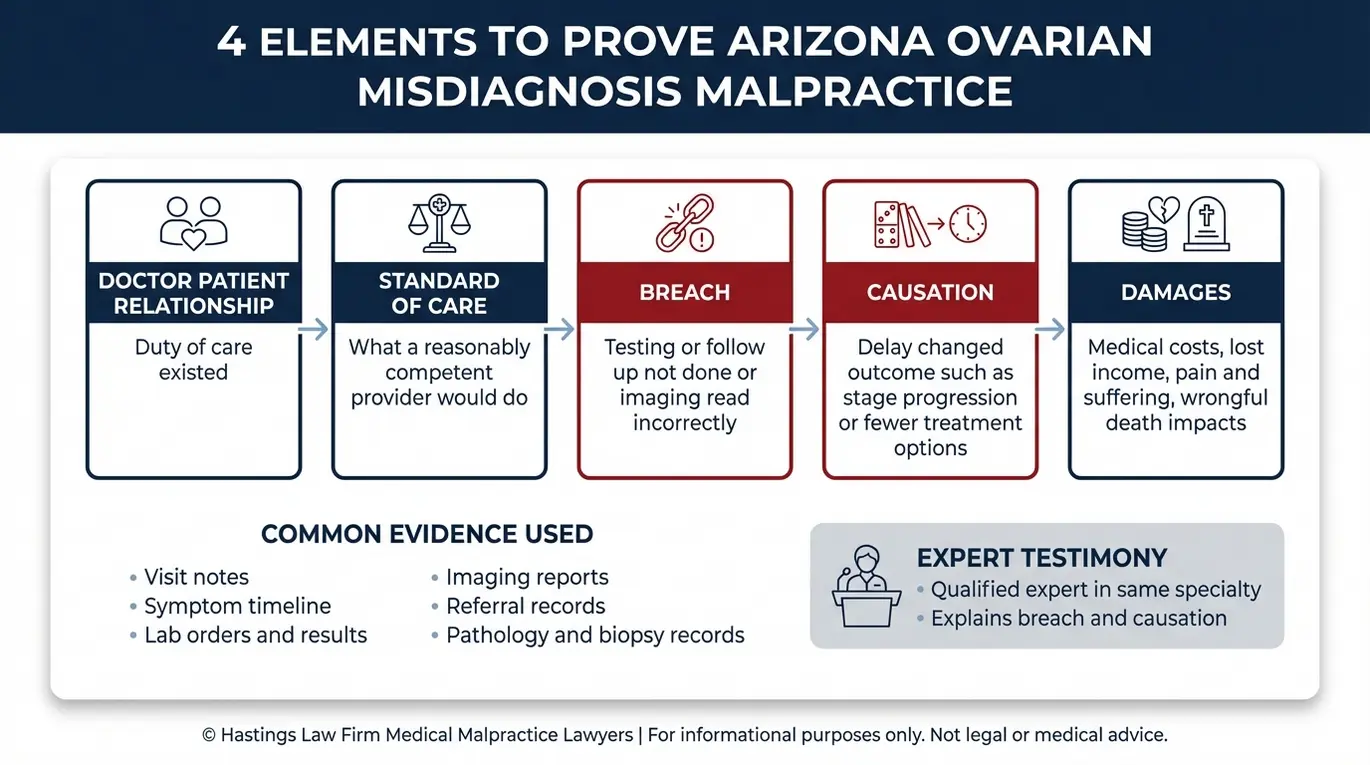
Arizona law breaks the burden of proof into four elements of negligence. Each must be established:
- Duty of care: The doctor had an established physician-patient relationship and owed a professional obligation to provide competent medical treatment.
- Breach of duty: The doctor’s actions fell below the standard of care, the accepted level of treatment that a reasonably competent professional in the same field would have provided in the same situation.
- Causation: The breach directly caused harm. In a delayed diagnosis case, this means proving the delay led to a measurable worsening of the patient’s condition, such as progression from a curable Stage I to a more advanced Stage III.
- Damages: The patient suffered real, quantifiable harm, whether physical, financial, or emotional.
For gynecologists and primary care physicians, the standard of care generally requires that persistent pelvic symptoms be investigated beyond surface-level explanations. When a patient reports weeks of bloating, pain, or urinary changes, the standard typically calls for imaging or lab work to rule out malignancy.
Proving causation is often the most difficult element. An Arizona ovarian cancer misdiagnosis lawyer works to establish not simply whether the doctor missed the diagnosis, but whether an earlier diagnosis would have changed the outcome. This requires expert testimony from a qualified oncologist who can compare the patient’s likely prognosis at the time the cancer should have been caught versus the actual prognosis at the time it was finally diagnosed.
Under Arizona Revised Statutes § 12-2604, expert witnesses in malpractice cases must be qualified in the same field as the defendant. A computed tomography (CT) scan, which produces cross-sectional images of the body, or a magnetic resonance imaging (MRI) scan, which uses magnetic fields to produce detailed soft-tissue images, may both be central pieces of evidence that an expert evaluates. Our team at Hastings Law Firm works with medical experts across the country to build this analysis from the earliest stages of investigation.
Liability and Compensation in Cancer Negligence Cases
Liability may extend beyond the primary care physician or gynecologist to include radiologists who misread imaging, laboratories that mishandled biopsy samples (the tissue analysis used for pathology confirmation), or the hospital system itself for staffing gaps or protocol failures. Compensation is sought for damages resulting from these diagnostic errors to restore financial stability. For example, if a radiologist identifies a mass but fails to communicate the urgency of the finding to the referring doctor, they may share liability. If a hospital laboratory loses a sample or mixes up patient records, the facility itself may be held responsible for the resulting delay in treatment.
In cancer negligence cases, our team examines the full chain of care. A delayed diagnosis may involve one provider, or it may involve several who each failed to act on warning signs. Radiologists, lab technicians, and supervising physicians can all bear liability depending on the facts.
Arizona law allows patients and families to pursue both economic and non-economic damages. The goal of this compensation is to restore the patient’s financial stability and acknowledge the profound personal loss. The following categories are commonly sought in ovarian cancer misdiagnosis claims:
- Past and future medical expenses, including surgery, chemotherapy, and ongoing treatment
- Lost wages and diminished earning capacity
- Pain and suffering caused by the disease and its treatment
- Loss of enjoyment of life
- Emotional distress
- Wrongful death claims filed by surviving family members when the patient does not survive, including loss of consortium and financial support
Arizona does not impose a cap on damages in medical malpractice cases, as the state constitution prohibits laws that limit recovery for personal injury or death. Settlement or verdict amounts depend on the severity of harm, the strength of the evidence, and the degree of negligence involved.
An Arizona ovarian cancer misdiagnosis lawyer at Hastings Law Firm evaluates each of these damage categories during the case investigation to ensure that every financial and personal loss is documented and supported.
Arizona Statutes and Time Limits for Filing Suit
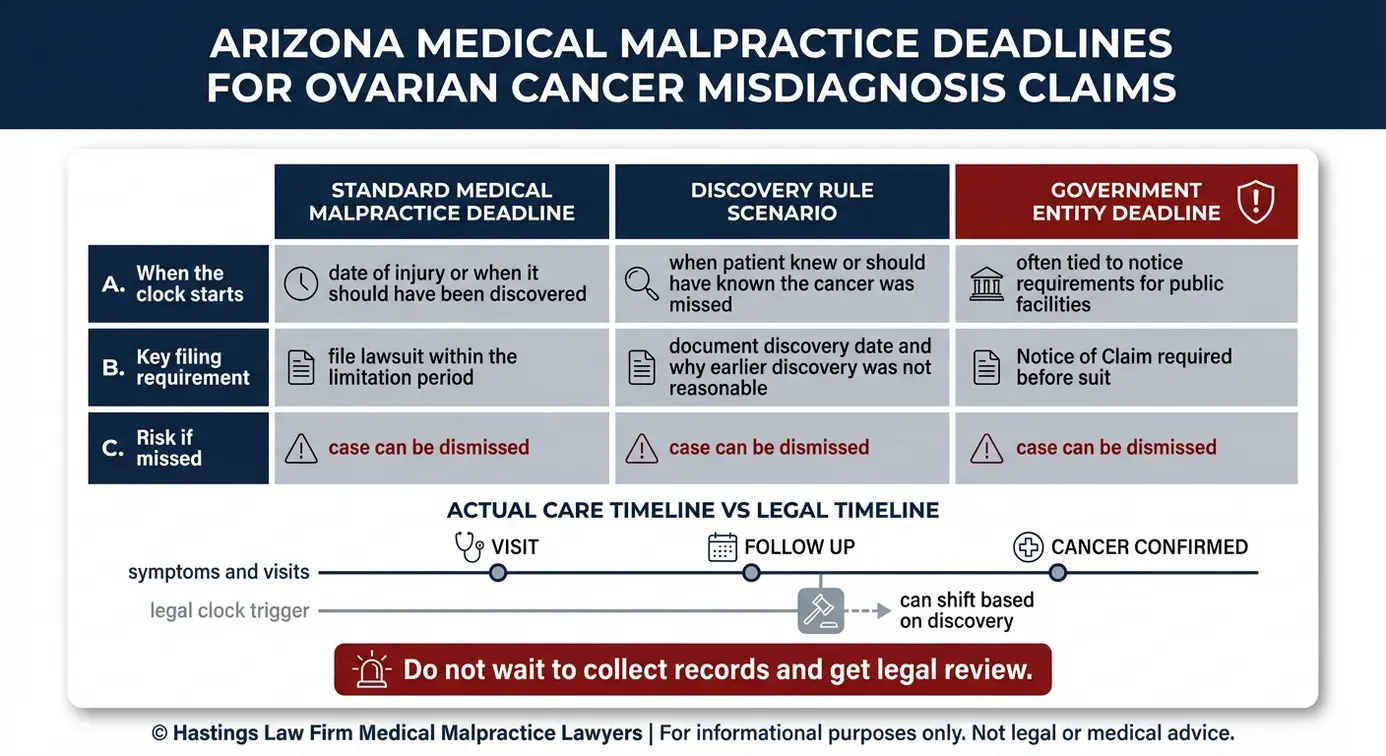
In Arizona, the statute of limitations for medical malpractice is generally two years from the date the injury occurred or was discovered, though specific exceptions apply for hidden errors. These legal deadlines for filing medical negligence lawsuits are strict, and missing them can permanently bar a claim.
The Two-Year Rule
Under Arizona Revised Statutes § 12-542, patients must file suit within two years. For most injuries, this period begins on the date the malpractice occurred. But in cancer misdiagnosis cases, the date of the negligent act and the date the patient learns about it are often very different.
The Discovery Rule: In delayed diagnosis cases, the two-year clock may not start until the patient knew, or reasonably should have known, that their cancer was missed. If ovarian cancer was misdiagnosed as a benign condition in 2021 but the error was not uncovered until 2023, the limitations period may begin in 2023. This exception exists because patients cannot be expected to file claims for harm they do not yet know about. However, once the suspicion of error arises, the clock begins ticking immediately, meaning families should not wait to investigate.
Government Entities
If the physician who missed the diagnosis was employed by a state, county, or municipal facility, the timeline is much shorter. Arizona law requires a formal Notice of Claim to be filed with the government entity within 180 days of the injury. Failing to meet this deadline can eliminate the right to pursue a case entirely.
Because these deadlines are strict, consulting an Arizona ovarian cancer misdiagnosis lawyer early protects your ability to take legal action. The Notice of Claim process is particularly unforgiving; unlike a standard complaint, it must contain specific settlement amounts and factual backing. A simple letter or phone call to the hospital administration does not satisfy this legal requirement. Our team can assess your timeline during a free case evaluation and determine which deadlines apply.
Contact the Arizona Misdiagnosis Attorneys at Hastings Law Firm Today for Help
A delayed ovarian cancer diagnosis changes the course of a life. While no amount of money can undo that, compensation can help secure the medical care, financial stability, and support your family needs going forward.
Hastings Law Firm focuses exclusively on medical malpractice. Our legal and medical team, including in-house nurse consultants and former defense attorneys, reviews every detail of your case with the goal of finding clear answers about what happened and why.
You pay no attorney fees or costs unless we recover compensation for you. If you believe ovarian cancer was missed or diagnosed late, a conversation with board-certified trial attorney Tommy Hastings and his team is a good first step.
Call our Phoenix office or request a free, confidential case evaluation online. Let us help you get the answers and accountability you deserve.
Frequently Asked Questions About Ovarian Cancer Misdiagnosis in Arizona


This content was researched and written by the Hastings Law Firm editorial team, which includes attorneys, medical professionals, and experienced researchers. Our writing is informed by internal knowledge and practical experience, and we cross-check critical details against authoritative sources cited throughout. Every piece undergoes human-led fact-checking and legal review. Because legal and medical information can change, if you spot an error, please contact us. Learn more about our content standards and review process on our editorial policy page.

Tommy Hastings, founder of Hastings Law Firm, is a board-certified personal injury trial lawyer dedicated exclusively to healthcare injury cases. Since 2001, he has represented injured patients and families in litigation against major hospital systems, pharmaceutical companies, and negligent healthcare providers nationwide. He has handled numerous high-profile cases that have drawn national media attention and resulted in multi-million dollar recoveries. He draws on that experience in his writing, helping readers understand how these cases work and what options may be available to them.
