


Arizona Gallbladder Surgery Error Lawyer
Gallbladder removal is often treated as routine, yet preventable mistakes during surgery or follow up care can lead to severe complications, repeat hospitalizations, long recoveries, and lasting changes in quality of life. Common problems described include injuries to nearby structures, delayed recognition of internal damage, and breakdowns in informed consent about surgical risks and possible conversion to open surgery. Arizona also places specific burdens on malpractice claims that can affect whether a case can move forward. If you or a loved one were harmed or worse due to gallbladder surgery errors in Arizona, contact Hastings Law Firm for a free, confidential case review.

Last Updated: July 27, 2026
Trusted Legal Representation for Surgical Negligence in Arizona
A cholecystectomy, the surgical removal of the gallbladder, is one of the most commonly performed procedures in the United States. Most patients go in expecting a routine operation and a quick recovery. When a preventable surgical error turns that expectation into weeks or months of pain, additional surgeries, and mounting medical bills, the experience can feel overwhelming and deeply unfair.
If you or a loved one suffered a serious injury during or after gallbladder surgery in Arizona, you may have grounds for a medical malpractice claim. At Hastings Law Firm, our team is led by board-certified trial lawyer Tommy Hastings, who has over 20 years of experience in medical negligence cases. Our team includes former defense attorneys and experienced hospital nurses who provide insider insight into how medical systems operate. We can review your situation, explain your options, and help you understand the path forward. The consultation is free, confidential, and comes with no obligation.

Common Gallbladder Surgical Errors Committed by Surgeons
Gallbladder surgical errors most frequently involve the accidental cutting or clipping of the common bile duct, perforation of nearby organs like the bowel, or a failure to convert from laparoscopic to open surgery when complications arise. While gallbladder removal is considered routine, the anatomy in the surgical field is tightly clustered, and mistakes during the procedure can cause life-altering harm. Patients often turn to a gallbladder malpractice lawyer to investigate these incidents.
A gallbladder surgery malpractice claim typically centers on whether the surgeon deviated from the accepted standard of care, meaning the level of skill and caution that a competent surgeon would have exercised under the same circumstances. The errors we most commonly investigate include:
- Misidentification of anatomy. The common bile duct (CBD), the tube that carries bile from the liver to the small intestine, sits close to the cystic duct that connects to the gallbladder. Surgeons are trained to establish what is known as the critical view of safety (CVS), a specific dissection technique used to visually confirm the anatomy before cutting or clipping any structure. When a surgeon skips or rushes this step, they can mistake the bile duct for the cystic duct, resulting in a devastating injury that often requires major reconstructive surgery.
- Laparoscopic entry and instrument errors. Most gallbladder removals are performed laparoscopically, using small incisions and a camera to guide the surgery. This method carries unique risks, including blind entry injuries when trocars are inserted into the abdomen, and instrument-related damage to surrounding organs. Research published in JAMA Network Open has examined how patient complexity and surgical approach affect the risk of bile duct injury, highlighting the precision required during these procedures. A surgical negligence attorney knows how to identify when this precision was lacking.
- Internal thermal injuries from cauterization tools. Surgeons use electrocautery instruments to cut tissue and control bleeding. Careless or prolonged use of these tools can cause thermal burns to the bile duct, bowel, or other nearby structures. These burns may not be immediately visible, and the resulting tissue damage can take days to present symptoms, making early detection difficult.
- Failure to convert to open surgery. When a laparoscopic procedure becomes difficult due to inflammation, scarring, or unclear anatomy, the standard of care may require the surgeon to convert to an open procedure for better visibility and control. Persisting with a botched surgical procedure when conditions call for conversion is a recognized form of surgical negligence. Our team examines the operative notes and timeline closely to determine whether this decision point was handled appropriately.
Risks of Laparoscopic vs. Open Gallbladder Surgery
Laparoscopic cholecystectomy, often called a “lap chole,” is the preferred method for gallbladder removal because of its shorter recovery time and smaller incisions. But the reduced visibility and reliance on camera-guided instruments create specific risks that differ from traditional open surgery.
In open surgery, the surgeon has a direct view of the surgical field and can feel the tissue with their hands. In laparoscopic surgery, that tactile feedback is largely absent. This distinction matters legally because the standard of care shifts depending on which method is used. A surgeon performing a lap chole is expected to take specific precautions, like establishing the critical view of safety, that account for the limitations of the approach.
Informed consent is also part of this analysis. Before any procedure, the surgeon has a duty to explain the risks associated with the chosen surgical method. If a patient was not told about the specific risks of laparoscopic surgery or the possibility of conversion to open surgery, that failure may support a malpractice claim. Our team examines the consent forms, pre-operative notes, and surgical records to evaluate whether the patient was given the information they needed to make an informed decision.

Severe Injuries Resulting from Negligent Gallbladder Procedures
Negligence during gallbladder removal can result in bile leakage leading to peritonitis, severe infection (sepsis), hemorrhage from nicked arteries, and permanent digestive issues requiring reconstructive Roux-en-Y surgery. These are not minor complications. Patients who suffer these injuries face months of recovery, repeat hospitalizations, and a dramatically reduced quality of life.
Bile leaks and peritonitis. When the bile duct or gallbladder bed is damaged during surgery, bile can leak into the abdominal cavity. A bile leak, the escape of bile from a damaged duct into surrounding tissue, leads to peritonitis, a dangerous inflammation and infection of the abdominal lining. Peritonitis can progress to sepsis, a systemic infection that can be life-threatening.
According to discharge guidance from MedlinePlus, patients are typically advised to watch for warning signs like fever, worsening abdominal pain, and jaundice after gallbladder surgery. Our in-house medical staff, including former hospital nurses, reviews records to identify where protocols were missed. When these symptoms are ignored or mismanaged by the care team, the consequences escalate quickly. An Arizona surgical error lawyer can evaluate if the response to these symptoms was adequate.
Bowel perforation. Instruments used during surgery can nick or puncture the intestine, leading to torn bowels. Perforating an organ like the bowel results in a spill of intestinal contents into the abdomen. Like bile leaks, perforated bowels carry a high risk of sepsis and often require emergency surgery to repair. Some patients need a temporary colostomy bag while the bowel heals.
Vascular injury and hemorrhage. The hepatic artery and other major blood vessels run near the gallbladder. Cutting or clipping these structures can cause significant hemorrhage during or after the procedure. Rapid blood loss may require transfusions and additional emergency surgery, and in severe cases, it can be fatal. Families facing this tragedy should consult a gallbladder injury attorney immediately.
Nerve damage and long-term digestive problems. Some patients suffer nerve damage that causes chronic pain in the abdomen or shoulder. Others develop long-term digestive issues because of damage to the biliary system, sometimes requiring a complex reconstructive procedure called a Roux-en-Y hepaticojejunostomy to reroute bile flow. A Phoenix malpractice lawyer can help quantify the lifetime cost of these complications.
When these injuries result from negligence, a gallbladder malpractice attorney can help document the full scope of harm, from the initial surgical error to every surgery, hospitalization, and limitation that followed. In the most tragic cases, these errors lead to wrongful death, leaving families to cope with a loss that should never have occurred.
| Injury Type | Long-Term Medical Impact |
|---|---|
| Bile duct injury / bile leak | Peritonitis, sepsis, reconstructive Roux-en-Y surgery, chronic digestive issues |
| Bowel perforation | Emergency repair surgery, possible colostomy, prolonged hospitalization, sepsis risk |
| Vascular injury (hemorrhage) | Blood transfusion, emergency surgery, organ damage, potential fatality |
| Nerve damage | Chronic abdominal or shoulder pain, reduced mobility, ongoing pain management |
| Internal thermal burns | Delayed tissue necrosis, repeat surgeries, infection risk |

The Hastings Law Firm Difference
Results matter, but what truly sets us apart is how we achieve them. Every verdict, every settlement, and every Arizona courtroom victory comes from one guiding promise: To treat each client’s fight for justice as if it were our own.
This balance of skill, experience, and empathy reflects our core philosophy that justice should not only compensate the injured, but also make health care safer nationwide.

Requirements to File a Medical Malpractice Lawsuit in Arizona
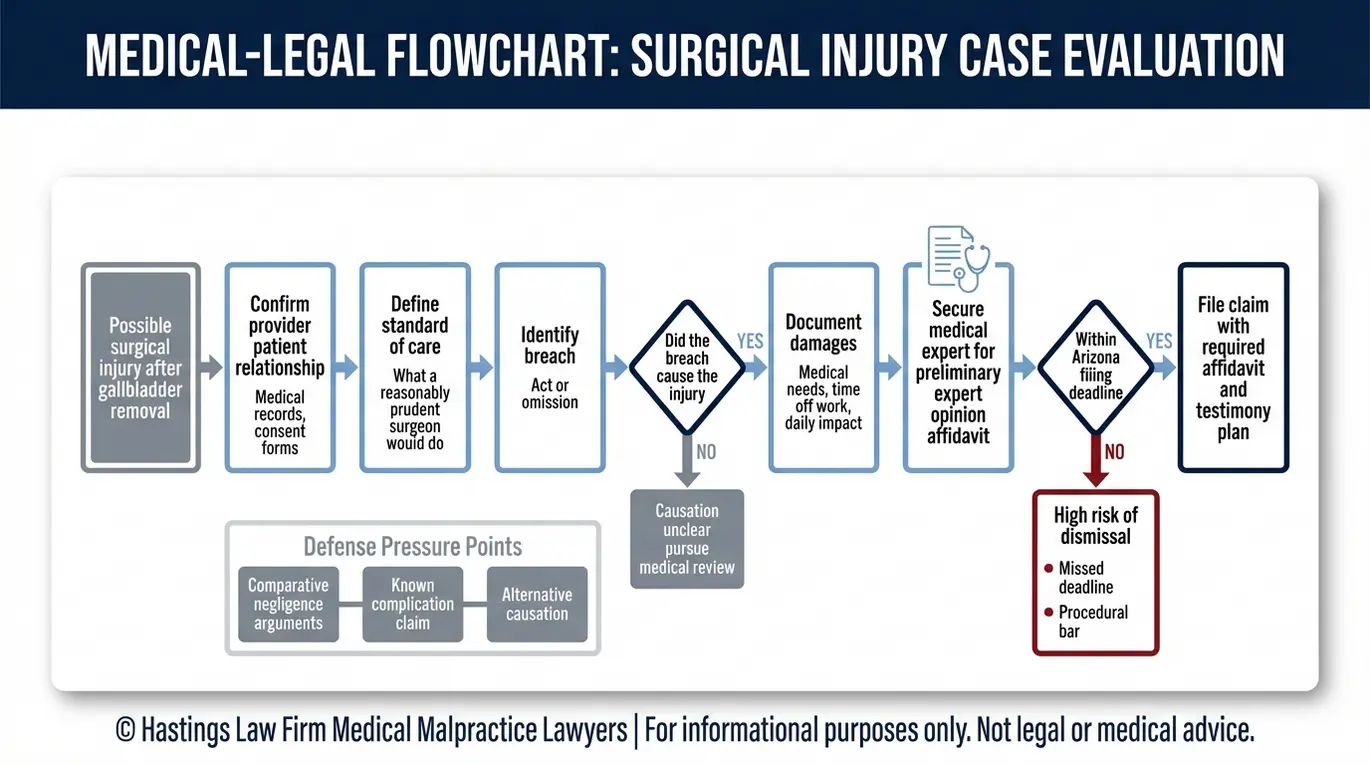
Arizona law requires plaintiffs to prove a doctor-patient relationship existed, that the physician breached the accepted standard of care, and that this breach directly caused specific damages; additionally, the state mandates a Preliminary Expert Opinion Affidavit to validate the claim’s merit.
The four elements of a malpractice claim. Building a strong Arizona malpractice lawsuit requires meeting specific burdens of proof. Every medical malpractice case in Arizona is built on four legal elements:
- Duty of care. The doctor or hospital had a professional obligation to treat the patient competently. This is established by showing a doctor-patient relationship existed at the time of the injury.
- Breach. The provider failed to meet the accepted standard of care. In a gallbladder surgery case, this might involve a failure to identify anatomy, improper use of surgical instruments, or continuing a laparoscopic approach when conversion was indicated.
- Causation. The breach directly caused the patient’s injury. It is not enough to show that a mistake was made; the mistake must be linked to the specific harm the patient suffered. Identifying all liable parties is crucial, as defense attorneys often argue that the injury would have occurred regardless of the surgeon’s actions.
- Damages. The patient suffered measurable harm, whether medical bills, lost income, pain, or diminished quality of life.
Expert testimony requirement. Arizona has a strict rule that sets it apart from many other states. Under Arizona Revised Statutes § 12-2603, a patient must serve a Preliminary Expert Opinion Affidavit along with the initial disclosure. This affidavit must come from a qualified expert witness who confirms, after reviewing the facts, that the provider’s care fell below the standard and caused the injury.
Without this affidavit, the court can dismiss the case. We use a national network of medical experts and in-house Board Certified Patient Advocates to ensure every detail of your medical records is thoroughly reviewed. Our medical advisors begin reviewing records from the start so that this requirement is handled correctly and on time.
Statute of limitations. Under Arizona Revised Statutes § 12-542, patients generally have two years from the date of injury, or from the date the injury was discovered or reasonably should have been discovered, to file a lawsuit. Missing this deadline almost always results in a permanent loss of the right to file a medical negligence claim in Arizona. Because some gallbladder surgery injuries take days or weeks to become apparent, the discovery date may differ from the surgery date, but the window is still narrow.
Comparative negligence. Arizona follows a comparative fault system, meaning defense attorneys may try to assign a portion of blame to the patient. For example, they might argue the patient delayed seeking follow-up care. Even if a jury assigns some fault to the patient, the claim is not necessarily lost; the damages award is reduced proportionally. Our attorneys anticipate these arguments and build evidence to counter them early in the process.
Recovering Compensation for Victims of Surgical Negligence
Victims of gallbladder surgery errors may recover economic damages for medical bills and lost wages, as well as non-economic damages for pain, suffering, and loss of quality of life, with no state cap on the amount a jury can award for these losses. Arizona does not impose a cap on the amount a jury can award for these losses, giving patients the opportunity to receive full financial recovery.
The types of compensation available in an Arizona surgical error case typically include:
- Economic damages: These cover measurable financial losses, including past and future medical expenses (such as reconstructive surgery, hospital stays, medication, and rehabilitation), lost wages, and reduced earning capacity if the injury affects your ability to work long-term. To calculate fair compensation for surgical error, we analyze future medical needs. We work with financial planners to project the lifetime costs of medical care, ensuring that settlements account for inflation and rising healthcare costs.
- Non-economic damages: These address the human cost of the injury, including physical pain, emotional suffering, scarring or disfigurement, loss of enjoyment of life, and loss of consortium, which refers to the impact on your relationship with your spouse or family. Pursuing an Arizona malpractice settlement allows patients to address these intangible losses. In cases of severe disability, the settlement must cover more than just bills; it must address the profound shift in the patient’s lifestyle.
- Wrongful death damages: If a gallbladder surgery error was fatal, surviving family members may pursue a wrongful death claim for funeral expenses, loss of financial support, and the emotional devastation of losing a loved one. For families, surgical injury compensation through a wrongful death claim can provide stability during an impossibly difficult time.
- Punitive damages: In rare cases involving extreme or reckless conduct, a jury may award punitive damages to deter similar behavior in the future.
Arizona’s protection against damage caps is rooted in the Arizona Constitution, which expressly prohibits the legislature from limiting personal injury or wrongful death awards. This is a meaningful safeguard for patients, and it is one reason why thorough case preparation matters so much. Because there is no cap, damages can truly reflect the magnitude of the harm, especially in cases involving permanent disability. When a claim is built with strong evidence and credible expert testimony, the full extent of the harm can be presented to a jury without an artificial ceiling.
Contact the Arizona Surgical Error Attorneys at Hastings Law Firm Today for Help
A “known complication” is not the same as an unavoidable one. Surgeons are trained to manage risk, identify anatomy, and respond appropriately when something goes wrong. When they fail to do so, that is not just a complication; it may be negligence.
If you or someone in your family was seriously injured during gallbladder surgery in Arizona, the team at Hastings Law Firm is ready to investigate what happened. Our legal and medical professionals review the surgical records, identify where care fell short, and build a case grounded in facts and expert analysis.
We handle these cases on a contingency fee basis, meaning you pay no attorney fees or costs unless we recover compensation for you. With Arizona’s two-year filing deadline, time matters. Contact us today for a free, confidential case evaluation and take the first step toward getting the answers you deserve.
Frequently Asked Questions About Gallbladder Surgery Error in Arizona


This content was researched and written by the Hastings Law Firm editorial team, which includes attorneys, medical professionals, and experienced researchers. Our writing is informed by internal knowledge and practical experience, and we cross-check critical details against authoritative sources cited throughout. Every piece undergoes human-led fact-checking and legal review. Because legal and medical information can change, if you spot an error, please contact us. Learn more about our content standards and review process on our editorial policy page.

Tommy Hastings, founder of Hastings Law Firm, is a board-certified personal injury trial lawyer dedicated exclusively to healthcare injury cases. Since 2001, he has represented injured patients and families in litigation against major hospital systems, pharmaceutical companies, and negligent healthcare providers nationwide. He has handled numerous high-profile cases that have drawn national media attention and resulted in multi-million dollar recoveries. He draws on that experience in his writing, helping readers understand how these cases work and what options may be available to them.
