


Arizona Wrong Patient Surgery Malpractice
Wrong patient surgery is a preventable operating room error that can leave lasting physical harm and deep emotional trauma. It often reflects a breakdown in basic identity checks, team communication, and required safety pauses before incision. These events can also create complex questions about responsibility across surgeons, anesthesiology, nursing staff, and the hospital itself. Arizona law also imposes strict requirements that can affect whether a claim can move forward. If you or a loved one were harmed or worse due to wrong patient surgery in Arizona, contact Hastings Law Firm for a free, confidential case review.

Last Updated: July 27, 2026
Trusted Arizona Medical Attorneys for Wrong Patient Surgery Negligence Claims
If you or a loved one underwent a surgery that was meant for a different patient, the confusion, anger, and sense of betrayal you may be feeling right now are completely understandable. Wrong patient surgery is one of the most preventable errors in medicine. When it happens, it raises serious questions about what went wrong inside the operating room and who should be held responsible.
Arizona wrong patient surgery malpractice cases demand a legal team with deep medical knowledge and real litigation experience. At Hastings Law Firm, our attorneys, in-house nursing staff, and medical experts focus exclusively on medical malpractice. We prepare every case as though it will go before a jury, because that level of preparation is what it takes to hold hospitals and surgical teams accountable.
If you believe you or a family member was harmed by a wrong patient surgical error in Arizona, we are here to review what happened and explain your legal options at no cost and no obligation.

Defining Wrong Patient Surgery Negligence in Arizona Healthcare
Wrong-patient surgery is a “never event,” a term the National Quality Forum uses to describe medical errors so serious they should simply never occur under any circumstances. When a hospital performs an operation on the wrong person, it reflects a fundamental breakdown in the safety systems designed to protect patients.
Under state law, wrong patient surgery malpractice in Arizona represents a clear violation of the standard of care, the level of treatment a reasonably competent medical professional would provide under similar circumstances. No competent surgical team following proper protocols should ever confuse one patient for another. Verification systems exist specifically to prevent this error. When these systems fail, it suggests that surgery on wrong patient negligence has occurred.
For patients, the impact goes far beyond the physical. Many people who experience this kind of error describe a deep loss of trust in the medical system. You trusted your care team with your body, and that trust was broken in one of the most alarming ways possible. Consulting an Arizona surgical malpractice lawyer helps patients handle the aftermath of these devastating errors.
Wrong-patient surgery falls squarely within the category of never events because national patient safety standards, including the Universal Protocol, were specifically created to eliminate it. When these safeguards fail, the question shifts from whether something went wrong to how many people and systems failed at the same time.
Common Causes of Wrong Patient Errors in Operating Rooms
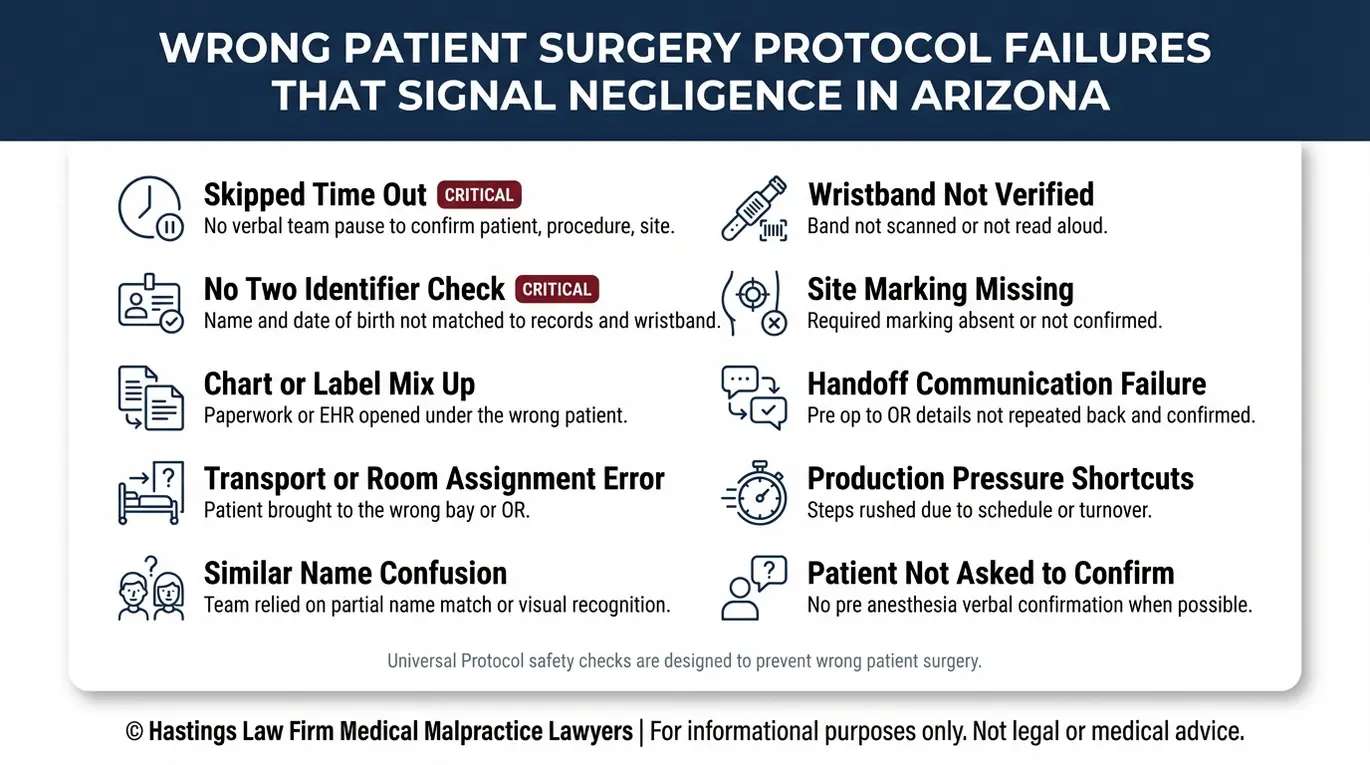
These errors typically stem from administrative failures, such as switching patient charts, failing to verify identity wristbands, or bypassing the mandatory “Time-Out” procedure before incision. Hospitals are high-volume, high-pressure environments. When that pressure leads to shortcuts, the consequences can be devastating. Production pressure, the institutional drive to move patients through the surgical schedule quickly, often drives these hospital protocol failures.
Understanding the causes of wrong patient surgery highlights where protocols fail. Common failures include:
- Failure to conduct a proper “Time-Out”: The surgical team skips or rushes through the required pause before incision, where the patient’s identity, procedure, and surgical site should be confirmed aloud.
- Mix-ups during patient transport or room assignment: A communication failure results in a patient being moved to the wrong pre-op bay or operating room, and no one catches the discrepancy before surgery begins.
- Reliance on chart tags instead of direct verbal verification: Staff members check a chart label or wristband number (adhering to HIPAA standards) without verbally confirming identity with the patient, allowing chart mix-ups to go undetected.
- Similar names or dates of birth: Two patients with nearly identical names or birth dates are scheduled on the same day, and no additional verification steps are taken to distinguish them. Two patient identifiers, such as the patient’s full legal name and medical record number (MRN), should always be confirmed independently.
The Role of the Universal Protocol
The Joint Commission’s Universal Protocol was created specifically to prevent wrong-site, wrong-procedure, and wrong-patient surgeries. This protocol is a surgical safety process used in hospitals nationwide to ensure patient security. It provides a standardized checklist that surgical teams must follow to confirm a patient’s identity.
The protocol requires three key steps before any procedure: pre-procedure verification, surgical site marking, and a formal surgical time-out. A time-out is a deliberate pause immediately before incision where every member of the team confirms the correct patient, correct procedure, and correct site.
Under Arizona’s medical malpractice statutes (A.R.S. §§ 12-561 through 12-563), medical malpractice claims require showing that a healthcare provider failed to meet the accepted standard of practice. When a hospital’s own surgical safety protocols are not followed, that failure becomes powerful evidence of a breach of duty in causes of wrong patient surgery.
The Hastings Law Firm Difference
Results matter, but what truly sets us apart is how we achieve them. Every verdict, every settlement, and every Arizona courtroom victory comes from one guiding promise: To treat each client’s fight for justice as if it were our own.
This balance of skill, experience, and empathy reflects our core philosophy that justice should not only compensate the injured, but also make health care safer nationwide.

Determining Liability for Surgery on the Wrong Patient
Liability may extend well beyond the lead surgeon to include the anesthesiologist, nursing staff, and the hospital entity itself, particularly under the doctrine of vicarious liability if employment relationships exist. Liability is the legal responsibility one party has for the harm caused to another. Our legal team includes former defense attorneys and hospital nurses who use their insider knowledge to identify protocol failures.
Surgeon Liability: Historically, courts applied the “Captain of the Ship” doctrine, holding the lead surgeon responsible for everything that happened in the operating room. Modern liability analysis takes a broader view, recognizing that surgical care involves an entire team. The surgeon still bears direct responsibility for verifying the patient and procedure, but liability is no longer limited to one person.
Hospital Liability: Hospitals can be held liable under theories of corporate negligence when they fail to enforce safety policies, provide adequate staffing, or maintain systems that prevent failures. If the institution itself created the conditions that allowed the error, suing a hospital in Arizona for its independent failures is a viable path.
Vicarious Liability: Under the legal principle of respondeat superior, meaning “let the master answer,” a hospital can be held financially responsible for the negligent acts of its employees. While similar to wrong-site surgery, an operation on the incorrect body part, and wrong-procedure surgery, the performance of an incorrect operation, wrong-patient errors are particularly serious. If a nurse, surgical tech, or anesthesiologist employed by the hospital failed to follow verification procedures, the hospital shares liability for that failure.
| Potentially Liable Party | Basis of Liability |
|---|---|
| Lead Surgeon | Direct negligence for failing to verify patient identity and procedure |
| Anesthesiologist | Failure to independently confirm patient identity before administering anesthesia |
| Nursing Staff | Failure to complete pre-procedure verification or conduct a proper Time-Out |
| Hospital / Facility | Corporate negligence for inadequate safety enforcement; vicarious liability for employed staff |
Identifying all liable parties in surgical malpractice claims strengthens the case and helps ensure full accountability for the harm caused by surgeon liability failures.

Proving Medical Negligence in Wrong Patient Operations
Proving negligence in these cases often relies on the legal doctrine of *res ipsa loquitur*, meaning “the thing speaks for itself,” as operating on the wrong patient does not occur without negligence. The principle applies when an injury would not normally occur without negligence, and the instruments or conditions that caused it were entirely within the defendant’s control.
In a typical medical malpractice case, proving surgical malpractice in Arizona requires detailed expert analysis to establish exactly how the provider deviated from the standard of care. Wrong-patient cases are somewhat different. Because the error is obvious even to someone without medical training, *res ipsa loquitur* can shift the burden of proof, requiring the defense to explain how the mistake happened rather than forcing the patient to reconstruct every clinical detail. An Arizona wrong patient surgery malpractice attorney will know how to apply this doctrine effectively.
The legal process still requires expert involvement. Arizona law requires the claimant to certify whether expert testimony is needed and, if so, to provide a sworn affidavit from a qualified medical expert under A.R.S. § 12-2603. This affidavit must include the expert’s credentials and a factual basis supporting the claim.
Failing to file the affidavit of merit can result in dismissal of the case, regardless of how clear the error was. Early legal representation helps ensure these requirements are met. Our team works with a national network of medical experts who can provide objective, credible opinions and prepare the documentation Arizona courts require. Pre-procedure verification and surgical site marking become key evidence in establishing exactly where the system broke down.
Compensation and Damages for Surgical Victims
Victims can recover economic damages for medical bills and lost wages, as well as non-economic damages for pain, suffering, and the profound psychological trauma of the event. Damages are the legal term for the financial compensation paid to a patient for their losses.
Economic damages cover the direct financial impact of the error. These typically include the cost of corrective surgeries, hospitalization, medication, rehabilitation, and any future medical care related to the injury. Lost wages and diminished earning capacity also fall into this category, particularly when recovery requires extended time away from work or results in lasting physical limitations. Compensation for surgical errors should account for both current and future financial needs.
Non-economic damages address the harm that does not come with a receipt. The mental anguish of learning you were operated on by mistake, the physical pain of an unnecessary procedure, loss of enjoyment of life, and lasting anxiety about future medical care all factor into medical malpractice damages in Arizona. These damages are often significant in wrong-patient cases because the psychological impact of such a fundamental trust violation can persist for years.
| Damage Category | Examples |
|---|---|
| Economic Damages | Corrective surgery costs, lost income, future medical care, rehabilitation expenses |
| Non-Economic Damages | Pain and suffering, mental anguish, loss of enjoyment of life, emotional distress |
| Punitive Damages | Available in cases meeting Arizona’s “evil mind” standard |
Arizona also allows punitive damages in limited circumstances. Under the “evil mind” standard established in Arizona case law, punitive damages may apply when the defendant acted with reckless indifference to the safety of others. In a wrong patient lawsuit settlement or trial, if evidence shows that safety protocols were deliberately ignored, this heightened standard could be met.
Statute of Limitations for Arizona Malpractice Claims
In Arizona, the standard statute of limitations for medical malpractice is generally two years from the date the injury occurred or was discovered, but strict exceptions apply.
The Two-Year Rule: Under A.R.S. § 12-542, most Arizona medical malpractice statute of limitations claims must be filed within two years. For wrong-patient surgery, the clock typically starts on the date of the operation, since the error is usually apparent immediately. The filing deadline for surgical malpractice cases must be taken seriously because courts rarely grant extensions.
The Discovery Rule: In some medical malpractice cases, the patient does not immediately realize an error occurred. Arizona’s Discovery Rule allows the statute of limitations to begin when the patient knew or reasonably should have known about the injury and its potential connection to negligence. While wrong-patient surgery is typically discovered quickly, there are scenarios involving sedation or post-operative confusion where this rule could apply.
Government Hospital Claims: If the surgery took place at a government-funded facility, a much shorter deadline applies. Arizona law requires filing a formal Notice of Claim within 180 days of the injury. Missing this deadline can permanently bar your right to pursue a claim. This applies to county hospitals, state university medical centers, and facilities operated by public entities. Arizona wrong patient surgery malpractice laws treat these timelines as firm, non-negotiable deadlines.
Acting quickly protects your rights and gives your legal team the best opportunity to preserve evidence, secure medical records, and identify all responsible parties.

Contact the Arizona Surgical Error Attorneys at Hastings Law Firm Today for Help
Surgery on the wrong patient is an inexcusable violation of the trust you placed in your medical team. If this happened to you or someone in your family, you deserve answers, and you deserve a legal team that knows how to get them.
Hastings Law Firm represents patients and families exclusively in medical malpractice cases. Founded by Tommy Hastings, a board-certified trial attorney, our firm provides the focused experience needed for these complex cases. We operate on a contingency fee basis, which means you pay no attorney fees or costs unless we recover compensation on your behalf.
Contact our Phoenix office for a free, confidential case evaluation. Let us review what happened, explain your options, and help you take the first step toward accountability.
Frequently Asked Questions About Wrong Patient Surgery Malpractice in Arizona


This content was researched and written by the Hastings Law Firm editorial team, which includes attorneys, medical professionals, and experienced researchers. Our writing is informed by internal knowledge and practical experience, and we cross-check critical details against authoritative sources cited throughout. Every piece undergoes human-led fact-checking and legal review. Because legal and medical information can change, if you spot an error, please contact us. Learn more about our content standards and review process on our editorial policy page.

Tommy Hastings, founder of Hastings Law Firm, is a board-certified personal injury trial lawyer dedicated exclusively to healthcare injury cases. Since 2001, he has represented injured patients and families in litigation against major hospital systems, pharmaceutical companies, and negligent healthcare providers nationwide. He has handled numerous high-profile cases that have drawn national media attention and resulted in multi-million dollar recoveries. He draws on that experience in his writing, helping readers understand how these cases work and what options may be available to them.
