


Phoenix Surgical Error Lawyer
Surgical negligence can leave lasting physical harm and a deep sense of uncertainty about whether an outcome was preventable. Some errors reflect breakdowns in basic operating room safeguards, while other complications are known risks that should be clearly explained during informed consent. Understanding that difference can shape what accountability looks like and what recovery may require, especially when hospitals rely on consent forms as a defense. If you or a loved one were harmed or worse due to surgical negligence in Phoenix, Arizona, contact Hastings Law Firm for a free, confidential case review.

Last Updated: July 27, 2026
Trusted Medical Attorneys for Surgical Negligence in Phoenix
When something goes wrong during surgery, the experience can leave you with more than physical pain. You may feel confused, dismissed, or unsure whether what happened to you was a preventable mistake or simply a risk of the procedure. That uncertainty is completely understandable.
At Hastings Law Firm, our team of attorneys, in-house nurse consultants, and board-certified patient advocates focuses exclusively on medical malpractice. We understand the protocols that should protect patients in the operating room. These range from the surgical “Time Out,” a mandatory pause to verify the patient and site, to the instrument counts that ensure nothing is left inside the body. When those safeguards fail, we know how to investigate what went wrong.
If you believe a surgical error caused you or a loved one harm, a Phoenix surgical error lawyer at our firm can review what happened and explain your options at no cost.

Common Types of Surgical Errors in Phoenix Hospitals
Surgical errors are preventable mistakes that deviate from the standard of care, often involving wrong-site procedures, retained foreign objects, anesthesia mismanagement, or accidental damage to surrounding organs like nerve damage. Surgical errors are medical mistakes that occur when a healthcare team fails to meet the accepted standard of care. These are not inherent risks, but failures in protocol that a competent team should avoid. A surgical error lawyer can help determine if the facts support a legal claim.
Retained Foreign Objects. A retained surgical item, or RSI, refers to a sponge, clamp, or instrument accidentally left inside a patient’s body cavity during a procedure. These objects can cause infection or sepsis. A review published in PubMed Central on minimizing retained surgical items notes these incidents persist despite counting protocols. If you developed unexplained pain or fever after surgery, a retained object may be the cause.
Wrong-Site or Wrong-Patient Surgery. Operating on the wrong limb or patient represents a breakdown in surgical verification. These errors typically result from failures during the pre-operative “Time Out” protocol, the standardized checklist designed to confirm details before incision.
Anesthesia Errors. Improper dosing or monitoring by anesthesia teams can lead to brain injury, hypoxia, or anesthesia awareness, where a patient regains consciousness during surgery but cannot move. These errors often stem from inadequate assessment or inattention.
Post-Operative Negligence. The medical team’s responsibility does not end when the procedure is over. Failure to monitor for hemorrhage, infection, or sepsis during recovery can be life-threatening. Post-operative negligence occurs when healthcare providers fail to detect complications during the critical hours or days following surgery.
Understanding “Never Events” in Surgery
Some surgical errors are classified as Never Events, which are medical mistakes so serious they should never occur under any circumstances. Never Events are serious medical errors that are considered entirely preventable through proper safety protocols. Wrong-site surgery, wrong-patient surgery, and retained surgical instruments all fall into this category. These events represent a clear breach of duty and are strong indicators of hospital negligence.
Because Never Events violate the most basic standard of care expectations, they often form the foundation of a strong malpractice claim. If you or a loved one experienced one of these errors, a lawyer for surgical errors can help you understand your legal options.
Distinguishing Actionable Negligence from Known Surgical Risks
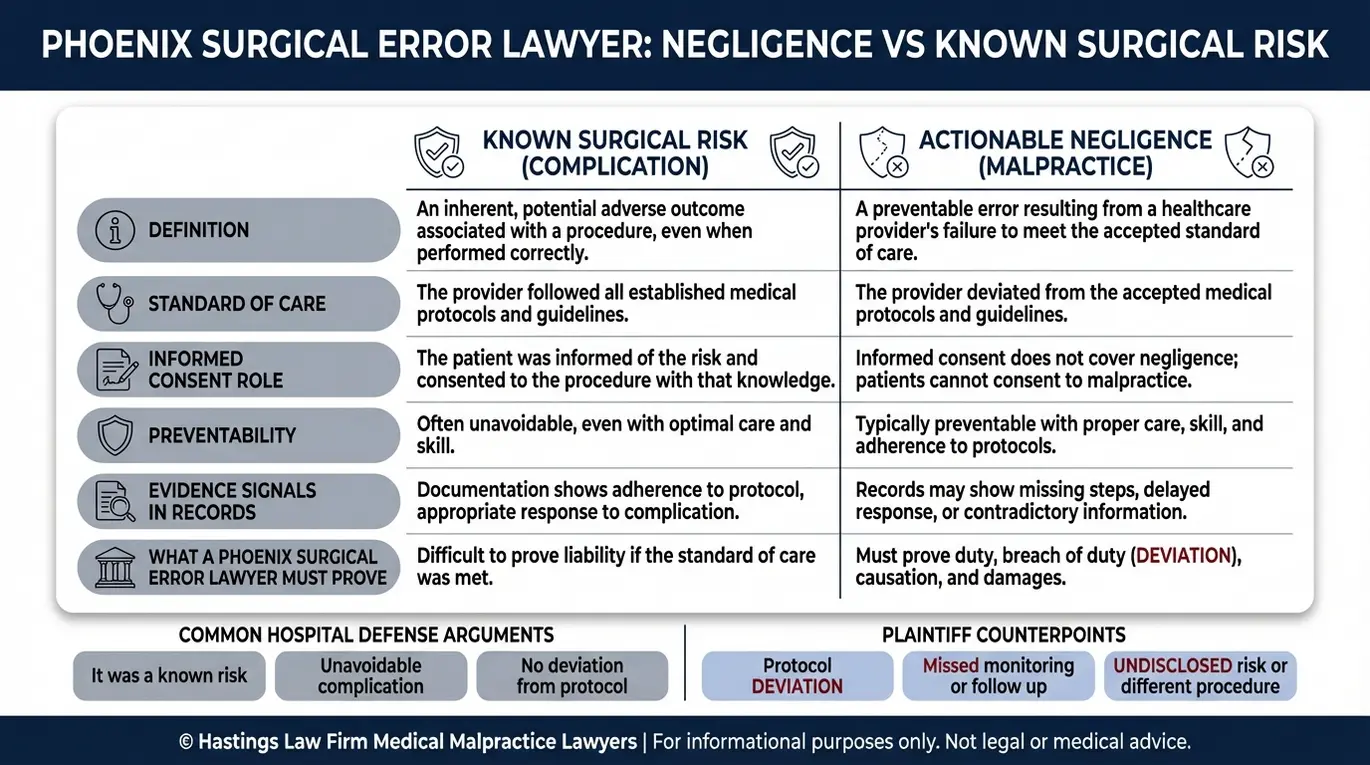
Not every bad surgical outcome is malpractice; negligence occurs only when the surgeon’s actions fall below the accepted medical standard of care, whereas a “known risk” is an unavoidable complication that was disclosed to the patient during informed consent. Medical negligence involves a breach of duty that leads to patient harm, distinct from unavoidable procedural risks. Informed consent is the process by which a doctor explains the risks, benefits, and alternatives of a procedure before the patient agrees to it.
Hospitals frequently rely on signed consent forms to defend against claims. The argument is simple: “The patient knew this could happen.” But a signed form does not provide blanket immunity. If a risk was never actually explained, if the surgery performed differed from what was authorized, or if the complication resulted from a deviation in technique rather than an inherent risk of the procedure, the consent defense may not hold. A surgical negligence attorney can help you distinguish between a true surgical complication and preventable harm.
| Actionable Negligence | Known Surgical Risk | |
|---|---|---|
| Definition | The surgeon deviated from the accepted standard of care | An unavoidable complication inherent to the procedure |
| Disclosure | May not have been disclosed, or the actual error differs from disclosed risks | Explained during informed consent and acknowledged by the patient |
| Example | Nerve damage caused by operating outside the surgical field | Temporary numbness near the incision site |
| Legal Standing | May support a malpractice claim | Generally not grounds for a lawsuit |
According to AORN’s guidelines on informed consent, the consent process must be thorough, voluntary, and specific to the planned procedure. A Phoenix surgical error lawyer can work with medical experts to evaluate whether the complication you experienced was truly a known risk or the result of a preventable error. Expert testimony is often the key to proving that distinction, demonstrating to a jury exactly where the standard of care was breached and validating your claim for damages.
The Hastings Law Firm Difference
Results matter, but what truly sets us apart is how we achieve them. Every verdict, every settlement, and every Phoenix courtroom victory comes from one guiding promise: To treat each client’s fight for justice as if it were our own.
This balance of skill, experience, and empathy reflects our core philosophy that justice should not only compensate the injured, but also make health care safer nationwide.

Identifying Liable Parties in Phoenix Surgical Injury Cases
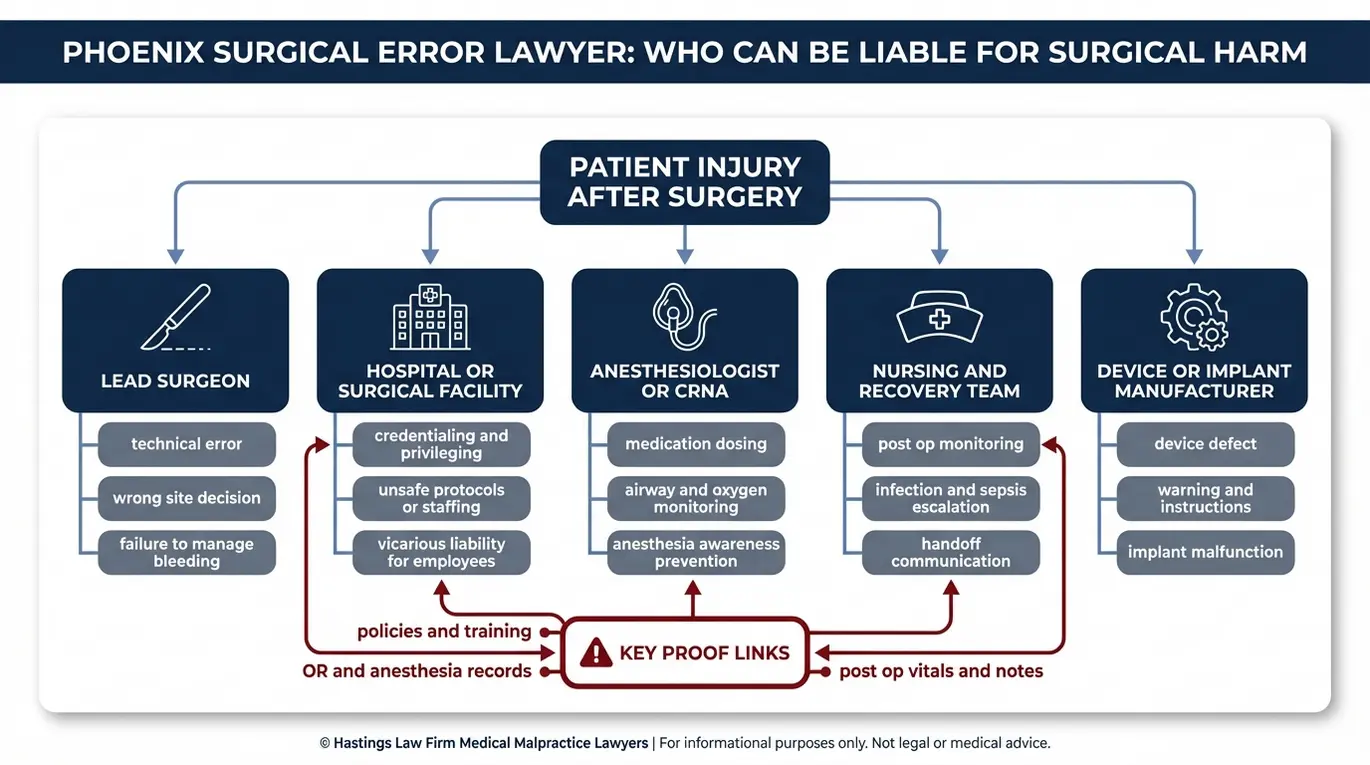
Liability for a surgical error may extend beyond the lead surgeon to include the hospital entity for staffing failures, anesthesiologists for medication errors, or nurses for inadequate post-operative monitoring. Identifying liable parties involves determining which individuals or institutions are legally responsible for a medical mistake. Identifying every responsible party, potentially through vicarious liability, is a critical part of building an effective claim.
Our team investigates the full chain of events, from pre-operative preparation through recovery, to determine who contributed to the harm. Here are the parties who may share liability:
- The Surgeon: Directly responsible for technical errors during the procedure, such as damaging a nerve, perforating an organ, or operating on the wrong site.
- The Hospital or Surgical Center: May bear corporate liability or be sued for hospital negligence due to systemic failures like understaffing, unsafe protocols, faulty equipment maintenance, or credentialing a surgeon who lacked the qualifications to perform the procedure.
- Anesthesia Teams: An anesthesiologist or nurse anesthetist may be liable for dosing errors, failure to review the patient’s medical history, or inadequate monitoring that leads to perioperative hypoxia, a dangerous drop in oxygen levels during the surgical period that can lead to brain damage.
- Nursing Staff: Nurses responsible for pre-operative preparation, surgical counts, and post-operative monitoring can be individually liable for errors like failing to detect signs of hemorrhage or infection.
- Medical Device Manufacturers: If a surgical implant, tool, or instrument malfunctioned during the procedure, the manufacturer may face medical product liability claims separate from the medical negligence case.
A Phoenix malpractice counsel at our firm will examine each of these potential sources of liability so that no responsible party is overlooked.
Damages and Compensation for Surgical Victims in Arizona
Arizona law allows victims of surgical negligence to recover economic damages for medical bills and lost wages, as well as non-economic damages for pain, suffering, and loss of quality of life, with no constitutional cap on the amount awarded. Legal damages refer to the financial and personal compensation intended to help a patient recover from their losses.
This is a meaningful distinction. Many states impose artificial limits on what injured patients can receive, particularly for non-economic damages. Arizona does not.
Article 2, Section 31 of the Arizona Constitution explicitly prohibits any law that would limit the amount of damages recoverable for personal injury or death. For patients facing a lifetime of medical needs after a surgical error, this protection matters. Filing a civil lawsuit is often the necessary step to secure full surgical injury compensation for future medical care.
Recoverable damages in an Arizona surgical injury case may include:
- Past and future economic damages, including medical expenses, corrective surgeries, rehabilitation, and ongoing care
- Lost wages and diminished earning capacity, ensuring financial stability while you cannot work
- Pain and suffering, accounting for the physical burden of the injury
- Emotional distress and trauma resulting from the negligent event
- Disfigurement or permanent disability
- Loss of enjoyment of life
- Wrongful death damages for families who lost a loved one due to a surgical mistake
A Phoenix surgical error lawyer can help you document the full scope of your losses so that any settlement or verdict reflects both your current needs and your future.
Critical Steps: Arizona Statute of Limitations and Affidavit of Merit
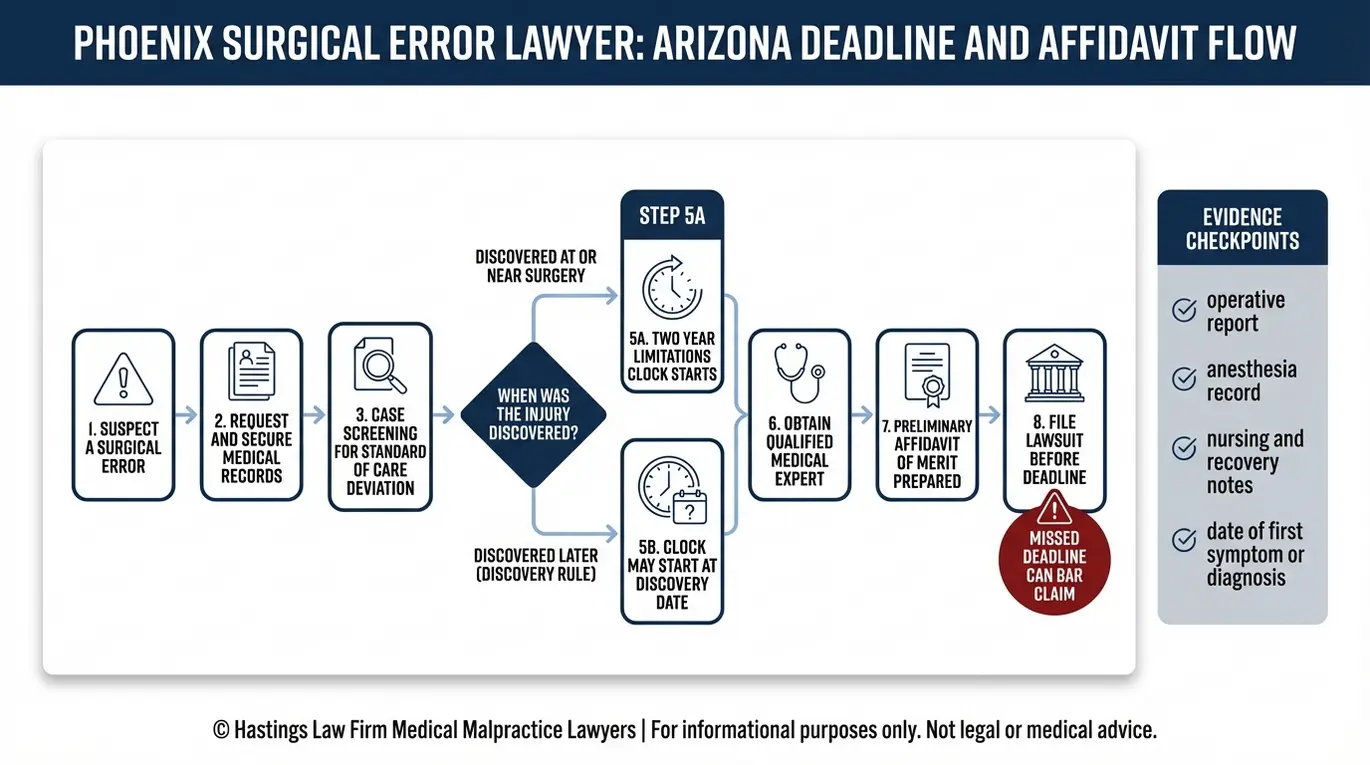
Arizona requires surgical error lawsuits to be filed within two years of the injury discovery and mandates a preliminary affidavit of merit from a qualified medical expert to validate the claim before it proceeds. Managing legal requirements like deadlines and expert certifications is necessary to bring a claim in Arizona.
Under A.R.S. § 12-542, the statute of limitations for personal injury in Arizona is two years. Missing this deadline almost always means losing the right to file a civil lawsuit. In some cases, the discovery rule may extend this timeline, such as when a retained sponge is not found until months or years after the original surgery.
Arizona also requires what is commonly called an affidavit of merit. Under A.R.S. § 12-2603, the patient must obtain a preliminary expert opinion from a qualified medical professional certifying that the standard of care was breached and that the breach caused the injury. This requirement exists early in the litigation process, making it essential to work with a Phoenix surgical error lawyer who can secure the necessary expert testimony from credible medical professionals.
Contact the Phoenix Surgical Error Attorneys at Hastings Law Firm Today for Help
Surgical errors leave more than physical scars. They create a deep sense of mistrust in the system that was supposed to help you heal. If you are carrying that weight, you do not have to carry it alone.
Hastings Law Firm is a Phoenix surgical malpractice law firm built to handle exactly these cases. Our team includes former defense attorneys who understand how hospitals build their arguments, and in-house medical professionals who can interpret the clinical details of what happened to you. Founded by board-certified trial attorney Tommy Hastings, every case we accept is prepared as if it will go before a jury.
We work on a contingency fee basis, which means you pay no attorney fees or costs unless we recover compensation for you. There is no financial risk in reaching out.
Contact us today for a free, confidential case evaluation. Let us review your records, answer your questions, and help you understand what comes next.
Frequently Asked Questions About Surgical Error in Phoenix


This content was researched and written by the Hastings Law Firm editorial team, which includes attorneys, medical professionals, and experienced researchers. Our writing is informed by internal knowledge and practical experience, and we cross-check critical details against authoritative sources cited throughout. Every piece undergoes human-led fact-checking and legal review. Because legal and medical information can change, if you spot an error, please contact us. Learn more about our content standards and review process on our editorial policy page.

Tommy Hastings, founder of Hastings Law Firm, is a board-certified personal injury trial lawyer dedicated exclusively to healthcare injury cases. Since 2001, he has represented injured patients and families in litigation against major hospital systems, pharmaceutical companies, and negligent healthcare providers nationwide. He has handled numerous high-profile cases that have drawn national media attention and resulted in multi-million dollar recoveries. He draws on that experience in his writing, helping readers understand how these cases work and what options may be available to them.
