


Phoenix Prostate Surgery Error Lawyer
Prostate procedures can carry real risks, but some outcomes happen because a surgical team failed to meet the accepted standard of care. Errors during prostatectomy or TURP can lead to lasting urinary problems, sexual dysfunction, infections, internal bleeding, and the need for additional procedures, with serious emotional and financial strain. Understanding whether a complication was expected or preventable often depends on careful review of operative details and post operative care. If you or a loved one were harmed or worse due to a prostate surgery error in Phoenix, Arizona, contact Hastings Law Firm for a free, confidential case review.

Last Updated: July 27, 2026
Trusted Phoenix Medical Attorneys for Negligent Urological Procedures
If you or someone you love suffered unexpected harm after a prostate procedure, you may be dealing with more than just physical pain. Complications like stress urinary incontinence (SUI), the involuntary leaking of urine during everyday activities, or erectile dysfunction (ED), the inability to achieve or maintain an erection, can fundamentally change your quality of life. When those outcomes result from a surgeon’s error rather than an unavoidable risk, you deserve honest answers about what happened and why.
A Phoenix prostate surgery error lawyer at Hastings Law Firm can review your medical records, consult with urology experts, and help you understand whether your surgeon’s actions fell below the accepted standard of care. Consultations are free, confidential, and carry no obligation. If you’re ready to learn what your options are, we’re here to listen.

Why You Need a Dedicated Phoenix Surgical Malpractice Attorney
A Phoenix surgical malpractice attorney is essential because distinguishing between a known surgical risk and actionable malpractice requires deep medical knowledge. Only a lawyer for surgical errors can secure qualified urology experts to evaluate whether your surgeon breached the standard of care, which is the level of skill and caution a competent urologist would exercise under similar circumstances.
Prostate procedures are among the most technically demanding operations in urology. A radical prostatectomy is the complete surgical removal of the prostate gland. A transurethral resection of the prostate (TURP) removes tissue through the urethra. Both involve delicate work near important nerves and organs. Evaluating whether something went wrong during these procedures requires an attorney who understands the anatomy, the surgical technique, and the medical records at a granular level.
Hospitals and their defense teams routinely argue that complications were “unavoidable risks” the patient accepted before surgery. A prostate surgery error lawyer who handles medical malpractice cases knows how to challenge that narrative using expert testimony and a detailed reconstruction of what actually happened in the operating room.
Here’s why a general injury lawyer isn’t enough for these cases:
- Medical depth matters. Phoenix surgical malpractice attorneys know that prostate surgery cases, especially those involving Da Vinci robotic systems, require an attorney who can interpret operative reports, robotic console logs, and post-surgical imaging.
- Defense teams are well-funded. Hospitals retain experienced defense attorneys and medical experts. Your lawyer must have the resources and the duty of care knowledge to match them.
- Expert-driven litigation is expensive. These cases require paid expert witnesses, records from multiple providers, and sometimes biomechanical or engineering analysis. Firms that lack financial resources may push for a quick, undervalued settlement.
At Hastings Law Firm, our team includes former defense attorneys and in-house medical professionals who previously worked within the hospital systems we now hold accountable. Founded by board-certified trial attorney Tommy Hastings, our firm has spent decades specializing in medical negligence cases. This experience gives us a strategic edge in identifying where negligence occurred and anticipating how the other side will try to explain it away.
Common Errors Committed During Prostate Procedures and Surgery
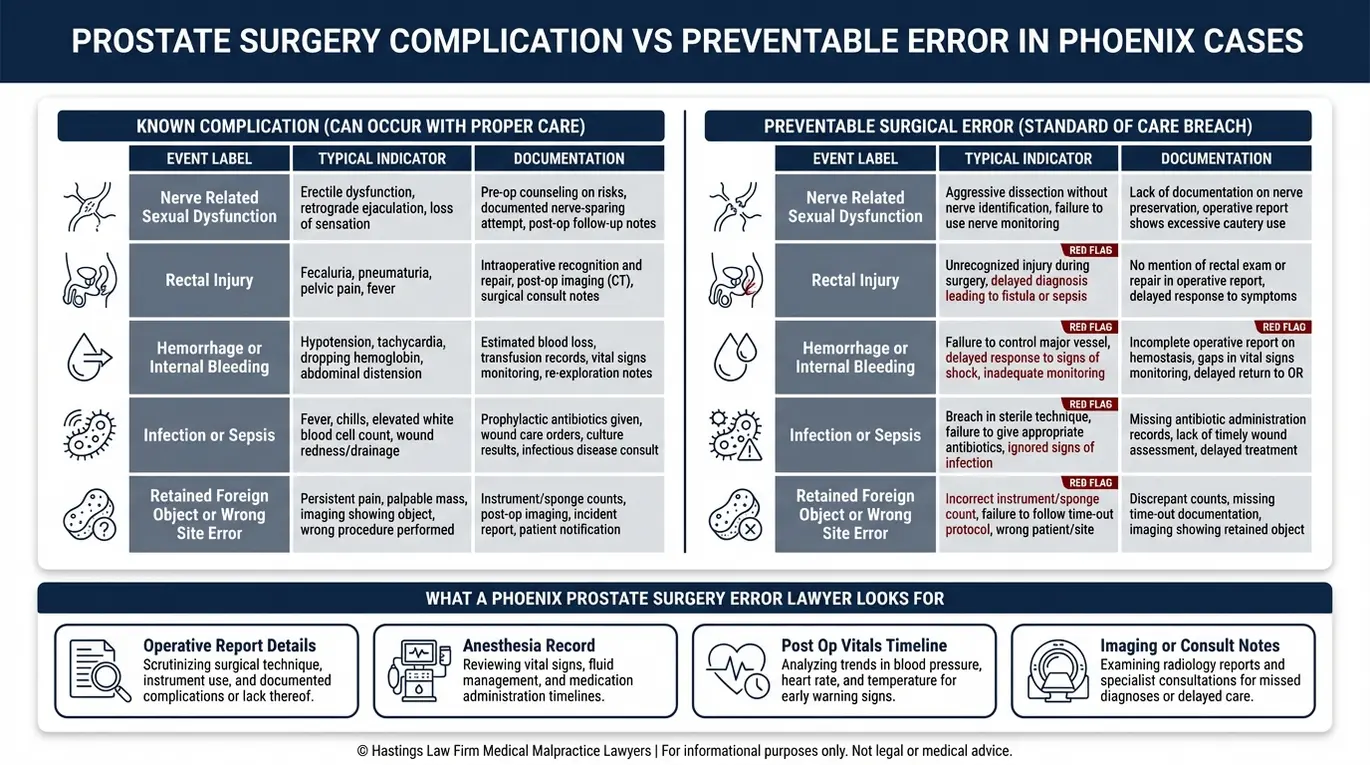
Common errors during prostate surgery include accidental perforation of the rectum, severing of the cavernous nerves (the neurovascular bundles responsible for erectile function), and failure to identify internal bleeding after the operation. These are not theoretical risks; they are instances of prostate surgery negligence that occur when surgeons fail to meet the standard of care.
Nerve-Sparing Failure. During a radical prostatectomy, surgeons are often expected to use nerve-sparing techniques to preserve erectile function. When a surgeon negligently damages or severs these nerves due to poor technique or rushing through the procedure, the result can be permanent impotence.
Rectal Perforation. A rectal perforation is a puncture or tear in the rectal wall during surgery. According to a study published by PubMed on the incidence of rectal injury after radical prostatectomy, these injuries can lead to serious infections, sepsis, or the formation of a fistula requiring additional surgery.
Robotic Surgery Errors. Da Vinci robotic prostatectomies rely on precise instrument control. Malfunctions, improper calibration, or user errors by an insufficiently trained surgeon can result in organ damage, hemorrhage, wrong-site surgery, or nerve injury that would not have occurred during a properly performed procedure.
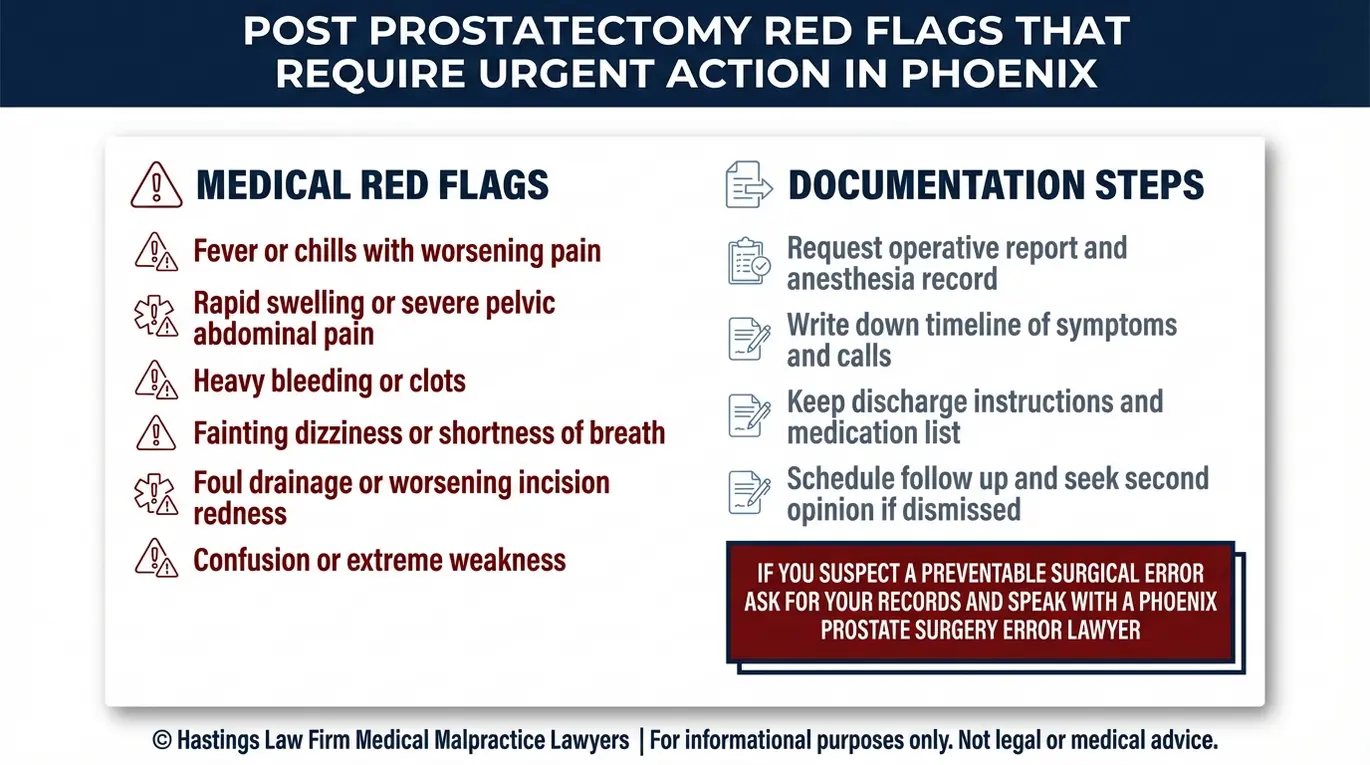
Post-Operative Neglect. Even when the surgery itself goes as planned, failures in post-operative monitoring can cause devastating outcomes. Missing signs of internal bleeding, infection, or retained surgical instruments can turn a survivable procedure into a life-threatening emergency. Proper post-operative monitoring ensures that complications are identified and treated before they escalate.
The Memorial Sloan Kettering Cancer Center’s guide on prostate surgery complications outlines expected recovery timelines and side effects. When outcomes fall significantly outside those expectations, it can indicate that something went wrong.
Under Arizona Revised Statutes § 12-563, a medical malpractice claim requires proof that the healthcare provider failed to meet the accepted standard of care and that the failure caused the patient’s injury. A surgical error lawyer in Phoenix can help determine whether your experience reflects a known complication or a preventable breach.
| Accepted Complication | Potential Surgical Error | |
|---|---|---|
| Urinary Incontinence | Temporary leaking that resolves within several months | Persistent, severe incontinence suggesting sphincter damage |
| Erectile Dysfunction | Gradual recovery over 12 to 24 months with nerve-sparing approach | Immediate, total loss of function indicating nerve transection |
| Bleeding | Controlled, expected blood loss during surgery | Unrecognized hemorrhage or delayed response to post-op bleeding |
| Infection | Minor wound infection treated with antibiotics | Sepsis from undiagnosed rectal perforation or retained instrument |
| Rectal Injury | Recognized and repaired intraoperatively | Undetected perforation leading to fistula or peritonitis |
Impact of Assembly Line Medicine on Surgical Safety
High-volume surgical centers can create environments where production pressure and profit-driven practices may affect patient safety. When surgeons are scheduled for back-to-back complex procedures, fatigue and time constraints may contribute to technical errors or incomplete nerve-sparing dissections. Surgical malpractice can occur from systemic conditions that make errors more likely. Our team examines surgical scheduling records, staffing logs, and institutional protocols to determine whether the standard of care was compromised by how the facility operated.
The Hastings Law Firm Difference
Results matter, but what truly sets us apart is how we achieve them. Every verdict, every settlement, and every Phoenix courtroom victory comes from one guiding promise: To treat each client’s fight for justice as if it were our own.
This balance of skill, experience, and empathy reflects our core philosophy that justice should not only compensate the injured, but also make health care safer nationwide.

Life-Altering Consequences of Botched Prostatectomies
Patients who suffer harm from a botched prostate surgery often face permanent urinary incontinence, total erectile dysfunction, and the need for painful corrective procedures. Some patients require a colostomy bag after a rectourethral fistula, an abnormal connection between the rectum and urethra caused by surgical injury. Others experience postoperative hemorrhage, dangerous bleeding that occurs after surgery and may require emergency intervention.
The physical toll can mean years of catheter use, adult diapers, and permanent urinary incontinence. A surgical error attorney knows that tools like the Expanded Prostate Cancer Index Composite (EPIC) developed by the University of Michigan Medical School measure the scope of these quality-of-life impacts.
The psychological toll is just as real. Depression, shame, loss of intimacy, and emotional distress can follow a patient for years. These are compensable harms known as non-economic damages, which cover pain and suffering and loss of enjoyment of life.
The financial toll compounds everything. Corrective surgeries and economic damages like lost wages during extended recovery add up quickly. A lawyer for prostate surgery complications can help you pursue compensation that accounts for all of these losses. If you have been harmed, a prostate surgery error lawyer is your best resource for recovery.
Damages Recoverable for Negligent Urological Procedures
Patients who can prove their injuries resulted from surgical negligence may recover compensation for surgical errors, covering medical expenses, future corrective procedures, lost wages, and significant non-economic damages for the impact on their daily life and relationships.
A Phoenix prostate surgery error lawyer will work to document the full scope of your harm, which may include:
- Past and future medical costs, including payment for devices like an artificial urinary sphincter (AUS), an implanted device that restores bladder control, or an inflatable penile prosthesis (IPP), a surgically implanted device used to treat erectile dysfunction
- Economic damages, such as diminished earning capacity
- Pain and suffering, covering the physical discomfort and emotional distress caused by the injury
- Loss of consortium, which compensates your spouse for the impact on your marital relationship, including loss of companionship and intimacy
- Punitive damages in rare cases involving extreme recklessness, such as a surgeon operating under the influence or demonstrating gross disregard for patient safety
Arizona does not cap compensatory damages in medical malpractice claims. According to analysis published in the Arizona Law Review on punitive damages in Arizona, these awards remain available when the defendant’s conduct is particularly egregious. A surgical error attorney at Hastings Law Firm handles every case on a contingency fee basis, meaning you pay no attorney fees or costs unless we secure a recovery on your behalf.
Arizona Statute of Limitations for Surgical Malpractice Claims
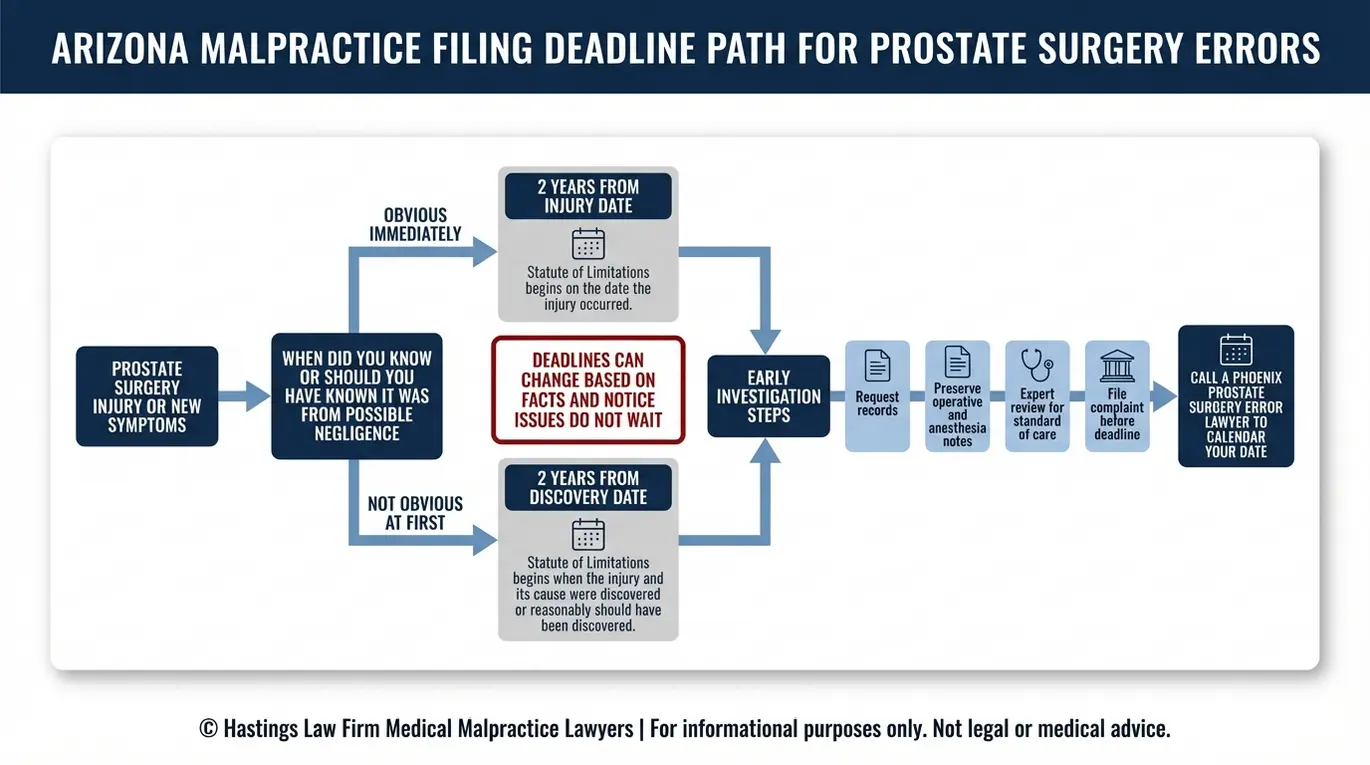
In Arizona, you generally have two years from the date of injury, or from the date you discovered (or reasonably should have discovered) the injury, to file a medical malpractice claim. This statute of limitations is the legal deadline for filing a lawsuit, as established under Arizona Revised Statutes § 12-542.
The discovery rule can extend this window in situations where the error was not immediately apparent. For example, a retained surgical instrument may not be found until imaging is performed months later. But even with the discovery rule, waiting too long puts your case at risk. Evidence degrades, memories fade, and critical records can become harder to obtain.
If you suspect something went wrong during your prostate surgery, contact a Phoenix prostate surgery error lawyer as soon as possible. Early investigation preserves the evidence your case depends on.
Using Res Ipsa Loquitur in Surgical Cases
In some surgical error cases, the legal doctrine of res ipsa loquitur, a Latin phrase meaning “the thing speaks for itself,” can simplify the burden of proof. This doctrine applies when the injury is of a type that would not normally occur without negligence, such as foreign objects left behind inside the body after surgery. In cases where a patient wakes up with an injury unrelated to the surgical site, this doctrine helps clarify the legal path. When res ipsa loquitur applies, the existence of the injury itself can serve as evidence of negligence, shifting the burden to the defense to explain what happened.
Contact the Phoenix Surgical Error Attorneys at Hastings Law Firm Today for Help
No one should have to accept a life of pain, incontinence, or lost intimacy because a surgeon failed to meet the standard of care. At Hastings Law Firm, we exist to uncover the truth about what happened in the operating room and to hold negligent providers accountable so the same mistakes are not repeated.
Our team of attorneys, former defense lawyers, and in-house medical staff is ready to evaluate your case at no cost. Every consultation is confidential, led by a Board Certified Patient Advocate, and designed to give you clear answers about your options.
You pay nothing unless we recover compensation for you. If you or a loved one was harmed during a prostate procedure, reach out to our Phoenix surgical error law firm for a no-cost case evaluation. Let us help you take the first step toward the answers and the accountability you deserve.
Frequently Asked Questions About Prostate Surgery Error in Phoenix


This content was researched and written by the Hastings Law Firm editorial team, which includes attorneys, medical professionals, and experienced researchers. Our writing is informed by internal knowledge and practical experience, and we cross-check critical details against authoritative sources cited throughout. Every piece undergoes human-led fact-checking and legal review. Because legal and medical information can change, if you spot an error, please contact us. Learn more about our content standards and review process on our editorial policy page.

Tommy Hastings, founder of Hastings Law Firm, is a board-certified personal injury trial lawyer dedicated exclusively to healthcare injury cases. Since 2001, he has represented injured patients and families in litigation against major hospital systems, pharmaceutical companies, and negligent healthcare providers nationwide. He has handled numerous high-profile cases that have drawn national media attention and resulted in multi-million dollar recoveries. He draws on that experience in his writing, helping readers understand how these cases work and what options may be available to them.
