


Arizona Prostate Surgery Error Lawyer
Prostate surgery is complex, and complications can be life changing when preventable errors occur during or after a radical prostatectomy. The text describes common surgical mistakes, risks tied to robotic assisted procedures, and how failures in technique, training, or post operative monitoring can lead to severe infections, lasting disability, incontinence, or impotence. It also highlights the importance of informed consent and the role of medical records in evaluating whether care fell below accepted standards. If you or a loved one were harmed or worse due to a prostate surgery error in Arizona, contact Hastings Law Firm for a free, confidential case review.

Last Updated: July 27, 2026
Trusted Legal Representation for Surgical Negligence in Arizona
If you or someone you love suffered unexpected harm after prostate surgery, the confusion and frustration you feel right now are understandable. A radical prostatectomy, the surgical removal of the prostate gland, is a complex procedure that carries real risks. But when those risks are made worse by preventable medical errors, the outcome can change the course of your life.
At Hastings Law Firm, we focus exclusively on medical malpractice. Our legal team includes in-house medical professionals and former defense attorneys who know how hospitals and their insurers respond to surgical negligence claims. As an experienced Arizona prostate surgery error lawyer, we are prepared to investigate what happened, identify where the standard of care was violated, and pursue the accountability you deserve.
If you believe a surgical error caused your injuries, we invite you to contact us for a free, confidential case evaluation. There are no fees unless we recover compensation on your behalf.

Common Errors During Radical Prostatectomy Procedures
Surgical errors during prostatectomy often involve accidental lacerations to the rectum, ureters, or bladder, as well as improper handling of the neurovascular bundles responsible for sexual function. These are not rare, abstract problems. They are well-documented failures that a prostate surgery error attorney can evaluate against the accepted standard of care to determine whether medical negligence occurred.
The prostate sits in a tight surgical field surrounded by critical structures. Even small deviations in technique or judgment can cause organ damage, hemorrhage, or long-term disability. When a surgeon performs the wrong procedure, uses excessive force on delicate tissue, or fails to recognize and repair an intraoperative injury, the consequences are often severe. In these radical prostatectomy cases, several types of mistakes can occur.
Here are some of the most common errors we investigate as an Arizona prostatectomy malpractice lawyer:
- Rectal perforation: A rectal perforation, or accidental puncture of the bowel wall, can occur when the surgeon dissects too close to the rectum. If not identified and repaired immediately, this injury can lead to life-threatening infection or sepsis. A systematic review and meta-analysis published in PubMed confirms that rectal injury remains a recognized complication of radical prostatectomy, and the failure to detect or properly manage it can fall below the surgical standard of care.
- Ureteral injury: A ureteral injury, damage to the tubes connecting the kidneys to the bladder, occurs when they are accidentally cut, clipped, or obstructed during dissection. This type of organ damage can lead to kidney dysfunction, additional corrective surgeries, and prolonged recovery if not caught intraoperatively. A prostate surgery error attorney can determine if this injury was preventable.
- Nerve bundle damage: In procedures marketed as “nerve-sparing,” the surgeon is expected to carefully preserve the neurovascular bundles that control erectile function. Negligent dissection, excessive thermal energy from cautery tools, or failure to identify the nerve planes can result in permanent erectile dysfunction that the patient was specifically told the surgery aimed to avoid. A surgical error lawyer in Phoenix can review your records for signs of negligence.
A surgical error lawyer in Phoenix can review operative reports, pathology results, and post-surgical imaging to determine whether the urologist’s technique fell below accepted standards. If you experienced complications that don’t align with what you were told to expect, our team can help you understand why.
Robotic Surgery Risks and Never Events in Urology
While robotic systems like the da Vinci surgical system, a robotic-assisted platform that allows surgeons to operate through small incisions using a remote console, offer enhanced precision, negligence can occur if the surgeon lacks sufficient training on the console or fails to convert to open surgery when complications arise. Our prostate surgery negligence team understands the nuances of these claims.
The learning curve matters. Robotic prostatectomy outcomes are closely tied to the surgeon’s experience. Surgeons with low “console time,” meaning limited hands-on hours operating the robotic system, have been shown to have higher complication rates. The NCBI Bookshelf overview of robotic surgery discusses how the adoption of these systems introduced new risk factors that traditional open surgery did not present. A urology error lawyer can investigate a surgeon’s training history, case volume, and credentialing to determine whether the hospital should have allowed that surgeon to operate the system at all.
Equipment failure versus surgeon error. Not every robotic complication is the surgeon’s fault. If a mechanical malfunction caused the injury, the claim may involve product liability against the device manufacturer. But if the surgeon failed to respond appropriately to a system alert, ignored visual cues on the console, or did not convert to open surgery, meaning a transition from robotic to traditional surgical technique when the robotic approach becomes unsafe, the liability may rest with the surgeon. Robotic surgery malpractice cases often turn on these details.
| Risk Category | Robotic Platform Issue | Preventable Surgeon or Team Error |
|---|---|---|
| Instrument malfunction | Arm or instrument fails mid-procedure | Surgeon continues operating despite malfunction warning |
| Limited visibility | Camera fogging or poor field of view | Failure to pause, reposition, or convert to open surgery |
| Retained foreign object | Instrument tip breaks inside body cavity | Team fails to account for all instruments post-surgery |
| Nerve or organ injury | Instrument delivers unintended energy | Surgeon applies excessive force or dissects outside safe planes |
Res ipsa loquitur and never events.
In the context of legal liability, certain errors are considered obvious. Some prostate surgery negligence cases involve outcomes so clearly wrong that negligence can be inferred without complex expert analysis. The legal doctrine of res ipsa loquitur, meaning “the thing speaks for itself,” may apply in situations like a retained foreign object left inside the patient, anesthesia errors, or a wrong-site surgery. These are classified as never events because they should never happen under any reasonable standard of care. In these cases, a jury may be permitted to infer negligence from the circumstances themselves, making it easier for an injured patient to establish liability.

The Hastings Law Firm Difference
Results matter, but what truly sets us apart is how we achieve them. Every verdict, every settlement, and every Arizona courtroom victory comes from one guiding promise: To treat each client’s fight for justice as if it were our own.
This balance of skill, experience, and empathy reflects our core philosophy that justice should not only compensate the injured, but also make health care safer nationwide.

Life-Altering Complications Including Incontinence and Impotence
Severe complications such as permanent erectile dysfunction (ED), the persistent inability to achieve an erection, and urinary incontinence, the involuntary loss of bladder control often referred to as stress urinary incontinence, may be grounds for a lawsuit if they result from a deviation from the surgical standard of care rather than known risks. The distinction between a recognized complication and medical negligence is central to every prostate surgery injury attorney’s evaluation. These long-term issues often follow a radical prostatectomy.
Some degree of incontinence and sexual dysfunction after prostatectomy is expected during initial recovery. Most patients see gradual improvement over weeks or months. But when these issues persist permanently, it can signal nerve damage or surgical technique errors that went beyond the normal risk profile.
A systematic review published in PubMed Central on urinary continence rates after robot-assisted radical prostatectomy provides important benchmarks for expected recovery timelines. When a patient’s outcome falls significantly outside those benchmarks, a malpractice lawyer for surgical errors can work with medical experts to determine whether negligence was a factor.
Informed consent means your doctor explained the specific risks of the procedure, including the realistic probability of ED and incontinence, and you agreed to move forward based on that information. If a surgeon minimized those risks, failed to discuss alternatives, or did not explain how their personal experience level might affect outcomes, the informed consent process may have been deficient. This can form an independent basis for a claim even if the surgery itself was technically performed correctly. A malpractice lawyer for surgical errors can evaluate the consent forms.
Post-operative negligence. The surgical team’s responsibility does not end when the operation is over. Failure to identify post-surgical infections, anastomotic leaks (leaks at the surgical connection site), or worsening symptoms in the days following surgery can turn a manageable complication into sepsis or permanent injury. Delayed diagnosis of these problems is a form of medical negligence that we investigate closely.
Proving Negligence and the Standard of Care in Urology
Proving negligence requires establishing that the urologist’s actions fell below the accepted medical standard of care and directly caused the patient’s injury. As an Arizona medical malpractice lawyer, our job is to build that proof through medical records, expert analysis, and a detailed reconstruction of the surgical timeline. Our medical staff includes Board Certified Patient Advocates who provide clinical insights into complex surgical errors. Successful urology negligence claims require specific evidence of a mistake.
Every surgical negligence case rests on four legal elements. Here is what a surgical negligence attorney must establish:
- Duty of care: A doctor-patient relationship existed, creating a legal obligation for the urologist to provide competent treatment. This element is typically straightforward once surgery has been scheduled and performed.
- Breach of the standard of care: The surgeon deviated from what a reasonably competent urologist would have done under similar circumstances. An Arizona medical malpractice lawyer helps victims prove this deviation. For example, cutting a neurovascular bundle, the nerve and blood vessel structures adjacent to the prostate that control erectile function, during a procedure intended to spare those nerves may represent a breach.
- Causation: The specific surgical error directly caused the patient’s current condition. Establishing liability means connecting the mistake to the disability, not just showing that something went wrong. Expert medical testimony from qualified urologists and other specialists is essential here.
- Damages: The patient suffered measurable harm, whether physical, financial, or emotional. A surgical negligence attorney quantifies these losses.
We use medical records, operative notes, imaging studies, and pathology reports to reconstruct exactly what happened during and after the procedure. Our in-house nursing staff reviews these records for charting inconsistencies, while our national network of expert witnesses provides opinions on whether the care met accepted standards. Under HHS guidelines for medical record access, patients have a right to obtain their own records, and we assist clients with that process from the start. A vesicourethral anastomosis leak, the failure of the surgical reconnection between the bladder and urethra, is one example of a complication that our experts evaluate to determine if it resulted from technical error.
Arizona Laws Governing Surgical Malpractice Claims
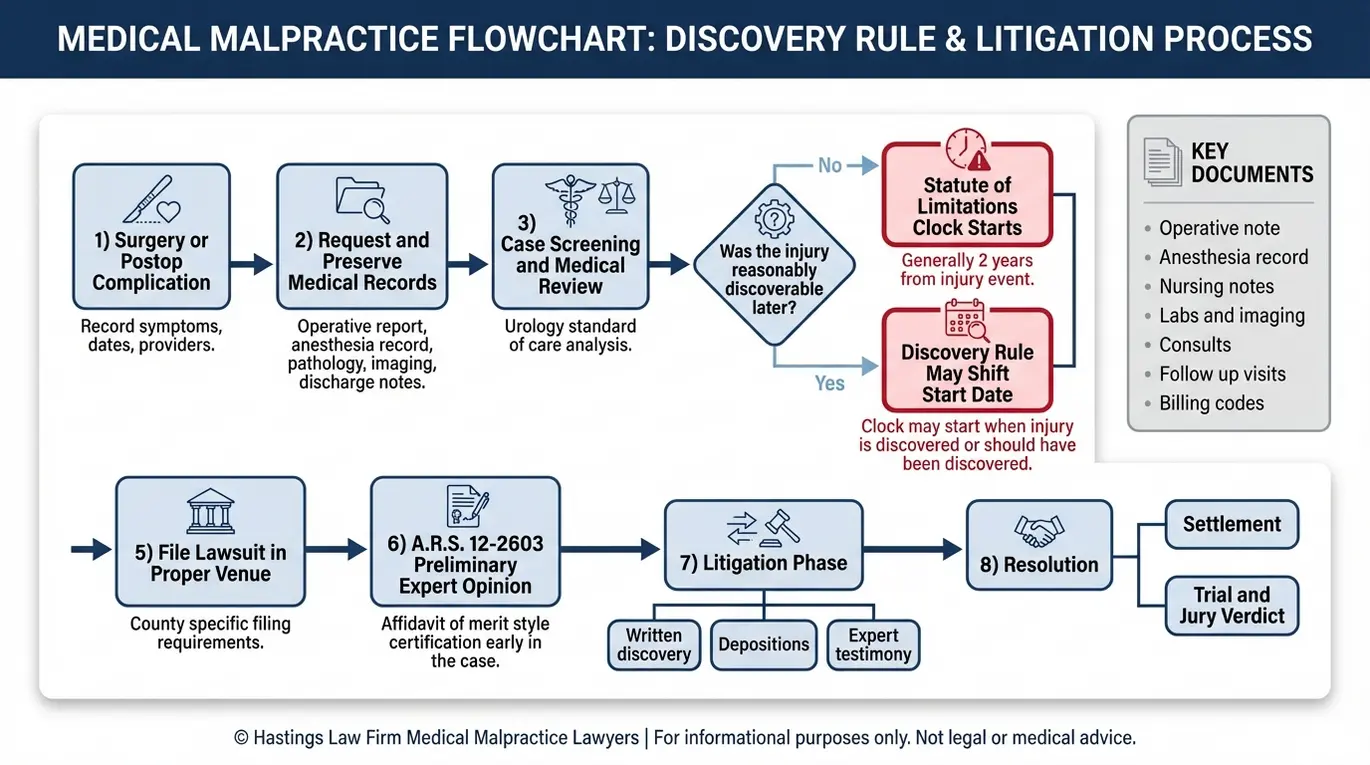
Arizona law requires claimants to file within a strict statute of limitations and requires a preliminary expert opinion affidavit to support the claim after the lawsuit is filed. Understanding these rules early is critical, and it is one of the first things we address when someone contacts our firm. Founded by Tommy Hastings, a board-certified trial attorney, we understand how to handle the specific requirements of state law. Surgical malpractice claims in the state are subject to specific legal requirements.
Statute of limitations.
This deadline limits how long a patient has to file a lawsuit. Under A.R.S. § 12-542, medical malpractice claims in Arizona must generally be filed within two years of the date the cause of action accrues. Arizona also recognizes the discovery rule, which means the clock may start from the date the patient knew, or reasonably should have known, about the injury and its connection to medical care. This is particularly relevant in prostate surgery cases where complications like a hidden ureteral leak or slow-developing nerve damage may not become apparent for weeks or months.
The A.R.S. § 12-2603 expert affidavit requirement.
This legal document is necessary to prove the claim has merit. After a medical malpractice lawsuit is filed in Arizona, A.R.S. § 12-2603 requires the plaintiff to serve a preliminary expert opinion affidavit from a qualified medical professional with the initial disclosure statements. This affidavit must confirm that the healthcare provider’s conduct fell below the standard of care. Our team handles the identification and retention of these experts so that our clients can focus on their recovery.
Local experience.
Regional legal knowledge helps in managing cases within the local court system. As a Phoenix malpractice attorney, our team has experience handling cases in Maricopa County Superior Court and understands the local procedural expectations, from liable parties identification to settlement negotiations and jury verdicts.
Damages and Compensation for Surgical Injuries
Patients who have been harmed by prostate surgery errors may recover compensation for medical bills, lost wages, and non-economic damages such as pain, suffering, and loss of consortium. The value of a medical malpractice compensation claim depends on the severity and permanence of the injuries, the impact on daily life, and the strength of the evidence supporting the case. Compensation in these cases covers the personal and financial impact of the error.
Economic damages cover the financial losses directly caused by the surgical error:
- Corrective or revision surgeries
- Ongoing costs for catheters, incontinence pads, and medications
- Lost income during recovery and, in some cases, diminished future earning capacity. Full medical malpractice compensation should cover these future needs.
- Future medical costs for long-term treatment and rehabilitation
Non-economic damages address the personal toll of the injury:
- Chronic physical pain and discomfort
- Mental anguish, depression, and anxiety
- Loss of enjoyment of life, including the inability to participate in activities that were once routine
Loss of consortium is a separate category that compensates a spouse for the impact on the marital relationship, including loss of intimacy, companionship, and support. In prostate surgery cases involving permanent erectile dysfunction, this can represent a significant component of a surgical injury settlement or jury verdict.
Every case is different. We evaluate the full scope of compensatory damages and work with medical and economic experts to present a clear picture of what recovery will cost, both now and in the years ahead.
Contact the Arizona Surgical Error Attorneys at Hastings Law Firm Today for Help
If you are living with complications from prostate surgery and believe a preventable error is responsible, you do not have to work through this alone. At Hastings Law Firm, every case is prepared from day one as if it will go to trial. That commitment signals to hospitals and their insurers that we will not accept less than fair compensation for our clients.
Our team includes in-house medical professionals, former defense attorneys, and a national network of expert witnesses, all focused exclusively on medical malpractice. We understand what you are going through, and we are here to help you find answers through a free, confidential case evaluation.
Contact our Arizona prostate surgery error lawyers to learn more. A patient advocate will listen to your story and help you understand your legal options. There are no fees unless we secure a recovery on your behalf.
Frequently Asked Questions About Prostate Surgery Error in Arizona


This content was researched and written by the Hastings Law Firm editorial team, which includes attorneys, medical professionals, and experienced researchers. Our writing is informed by internal knowledge and practical experience, and we cross-check critical details against authoritative sources cited throughout. Every piece undergoes human-led fact-checking and legal review. Because legal and medical information can change, if you spot an error, please contact us. Learn more about our content standards and review process on our editorial policy page.

Tommy Hastings, founder of Hastings Law Firm, is a board-certified personal injury trial lawyer dedicated exclusively to healthcare injury cases. Since 2001, he has represented injured patients and families in litigation against major hospital systems, pharmaceutical companies, and negligent healthcare providers nationwide. He has handled numerous high-profile cases that have drawn national media attention and resulted in multi-million dollar recoveries. He draws on that experience in his writing, helping readers understand how these cases work and what options may be available to them.
