


Phoenix Postoperative Malpractice Lawyer
Postoperative recovery depends on careful monitoring, timely treatment, and clear communication among the care team. When warning signs are missed or responses are delayed, patients can face worsening complications, prolonged suffering, permanent disability, or life-threatening consequences. Postoperative negligence can involve gaps in vital sign checks, overlooked lab changes, medication mistakes, premature discharge, or a failure to rescue when a patient is deteriorating. Understanding the difference between an expected surgical risk and substandard care can help families make sense of what happened. If you or a loved one were harmed or worse due to postoperative negligence in Phoenix, Arizona, contact Hastings Law Firm for a free, confidential case review.

Last Updated: July 27, 2026
Trusted Phoenix Medical Attorneys for Surgical Recovery Negligence Claims
When recovery after surgery takes an unexpected turn, it can be difficult to know whether what you are experiencing is a normal part of healing or the result of a preventable medical error. That uncertainty is exhausting, and it often comes at a time when you are already dealing with pain, fear, and unanswered questions. You deserve clarity about what happened and whether the postoperative care, meaning the monitoring, treatment, and follow-up provided after a surgical procedure, met acceptable medical standards.
A Phoenix postoperative malpractice lawyer at Hastings Law Firm can review your medical records, consult with qualified experts, and help you understand your legal options. Our consultations are free and confidential, and you pay no fees unless we recover compensation on your behalf.

Understanding Postoperative Negligence and Failure to Rescue
Postoperative negligence occurs when medical staff fail to properly monitor a patient’s recovery, leading to complications like infection or hemorrhage that should have been identified and treated promptly. Not every complication after surgery means someone made a mistake. But when a care team misses warning signs or delays a necessary response, the consequences can be severe and entirely preventable.
Every hospital and surgical center is bound by a standard of care, which is the level of treatment a reasonably competent medical professional would provide under similar circumstances. In the recovery setting, this standard has specific requirements.
Inside the post-anesthesia care unit (PACU), patients are monitored immediately after surgery. Nurses are expected to perform vitals monitoring at regular intervals, assess pain levels, watch for bleeding, and confirm the patient is emerging safely from anesthesia. A Phoenix postoperative malpractice lawyer knows that even small lapses in this monitoring can lead to disaster.
Once a patient moves from the PACU to a general hospital floor, the duty to monitor does not disappear. Staff must continue checking vitals, reviewing lab results, and responding to any changes in the patient’s condition. A breach of duty occurs when a provider fails to meet this standard, whether through inattention, understaffing, or a breakdown in communication between team members. Our postoperative negligence attorneys frequently find that understaffing on nights or weekends contributes to these breaches.
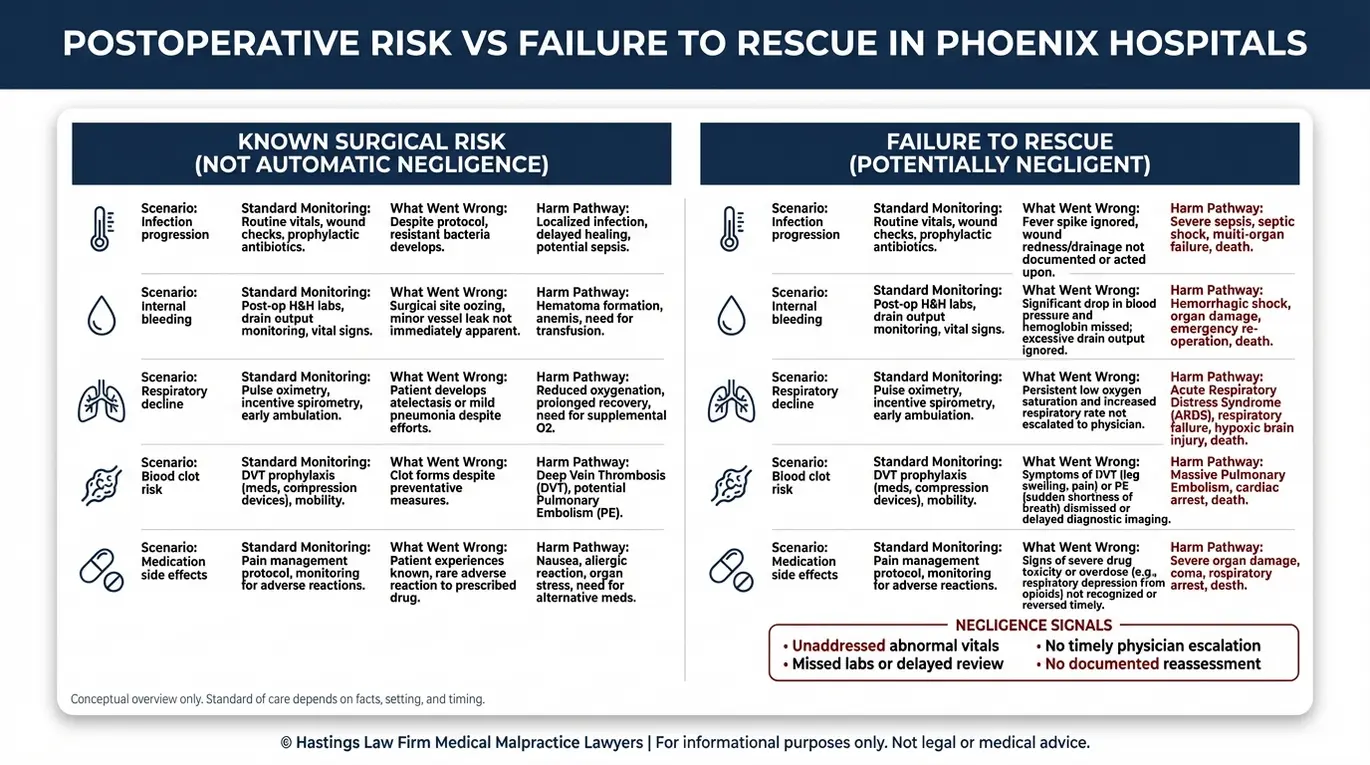
One of the most critical concepts in postoperative care is failure to rescue, a term used when clinicians fail to recognize and respond to signs that a patient is deteriorating. According to the Agency for Healthcare Research and Quality (AHRQ) Patient Safety Network, failure to rescue is now considered a key indicator of hospital quality. It does not refer to the initial complication itself, but rather to the missed opportunity to intervene before that complication becomes life-threatening. Our surgical recovery counsel can help families determine if an intervention window was missed.
A Phoenix postoperative malpractice lawyer evaluates whether the care team’s response was timely and appropriate given the clinical signs. There is an important distinction between a known surgical risk and medical negligence. Surgery always carries some degree of risk, and patients are informed of those risks before the procedure. But when a complication arises and the team fails to act on it, or when the complication itself was caused by substandard technique or care, that crosses the line from an accepted risk into potential negligence. An experienced postoperative negligence attorney can distinguish between bad luck and bad medicine.
Our postoperative negligence attorneys work with medical experts who specialize in surgical recovery standards. We examine nursing notes, vitals logs, medication records, and physician orders to determine whether follow-up care met the expected standard or whether a failure to rescue occurred. If you suspect that your care team missed something during your recovery, a Phoenix postoperative malpractice lawyer at Hastings Law Firm can help you get answers.
Your surgical recovery counsel will fight to ensure that negligent providers are held accountable for the harm caused by their inaction. We act as your dedicated postoperative negligence attorney throughout the entire legal process.
Common Types of Postoperative Care Errors in Phoenix Hospitals
Common postoperative errors include failure to diagnose sepsis, ignoring signs of internal bleeding, discharging patients before they are stable, and medication administration mistakes during recovery. These Common postoperative errors happen when hospital staff fail to follow safety protocols or standard medical procedures. Understanding what can go wrong helps you recognize whether the care you or a loved one received may have fallen below acceptable standards. A Phoenix surgical negligence lawyer can review the specific facts of your situation to identify these errors.
Infections and Sepsis
Postoperative infections can develop when sterile protocols are not followed during or after surgery, or when early signs of infection are overlooked by hospital staff. A rising white blood cell count, persistent fever, and increased wound redness are signals that should prompt immediate evaluation and treatment. An experienced postoperative malpractice lawyer in Phoenix knows that time is of the essence when infection sets in.
When these signs are missed or dismissed, an infection can escalate into sepsis, the body’s dangerous and potentially fatal overreaction to infection. Sepsis is a severe medical emergency where the body’s response to an infection damages its own tissues. The Centers for Disease Control and Prevention (CDC) identifies symptoms such as high fever, rapid heart rate, confusion, and clammy skin as warning signs that require urgent intervention. A Phoenix surgical negligence lawyer can investigate whether your care team failed to act on these indicators in a timely manner. If the staff ignored the protocol for sepsis management, a hospital negligence attorney can help you seek justice.
Bleeding and Blood Clots
Hemorrhage and internal bleeding are serious risks after many types of surgery. Hemorrhage refers to excessive bleeding from a ruptured blood vessel. Monitoring for these complications requires regular assessment of vital signs, drainage output, and hemoglobin levels. When staff fail to identify signs of blood loss, a patient can deteriorate rapidly.
A Phoenix postoperative malpractice claim often hinges on proving that these signs were evident in the charts but ignored by staff.
Blood clots represent another significant danger. Thromboprophylaxis is the preventative treatment used to stop blood clots from forming in the circulatory system. This treatment involves the use of anticoagulant medications as a well-established part of postoperative care.
A failure to administer these medications can lead to deep vein thrombosis (DVT), a blood clot that typically forms in the legs, or a pulmonary embolism, which occurs when a clot travels to the lungs and can be fatal. Research published in the JAMA Network on perioperative management of antithrombotic therapy underscores the importance of proper clot prevention protocols following surgery.
A postoperative malpractice lawyer in Phoenix can review whether your surgical team followed established guidelines for clot prevention and monitoring. If they failed to prescribe necessary anticoagulants, a hospital negligence attorney can hold them liable.
Early Discharge
Early discharge, the practice of sending a patient home before their condition is medically stable, occurs when patients are released while still showing signs of complications that have not been fully evaluated or resolved. Discharge refers to the formal release of a patient from a hospital or clinic after treatment. If a patient returns to the emergency room within hours or days of discharge with a worsening condition, the timing and circumstances of that discharge become a focus of our investigation. A Phoenix surgical negligence lawyer will scrutinize the discharge summary for evidence of premature release.
The standard of care generally requires that discharge decisions be based on objective clinical criteria, not bed availability or scheduling pressures. Hospital systems sometimes prioritize turnover, which can lead to these dangerous decisions. A postoperative malpractice lawyer in Phoenix can investigate the records to see if safety protocols were followed.
Medication Errors During Recovery
Medication errors in the recovery ward can include administering the wrong drug, the wrong dosage, or the wrong combination of medications. A medication administration record is the report that tracks all drugs given to a patient during their stay. Postoperative patients are particularly vulnerable because they may be receiving multiple drugs simultaneously for pain management, infection prevention, and other recovery needs. A Phoenix postoperative malpractice claim can address the harm caused by these preventable mix-ups.
An overdose of opioid pain medication, for example, can suppress breathing and lead to respiratory failure. Errors in the medication administration record may indicate a breakdown in the chain of care between the prescribing physician and the administering nurse. A Phoenix surgical negligence lawyer understands how to trace these errors back to the source.
The table below highlights some differences between expected recovery and warning signs that may point to a care failure:
| Normal Recovery Signs | Red Flags That May Indicate Negligence |
|---|---|
| Mild, manageable pain controlled by prescribed medication | Escalating pain that staff do not reassess or address |
| Slight fever in the first 24-48 hours | Persistent or rising fever beyond 48 hours without investigation |
| Minor swelling around the incision site | Signs of infection (redness, warmth, drainage) that go unreported |
| Gradual improvement in mobility and alertness | Sudden confusion, rapid heart rate, or drop in blood pressure |
| Stable vitals during PACU monitoring | Gaps in vitals documentation or delayed response to abnormal readings |
Preventable Never Events in Surgical Recovery
Some postoperative errors are so egregious that the medical community classifies them as never events, serious incidents that should simply never occur under competent care. Never events are errors that are considered entirely preventable and should not occur if safety protocols are followed. A retained surgical item (RSI), meaning a sponge, clamp, or other instrument left inside a patient’s body after surgery, is one of the most well-known examples. Retained surgical instruments can cause severe infection, pain, and organ damage.
When a never event occurs, the legal doctrine of res ipsa loquitur, a Latin term meaning “the thing speaks for itself,” can apply. Under this principle, the mere occurrence of the event can be treated as evidence of negligence, because these errors do not happen in the absence of a failure in care. This can shift the burden of proof and strengthen the patient’s position in a Phoenix postoperative malpractice claim. Your hospital negligence attorney will use this doctrine to build a compelling case for compensation.
The Hastings Law Firm Difference
Results matter, but what truly sets us apart is how we achieve them. Every verdict, every settlement, and every Phoenix courtroom victory comes from one guiding promise: To treat each client’s fight for justice as if it were our own.
This balance of skill, experience, and empathy reflects our core philosophy that justice should not only compensate the injured, but also make health care safer nationwide.

Proving Liability in Phoenix Postoperative Injury Cases
Proving liability requires establishing that a duty of care existed, demonstrating a breach of that standard through expert testimony, and linking that breach directly to the patient’s specific injury or decline. Liability refers to the legal responsibility of a provider for causing harm through substandard care. Building a strong postoperative malpractice case takes more than knowing something went wrong. It requires a systematic investigation that connects the medical evidence to a specific failure in care.
A Phoenix postoperative malpractice lawyer is essential for managing these complex legal requirements.
Collecting and Preserving Evidence
One of the first steps a Phoenix postoperative malpractice lawyer takes is securing the complete medical record. This includes surgical reports, nursing notes, and vitals logs. We also secure the medication administration record (MAR), which is the document recording every drug given and its timing. Finally, we review records from the rapid response team (RRT). This is the emergency clinical team called when a patient’s condition deteriorates suddenly.
Under federal law, patients have a right to access their own health information. The U.S. Department of Health and Human Services (HHS) guidance on individuals’ right to access health information under HIPAA confirms that healthcare providers must produce these records upon request. Obtaining them quickly is critical, as early preservation reduces the risk of records being altered or incomplete. A medical malpractice lawyer ensures that no page is missing and no digital entry is overlooked.
The Discovery Process
Once a lawsuit is filed, the case enters the discovery process, a formal exchange of information between the parties. Discovery is the formal process where both sides exchange evidence and information. Your liability attorney will use this phase to interrogate the medical staff involved in your care.
Through depositions, interrogatories, and requests for production, a Phoenix postoperative malpractice lawyer can uncover details that do not appear in the standard medical charts. We may discover that a nurse was fatigued, that a surgeon was double-booked, or that hospital policies were ignored. This deeper level of investigation is often where the strongest evidence of hospital negligence is found.
Arizona’s Affidavit of Merit Requirement
Arizona law imposes a specific procedural requirement before a medical malpractice lawsuit can proceed. Under Arizona Revised Statutes § 12-2603, a plaintiff must file a preliminary expert opinion, often called an affidavit of merit, certifying that a qualified medical expert has reviewed the case and believes the standard of care was breached. This requirement exists to ensure that claims have a legitimate medical basis before moving forward.
At Hastings Law Firm, our in-house medical staff and national expert network handle this process from the start. We work with specialists in the relevant field of surgery and recovery care to evaluate whether a breach occurred and whether it caused the patient’s injury. Your medical malpractice lawyer manages this critical step to prevent procedural dismissal.
Identifying the Responsible Parties
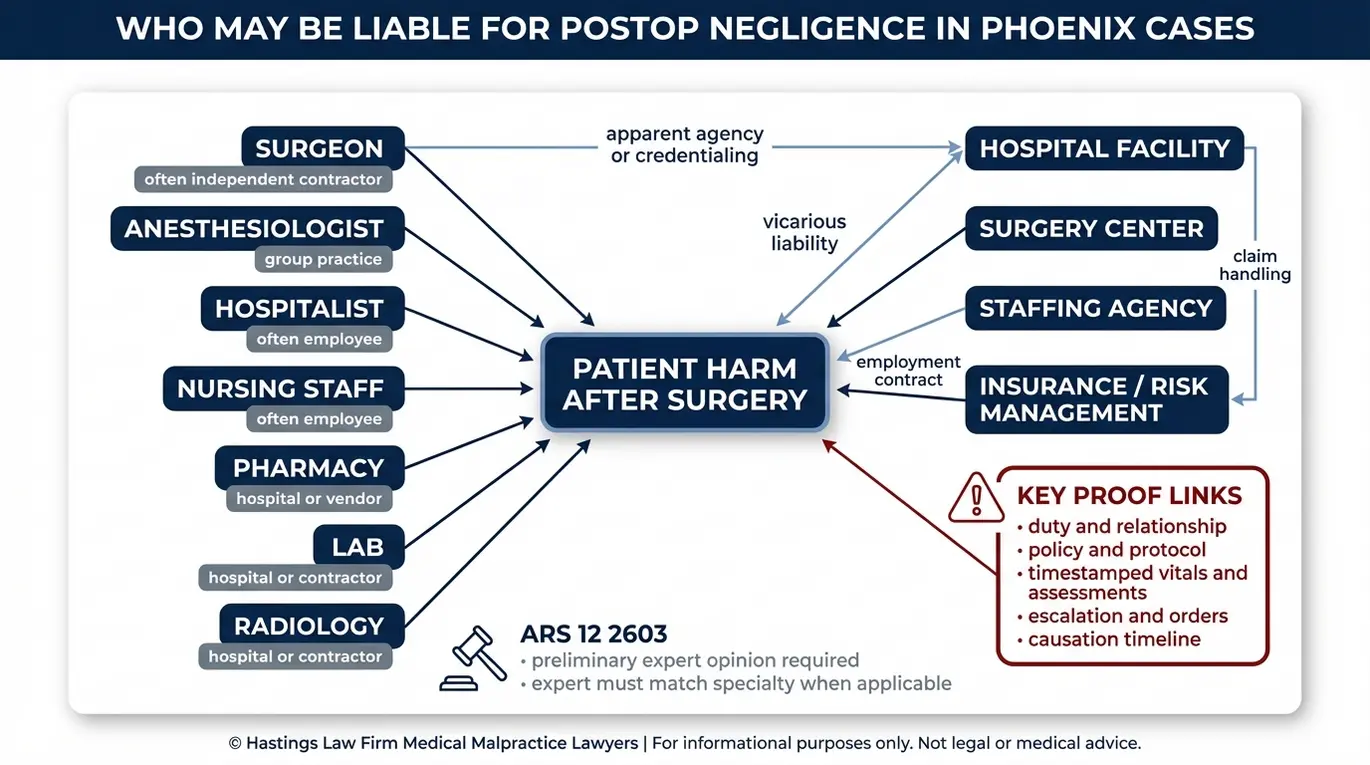
Postoperative cases often involve multiple parties. The surgeon who performed the procedure may be an independent contractor rather than a hospital employee, which affects how liability is assigned. Nursing staff, anesthesiologists, and the hospital itself may each bear separate or overlapping responsibility. A liability attorney can clarify these employment relationships to identify every defendant.
Our medical malpractice lawyers examine employment relationships, hospital policies, and the chain of communication to determine which parties may be liable. Here is a general outline of our investigation process:
- Obtain and preserve the full medical record, including imaging, lab results, and nursing documentation.
- Establish a minute-by-minute timeline of the patient’s postoperative course.
- Identify each provider involved in postoperative monitoring and treatment decisions.
- Retain a qualified expert witness to review the records and assess whether the standard of care was met.
- Determine whether the breach caused or contributed to the patient’s injury through causation analysis.
- File the required affidavit of merit and initiate formal legal proceedings.
A Phoenix postoperative malpractice lawyer at Hastings Law Firm manages every phase of this process so you can focus on your health. Whether dealing with a surgeon or a large hospital system, your liability attorney will fight for your interests. We understand that proving hospital negligence requires tenacity and expertise.
Arizona Statute of Limitations for Surgical Injury Claims
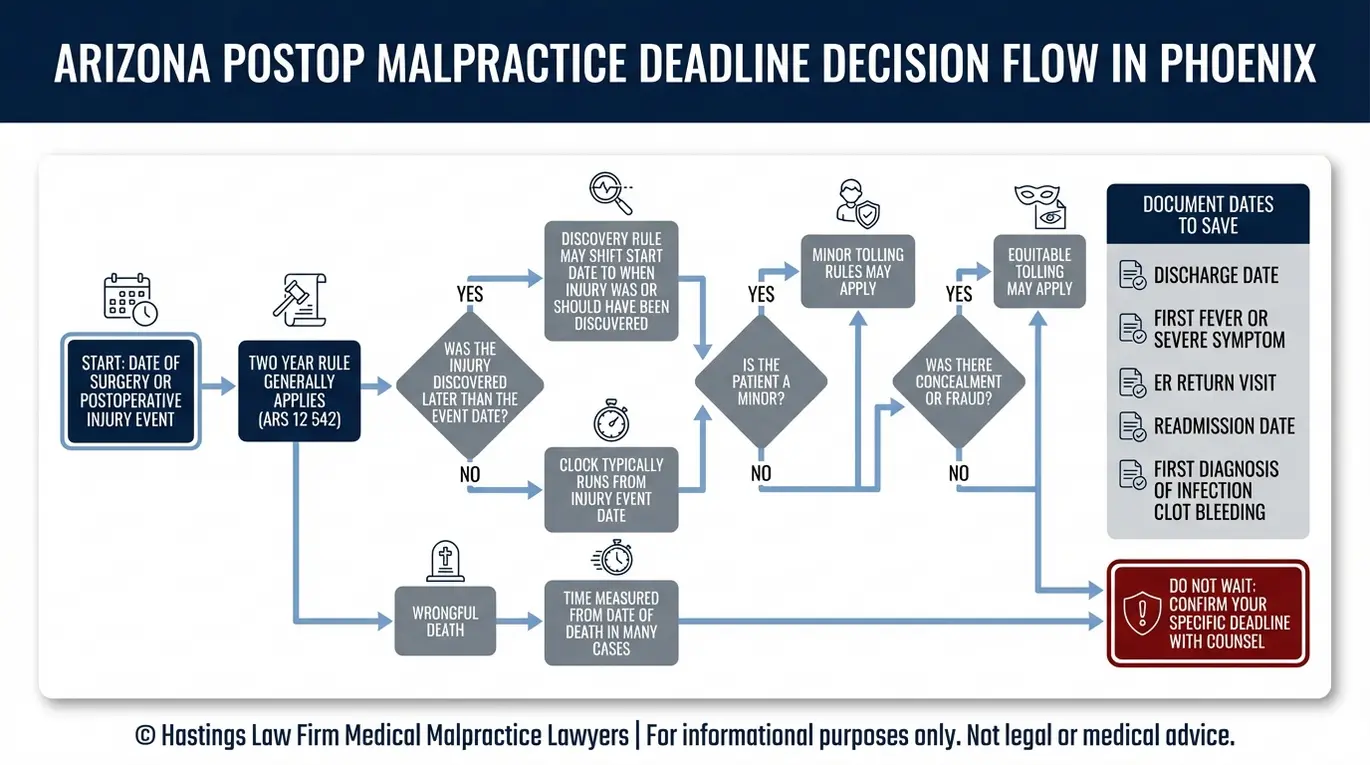
In Arizona, the standard statute of limitations for medical malpractice is generally two years from the date the injury occurred or was discovered. A statute of limitations is the legal deadline for filing a claim. Missing this deadline can permanently bar your ability to file a claim, regardless of how strong the evidence may be. A Phoenix malpractice lawyer can calculate the exact deadline for your specific case.
The baseline rule comes from Arizona Revised Statutes § 12-542, which sets a two-year window for personal injury claims. This law defines the timeline for filing personal injury claims, including those arising from postoperative negligence. In most cases, the clock starts on the date the injury happens. However, understanding when the clock truly starts can be complicated, which is why consulting a legal time limits expert is important.
Arizona recognizes the discovery rule. This rule applies when a patient could not reasonably have known about the injury at the time it occurred. For example, if a retained surgical instrument was not detected until imaging was performed months after the procedure, the two-year period may begin from the date the object was discovered rather than the date of surgery. A postoperative injury claim involving a hidden error often relies on this rule to remain valid.
There are several exceptions that may affect the filing deadline:
- Minors: If the injured patient is a child, the statute of limitations is often paused. For minor children, the statute may be tolled until they reach the age of majority, providing a longer window to file a suit. A Phoenix malpractice lawyer can explain how this applies to pediatric cases.
- Wrongful death: When a patient dies as a result of postoperative negligence, family members generally have two years from the date of death to file a wrongful death claim. This timeline is distinct from the injury claim.
- Fraudulent concealment: If a provider actively concealed evidence of an error, the filing deadline may be extended based on when the patient or family discovered the concealment.
Because these rules interact in ways that depend on the specific facts of your case, consulting a Phoenix malpractice lawyer early is the safest way to protect your rights. Hastings Law Firm can evaluate your timeline during a free consultation and help determine whether your postoperative injury claim falls within the allowable window. Do not assume you have time; let a legal time limits professional verify your dates.
Calculable Damages for Postoperative Negligence Victims
Patients harmed by postoperative negligence may recover economic damages for medical bills and lost wages, as well as non-economic damages for pain, suffering, and loss of quality of life. Economic and non-economic damages represent the total compensation requested for the losses you sustained. Arizona law does not impose caps on these damages, which is a meaningful distinction from many other states. A Phoenix postoperative malpractice lawyer will fight to maximize every category of compensation available to you.
Economic Damages
Economic damages cover the measurable financial losses caused by the injury. Economic damages are the quantifiable financial losses a person suffers after an injury. These can include the cost of corrective surgeries, extended hospital stays, rehabilitation, physical therapy, prescription medications, and home care. When a postoperative injury affects your ability to work, lost wages and reduced future earning capacity are also recoverable. A compensation attorney will work with economists to calculate these totals precisely.
In serious cases, a Phoenix postoperative malpractice lawyer may work with financial and medical experts to develop a life care plan. This document projects the long-term costs of the injury, including ongoing treatment, assistive devices, and any modifications needed for daily living. Life care plans help ensure that a settlement or verdict accounts for future needs, not just current expenses. Your damages lawyer ensures that no future cost is overlooked.
Non-Economic Damages
Non-economic damages address the human cost of the injury: physical pain, emotional distress, disfigurement, loss of enjoyment of life, and the strain on personal relationships. These losses are harder to quantify, but they are no less real. A postoperative complication that leads to chronic pain, permanent disability, or prolonged suffering carries a weight that goes beyond hospital bills. In cases of wrongful death, these damages also account for the loss of companionship and guidance suffered by the surviving family members.
Arizona’s Constitutional Protection Against Damage Caps
Many states limit how much a patient can recover in a medical malpractice case by imposing statutory damage caps on non-economic damages. Arizona takes a different approach. Under Article 2, Section 31 of the Arizona Constitution, the right to recover damages for injury or death cannot be limited by the legislature. This constitutional prohibition means that a jury in Phoenix can award the full amount it believes is fair, without an artificial ceiling imposed by statute.
This protection is significant for patients with severe postoperative injuries. A Phoenix postoperative malpractice lawyer at Hastings Law Firm understands how to present these damages effectively so that the full scope of the injury is reflected in the outcome. Because there are no damage caps, your compensation attorney can seek a verdict that truly reflects the magnitude of your loss. An experienced damages lawyer knows that this constitutional right is a powerful tool for justice.
Why Choose Hastings Law Firm for Your Recovery
Hastings Law Firm brings a trial-ready approach, board-certified leadership, and no upfront fees to every postoperative malpractice case we handle. Our firm exists for one reason: to hold healthcare providers accountable when their failures cause preventable harm. When you hire a Phoenix postoperative malpractice lawyer from our team, you are sending a message that you are serious about your recovery.
Trial-Ready From Day One
Every case we accept is investigated and prepared as though it will go before a jury. This is not just a philosophy; it is how we operate. When defense attorneys and insurance carriers know that a Phoenix postoperative malpractice lawyer at our firm is prepared to try the case, it changes the dynamics of negotiation. Fair settlement offers are more likely when the other side understands that we will not accept less than what the evidence supports. Our trial attorneys are known for their courtroom capability.
A Team Built for Medical Malpractice
Hastings Law Firm is not a general personal injury practice. Our entire team, including attorneys, nurse consultants, and patient advocates, focuses exclusively on medical negligence. Our legal staff includes former defense attorneys who once represented hospitals, giving us direct insight into the strategies the other side will use.
Our in-house medical professionals review records, identify charting inconsistencies, and help translate clinical data into clear legal arguments. As a dedicated medical negligence firm, we have the resources to match the hospital’s legal team.
Board-Certified Leadership
Founder Tommy Hastings is board certified in Personal Injury Trial Law by the Texas Board of Legal Specialization, a distinction held by fewer than two percent of Texas attorneys. In 2025, he was inducted into the American Board of Trial Advocates (ABOTA), an invitation-only organization recognizing elite trial lawyers. His record includes multi-million dollar recoveries in cases involving surgical error, monitoring failures, and hospital negligence.
No Fee Unless We Recover for You
We operate on a contingency fee basis. You pay no attorney fees and no out-of-pocket costs unless we obtain compensation on your behalf. This structure removes the financial barrier that often prevents injured patients from seeking legal help. Your Phoenix postoperative malpractice lawyer is invested in your success.
- Free consultation led by a patient advocate to review your claim details.
- No upfront fees or costs at any stage of the process, ensuring access to justice.
- Full medical-legal investigation using in-house clinical staff and a national network of expert witnesses.
- Trial-ready preparation that strengthens every phase of your case, from negotiation through verdict.
Choosing a medical negligence firm like Hastings Law Firm means you have a Phoenix postoperative malpractice lawyer and trial attorneys who are committed to restoring your future.
Contact the Phoenix Surgical Error Attorneys at Hastings Law Firm Today for Help
Postoperative complications caused by medical negligence can upend your health, your finances, and your sense of trust in the healthcare system. Contacting an attorney is an important step in protecting your legal rights after a medical error. You do not have to sort through the medical records or figure out what went wrong on your own. A Phoenix postoperative malpractice lawyer can take that burden off your shoulders.
Hastings Law Firm is here to help you find answers. Our medical law firm can review what happened during your surgical recovery, determine whether the care you received met acceptable standards, and explain your options going forward. Every conversation starts with a free, confidential evaluation, and you will never owe us a fee unless we secure a recovery on your behalf.
If you or a loved one suffered a serious complication after surgery in Phoenix, reach out to a Phoenix postoperative malpractice lawyer at Hastings Law Firm. Contact our firm today to take the first step toward understanding what happened and protecting your future.
Frequently Asked Questions About Postoperative Malpractice in Phoenix


This content was researched and written by the Hastings Law Firm editorial team, which includes attorneys, medical professionals, and experienced researchers. Our writing is informed by internal knowledge and practical experience, and we cross-check critical details against authoritative sources cited throughout. Every piece undergoes human-led fact-checking and legal review. Because legal and medical information can change, if you spot an error, please contact us. Learn more about our content standards and review process on our editorial policy page.

Tommy Hastings, founder of Hastings Law Firm, is a board-certified personal injury trial lawyer dedicated exclusively to healthcare injury cases. Since 2001, he has represented injured patients and families in litigation against major hospital systems, pharmaceutical companies, and negligent healthcare providers nationwide. He has handled numerous high-profile cases that have drawn national media attention and resulted in multi-million dollar recoveries. He draws on that experience in his writing, helping readers understand how these cases work and what options may be available to them.
