


Phoenix Delayed or Prolonged Surgery Lawyer
Surgical delays and prolonged procedures can turn a treatable problem into lasting harm, especially when time sensitive emergencies are not addressed promptly. Delays can stem from scheduling breakdowns, understaffing, triage errors, missed diagnoses, or mistakes during the operation that extend anesthesia time and raise the risk of serious complications. Accountability often depends on whether care fell below the accepted standard and whether the delay changed the outcome. If you or a loved one were harmed or worse due to delayed or prolonged surgery in Phoenix, Arizona, contact Hastings Law Firm for a free, confidential case review.

Last Updated: July 27, 2026
Trial-Ready Phoenix Medical Malpractice Attorneys for Surgical Delays
When a surgery is delayed or takes far longer than it should, the consequences can be severe and life-altering. Minutes matter in medicine, especially during what doctors call the “golden hour,” the critical window after a medical emergency when timely intervention is most likely to prevent permanent harm. If you or a loved one suffered because a necessary procedure did not happen when it should have, you deserve to know whether negligence played a role.
Hastings Law Firm is a nationally recognized trial firm that focuses exclusively on medical negligence. Our team of attorneys, in-house nurses, and medical consultants investigates surgical delay cases throughout Arizona to determine what went wrong, who is responsible, and what your options are. Contact us for a free consultation to review what happened and learn where you stand.

Understanding Negligence in Delayed or Prolonged Surgery Cases
Negligence in a delayed surgery case occurs when a medical provider fails to act within the accepted standard of care, allowing a treatable condition to worsen and cause preventable harm. Not every delay amounts to malpractice, but when a doctor’s mistake or provider’s inaction falls below what a reasonably competent surgeon would have done in the same situation, it may give rise to a legal claim. Hospital negligence can also play a role if systemic issues caused the wait. Determining negligence involves looking at what a standard medical response should have been in your specific clinical situation.
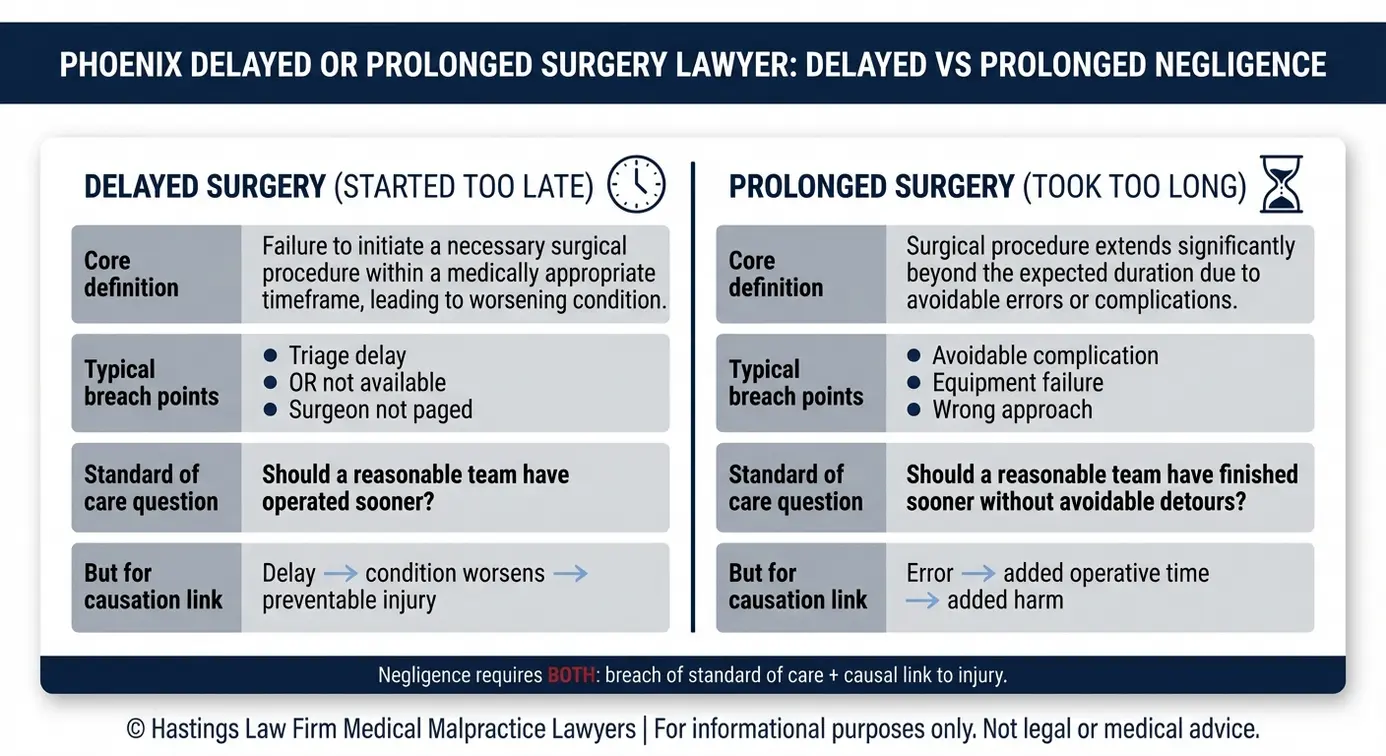
The distinction between delayed surgery and prolonged surgery matters both medically and legally. Delayed surgery refers to an unreasonable wait before a procedure begins, such as a patient with a ruptured appendix sitting in the emergency department for hours without being taken to the operating room. Prolonged surgery, or extended operative time, occurs when a procedure takes significantly longer than expected because of errors during the operation itself. This may include a surgeon inadvertently damaging surrounding tissue and needing additional time to repair it.
In either scenario, the legal question centers on Arizona’s standard of care: would a reasonable surgeon, facing the same clinical picture, have acted faster or performed the procedure differently? This is not a matter of opinion. It requires qualified medical expert testimony to establish what should have happened and when.
From there, the case depends on the “but-for” causation test. This means we must prove that the injury would not have happened if the medical team had acted correctly. A delayed surgery attorney examines the timeline, the medical records, and the clinical decisions at each stage to determine whether negligence caused or worsened the injury. If the evidence supports it, the hospital, surgeon, or other responsible parties may be held accountable for the harm that followed.
Medical malpractice claims involving surgical delays require both legal skill and deep medical knowledge. At Hastings Law Firm, our team includes former defense attorneys who understand how hospitals build their cases, along with in-house nursing staff who can identify exactly where the standard of care broke down.
Common Causes of Dangerous Surgical Delays in Arizona Hospitals
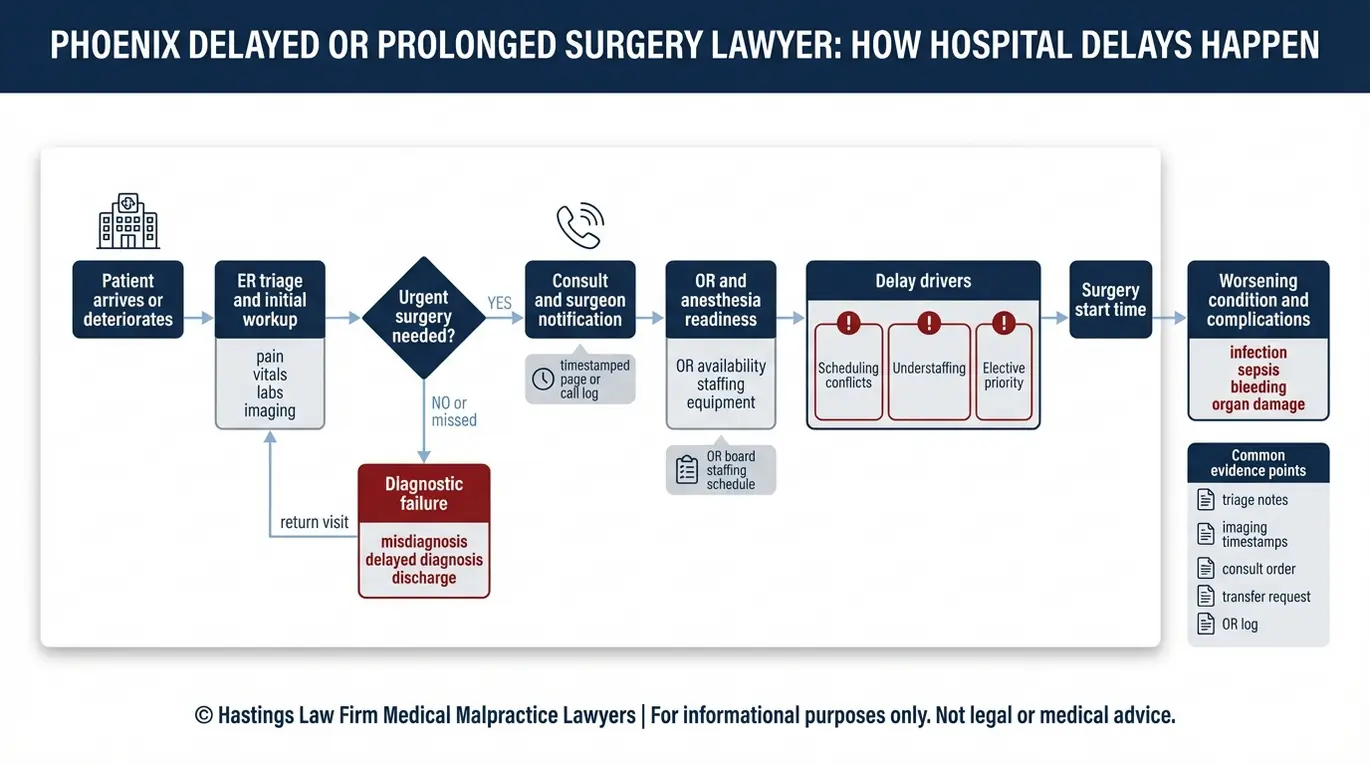
Surgical delays are often caused by administrative failures, such as scheduling conflicts and understaffing, or by diagnostic errors like misdiagnosis in the emergency room. Understanding the root cause of a delay is essential because it determines who may be legally responsible.
These failures generally fall into three categories: systemic breakdowns, diagnostic errors, and intraoperative mistakes.
Systemic failures happen at the institutional level. Operating room scheduling conflicts, where ORs are double-booked or elective procedures are prioritized over urgent cases, can push emergency patients further down the queue. Triage, the process of assessing and prioritizing patients by the severity of their condition, may also break down when emergency departments are short-staffed or overwhelmed. Triage failures leading to emergency room delays often occur when departments are short-staffed or overwhelmed. A lack of available anesthesiologists or surgical nurses can stall procedures that need to happen immediately.
Diagnostic failures occur when providers in the emergency room or other settings fail to recognize a condition that requires urgent surgical intervention. A patient with a bowel obstruction who is misdiagnosed and sent home, only to return hours later in far worse condition, is one example. A delayed diagnosis like this can turn a manageable situation into a medical emergency.
Intraoperative errors involve mistakes made during the surgery itself, such as a surgeon nicking an organ or blood vessel. These errors force the surgical team to spend additional time correcting the damage, prolonging the patient’s time under anesthesia and increasing the risk of complications.
The Agency for Healthcare Research and Quality (AHRQ) Patient Safety Indicators provide standardized metrics hospitals use to track exactly these kinds of events, including complications from procedures that should have been routine.
| Cause of Delay | Legal Implication |
|---|---|
| OR scheduling conflicts or double-booking | May support a hospital negligence claim for inadequate resource management |
| Understaffing (nurses, anesthesiologists) | Can establish corporate negligence against the facility |
| Emergency room misdiagnosis or missed diagnosis | May create liability for the treating physician and the hospital |
| Triage failures (incorrect prioritization) | Can indicate a breach of standard emergency protocols |
| Intraoperative errors prolonging surgery | May support a surgical malpractice claim against the surgeon |
A surgical delay attorney investigates each of these potential causes by reviewing hospital staffing records, OR schedules, emergency department logs, and the clinical decision-making documented in the chart.
Unnecessary Surgery Driven by Delays
In some cases, a delay in treating a relatively minor condition can lead to a far more invasive procedure later. This occurs when a manageable condition worsens into a medical emergency because of a failure to operate promptly. For example, an untreated infection may progress to tissue necrosis, the death of body tissue caused by loss of blood supply or severe infection, which can ultimately require amputation or major reconstructive surgery. What might have been resolved with a timely, straightforward procedure becomes an unnecessary surgery because the window for less aggressive treatment was missed. These additional procedures happen because the underlying issue was not addressed in time.
The Hastings Law Firm Difference
Results matter, but what truly sets us apart is how we achieve them. Every verdict, every settlement, and every Phoenix courtroom victory comes from one guiding promise: To treat each client’s fight for justice as if it were our own.
This balance of skill, experience, and empathy reflects our core philosophy that justice should not only compensate the injured, but also make health care safer nationwide.

Medical Consequences of Waiting Too Long for Treatment
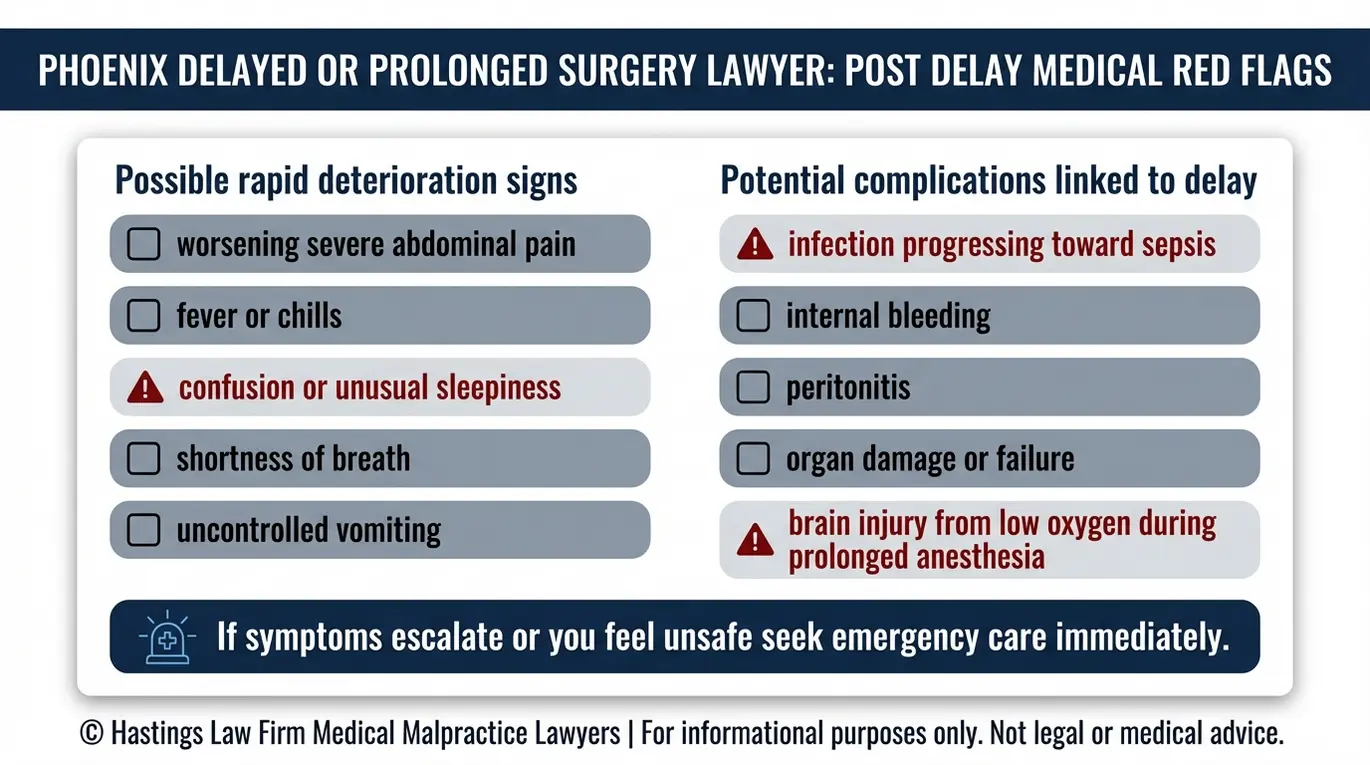
Patients forced to wait for necessary surgery can suffer rapid disease progression, including sepsis, internal bleeding, and permanent organ damage that was otherwise preventable. When treatment is delayed, conditions that are easily managed can quickly become dangerous. The human body does not pause while a hospital works through its scheduling backlog or while a diagnostic error goes uncorrected.
Certain conditions are acutely time-sensitive. Appendicitis, ectopic pregnancy, and bowel obstructions can worsen exponentially with every hour of delay. A contained infection can spread, or a partial obstruction can become complete. A slow bleed can become hemorrhagic.
In each of these scenarios, the difference between a routine recovery and a catastrophic outcome may come down to hours, or even minutes.
The risk of sepsis, a dangerous, body-wide response to infection that can lead to organ failure and death, increases dramatically when internal issues like a perforated bowel are left untreated. Peritonitis, the inflammation of the tissue lining the inner abdominal wall, often follows a perforation and can progress to septic shock without timely surgical intervention. These are not rare outcomes. They are well-documented consequences of delayed treatment.
Prolonged surgery carries its own set of dangers. Extended time under anesthesia is associated with increased risks that can include:
- Hypoxic brain injury: Reduced oxygen delivery to the brain during prolonged procedures
- Cardiovascular events: Heart attack or stroke triggered by extended operative stress
- Internal bleeding: Uncontrolled hemorrhage from intraoperative complications
- Organ damage: Injury to surrounding tissues during an extended or complicated procedure
- Severe infection: Greater exposure time in an open surgical field
- Permanent disability: Loss of function resulting from any of the above
Research from the UCLA Health Department of Anesthesiology & Perioperative Medicine confirms that longer anesthesia exposure correlates with higher rates of postoperative complications, particularly in older adults and patients with pre-existing conditions.
A Phoenix delayed surgery lawyer works with medical experts to connect the timeline of the delay to the specific injuries that followed. This causation link is the core of any surgical delay claim.
Establishing Liability for Prolonged or Delayed Procedures
Liability may extend beyond the surgeon to the hospital for staffing failures, the emergency room staff for triage errors, or administrative entities for policy failures. Identifying who is responsible is a key part of building a case for medical errors. Depending on the facts, the hospital itself, emergency room staff, anesthesiologists, and even administrative decision-makers can bear legal responsibility.
Surgeon liability can arise when a surgeon fails to respond promptly to an emergency, arrives late for a scheduled procedure, or makes errors during the operation that extend its duration and cause additional harm. If the evidence shows that a competent surgeon would have acted differently under the same circumstances, that gap between what happened and what should have happened forms the foundation of a negligence claim.
Hospital liability often involves what is known as corporate negligence. If a hospital failed to maintain adequate staffing levels, allowed scheduling practices that delayed emergency cases, or lacked policies to escalate urgent surgical needs, the institution itself may be held accountable. Hospitals may face vicarious liability for the actions of their employees, which means the employer is legally responsible for the mistakes of its staff. This can include nurse malpractice if bedside staff failed to escalate vital sign changes.
Anesthesiologist liability may apply when anesthesia errors cause a procedure to stall, pause, or extend unnecessarily. Prolonged anesthesia exposure, meaning the patient remains under sedation for significantly longer than the procedure should require, can result in hypoxic brain injury, a condition where insufficient oxygen reaches the brain and causes neurological damage.
Under Arizona Revised Statutes § 12-2603, medical malpractice claims in Arizona require a preliminary expert opinion affidavit. This means a qualified medical expert must review the case and confirm, before the lawsuit moves forward, that the standard of care was breached. Our team includes former defense counsel who previously worked for the systems we now challenge, providing a strategic advantage in identifying hospital errors.
At Hastings Law Firm, our investigation identifies every responsible party. Our attorneys know how hospitals and their insurers structure their defense, and we build our cases to address those strategies.
Damages Recoverable in Phoenix Delayed Surgery Lawsuits
Patients harmed by a delayed or prolonged surgery can recover both economic damages for measurable financial losses and non-economic damages for the personal toll the injury has taken on their lives. These legal claims help families handle the unexpected costs and trauma of a medical error.
Economic damages cover the concrete, quantifiable costs of the harm:
- Past and future medical bills, including surgeries, rehabilitation, medications, and ongoing care needs
- Lost wages from time missed at work during recovery
- Lost earning capacity if the injury resulted in a disability that limits the patient’s ability to return to their previous occupation
- The cost of a life care plan if long-term or permanent medical support is needed
The Centers for Medicare and Medicaid Services offers resources that help patients understand their medical billing rights, which can be useful when documenting the full scope of treatment costs and ensuring all expenses are accounted for in the claim.
Non-economic damages address losses that do not carry a specific price tag but are no less real:
- Physical pain and suffering endured during the delay and its aftermath
- Emotional distress and mental anguish
- Loss of quality of life or loss of enjoyment of daily activities
- Loss of consortium, the impact on the injured person’s relationship with their spouse or family
In wrongful death cases arising from surgical delays, surviving family members may recover funeral and burial expenses, loss of companionship, and the future income the deceased would have provided.
A Phoenix delayed surgery compensation lawyer calculates these damages by working closely with medical experts, economists, and life care planners to present the full picture of what the delay has cost.
Why Choose Hastings Law Firm for Your Malpractice Claim
Hastings Law Firm offers a trial-ready approach with no upfront costs, ensuring that even the most complex cases are litigated aggressively against powerful hospital systems. We bring a team that includes former defense attorneys, in-house nurses, and a national network of medical experts to every surgical delay case. This combination of legal strategy and medical insight is what sets us apart when handling delayed or prolonged surgery claims in Phoenix.
We prepare every case for trial from day one. This is how we operate. Defense attorneys and insurance carriers take notice when a case is built to withstand courtroom scrutiny with engaged expert witnesses. Being fully prepared to present the case to a jury changes the entire dynamic of negotiations. Many cases settle before trial specifically because the other side knows we will not accept less than what is fair.
Our team includes people who used to work for the other side. Our former defense counsel and experienced nurses previously worked within the hospital systems we now hold accountable. That background gives us insider insight into how hospitals document care, how defense teams build their arguments, and where the gaps in their case are most likely to appear.
You pay nothing unless we recover compensation for you. We handle delayed surgery cases on a contingency fee basis, meaning there are no upfront attorney fees or costs to worry about while you focus on healing. Founder Tommy Hastings is a board-certified trial lawyer, an honor held by less than 2% of attorneys in the state. Recognized by the American Board of Trial Advocates and named a Texas Super Lawyer since 2013, he built this firm on the belief that every patient deserves access to skilled representation regardless of their financial situation.
We also understand that this is about more than money. Many of our clients want to know what actually happened and why. They want to prevent it from happening to someone else. That drive for truth and accountability is something we share, and it guides every case we take.
Contact the Phoenix Surgical Error Attorneys at Hastings Law Firm Today for Help
You do not have to face the hospital’s legal team on your own. If you believe a surgical delay or prolonged procedure caused harm to you or someone you love, there are answers available, but Arizona’s statute of limitations places strict time limits on when you can file a claim.
Hastings Law Firm offers a free, confidential case evaluation so you can understand what happened, whether negligence may have played a role, and what your options are. There is no fee unless we recover compensation for you.
Call our Phoenix office or contact us online to speak with a member of our medical-legal team. A Phoenix delayed or prolonged surgery lawyer at Hastings Law Firm is ready to review your case and help you take the next step.
Frequently Asked Questions About Delayed or Prolonged Surgery in Phoenix


This content was researched and written by the Hastings Law Firm editorial team, which includes attorneys, medical professionals, and experienced researchers. Our writing is informed by internal knowledge and practical experience, and we cross-check critical details against authoritative sources cited throughout. Every piece undergoes human-led fact-checking and legal review. Because legal and medical information can change, if you spot an error, please contact us. Learn more about our content standards and review process on our editorial policy page.

Tommy Hastings, founder of Hastings Law Firm, is a board-certified personal injury trial lawyer dedicated exclusively to healthcare injury cases. Since 2001, he has represented injured patients and families in litigation against major hospital systems, pharmaceutical companies, and negligent healthcare providers nationwide. He has handled numerous high-profile cases that have drawn national media attention and resulted in multi-million dollar recoveries. He draws on that experience in his writing, helping readers understand how these cases work and what options may be available to them.
