


Arizona Delayed or Prolonged Surgery Lawyer
Delayed or prolonged surgery can turn a treatable problem into lasting harm when a hospital system breaks down or a procedure runs longer than medically appropriate. Some delays reflect careful clinical judgment, but others stem from scheduling conflicts, staffing shortages, communication failures, or missing resources. Waiting too long can worsen outcomes, including severe infection, permanent organ damage, and long term disability, while extended anesthesia time can add additional risks and recovery burdens. If you or a loved one were harmed or worse due to delayed or prolonged surgery in Arizona, contact Hastings Law Firm for a free, confidential case review.

Last Updated: July 27, 2026
Trusted Legal Representation for Surgical Negligence in Arizona
When surgery is delayed or a procedure takes longer than it should, the consequences can be severe and life-altering. If you or a loved one suffered harm because of an unnecessary wait for surgery or a prolonged operation in Arizona, the confusion and frustration you feel are understandable. You trusted a medical team to act on time, and now you are left dealing with injuries that may have been preventable.
At Hastings Law Firm, we focus exclusively on medical malpractice. Our legal and medical team, including in-house nurse consultants and former defense attorneys, knows how to investigate surgical timelines, identify where breakdowns occurred, and hold the responsible parties accountable. As an Arizona delayed or prolonged surgery lawyer, we prepare every case as if it will go to trial so that your claim carries real weight from day one.
If you believe a surgical delay made your condition worse, we can review what happened and explain your options in a free, confidential consultation.

Common Causes of Surgical Delays and Prolonged Procedures
Surgical delays often stem from administrative failures such as double-booking operating rooms, understaffing of anesthesia providers, or miscommunication between emergency departments and surgical teams. While some delays result from legitimate medical decisions, others are the product of administrative errors and preventable logistical breakdowns that put patients at risk.
Understanding the difference between these two categories is central to any delayed surgery claim.
Administrative vs. Medical Negligence in the OR
Not every surgical delay points to negligence. A surgeon may choose to postpone a procedure to stabilize a patient’s blood pressure or address a newly discovered complication. In legal terms, a surgeon has a duty to prioritize patient safety, and postponing for stability is not a breach of that duty. That kind of clinical judgment, even if it leads to a longer wait, may fall within the accepted standard of care.
Administrative and systemic failures are a different matter entirely. However, when delays are caused by clerical mistakes, non-medical staff liability may arise. These are delays that have nothing to do with your medical condition and everything to do with how the hospital manages its resources. Common causes include:
- Hospital scheduling conflicts: Hospitals use a system called OR block scheduling, where blocks of operating room time are reserved for specific surgeons or departments. When rooms are double-booked or blocks overlap, patients who need urgent procedures can be pushed back for hours.
- Understaffing of anesthesia teams: An anesthesia team, typically an anesthesiologist or a certified registered nurse anesthetist (CRNA), must be present for surgery to proceed. When there are not enough providers on shift, surgeries stall regardless of how ready the surgeon is.
- Communication breakdowns: A failure to relay critical information between the emergency department, the surgical team, and the nursing staff can cause dangerous gaps in care. A patient flagged as urgent may sit in a holding area because the handoff never happened.
- Resource constraints and equipment shortages: If specialized instruments, blood products, or imaging equipment are unavailable, a time-sensitive surgery may be delayed while the team scrambles to find alternatives.
- Operating room turnover time, the period required to clean, restock, and prepare an OR between procedures, can also create bottlenecks when hospitals prioritize volume over safety.
The Agency for Healthcare Research and Quality (AHRQ) Patient Safety Indicators track metrics designed to flag exactly these types of operating room delay risks. Patient Safety Indicators (PSIs) are clinical tools that help identify potential safety events occurring during hospital care. When a hospital’s scheduling practices or staffing models consistently create delays, it may reflect a pattern of institutional negligence rather than an isolated incident.
As a delayed surgery attorney, our team examines hospital staffing records, OR logs, and internal communications to determine whether the delay in your case was a sound medical decision or a preventable failure. A lawyer for prolonged surgery injuries can identify whether the root cause was clinical judgment or something the facility had the power to prevent.
The Medical Consequences of Waiting Too Long for Surgery
Unnecessary delays can allow a patient’s condition to deteriorate rapidly, leading to sepsis, permanent organ damage, or the loss of a “window of opportunity” for effective treatment. What might have been a manageable surgical case can become a medical emergency when hours pass without intervention. These delays can lead to permanent organ damage if essential systems do not receive treatment in time.
The human body does not pause while a hospital works through scheduling problems. An inflamed appendix can rupture. Internal bleeding, or hemorrhage, can deprive organs of the blood supply they need to survive. A compressed nerve can sustain permanent damage. The longer the wait, the narrower the path to a good outcome.
One of the most dangerous progressions we see in delayed surgery cases involves the escalation from localized infection to sepsis. As defined by The Third International Consensus Definitions for Sepsis and Septic Shock (Sepsis-3), sepsis is life-threatening organ dysfunction caused by a dysregulated host response to infection. A patient who could have been treated with a routine procedure may develop organ failure simply because the surgery did not happen on time.
Prolonged anesthesia time, meaning the total duration a patient remains under general anesthesia, creates its own set of risks. Extended time under anesthesia is associated with higher rates of respiratory complications, blood clots, cognitive effects, and cardiovascular stress, particularly in older patients or those with pre-existing conditions.
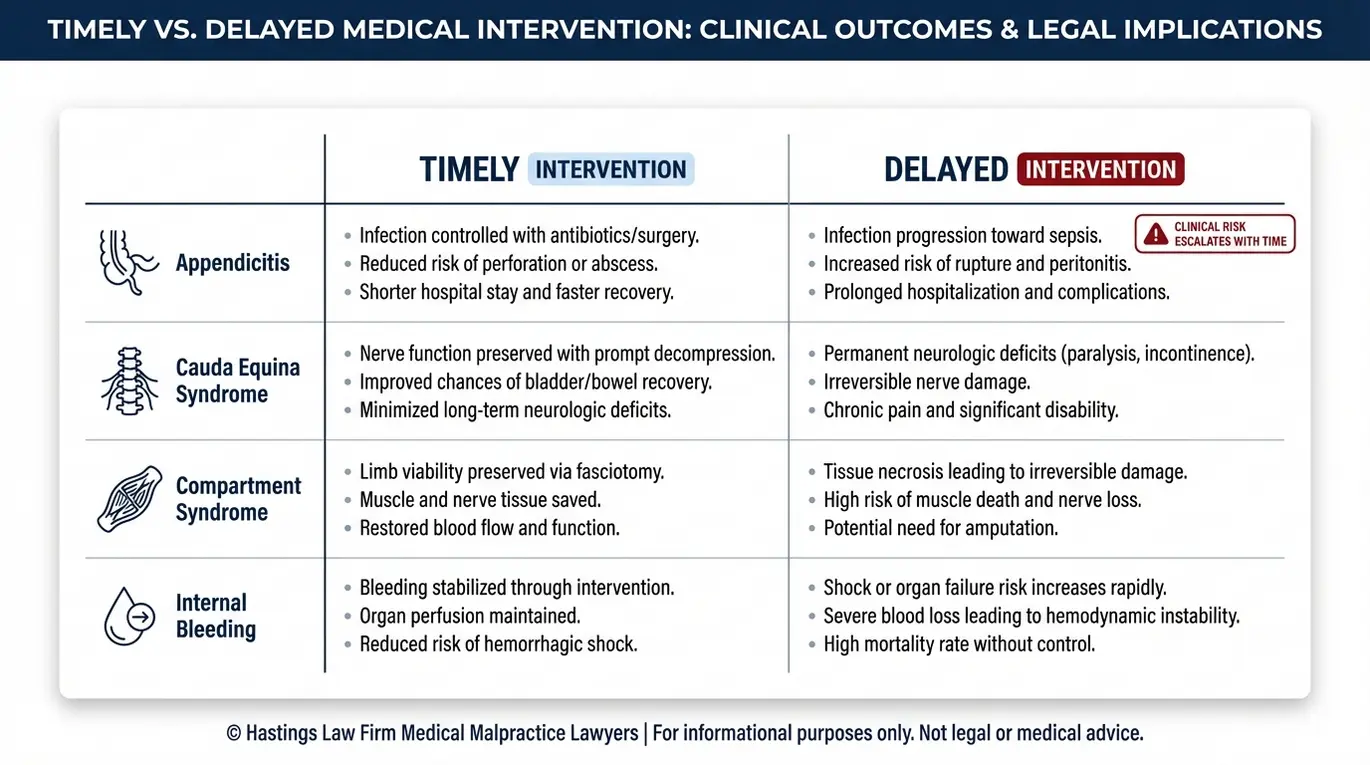
The following table illustrates how outcomes can change dramatically depending on whether surgery occurs within the medically recommended timeframe:
| Condition | Timely Intervention Outcome | Delayed Intervention Outcome |
|---|---|---|
| Appendicitis | Laparoscopic removal; short recovery | Rupture, peritonitis, sepsis, extended ICU stay |
| Cauda Equina Syndrome | Preserved nerve function; restored mobility | Permanent paralysis, bladder/bowel dysfunction |
| Compartment Syndrome | Fasciotomy relieves pressure; limb preserved | Tissue death, amputation, permanent disability |
| Internal Bleeding (Hemorrhage) | Controlled surgically; stable recovery | Organ failure, hypovolemic shock, wrongful death |
These are not abstract possibilities. They represent the types of cases where an Arizona delayed surgery counsel can demonstrate that earlier action would have led to a significantly different result. The physical toll is only part of the picture. Patients who endure prolonged, complicated procedures often face lasting emotional trauma, extended rehabilitation, and a diminished quality of life that affects their families as well.
The Hastings Law Firm Difference
Results matter, but what truly sets us apart is how we achieve them. Every verdict, every settlement, and every Arizona courtroom victory comes from one guiding promise: To treat each client’s fight for justice as if it were our own.
This balance of skill, experience, and empathy reflects our core philosophy that justice should not only compensate the injured, but also make health care safer nationwide.

Proving Causation Using the Window of Opportunity Doctrine
To win a delayed surgery claim, a plaintiff must prove that the delay was the proximate cause of the worsened outcome, often by demonstrating that earlier intervention would have likely prevented the permanent injury. Expert testimony becomes essential to bridge the gap between medical delays and physical harm. This concept is known as the window of opportunity, and it describes the limited time available to treat a condition before the harm becomes permanent.
In time-sensitive medical emergencies, there is often a finite period during which treatment can prevent irreversible harm. This concept refers to the time-sensitive interval in which a surgical intervention must occur to achieve the best possible result. Once that window closes, the damage may be permanent.
Consider conditions like cauda equina syndrome, where surgical decompression is widely regarded as time-critical. Research published in PLOS ONE on the definition and surgical timing in cauda equina syndrome has reinforced the relationship between the timing of surgery and the likelihood of neurological recovery. When surgery is performed within the recommended timeframe, patients have significantly better outcomes. When it is not, the chances of regaining full function drop sharply.
To build this connection between delay and harm, a delayed surgery lawyer in Arizona must establish several things. First, the standard of care required surgery within a specific timeframe given the patient’s diagnosis. Second, the surgery did not occur within that window. Third, the delay, not the underlying condition alone, caused or materially contributed to the worsened outcome.
Ischemia, or the lack of blood flow to tissues or organs, often becomes relevant in these cases. Many surgical emergencies involve conditions where blood supply is compromised. The longer ischemia persists, the greater the tissue damage. Establishing a timeline of ischemic injury through medical records and imaging studies helps connect the delay directly to the patient’s outcome.
Our team works with qualified medical experts who can review the clinical timeline, analyze the records, and offer opinions on what would have happened if surgery had been performed sooner. As a prolonged operation attorney, we reconstruct the sequence of events minute by minute, identifying where the standard of care required action and where that action failed to occur.
In some cases, the injury involves what is known as the Loss of Chance doctrine. If a delay reduced a patient’s chance of survival or recovery, even if the outcome was not certain to begin with, the patient may still have a viable claim. This legal rule allows for compensation when a healthcare provider’s error lowers the probability of a better medical result. Arizona courts evaluate these claims carefully, and strong expert testimony is the foundation of proving them.
Arizona Legal Requirements for Malpractice Claims
Arizona law requires claimants to certify whether expert testimony is necessary via an Affidavit of Merit and generally mandates strict adherence to preliminary expert opinion statutes to prevent case dismissal. Missing any of these steps can end a case before it truly begins.
Under A.R.S. § 12-2603, a patient filing a medical malpractice claim in Arizona must provide a preliminary expert opinion affidavit, often referred to as an Affidavit of Merit. This affidavit must include a statement from a qualified medical expert confirming that the defendant’s conduct fell below the accepted standard of care and that this breach caused the injury. The expert must be licensed, board-certified, or otherwise qualified in a relevant specialty.
The burden of proof in Arizona medical negligence cases rests on the patient. You must demonstrate, by a preponderance of the evidence, that the healthcare provider’s actions or inactions were negligent and that the negligence caused your harm. In delayed surgery cases, this means showing not just that a delay occurred, but that the delay itself led to a worse outcome than timely intervention would have produced.
Meeting these requirements demands preparation from the very start. An Arizona delayed surgery legal team must secure qualified experts, obtain and review complete medical records, and build a causation argument before the initial filings are submitted. At Hastings Law Firm, our in-house medical staff, including nurse practitioners and board-certified patient advocates, begins reviewing clinical records during our initial case evaluation to identify potential breaches early.
Here is a checklist of procedural requirements for Arizona medical malpractice claims:
- Obtain and preserve all relevant medical records and surgical logs
- Identify and retain a qualified medical expert in the relevant specialty
- Secure a preliminary expert opinion affidavit under A.R.S. § 12-2603
- File the claim within the applicable statute of limitations
- Comply with all notice requirements if the claim involves a public hospital or government entity
- Prepare to demonstrate causation through expert testimony and medical evidence
These procedural steps are necessary to move forward with a claim. A firm that handles these requirements from day one protects your case from early dismissal and positions it for the strongest possible outcome.
Compensation for Delayed Surgery Injuries in Arizona
Victims of surgical delays may recover economic damages for additional medical costs and lost wages, as well as non-economic damages for pain, suffering, and loss of quality of life, which are constitutionally protected in Arizona. Arizona law provides meaningful protections for injured patients seeking fair compensation. Economic damages include all financial losses that can be calculated, such as the costs of future care and lost income.
Economic damages cover the measurable financial losses caused by the delay. These include the cost of additional surgeries, extended hospital stays, rehabilitation, medications, medical devices, and any future care you may need because of a permanent disability. If your injuries prevent you from returning to work, either temporarily or permanently, lost wages and lost earning capacity are also recoverable.
Non-economic damages address the harm that is harder to quantify but no less real. Pain and suffering, emotional distress, loss of enjoyment of life, and the impact on your relationships all fall into this category. For patients who endured a preventable worsening of their condition, these damages often represent a significant portion of their claim.
Arizona stands apart from many states on one important point: the Arizona Constitution, under Article 2, Section 31, prohibits the legislature from imposing caps on damages for personal injury or wrongful death. This means that a jury in Arizona has the authority to award compensation that reflects the true scope of your losses without arbitrary limits reducing that amount.
When a surgical delay results in permanent disability, the long-term financial impact can be substantial. An attorney for surgery delays will work with medical and economic experts to project the full cost of future care, lost income, and diminished quality of life so that any settlement or verdict accounts for what you will need going forward, not just what you have already spent.
Time Limits and the Arizona Statute of Limitations
In Arizona, medical malpractice lawsuits generally must be filed within two years from the date the injury occurred or was discovered, though specific exceptions apply for minors and public entities. Missing this deadline almost always means losing your right to pursue a claim.
The standard rule is outlined in A.R.S. § 12-542, which sets a two-year statute of limitations for personal injury claims, including medical malpractice. The clock typically starts on the date the injury occurs. In delayed surgery cases, that may be the date of the procedure or the date complications from the delay became apparent. In limited circumstances, the statute of limitations may be paused. This legal concept, known as tolling, applies if a patient is legally incapacitated or under the age of 18, though it is applied narrowly.
Arizona does recognize a version of the discovery rule. If you could not have reasonably known that the surgical delay caused your injury at the time it happened, the statute of limitations may begin running from the date you discovered, or should have discovered, the connection between the delay and your harm. However, courts apply this exception narrowly, and it should not be relied upon without legal guidance.
WARNING: Claims against public hospitals carry a much shorter deadline. If the facility that delayed your surgery is operated by a city, county, or the state, you must file a Notice of Claim within 180 days of the injury. This is a strict prerequisite, and failing to adhere to this timeline can be catastrophic for your case. If you miss this window, your claim may be permanently barred, regardless of how strong the evidence is.
An Arizona prolonged surgery lawyer can evaluate your timeline quickly and determine which deadlines apply. At Hastings Law Firm, we conduct a free initial evaluation that includes identifying your filing deadlines so that no procedural misstep jeopardizes your case.
Do not wait to explore your options. The sooner you consult with an attorney, the more time your legal team has to investigate, secure evidence, and retain the right experts.
Choosing a Specialized Medical Malpractice Firm in Arizona
Selecting a firm that focuses exclusively on medical malpractice ensures your legal team understands complex hospital protocols, medical charting, and the specific liability laws that govern surgical negligence. Not every personal injury firm has the medical knowledge or litigation experience these cases demand.
Hastings Law Firm does not handle car accidents, slip-and-fall cases, or general injury claims. Every member of our team, from our attorneys to our in-house nurse consultants, works on medical malpractice cases. Our legal staff includes former defense attorneys who previously represented hospitals, giving us direct insight into the strategies the other side will use. This focus means we know how to read surgical logs, identify charting inconsistencies, and work with the right medical experts to build your case.
Founded by Tommy Hastings, a board-certified trial lawyer, our firm was built around the mission of restoring trust for people who feel let down by the healthcare system. We pride ourselves on providing client-centric care, treating every client as a partner, not a case number, with transparent communication at every stage. Our trial-ready approach means we are always prepared to go to court if a fair settlement is not offered.
We handle cases on a contingency fee basis, which means you pay no attorney fees or costs unless we recover compensation for you. There is no financial risk in reaching out.
Contact the Arizona Surgical Error Attorneys at Hastings Law Firm Today for Help
You should not have to carry the financial and physical burden of injuries that a hospital’s scheduling failure or a surgeon’s negligence could have prevented. If a surgical delay made your condition worse, you deserve to know what happened and whether you have a legal path forward.
Hastings Law Firm is an Arizona delayed or prolonged surgery law firm with the medical knowledge and trial experience to investigate your case thoroughly. Our Phoenix office serves patients and families throughout Arizona, and our team is ready to listen.
Contact us today for a free, confidential case evaluation. We will review your medical records, assess your timeline, and explain your options clearly. You pay nothing unless we win your case.
Frequently Asked Questions About Delayed or Prolonged Surgery in Arizona


This content was researched and written by the Hastings Law Firm editorial team, which includes attorneys, medical professionals, and experienced researchers. Our writing is informed by internal knowledge and practical experience, and we cross-check critical details against authoritative sources cited throughout. Every piece undergoes human-led fact-checking and legal review. Because legal and medical information can change, if you spot an error, please contact us. Learn more about our content standards and review process on our editorial policy page.

Tommy Hastings, founder of Hastings Law Firm, is a board-certified personal injury trial lawyer dedicated exclusively to healthcare injury cases. Since 2001, he has represented injured patients and families in litigation against major hospital systems, pharmaceutical companies, and negligent healthcare providers nationwide. He has handled numerous high-profile cases that have drawn national media attention and resulted in multi-million dollar recoveries. He draws on that experience in his writing, helping readers understand how these cases work and what options may be available to them.
