


Phoenix Gallbladder Surgery Error Lawyer
Gallbladder surgery is often routine, but a preventable surgical mistake can leave a patient facing severe pain, additional procedures, infection, long recoveries, and in the worst cases fatal outcomes. Distinguishing an accepted complication from negligence often turns on whether basic safety steps were followed in the operating room and whether the care team responded appropriately when visibility or anatomy was unclear. Accountability can also depend on whether responsibility rests with a surgeon, a hospital, or both. If you or a loved one were harmed or worse due to a gallbladder surgery error in Phoenix, Arizona, contact Hastings Law Firm for a free, confidential case review.

Last Updated: July 27, 2026
Trusted Phoenix Medical Attorneys for Surgical Negligence Claims
When gallbladder surgery doesn’t go as planned, the aftermath can be overwhelming. You may be dealing with unexpected pain, additional procedures, mounting medical bills, and a growing sense that something went wrong in the operating room. Those concerns deserve to be taken seriously.
Gallbladder removal is one of the most commonly performed surgeries in the United States, and most go smoothly. But when a surgeon’s preventable mistake causes a serious injury, the consequences can change the course of your life. Understanding whether what happened to you or your loved one was medical malpractice, and not simply a known risk, is the first step toward accountability.
Hastings Law Firm was founded in 2005 and focuses exclusively on medical malpractice litigation. As a Phoenix gallbladder surgery error lawyer team, we can review what happened, explain your legal options, and help you decide how to move forward. Your initial consultation is free and confidential.

Understanding Negligence in Gallbladder Procedures
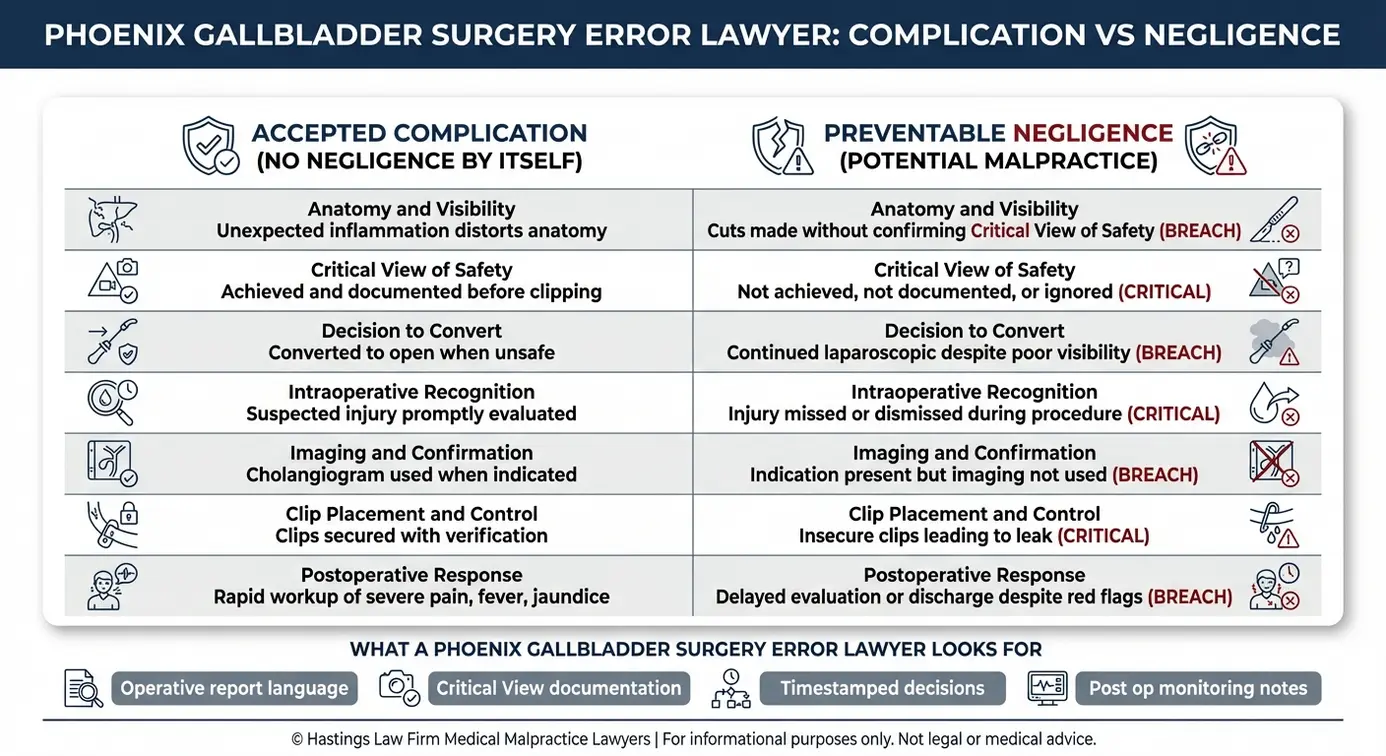
Gallbladder surgery negligence occurs when a surgeon deviates from the accepted standard of care, often by failing to identify critical anatomical landmarks before cutting or neglecting to convert to open surgery when complications arise. The standard of care is a medical benchmark used to measure whether a doctor acted appropriately. Not every difficult outcome after surgery qualifies as malpractice, but a preventable error that causes harm may. A surgical error lawyer can help distinguish between the two.
The standard of care is the level of treatment a reasonably competent surgeon would provide under similar circumstances. Our gallbladder surgery lawyers know that in a laparoscopic cholecystectomy, the minimally invasive procedure used to remove the gallbladder through small incisions, that standard includes specific safety steps designed to prevent the most serious injuries.
One of the most important of those steps is achieving the Critical View of Safety (CVS), a surgical technique requiring the surgeon to clearly identify the cystic duct and cystic artery before cutting or clipping anything. Research published by Frontiers in Surgery on patient and surgeon predictors of achieving the critical view of safety confirms that obtaining the CVS is a widely recognized safeguard against bile duct injuries. When a surgeon skips this step or misidentifies the anatomy, the risk of a catastrophic error rises significantly.
A Phoenix gallbladder surgery error lawyer evaluates whether the surgeon met the standard of care by examining several key factors:
- Whether the surgeon achieved the Critical View of Safety before dividing any structures
- Whether the surgeon recognized signs of unclear anatomy and paused or converted to an open procedure
- Whether proper imaging or diagnostic tools were used during the operation
- Whether the surgical team responded appropriately to intraoperative complications
The distinction between a known risk and negligence matters. Every surgery carries some inherent danger, and patients are typically informed of those risks before the procedure. But when a complication occurs because a surgeon failed to follow established safety protocols, that crosses the line from an accepted risk into potential malpractice. A gallbladder malpractice attorney can help determine which side of that line your situation falls on.
Common Types of Gallbladder Surgery Errors and Injuries
The most frequent errors in gallbladder surgery involve cutting the common bile duct, puncturing adjacent organs like the bowel or liver, and failing to properly secure surgical clips, leading to bile leaks and severe infection. These errors in gallbladder surgery can turn a routine same-day procedure into months of additional treatment. A gallbladder surgery error lawyer often sees these life-altering consequences.
Bile duct injuries are among the most serious outcomes. The common bile duct, the tube that carries bile from the liver to the small intestine, can be accidentally cut, clipped, or burned during a laparoscopic cholecystectomy. This type of injury often requires a complex reconstructive surgery called a Roux-en-Y hepaticojejunostomy. Recovery is often lengthy.
Bowel and vascular injuries can occur during trocar insertion. Research published by PubMed on trocar injuries in laparoscopic surgery indicates these puncture injuries, while uncommon, can cause life-threatening bleeding or bowel perforation if not immediately recognized and repaired.
Retained stones, meaning gallstones or bile duct stones unintentionally left behind after surgery, can cause post-operative blockages, infection, and pancreatitis. When a surgeon fails to confirm that all stones have been removed, complications may arise if post-operative care is insufficient. An attorney for gallbladder errors can investigate these failures.
Failure to convert to open surgery is another common basis for gallbladder surgery error claims. A study in PubMed Central comparing outcomes of laparoscopic cholecystectomy to open procedures reinforces that surgeons must be prepared to convert when patient safety demands it. Continuing a laparoscopic approach through poor visibility is a recognized form of surgical negligence.
Common injuries that may result from errors in gallbladder surgery include:
- Bile duct transection or thermal injury requiring reconstructive surgery
- Bowel perforation from trocar insertion
- Uncontrolled bleeding from vascular damage
- Post-operative bile leaks leading to peritonitis or sepsis
- Retained stones causing recurrent pain, infection, or pancreatitis
- Wrong-site surgery or organ damage to the liver or intestine
- Death in the most severe, unrecognized cases
Economic Pressures and Rushed Surgeries
High-volume surgical centers may operate under tight schedules. In some facilities, the focus on managing high patient volumes can lead to situations where safety protocols are not fully followed. Phoenix gallbladder injury lawyers often find that time pressure leads to errors, such as the improper use of a trocar, a sharp pointed device used to create small openings for tools, or a failure to perform a conversion to open surgery, switching to a traditional incision when visibility is poor. A Phoenix surgical error attorney examines whether these systemic failures contributed to your injury.
The Hastings Law Firm Difference
Results matter, but what truly sets us apart is how we achieve them. Every verdict, every settlement, and every Phoenix courtroom victory comes from one guiding promise: To treat each client’s fight for justice as if it were our own.
This balance of skill, experience, and empathy reflects our core philosophy that justice should not only compensate the injured, but also make health care safer nationwide.

Recovering Compensation for Surgical Malpractice Damages
Victims of botched gallbladder surgeries can recover economic damages for medical bills and lost wages, as well as non-economic damages for pain, suffering, and permanent digestive issues. Damages are legal awards meant to compensate you for the physical and financial losses caused by the error. The full scope of compensation for surgical error depends on how the injury has affected your health, your finances, and your daily life.
Economic damages cover the measurable financial losses tied to the injury. These often include the cost of corrective surgeries such as biliary reconstruction, a Roux-en-Y hepaticojejunostomy that can require extended hospitalization and follow-up care. Lost income during recovery, ongoing medication costs, and future medical expenses are also included.
Non-economic damages address the personal toll of the injury. Chronic pain, emotional distress, dietary restrictions, and loss of quality of life are all recognized categories. For patients who develop permanent complications like recurring bile duct strictures or digestive dysfunction, these damages may be substantial.
Wrongful death damages may be available to families when a surgical error leads to fatal complications such as uncontrolled sepsis or hemorrhage. A lawyer for gallbladder injury can pursue financial compensation for funeral costs and loss of companionship.
| Damage Category | Examples |
|---|---|
| Economic Damages | Corrective surgeries, hospital stays, lost wages, future medical care, rehabilitation |
| Non-Economic Damages | Chronic pain, emotional distress, loss of quality of life, dietary limitations |
| Wrongful Death Damages | Funeral expenses, loss of income/support, loss of companionship |
A Phoenix gallbladder surgery error lawyer can help you identify every category of compensation that applies to your situation, so nothing is overlooked during settlement negotiations or at verdict. You may need a Phoenix gallbladder malpractice lawyer to ensure your rights are protected.
Determining Liability: Surgeon vs. Hospital
Liability may lie with the individual surgeon for procedural errors, or with the hospital if the negligence involved nursing staff, inadequate equipment, or credentialing failures. Liability refers to the legal responsibility a provider has for causing harm. In many cases, more than one party may share responsibility.
Surgeon liability typically arises from errors in judgment or technique. This can include failure to achieve the Critical View of Safety, misidentification of the bile duct, or failure to perform an intraoperative cholangiogram (IOC), an imaging study to map anatomy. Suing a surgeon in Phoenix requires proving these specific failures. A surgeon may also be liable for improperly placing surgical clips, small fasteners used to seal the cystic duct.
Hospital liability may apply when institutional failures contribute to the injury. Examples include staffing errors, equipment failures, or neglecting post-operative care. A hospital liability lawyer can determine if the facility is responsible. Hospitals can also be held liable under vicarious liability principles.
Informed consent is another consideration. Informed consent means your doctor explained the risks and you agreed to the treatment. If the patient was not adequately informed about the specific risks of the procedure, or if the surgeon performed a different operation than what was discussed, a separate basis for the claim may exist.
We build each case to hold every responsible party accountable. Consulting a Phoenix gallbladder surgery error lawyer or gallbladder surgery liability attorney is important to untangle these complex relationships.

Why Choose Hastings Law Firm for Your Claim
Hastings Law Firm specializes exclusively in medical malpractice, bringing a “Trial-Ready” approach and a team of former defense attorneys to advocate for clients against hospital legal teams.
What sets our firm apart:
- Board-certified leadership: Founder Tommy Hastings is Board Certified in Personal Injury Trial Law by the Texas Board of Legal Specialization, a distinction earned by less than 2% of attorneys in the state.
- Former defense attorneys: Our medical negligence lawyer team includes former defense counsel who understand the internal strategies hospitals use to defend these claims.
- In-house medical professionals: Our staff includes board-certified patient advocates who review medical records to build the foundation of your case.
- Contingency fee structure: You pay no surgical error attorney fees unless we recover compensation for you.
- National expert network: We work with top-tier medical experts across the country.
As a Phoenix gallbladder surgery error lawyer team, we prepare every case as though it is going to a jury. We aim to provide the dedicated legal representation Phoenix residents deserve. A Phoenix medical malpractice lawyer from our firm is ready to help you.
Arizona Statute of Limitations for Surgical Injuries
In Arizona, victims generally have two years from the date of the injury (or discovery of the injury) to file a medical malpractice lawsuit, though specific exceptions may apply. A statute of limitations is a strict legal deadline that limits how long you have to take legal action. This deadline is established under Arizona Revised Statutes § 12-542.
Under Arizona malpractice laws, the “discovery rule” can extend the time limit to sue if the injury was hidden, such as a retained stone. This rule ensures the clock only starts ticking when a patient reasonably should have known about the injury. Additionally, Arizona law requires a preliminary expert opinion affidavit to be served with initial disclosures in most medical malpractice cases, and a notice of claim may be required if the lawsuit involves a public entity such as a government-operated hospital.
Important: Medical records can be lost over time. A Phoenix gallbladder surgery error lawyer can take immediate steps to secure the evidence needed to evaluate your claim.

Contact the Phoenix Surgical Error Attorneys at Hastings Law Firm Today for Help
If you or a loved one suffered a serious injury during gallbladder surgery, you deserve clear answers about what happened and whether negligence was involved. The medical system holds the records, the expertise, and the institutional resources. You don’t have to face that alone.
Hastings Law Firm is here to restore trust and protect your future. Our team of Phoenix gallbladder surgery error lawyers, medical professionals, and patient advocates will review your case, explain your options, and stand beside you through every step of the process.
Your initial confidential consultation is free and led by a patient advocate who understands both the medical and legal sides of your situation. There is no fee unless we recover compensation for you. Contact our firm today to get started.
Frequently Asked Questions About Gallbladder Surgery Error in Phoenix


This content was researched and written by the Hastings Law Firm editorial team, which includes attorneys, medical professionals, and experienced researchers. Our writing is informed by internal knowledge and practical experience, and we cross-check critical details against authoritative sources cited throughout. Every piece undergoes human-led fact-checking and legal review. Because legal and medical information can change, if you spot an error, please contact us. Learn more about our content standards and review process on our editorial policy page.

Tommy Hastings, founder of Hastings Law Firm, is a board-certified personal injury trial lawyer dedicated exclusively to healthcare injury cases. Since 2001, he has represented injured patients and families in litigation against major hospital systems, pharmaceutical companies, and negligent healthcare providers nationwide. He has handled numerous high-profile cases that have drawn national media attention and resulted in multi-million dollar recoveries. He draws on that experience in his writing, helping readers understand how these cases work and what options may be available to them.
