


Arizona Perfusionist Malpractice Lawyer
Perfusionists operate the heart lung machine during cardiopulmonary bypass, and a mistake in monitoring, alarms, chemicals, or emergency backup response can cause catastrophic harm. These events often leave families searching for clear answers about whether the injury came from operator error, a device problem, or a hospital system failure. Liability can involve the perfusionist, a contracted perfusion group, or the hospital, and proving a breach often depends on detailed records and machine logs. If you or a loved one were harmed or worse due to perfusionist negligence in Arizona, contact Hastings Law Firm for a free, confidential case review.

Last Updated: July 27, 2026
Trusted Legal Representation for Bypass Specialist Negligence in Arizona
When a surgery that was supposed to save a life instead causes a serious injury, the sense of betrayal can be overwhelming. If you or a loved one suffered harm during a procedure involving cardiopulmonary bypass, the medical technology that temporarily takes over the heart’s and lungs’ functions, you may have questions about what went wrong and who is responsible. The perfusionist, a certified clinical specialist responsible for operating the heart-lung machine, holds your life in their hands during these critical moments. Errors by this team member can lead to severe and permanent harm.
Founded by board-certified trial attorney Tommy Hastings, our firm focuses exclusively on medical malpractice cases. We understand both the medicine and the law behind these claims, and we are here to help you find answers. Contact us for a free, confidential case evaluation to learn about your options.

Understanding Perfusionist Negligence and Heart-Lung Machine Failures
Perfusionist negligence occurs when a certified clinical perfusionist fails to meet the standard of care, the level of treatment a reasonably competent professional would provide under similar circumstances, while operating cardiopulmonary bypass equipment, resulting in preventable injury or death.
During open-heart surgery, the perfusionist manages the heart-lung machine (also called a bypass pump). This is the device that circulates and oxygenates the patient’s blood while the surgeon operates on a still heart. According to the Mayo Clinic College of Medicine and Science, cardiovascular perfusionists are highly trained specialists. They are responsible for maintaining blood flow, gas exchange, and proper chemical balance throughout the procedure. Some cases involve perfusionists operating extracorporeal membrane oxygenation (ECMO) circuits, which provide prolonged heart and lung support outside the operating room.
The stakes are high. The perfusionist must constantly monitor flow rates, oxygenation, and chemistry. Any lapse can deprive organs of oxygenated blood instantly. Families facing these tragedies often turn to a heart bypass machine lawyer for answers.
Common perfusionist errors include:
- Allowing air to enter the bypass circuit, which can cause an air embolism that blocks blood flow to the brain
- Mixing incorrect concentrations of cardioplegia solution or other chemicals
- Failing to maintain adequate flow rates, leading to organ ischemia, which is tissue damage caused by low blood flow
- Ignoring or failing to recognize machine alarms and warning indicators
- Leaving the bypass pump unattended during critical phases of surgery
- Failing to properly de-air the circuit before initiating bypass
We must distinguish between defective devices and operator error. Device malfunctions fall under product liability, while operator errors constitute medical malpractice. In many cases, both theories may apply, and a thorough investigation by a lawyer for perfusionist negligence is needed to determine the true cause. This distinction is important when suing a perfusionist in Arizona.
As Arizona perfusionist malpractice lawyers and Phoenix perfusionist malpractice lawyers, our team at Hastings Law Firm, which includes in-house nurse consultants and former defense attorneys, examines every layer of the case to identify exactly where the failure occurred and who bears responsibility.
Manual Crank Failure and Emergency Protocol Violations
One of the most preventable yet serious perfusion errors involves the failure to maintain blood flow during a power failure. In these situations, maintaining circulation is essential while the heart-lung machine is offline. Every bypass pump is equipped with a manual hand crank, a mechanical backup that allows the perfusionist to keep blood circulating by hand if the machine loses electrical power.
When power is lost and the perfusionist does not immediately engage the manual crank, the patient’s blood flow stops. Within minutes, this can cause anoxia, a complete deprivation of oxygen to the brain and organs, leading to severe and irreversible brain damage or death. The standard of care requires perfusionists to be trained and drilled on manual crank procedures so they can respond without hesitation. When a facility does not follow protocols, or if a perfusionist is unable to respond during a crisis, the consequences can be severe.
If you suspect a power failure or machine failure contributed to a loved one’s surgical injury, an Arizona surgical error attorney can investigate the facility’s emergency protocols and the perfusionist’s training history.

Liability for Perfusion Errors in Arizona Hospitals
Liability in perfusion cases can extend to the hospital, the independent perfusion contract group, and the individual perfusionist, depending on employment status and the specific nature of the negligence.
Many Arizona hospitals do not employ perfusionists directly. Instead, they contract with third-party perfusion companies that provide staff on an as-needed basis. When something goes wrong, this arrangement becomes a significant legal issue, often central to hospital negligence claims. Hospitals may argue that the perfusionist was an independent contractor, not an employee, and that the hospital should not be held liable for the contractor’s errors.
Arizona law, however, recognizes several ways to hold the hospital accountable even in these situations. Under the doctrine of vicarious liability and the hospital’s duty of care, if the hospital exercised control over how the perfusionist performed their duties, the hospital may still share responsibility. A related theory, apparent agency, applies when the patient had no reason to know the perfusionist was not a hospital employee. If the hospital presented the perfusionist as part of its surgical team without disclosing the independent contractor relationship, the hospital can be held liable for the patient’s injuries.
As discussed in an Amicus Brief filed by the State of Arizona, the question of institutional liability in medical settings is an evolving area of Arizona jurisprudence. These legal arguments require an experienced medical negligence lawyer Arizona residents trust who understands how to trace the chain of responsibility.
Complexity increases when the surgery takes place at a government-funded facility. Arizona law requires a formal notice of claim to be filed with the appropriate government entity before a lawsuit can proceed. Missing this step, or filing it incorrectly, can jeopardize the entire case and potential settlement.
When suing a hospital for bypass errors, understanding liability for surgical errors is key. A hospital negligence lawyer can help establish perfusionist liability Arizona laws enforce. Our Arizona medical malpractice attorney team is your dedicated Arizona Perfusionist Malpractice Lawyer.

The Hastings Law Firm Difference
Results matter, but what truly sets us apart is how we achieve them. Every verdict, every settlement, and every Arizona courtroom victory comes from one guiding promise: To treat each client’s fight for justice as if it were our own.
This balance of skill, experience, and empathy reflects our core philosophy that justice should not only compensate the injured, but also make health care safer nationwide.

Establishing Breach of Standard of Care in Bypass Surgery
To prove a breach of standard of care, we must demonstrate that a prudent perfusionist would have acted differently under similar circumstances, confirmed through expert testimony and medical record analysis. This is the core of proving perfusionist negligence.
Building a perfusionist negligence case requires more than a bad outcome. We need evidence showing that the perfusionist’s specific actions, or failure to act, fell below what the profession demands. A thorough investigation matters, and it is why we prepare every case from day one as if it will go to trial. As a heart surgery malpractice attorney and perfusionist error attorney, we know the stakes.
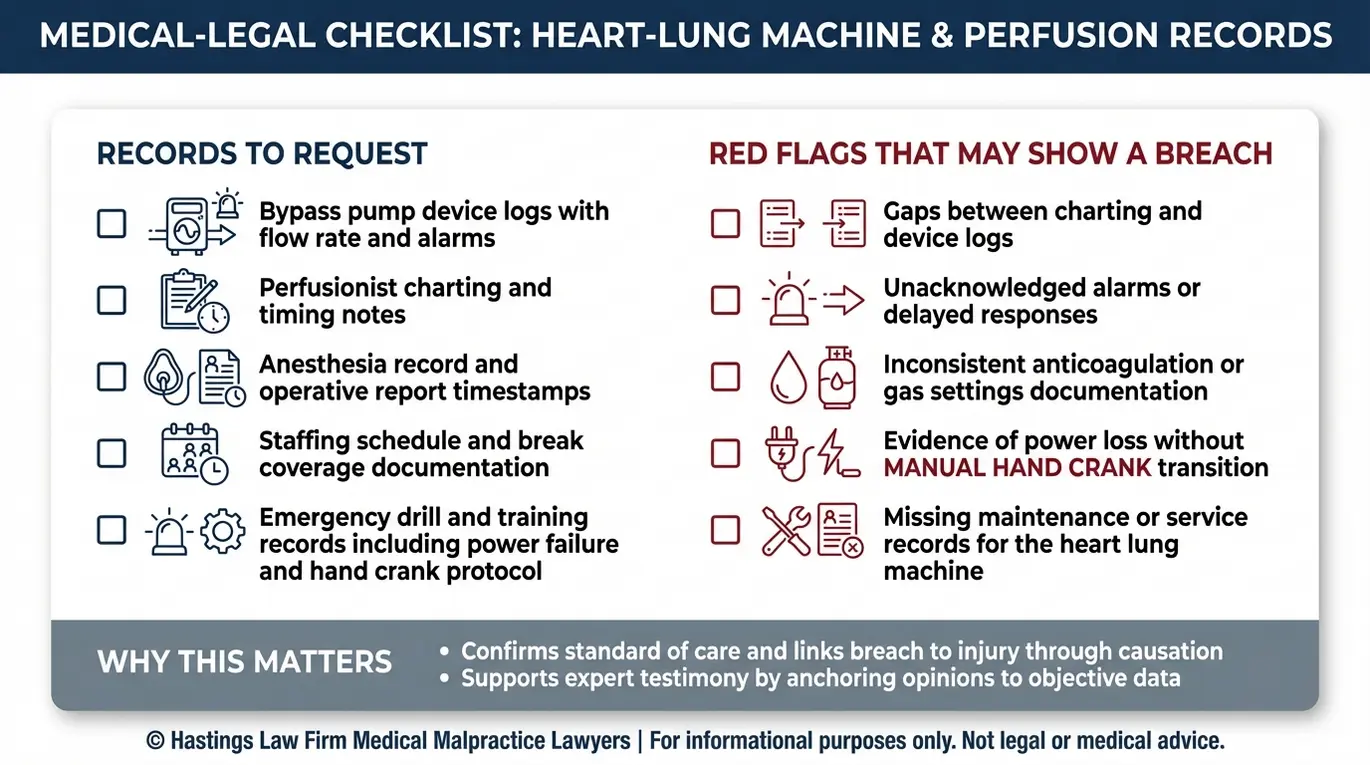
Critical medical malpractice evidence we examine in bypass surgery cases includes:
- Digital logs from the bypass machine, which record flow rates, pressure readings, temperature data, and alarm events in real time
- The perfusionist’s written charting and any notes documenting actions taken during the procedure
- Training and certification records, including documentation of emergency drills and continuing education
- Hospital staffing logs showing whether the perfusionist was responsible for multiple rooms or was called in after inadequate rest
- Surgical safety checklists and pre-bypass verification protocols
- Communication records between the perfusionist, surgeon, and anesthesiologist
The bypass machine’s digital logs are often the most telling piece of evidence. These logs can reveal whether alarms were triggered and ignored, whether flow rates dropped below safe levels, and whether there were gaps in monitoring. A bypass surgery lawyer analyzes these logs to prove causation. Research published in PubMed Central on the WHO Surgical Safety Checklist confirms that adherence to standardized checklists reduces complication rates and communication failures in surgical settings. When a perfusionist or surgical team skips these steps, it can be strong evidence of a breach.
Device-specific documentation also matters. Manufacturers like XVIVO publish detailed Instructions for Use for perfusion systems that outline proper operating parameters and safety protocols. Deviation from these published guidelines can help establish that the perfusionist operated the equipment outside its intended specifications. Proper risk mitigation is impossible if the device is misused.
Two medical terms frequently arise in these cases. An air embolism occurs when air enters the bypass circuit and travels to the brain, potentially causing stroke or death. Cardioplegia refers to a chemical solution used to temporarily stop the heart during surgery; errors in its preparation or delivery can cause direct cardiac injury.
To tie all of this together, we retain qualified perfusion experts who can review the evidence and provide testimony on whether the standard of care was met. Our team’s in-house medical staff, including nurse consultants and board-certified patient advocates, works alongside these experts to reconstruct a minute-by-minute timeline of the procedure. An Arizona surgical negligence lawyer works alongside these experts. As an Arizona Perfusionist Malpractice Lawyer, we leave nothing to chance.
Arizona Statute of Limitations for Surgical Malpractice Claims
In Arizona, medical malpractice claims generally must be filed within two years of when the patient knew or should have known the injury was caused by negligence, though the clock often starts on the date of the procedure when the injury is immediately apparent. The Arizona statute of limitations medical malpractice claims must follow is strict.
The medical malpractice filing deadline Arizona mandates is firm, and missing it typically means losing the right to pursue a claim entirely. There is a strict time limit to sue perfusionist professionals. For perfusion injuries that occur during surgery, the clock usually starts on the date of the procedure. But bypass-related injuries are not always immediately apparent.
The Discovery Rule recognizes this reality. If the patient could not have reasonably known that their injury was connected to the perfusionist’s error at the time of surgery, the two-year period may begin from the date the injury was discovered or should have been discovered. This applies to wrongful death statute of limitations Arizona claims as well. This exception is particularly relevant in cases involving internal organ damage or neurological injuries that develop gradually after surgery.
One important advantage for patients in Arizona: the state constitution explicitly prohibits caps on damages in personal injury and wrongful death cases. Unlike many other states that limit what a jury can award for pain, suffering, and loss of quality of life, Arizona allows for full recovery. We also consider how comparative negligence might impact your claim. This makes it essential to work with an Arizona Perfusionist Malpractice Lawyer who can accurately present the full scope of harm to a jury.
Contact the Arizona Surgical Error Attorneys at Hastings Law Firm Today for Help
If a loved one suffered a catastrophic injury or died due to a heart-lung machine error during surgery, you deserve answers, and you deserve a legal team that understands the medicine behind your case. Hastings Law Firm is dedicated to restoring trust for families who have been failed by the healthcare system and to securing the financial stability they need to move forward.
Our team of attorneys, nurse consultants, and medical experts will review your records, identify what went wrong, and explain your legal options. As a perfusionist malpractice attorney Arizona trusts, we handle every aspect of the investigation and litigation so you can focus on what matters most. Trust the Arizona Perfusionist Malpractice Lawyer team at Hastings Law Firm.
We work on a contingency fee basis, meaning you pay nothing unless we recover compensation for you. Call us today or complete our online form for a free, confidential case evaluation.
Frequently Asked Questions About Perfusionist Malpractice in Arizona


This content was researched and written by the Hastings Law Firm editorial team, which includes attorneys, medical professionals, and experienced researchers. Our writing is informed by internal knowledge and practical experience, and we cross-check critical details against authoritative sources cited throughout. Every piece undergoes human-led fact-checking and legal review. Because legal and medical information can change, if you spot an error, please contact us. Learn more about our content standards and review process on our editorial policy page.

Tommy Hastings, founder of Hastings Law Firm, is a board-certified personal injury trial lawyer dedicated exclusively to healthcare injury cases. Since 2001, he has represented injured patients and families in litigation against major hospital systems, pharmaceutical companies, and negligent healthcare providers nationwide. He has handled numerous high-profile cases that have drawn national media attention and resulted in multi-million dollar recoveries. He draws on that experience in his writing, helping readers understand how these cases work and what options may be available to them.
