


Arizona Spinal Cord Injury From Surgery Lawyer
Written by: Hastings Law Firm | Reviewed by: Tommy Hastings | Updated: July 27, 2026
Surgical spinal cord damage can leave a person facing sudden weakness, nerve injury, or paralysis and the impact can affect mobility, independence, and long term care needs. Some injuries stem from preventable mistakes such as hardware problems, missed warning signs during monitoring, or delayed response to complications. Understanding how the injury happened and how severity is measured can shape what comes next for a family. If you or a loved one were harmed or worse due to spinal cord injury from surgery in Arizona, contact Hastings Law Firm for a free, confidential case review.

Trusted Arizona Medical Attorneys for Surgical Spinal Cord Damage Claims
What You Should Know About Surgical Spinal Cord Damage Claims in Arizona:
- Long term recovery and daily function can change dramatically after surgical spinal cord damage, especially when paralysis follows a spinal procedure.
- Accountability can be disputed because defense arguments often frame the outcome as an unavoidable complication rather than a preventable mistake.
- A claim can be harder to win when jurors give doctors the benefit of the doubt, which can make clear objective medical evidence central.
- Permanent financial strain can follow because lifetime care needs can include ongoing nursing support and major home and mobility modifications.
- Compensation can involve both financial losses and human losses, including medical costs and lost wages as well as pain and suffering.
- Additional damages may be limited to extreme misconduct, since punitive damages are reserved for willful behavior beyond ordinary negligence.
- Legal options can be lost entirely if filing requirements are missed, including special rules that apply to government operated hospitals.
- The severity classification can shape disability proof and damages because the ASIA grading and neurological level are used to document functional limits.
- Preventable error patterns can be central to causation disputes, including hardware misplacement and failure to monitor nerve signals.
- The strength of medical proof can depend on what the records show, including operative reports, imaging, and monitoring documentation.

A Healthcare Focused Law Firm
A spinal cord injury caused by a surgical error changes everything in an instant. If you or a loved one experienced nerve damage, weakness, or paralysis after a spinal procedure, you likely have questions about what went wrong and who is responsible. These are reasonable questions, and you deserve honest answers.
At Hastings Law Firm, we focus exclusively on medical malpractice. Our legal team includes former defense attorneys, nurse consultants, and board-certified patient advocates who understand both the medicine and the law behind surgical spinal cord injuries. As an Arizona spinal cord injury from surgery lawyer, we know how to identify where care went wrong, build the medical proof, and hold the responsible parties accountable.
If you believe a surgical error caused lasting harm, we are here to review what happened and explain your options at no cost and no obligation.
Legal Representation for Surgical Spinal Cord Injuries in Arizona
An experienced attorney specializing in surgical injuries is essential for navigating Arizona’s complex malpractice laws, proving negligence through expert testimony, and securing compensation for lifetime care costs.
Spinal surgeries like spinal fusion, a procedure where two or more vertebrae are permanently joined together, or spinal instrumentation involving pedicle screws and rods placed to stabilize the spine, carry inherent risks. But there is a difference between a known surgical risk and a preventable mistake. Proving that difference requires showing that the surgeon breached the standard of care, the accepted level of treatment a reasonably competent surgeon would have provided under similar circumstances.
Founded by board-certified trial attorney Tommy Hastings, we bridge that gap by translating complicated medical jargon into plain language that jurors can understand and accept. Medical malpractice cases involving spinal surgery demand specialized legal and medical knowledge. The defense will present the surgeon’s credentials, years of experience, and arguments that the injury was an unavoidable complication.
Juries can be influenced by what is sometimes called the “White Coat Effect,” an implicit trust in doctors that makes them hesitant to find fault. This bias can make it difficult for a patient to succeed in a claim even when the error seems obvious. An Arizona spinal cord injury from surgery lawyer must anticipate this and counter it with clear, objective medical evidence that dismantles the defense’s narrative.
At Hastings Law Firm, we prepare every case from day one as though it will go before a jury. This trial-ready approach signals to hospitals and their insurers that we will not accept less than fair value.
Our team includes former defense counsel who know how the other side builds their case, giving us insight into the strategies they will use to minimize or deny your claim. An experienced attorney who concentrates on surgical malpractice cases is essential for meeting Arizona’s strict malpractice requirements, proving negligence through qualified expert witness testimony, and pursuing compensation that reflects the true, lifelong cost of a spinal cord injury. A spinal cord injury lawyer in Arizona needs that level of preparation to stand up against well-funded hospital defense teams.
Common Surgical Errors Leading to Spinal Cord Damage
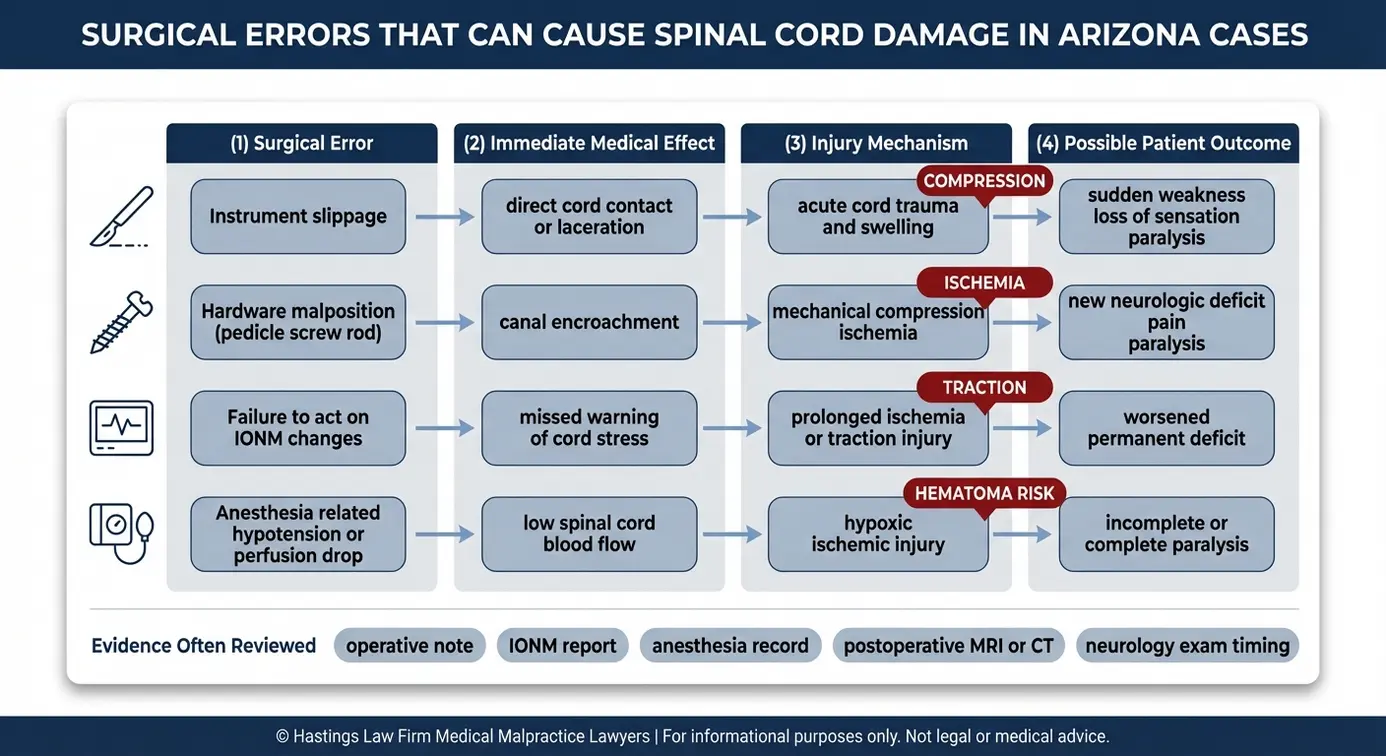
Surgical spinal cord injuries often result from instrument slippage, failure to monitor evoked potentials during the procedure, anesthesia errors causing hypotension, or misplacement of hardware such as pedicle screws. While each case is different, these errors represent patterns we evaluate closely.
The most common surgical mistakes leading to spinal cord damage include:
- Instrument slippage: During dissection or decompression, a surgical tool can slip and cause direct trauma to the spinal cord or surrounding nerve roots. Even a fraction of a millimeter matters in the spinal canal.
- Hardware misplacement: Screws or rods placed incorrectly can impinge on the spinal canal, compressing the cord or nerve roots. Misplaced pedicle screws are one of the more frequently documented causes of post-surgical neurological deficits.
- Failure to monitor nerve signals: Effective intraoperative spinal cord monitoring often uses a system called intraoperative spinal cord monitoring (IONM). This system tracks the electrical activity of the spinal cord and nerves in real time. These signals can alert the surgical team to developing injuries. When these signals are ignored, preventable damage may go undetected until it is too late. A Clinical Practice Guideline for Prevention, Diagnosis, and Management of Intraoperative Spinal Cord Injury published in PubMed Central reinforces that proper monitoring protocols are central to reducing injuries.
- Post-operative hematoma: An epidural hematoma is a collection of blood that forms in the space around the spinal cord after surgery. It can compress the cord if not identified and treated quickly. Delays in recognizing and evacuating these bleeds can result in permanent neurological damage.
As Arizona spinal cord injury from surgery lawyers, we work with independent medical experts to reconstruct what happened during the procedure. We determine whether any of these errors occurred and establish how the injury could have been prevented. A surgical spinal cord injury attorney needs access to specialists who can review operative reports, imaging, and monitoring records with precision.
The Hastings Law Firm Difference
Results matter, but what truly sets us apart is how we achieve them. Every verdict, every settlement, and every Arizona courtroom victory comes from one guiding promise: To treat each client’s fight for justice as if it were our own.
This balance of skill, experience, and empathy reflects our core philosophy that justice should not only compensate the injured, but also make healthcare safer nationwide.

Understanding Spinal Cord Injury Levels and Functional Outcomes
The severity of a spinal cord injury depends on the level of the spine affected and whether the injury is complete or incomplete, with higher injuries (cervical) typically resulting in more extensive paralysis (quadriplegia) than lower injuries (lumbar/paraplegia). Generally, injuries higher on the spinal column cause more widespread loss of function.
A complete spinal cord injury, a condition resulting in complete paralysis with total loss of motor function and sensation below the level of injury, differs significantly from an incomplete spinal cord injury. The latter, a trauma where some nerve signals still pass through the damaged area, results in incomplete paralysis allowing partial movement or sensation. This distinction has a major impact on long-term recovery potential and the value of a legal claim.
The following table provides a general overview of how injury level relates to functional outcome:
| Spinal Level | General Functional Outcome |
|---|---|
| Cervical (C1–C8) | May result in quadriplegia (also called tetraplegia), affecting all four limbs, trunk, and potentially breathing. Higher cervical injuries often require ventilator support. |
| Thoracic (T1–T12) | Typically causes paraplegia, affecting the legs and lower trunk. Arm and hand function is usually preserved. |
| Lumbar (L1–L5) | Can affect the hips, legs, and bladder/bowel control. Some walking ability may be retained depending on severity. |
| Sacral (S1–S5) | May cause loss of bowel and bladder function and some leg weakness, but walking is often still possible. |
How the ASIA Impairment Scale Affects Your Claim
Doctors classify spinal cord injuries using the ASIA Impairment Scale (AIS), a standardized grading system developed by the American Spinal Injury Association. The scale ranges from Grade A (complete injury with no motor or sensory function below the injury) to Grade E (normal function).
The neurological level of injury (NLI), the lowest spinal segment where both motor and sensory function remain intact, determines where on this scale a patient falls. Medical professionals use this classification to provide a clear picture of a patient’s functional status.
The International Standards for Neurological Classification of Spinal Cord Injury (ISNCSCI) developed by the American Spinal Injury Association (ASIA) provides the clinical framework behind this classification. In court, the AIS grade provides a precise disability rating, providing objective, medical evidence of the degree of disability. An Arizona spinal cord injury from surgery lawyer uses this classification to support damage calculations and demonstrate functional limitations.

The Lifetime Cost of Care for Paralyzed Victims
The lifetime cost for a person with high tetraplegia can exceed several million dollars, covering expenses such as 24/7 nursing care, home modifications, specialized wheelchairs, and ongoing rehabilitation therapies. According to data published by the National Spinal Cord Injury Statistical Center, these costs vary significantly based on injury severity and the age at the time of injury.
Through life care planning, we develop a life care plan, a detailed document prepared by medical and rehabilitation experts that projects a patient’s future care needs and associated costs. This is central to building a complete picture of damages. As an Arizona spinal cord injury from surgery lawyer, we work with life care planners to ensure every category of expense is accounted for.
Key categories of lifetime costs include:
- Immediate costs: Emergency surgery, ICU stays, and acute inpatient rehabilitation programs that can last weeks or months.
- Long-term care costs: Wheelchair replacements (typically every five years), accessible vehicles, home ramps, assistive devices, lifts, and modifications to living spaces.
- Lost earning capacity: Many spinal cord injury patients are unable to return to their previous occupation, and some cannot work at all. Economic experts calculate the total income lost over a projected working life.
- Hidden costs: Treatment for secondary complications that develop over time, including pressure sores, urinary tract infections, respiratory issues, chronic pain management, and mental health care.
Every dollar matters because these expenses do not end. Settling for less than the full projected cost of future medical bills and care leaves families covering the gap out of their own pockets for decades.
Recovering Compensation for Negligent Surgical Injuries
Victims of surgical negligence in Arizona may recover both economic damages for medical bills and lost wages, as well as non-economic damages for pain, suffering, and loss of enjoyment of life.
Economic damages cover quantifiable financial losses. These include past and future medical bills, rehabilitation costs, prescription medications, assistive devices, and lost wages or lost earning capacity if the injury prevents you from returning to work or advancing in your career.
Non-economic damages compensate for the harm that cannot be easily measured in dollars. This includes physical pain and suffering, emotional distress, loss of enjoyment of life, and loss of consortium. Loss of consortium refers to the impact the injury has on your relationship with your spouse or family. These damages acknowledge the profound human cost of living with paralysis.
Punitive damages are different. They are not designed to compensate the patient but to punish the defendant for conduct that goes beyond ordinary negligence. According to a detailed analysis published by the Arizona Law Review on Punitive Damages in Arizona, these damages are reserved for cases involving outrageous or willful misconduct reflecting an “evil mind,” a standard that requires more than ordinary or even gross negligence.
An Arizona spinal cord injury from surgery lawyer evaluates each of these categories based on the specific facts of your case. We consider the severity of the injury and the projected long-term impact on your family’s financial stability. This evaluation is essential for recovering compensation that reflects the total impact of the surgical error.
Arizona Statute of Limitations for Surgical Malpractice
In Arizona, medical malpractice claims must generally be filed within two years from the date of the injury, though the “discovery rule” may extend this if the injury was not immediately reasonably discoverable.
Under A.R.S. § 12-542, the standard filing window is two years. Arizona recognizes a “discovery rule” that may extend this period if the injury was not immediately apparent. For example, if a misplaced pedicle screw is not detected until months after surgery when symptoms develop, the two-year clock may begin on the date you discovered the injury.
There is one important exception that carries a much shorter deadline. If the surgery took place at a government-operated hospital, such as a state or county medical facility, you must file a formal Notice of Claim within 180 days after the cause of action accrues. Failing to meet this requirement can eliminate your ability to pursue the case entirely.
Because these deadlines are strict and the consequences of missing them are permanent, speaking with an Arizona spinal cord injury from surgery lawyer as early as possible protects your right to pursue a claim. Missing this statute of limitations deadline can permanently bar your right to seek compensation, regardless of the strength of your case.

Contact the Arizona Surgical Error Attorneys at Hastings Law Firm Today for Help
If a surgical error left you or someone you love with a spinal cord injury, you do not have to handle the hospital’s legal team on your own. Hastings Law Firm brings together medical professionals and experienced trial attorneys who concentrate solely on medical malpractice cases. Our team includes former defense attorneys who understand how hospitals and insurers build their case, and we use that knowledge to build yours.
We operate on a contingency fee basis, which means you pay no attorney fees or costs unless we secure a recovery for you. Your initial consultation is free and confidential.
Call Hastings Law Firm today or contact us online to speak with a team member who can review your case, answer your questions, and help you understand your legal options going forward.
Frequently Asked Questions About Spinal Cord Injury From Surgery in Arizona


This content was researched and written by the Hastings Law Firm editorial team, which includes attorneys, medical professionals, and experienced researchers. Our writing is informed by internal knowledge and practical experience, and we cross-check critical details against authoritative sources cited throughout. Every piece undergoes human-led fact-checking and legal review. Because legal and medical information can change, if you spot an error, please contact us. Learn more about our content standards and review process on our editorial policy page.

Tommy Hastings, founder of Hastings Law Firm, is a board-certified personal injury trial lawyer dedicated exclusively to healthcare injury cases. Since 2001, he has represented injured patients and families in litigation against major hospital systems, pharmaceutical companies, and negligent healthcare providers nationwide. He has handled numerous high-profile cases that have drawn national media attention and resulted in multi-million dollar recoveries. He draws on that experience in his writing, helping readers understand how these cases work and what options may be available to them.
