


Arizona Neurosurgeon Malpractice Lawyer
Neurosurgeon malpractice claims often turn on whether a brain or spine surgery injury came from an accepted surgical risk or a preventable error that fell below the standard of care. The difference can affect accountability, compensation, and long term stability after life changing harm. Common concerns involve technical mistakes, planning failures, and post operative monitoring lapses, along with documentation that clarifies what occurred during critical moments. If you or a loved one were harmed or worse due to neurosurgeon malpractice in Phoenix, Arizona, contact Hastings Law Firm for a free, confidential case review.

Last Updated: July 27, 2026
Trusted Legal Representation for Surgical Negligence in Arizona
When a neurosurgeon’s error causes a brain or spinal cord injury, the consequences can reshape every part of your life. You may be facing a future that looks nothing like what you expected, and the weight of that reality is overwhelming. We understand that feeling. At Hastings Law Firm, we focus exclusively on medical malpractice, and we have the medical and legal knowledge to evaluate what happened during your procedure and determine whether negligence played a role.
As an experienced Arizona neurosurgeon malpractice lawyer team, we bring former defense attorneys, in-house nurse consultants, and a national network of medical experts to every case we accept. If you or a loved one suffered a serious injury following brain or spine surgery, we are here to help you understand your options. Contact us for a free, confidential case evaluation.

Defining Medical Malpractice by a Neurosurgeon in Arizona
Neurosurgical malpractice occurs when a brain or spine surgeon deviates from the accepted standard of care, the level of treatment a reasonably competent neurosurgeon would provide under similar circumstances, and that deviation causes a preventable injury. Because neurosurgery involves some of the most delicate and high-risk procedures in medicine, the duty of care placed on these specialists is exceptionally strict. Determining whether a breach of duty occurred requires a nuanced understanding of these complex protocols.
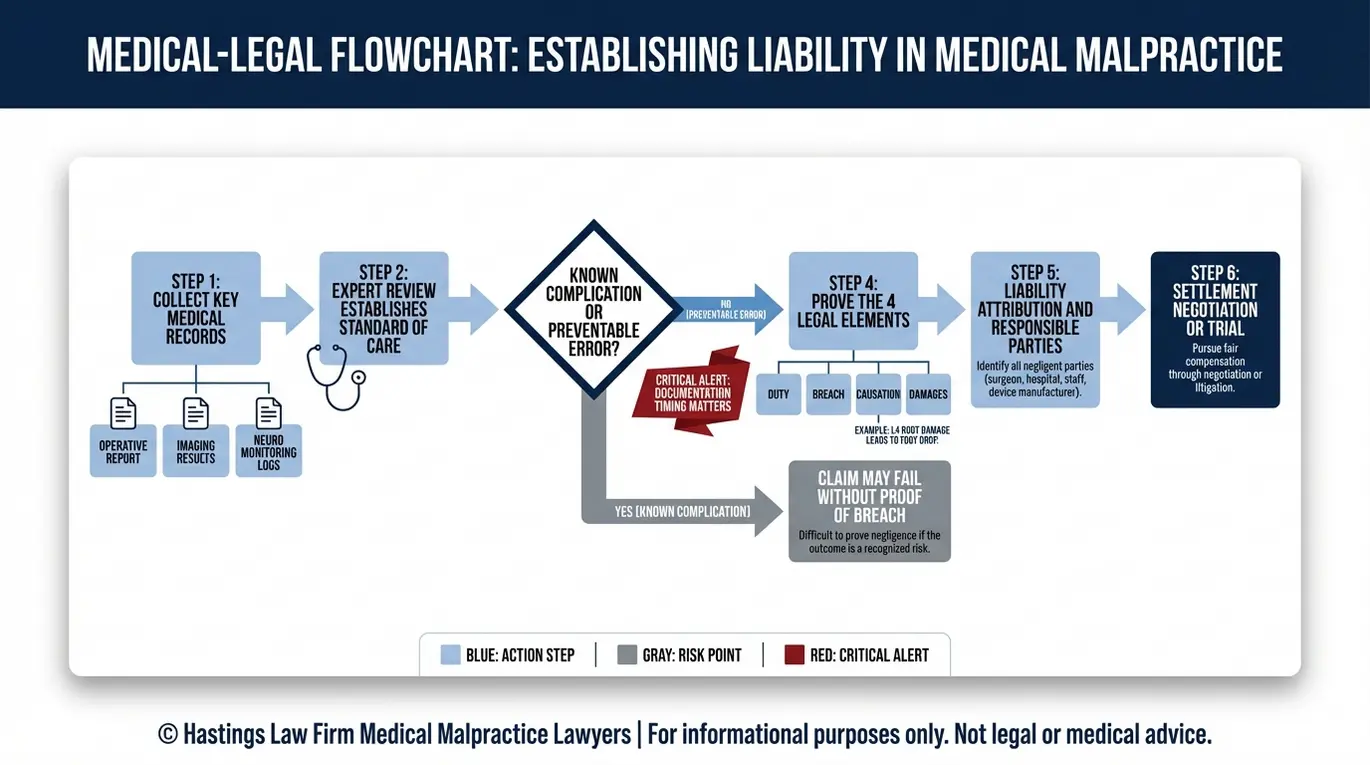
Not every poor outcome after surgery is malpractice. Neurosurgery carries inherent risks. Complications like a dural tear, an incidental opening in the protective membrane surrounding the spinal cord, can occur even when the surgeon performs correctly. The legal question is whether the injury resulted from a known and accepted risk of the procedure or from an error that a competent neurosurgeon would not have made.
This distinction matters because it is the core of every neurosurgery malpractice case. Proper documentation is essential to establishing what happened. The Arizona AHCCCS Documentation Requirements outline the records that healthcare providers must maintain, and these records often become central evidence in our investigations. We meticulously review these charts to identify inconsistencies or gaps that may suggest a failure to monitor the patient’s condition or record vital signs during critical moments.
Many patients and families hesitate to question a neurosurgeon’s judgment. Years of conditioning tell us to trust the specialist in the room. But trusting your doctor and holding them accountable when something goes wrong are not contradictory ideas. If your instinct tells you that what happened was not simply a “complication,” that instinct deserves a thorough, independent review.
Our Phoenix neurosurgery malpractice attorneys work with a qualified expert witness to evaluate whether the care you received met the standard your surgeon was obligated to provide.
Common Errors Committed by Brain and Spine Surgeons
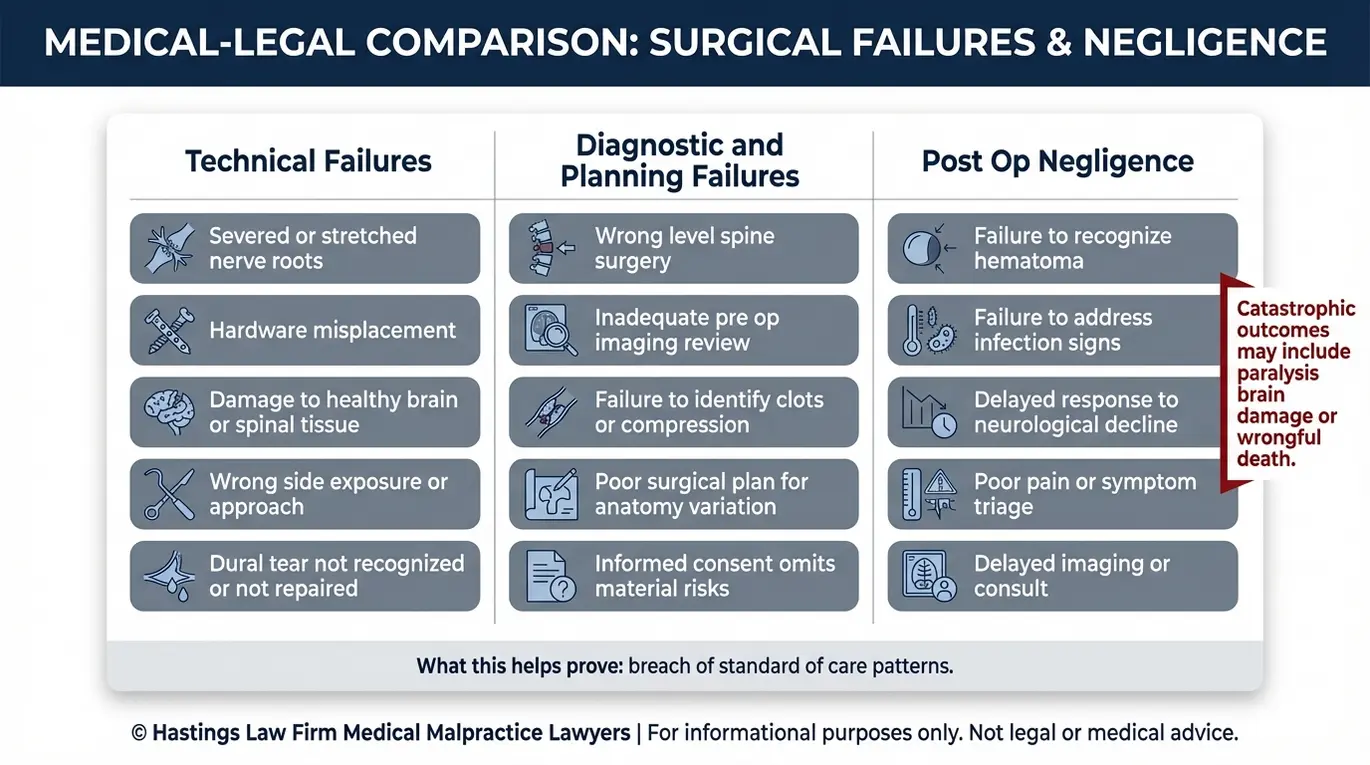
The most frequent surgical error examples include wrong-site surgery, severing or damaging nerves, failure to monitor intracranial pressure (the pressure inside the skull that can rise dangerously after surgery), and inadequate post-operative follow-up. These errors can lead to paralysis, permanent brain damage, and in the most devastating cases, wrongful death.
Understanding these errors requires looking at three broad categories: technical failures, diagnostic and planning failures, and post-operative negligence.
| Category | Examples | Potential Consequences |
|---|---|---|
| Technical Failures | Severed nerves, hardware misplacement, damage to healthy tissue | Paralysis, chronic pain, loss of motor function |
| Diagnostic/Planning Failures | Operating on the wrong spinal level, failure to identify blood clots | Unnecessary surgery, stroke, worsening condition |
| Post-Operative Negligence | Failure to recognize hematomas or infection after surgery | Brain damage, spinal cord injury, death |
Technical Failures
Technical errors happen during the procedure itself. These include severing a nerve that should have been preserved, placing a pedicle screw, a piece of spinal hardware anchored into a vertebra, in the wrong position so that it compresses or damages the spinal cord, or inadvertently removing healthy tissue. These technical mistakes often result in immediate and catastrophic harm, such as permanent loss of motor function or chronic, debilitating pain. A neurosurgeon negligence lawyer looks closely at the operative report and imaging to determine whether the surgical technique met the expected standard.
Diagnostic and Planning Failures
Some of the most preventable injuries happen before the surgeon picks up a scalpel. Wrong-level spine surgery, where a surgeon operates on the incorrect vertebra, is a well-documented example of preventable errors. Research published through PubMed Central on wrong-level spine surgery prevention examines how verification protocols can prevent these events.
Despite these established protocols, system errors continue to occur. A failure to identify a blood clot on pre-operative imaging or an incomplete review of the patient’s anatomy can also lead to catastrophic outcomes.
Post-Operative Negligence
The hours and days following neurosurgery are a critical window. A postoperative hematoma, a collection of blood that compresses the brain or spinal cord after surgery, can cause irreversible damage if not identified and treated promptly. The same is true for signs of infection or swelling.
When surgical teams fail to monitor patients closely or dismiss early warning signs during post-operative care, the consequences can be severe. A delay of even a few hours in decompressing a hematoma can mean the difference between recovery and permanent paralysis.
Technical Versus Non-Technical Surgical Failures
It is also important to distinguish between “hand” errors and “system” errors. A technical failure is a mistake made by the surgeon during the procedure. Current peer-reviewed research suggests that many adverse events stem from non-technical causes.
A system failure involves communication failures, staffing shortages, or protocols that contribute to the injury. For example, if a surgical team fails to relay critical information during a shift change, or if a facility lacks adequate staffing to monitor a post-surgical patient, the resulting harm may involve liability beyond the individual surgeon. As Arizona surgical malpractice counsel, we investigate both the surgeon’s actions and the systems surrounding the care to identify every responsible party.
The Hastings Law Firm Difference
Results matter, but what truly sets us apart is how we achieve them. Every verdict, every settlement, and every Arizona courtroom victory comes from one guiding promise: To treat each client’s fight for justice as if it were our own.
This balance of skill, experience, and empathy reflects our core philosophy that justice should not only compensate the injured, but also make health care safer nationwide.

Proving Negligence in Complex Neurosurgical Procedures
Proving negligence in a neurosurgery case requires establishing four distinct legal elements: duty, breach, causation, and damages, each supported by qualified expert testimony. We investigate the specific details of your care to establish whether the surgeon met their legal obligations.
- Duty: The neurosurgeon owed you a duty of care based on the doctor-patient relationship.
- Breach: The surgeon’s conduct fell below the accepted standard of care for a neurosurgeon performing that specific procedure.
- Causation: The breach directly caused your injury, meaning the harm would not have occurred but for the surgeon’s error.
- Damages: You suffered measurable harm, whether physical, financial, or emotional.
Duty and Breach
Establishing a breach means showing what a prudent, qualified neurosurgeon would have done under the same circumstances and demonstrating that the surgeon in your case failed to meet that benchmark. This is not a general medical standard. It is specific to the subspecialty and the procedure performed. The surgeon must also obtain informed consent, clearly explaining all significant risks before the patient agrees to the procedure.
Causation
Causation is often the most contested element. The defense will argue that the injury was a known risk or caused by a pre-existing condition. Our job as a malpractice lawyer for neurosurgery is to connect the surgeon’s specific error to the specific injury. This legal concept, often referred to as proximate cause, links the breach directly to the damages.
For example, if a patient develops foot drop, the inability to lift the front of the foot due to nerve damage, we work to establish whether compression of the L5 nerve root, a spinal nerve in the lower back, occurred as a direct result of surgical error rather than the underlying condition.
The Role of Expert Witnesses
In neurosurgery malpractice cases, you need a neurosurgeon to testify against a neurosurgeon. Arizona courts apply strict specialty matching rules, meaning a general surgeon or orthopedic surgeon typically cannot testify about the standard of care for a board-certified neurosurgeon. Without a supportive expert who meets these strict criteria, a case cannot proceed to trial.
The State Bar of Arizona Expert Witness Guide outlines the qualifications and standards for expert testimony in Arizona litigation. At Hastings Law Firm, our national network of medical experts includes practicing neurosurgeons who can credibly evaluate the care you received and testify about where it fell short.
The Critical Role of Neuro Monitoring Logs
During many brain and spine surgeries, technicians use intraoperative neuro-monitoring (IONM), a real-time system that tracks nerve function throughout the procedure. IONM relies on signals like somatosensory evoked potentials (SSEPs), electrical responses that measure whether nerve pathways are intact. If these signals show distress during surgery and the surgeon does not respond appropriately, those logs become powerful evidence.
As lawyers suing neurosurgeons, we obtain these critical medical records and analyze the monitoring data to evaluate whether warning signs were ignored. Our liability focus centers on whether the surgical team reacted to these alerts.
Compensation for Victims of Catastrophic Surgical Errors
Recoverable damages in a neurosurgery malpractice case include lifetime medical care costs, lost earning capacity, and non-economic losses like pain and suffering. Because these injuries are often permanent, the financial impact can extend across decades.
Economic damages cover measurable financial losses. For a patient left with paralysis or significant nerve damage, this can include:
- Past and future medical care, including surgeries, rehabilitation, and medication
- Assistive equipment such as wheelchairs and home modifications
- In-home nursing or attendant care
- Lost wages and diminished future earning capacity
Calculating these costs accurately often requires a life care plan, a detailed projection of the patient’s medical and support needs for the remainder of their life. Our Arizona neurosurgery injury attorney team works with medical and economic experts to build these projections. A comprehensive life care plan accounts for inflation and the rising cost of healthcare so that a settlement or verdict reflects the true cost of the injury.
Non-economic damages address the losses that do not come with a receipt. These include pain and suffering, loss of enjoyment of life, emotional distress, and loss of consortium, the impact on the injured person’s relationship with their spouse or family.
Arizona law strongly protects your right to full medical negligence compensation. Under Article 2, Section 31 of the Arizona Constitution, the legislature is prohibited from placing caps on damages for personal injury or wrongful death. This means there is no artificial ceiling on what a jury can award.
Impact of Pure Comparative Negligence in Arizona
Under A.R.S. §12-2505, Arizona follows a pure comparative negligence system. While some states use a system of contributory negligence that bars recovery if the patient is partly at fault, Arizona allows you to recover damages even if you share responsibility. This means that even if a patient had pre-existing spinal conditions or other contributing health factors, they can still recover damages as long as the surgeon’s negligence contributed to the outcome.
The award is reduced by the patient’s percentage of fault, but it is not eliminated. This is an important protection for patients whose medical histories are complex, because the defense will almost always point to pre-existing conditions as the cause of the injury.
Time Limits for Filing a Neurosurgery Claim in Arizona
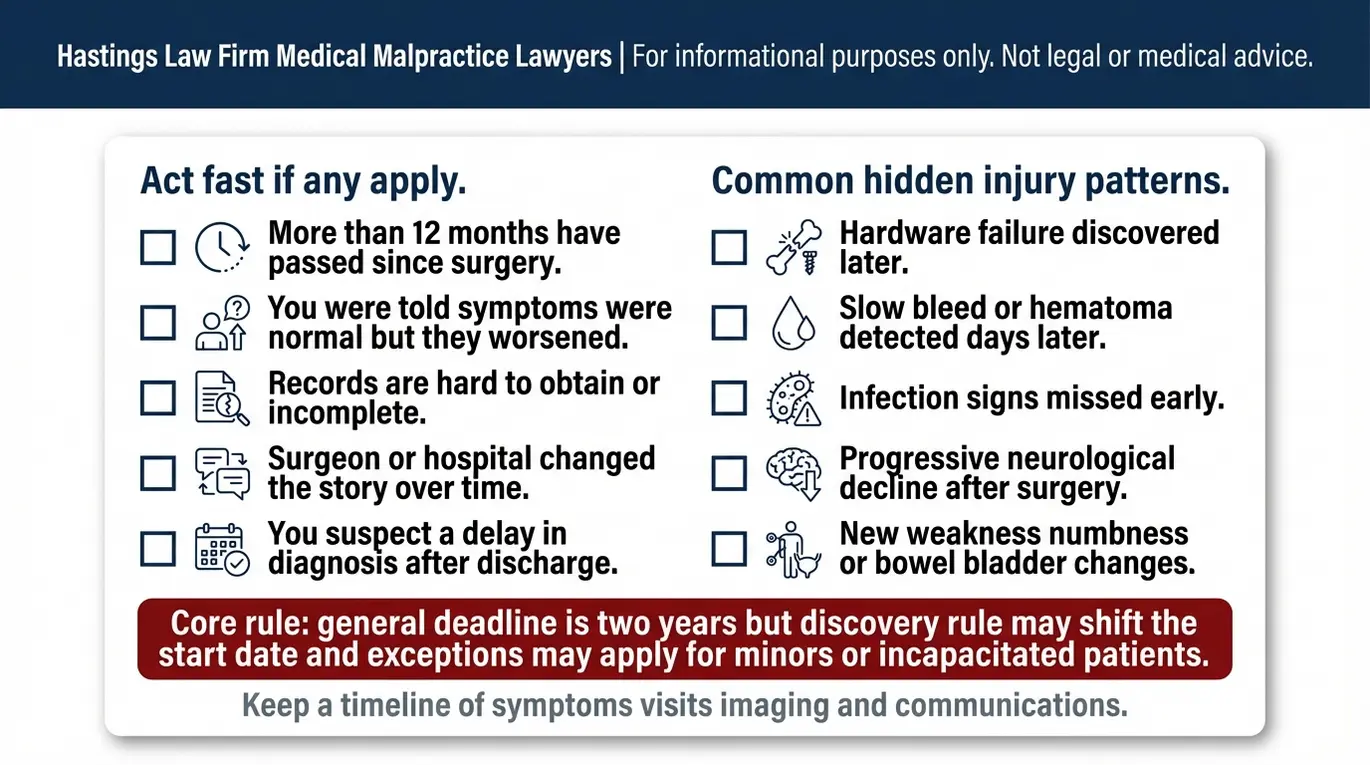
Arizona law generally gives you two years from the date of injury to file a medical malpractice lawsuit. This two-year deadline is set by A.R.S. §12-542, and missing it typically means losing your right to pursue a claim entirely.
However, filing a neurosurgery lawsuit involves an important exception known as the discovery rule. In many neurosurgical cases, an injury is not immediately apparent. A misplaced piece of spinal hardware may not cause symptoms for months. A slow intracranial bleed may not be diagnosed until long after discharge.
Under the discovery rule, the statute of limitations may begin when the patient knew, or reasonably should have known, that their injury was caused by negligence, rather than the date of the surgery itself. This concept is critical in cases of delayed diagnosis, where the harm is not immediately visible.
Important: Do not assume you have more time than you do. The discovery rule involves fact-specific legal analysis, and courts interpret it narrowly. If you suspect a surgical error caused your injury, consult with an attorney as soon as possible to protect your rights.
There are also specific exceptions for minors and individuals who are legally incapacitated. For children, the statute of limitations may be tolled, or paused, until they reach the age of majority. This ensures that a child is not penalized for their parents’ failure to file a claim. Once the child turns 18, the clock begins to tick immediately. For incapacitated patients, the deadline may be extended based on the circumstances of their condition.
The safest course of action is to seek legal guidance early, even if you are not certain your injury was caused by negligence. Waiting too long can result in the loss of critical evidence, such as video logs or staffing records, which are often purged after a set period. Preserving evidence and medical records promptly strengthens any potential claim.
Contact the Arizona Surgical Error Attorneys at Hastings Law Firm Today for Help
Neurosurgical errors carry consequences that last a lifetime. Pursuing accountability for those injuries requires a legal team that understands both the medicine and the law at the highest level. Hastings Law Firm focuses exclusively on medical malpractice. Our team includes former defense attorneys, in-house nurse consultants, and access to top neurosurgical experts across the country.
Tommy Hastings, our founder, is board-certified in Personal Injury Trial Law by the Texas Board of Legal Specialization. Every case we accept is prepared from day one as if it will go to trial.
If you or a loved one suffered a serious injury after brain or spine surgery in Arizona, we want to hear from you. As a dedicated Arizona neurosurgeon malpractice lawyer team, our goal is to help you find the truth about what happened and hold those responsible accountable. Contact us today for a free, confidential case evaluation. You pay no fees unless we recover compensation on your behalf.
Frequently Asked Questions About Neurosurgeon Malpractice in Arizona


This content was researched and written by the Hastings Law Firm editorial team, which includes attorneys, medical professionals, and experienced researchers. Our writing is informed by internal knowledge and practical experience, and we cross-check critical details against authoritative sources cited throughout. Every piece undergoes human-led fact-checking and legal review. Because legal and medical information can change, if you spot an error, please contact us. Learn more about our content standards and review process on our editorial policy page.

Tommy Hastings, founder of Hastings Law Firm, is a board-certified personal injury trial lawyer dedicated exclusively to healthcare injury cases. Since 2001, he has represented injured patients and families in litigation against major hospital systems, pharmaceutical companies, and negligent healthcare providers nationwide. He has handled numerous high-profile cases that have drawn national media attention and resulted in multi-million dollar recoveries. He draws on that experience in his writing, helping readers understand how these cases work and what options may be available to them.
