


Arizona Organ Puncture or Perforation Lawyer
An organ puncture or perforation during surgery can turn a planned procedure into a medical emergency with severe pain, infection, and lasting complications. Some injuries are recognized risks, but preventable harm can occur when a perforation is missed, not repaired, or warning signs are dismissed after surgery. Understanding how these injuries happen, how symptoms can be masked, and how responsibility may extend beyond the surgeon can help families make informed decisions after a frightening outcome. If you or a loved one were harmed or worse due to organ puncture or perforation in Arizona, contact Hastings Law Firm for a free, confidential case review.

Last Updated: July 27, 2026
Trusted Legal Representation for Surgical Negligence in Arizona
When a routine surgery leads to an organ puncture or perforation, the aftermath can feel overwhelming. What was supposed to be a step toward better health may have left you or someone you love facing emergency interventions, extended hospital stays, and a recovery far more painful than expected. If you suspect the injury was preventable, you deserve honest answers about what went wrong.
Hastings Law Firm focuses exclusively on medical malpractice cases. Founded by board-certified trial attorney Tommy Hastings, our team of attorneys, nurse consultants, and medical staff has the experience to investigate surgical errors thoroughly. As a trusted Arizona Organ Puncture or Perforation Lawyer, we are prepared to review your medical records, identify where the standard of care may have been breached, and explain your legal options.
If you or a loved one experienced an organ perforation during a surgical procedure, contact us for a free, confidential case evaluation. We can review what happened and help you understand the path forward.

Identifying Signs of Undiagnosed Organ Perforation After Surgery
An undiagnosed organ perforation typically manifests as severe abdominal pain, fever, low blood pressure, and signs of infection like sepsis within days of the procedure. This medical emergency occurs when a surgical instrument accidentally creates a hole or tear in the wall of an organ. Recognizing these symptoms early is critical because even a small nick can cause internal bleeding or escalate into a life-threatening emergency when left undetected.
Here is how the clinical progression often unfolds. During surgery, an instrument may create a small cut or tear in a nearby organ, such as the bowel or bladder. If the surgical team does not identify and repair the injury before closing, bacteria and other contents can leak into the abdominal cavity. This triggers peritonitis, an inflammation of the peritoneum (the thin tissue lining the inside of the abdomen), which can rapidly progress to sepsis, the body’s extreme and life-threatening response to infection. Research published in JAMA Network Open on sepsis treatment delays confirms that even short delays in intervention significantly increase the risk of dying.
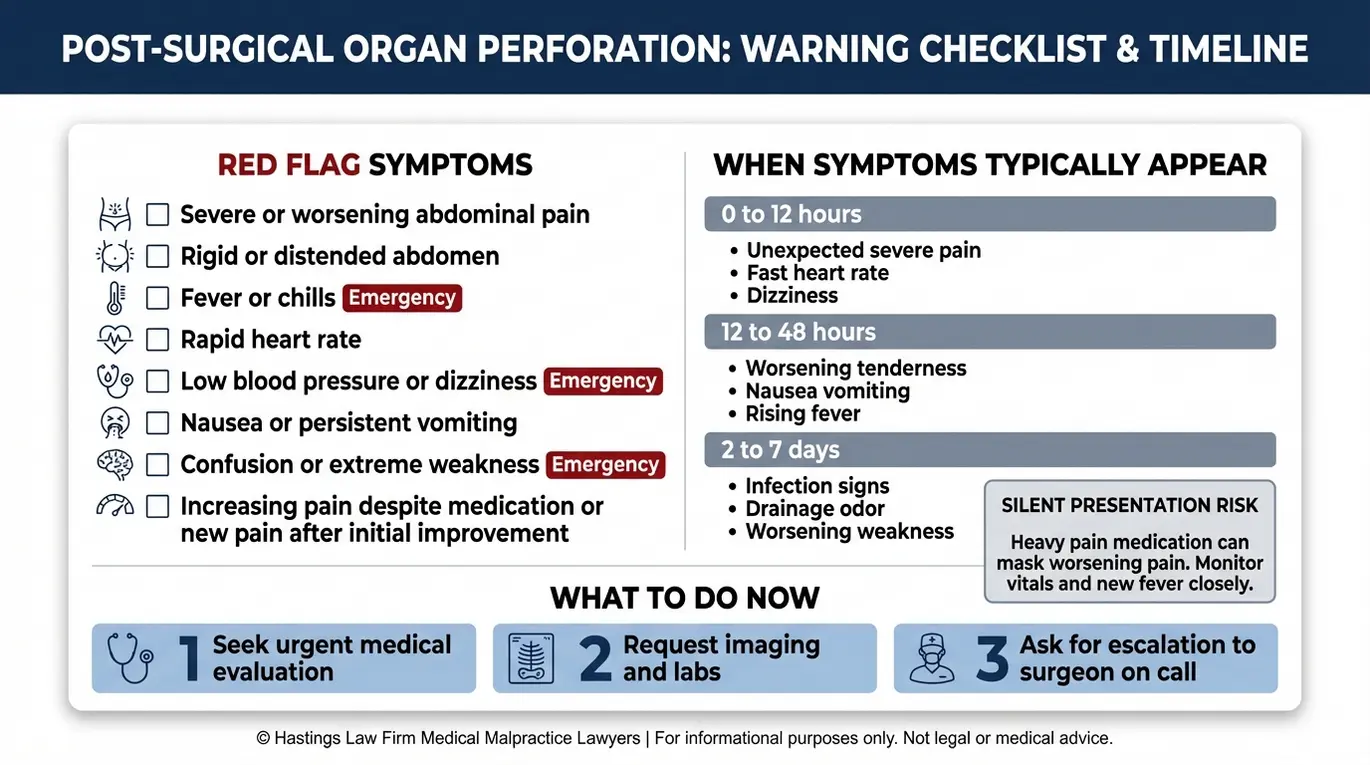
One of the most dangerous aspects of post-surgical perforations is what we call “silent symptoms.” Patients recovering from surgery are frequently on strong pain medications that can mask the warning signs. Increasing abdominal pain, a rising heart rate, or a low-grade fever may be dismissed as normal post-operative discomfort by nursing staff. By the time the perforation is recognized, the patient may already be in septic shock or facing organ failure.
The consequences of delayed diagnosis are severe. Many patients require revision surgery, extended ICU stays, and long courses of intravenous antibiotics. In some cases, the damage is so large that a patient must live with a colostomy bag, a surgically created opening in the abdomen for waste elimination, permanently altering their quality of life.
If you experienced worsening symptoms after a procedure and were told it was “normal,” an Arizona organ perforation lawyer at Hastings Law Firm can investigate whether your post-operative care met the accepted standard.
Post-Operative Symptom Timeline:
| Timeframe | Warning Signs |
|---|---|
| 0 to 12 Hours Post-Op | Increasing abdominal pain not relieved by medication, rapid heart rate, low urine output |
| 12 to 48 Hours Post-Op | Fever above 101°F, abdominal rigidity or swelling, nausea and vomiting |
| 48 to 72+ Hours Post-Op | Signs of sepsis (confusion, dangerously low blood pressure, rapid breathing), organ dysfunction |
Common Surgeries Leading to Accidental Punctures and Perforations
Laparoscopic and robotic surgeries carry the highest risk for accidental punctures, particularly involving the bowel, bladder, or blood vessels during the initial insertion of instruments. These minimally invasive procedures use a camera and small tools to operate through tiny incisions. While these techniques offer many benefits, they also introduce specific hazards that surgeons are trained to anticipate and manage.
A primary risk factor involves the trocar, a sharp, pointed instrument used to create small entry points in the abdomen so that a camera and surgical tools can be inserted. Because the first trocar is often inserted without direct visualization, there is a recognized risk of blindly puncturing an underlying organ or blood vessel. A bowel nick, which is a perforation of the intestinal wall, is one of the most common and dangerous injuries during these procedures.
High-risk procedures for organ puncture or perforation include:
- Laparoscopic and robotic surgery: Trocar insertion injuries to the bowel, bladder, or major blood vessels remain a well-documented concern across all types of minimally invasive abdominal procedures.
- Hysterectomy and cesarean sections: The bladder and ureters sit in close proximity to the uterus, making them vulnerable during dissection or instrument placement. If a surgeon fails to identify the ureter, they may accidentally clamp or cut it, leading to urine leakage and severe infection.
- Colonoscopy: Perforation can occur during polyp removal or when the scope is advanced through a narrowed or inflamed section of the colon. As documented in a PubMed review on the management of polypectomy complications, the risk increases with larger or more complex polyps.
- Gallbladder removal (cholecystectomy): The common bile duct and surrounding bowel are at risk, especially when inflammation obscures the surgeon’s view of the anatomy. A misidentification of the ductal structures can result in a transection that requires complex reconstruction.
Not every perforation during these procedures amounts to a surgical error or malpractice. But when a surgical puncture attorney in Arizona reviews the operative notes, we look closely at whether the surgeon followed established protocols to minimize risk and whether the injury was identified and addressed before the procedure ended.
The Hastings Law Firm Difference
Results matter, but what truly sets us apart is how we achieve them. Every verdict, every settlement, and every Arizona courtroom victory comes from one guiding promise: To treat each client’s fight for justice as if it were our own.
This balance of skill, experience, and empathy reflects our core philosophy that justice should not only compensate the injured, but also make health care safer nationwide.

Known Risk vs. Negligence: When Is a Nick Malpractice?
While perforation is a known risk of many surgeries, malpractice occurs when the surgeon fails to meet the standard of care to prevent the injury, or more critically, fails to recognize and repair it before closing the patient. In legal terms, negligence occurs when a provider’s actions fall below the accepted medical standard of care. This distinction is at the heart of most organ puncture cases.
The Consent Form Defense
One of the first arguments hospitals raise is the consent form. Before surgery, patients sign documents acknowledging that complications, including organ perforation, can occur. But signing a consent form does not give a surgeon a license to be careless. Informed consent means your doctor explained the risks and you agreed to the treatment; it does not excuse the surgeon from performing the procedure with reasonable skill and attention. Courts consistently hold that consent covers known complications, not negligence.
The Failure to Detect
In many cases we examine, the puncture itself may not be the act of negligence. Organs sit close together, and even careful surgeons can cause a small tear. The stronger basis for a claim often lies in what happened next. Identifying an injury during the procedure itself is a core competency expected of any qualified surgeon.
A competent surgeon would perform checks before closing, such as testing for bowel integrity or inspecting surrounding tissue. When those steps are skipped and a perforation goes unnoticed, the patient may need a dangerous revision surgery, a re-operation to repair what should have been caught the first time.
Under Arizona Revised Statutes § 12-563, a medical malpractice claim requires proof of a breach of duty where the provider failed to meet the accepted standard of care and that this failure caused the patient’s injury. An organ puncture attorney evaluates the surgical record to determine whether appropriate safeguards were followed.
Complication vs. Malpractice: Key Differences
| Factor | Known Complication | Potential Malpractice |
|---|---|---|
| The injury itself | Occurred despite proper technique | Resulted from deviation from accepted standards |
| Intraoperative response | Identified and repaired during the procedure | Missed, ignored, or inadequately addressed |
| Post-operative monitoring | Symptoms recognized and treated promptly | Warning signs dismissed or not escalated |
| Consent disclosure | Risk was disclosed and materialized despite care | Consent form used to excuse substandard technique |
If you are unsure whether your situation crosses the line from complication to negligence, an Arizona Organ Puncture or Perforation Lawyer at Hastings Law Firm can help clarify the distinction after reviewing your records.
Establishing Liability for Surgical Punctures in Arizona Hospitals
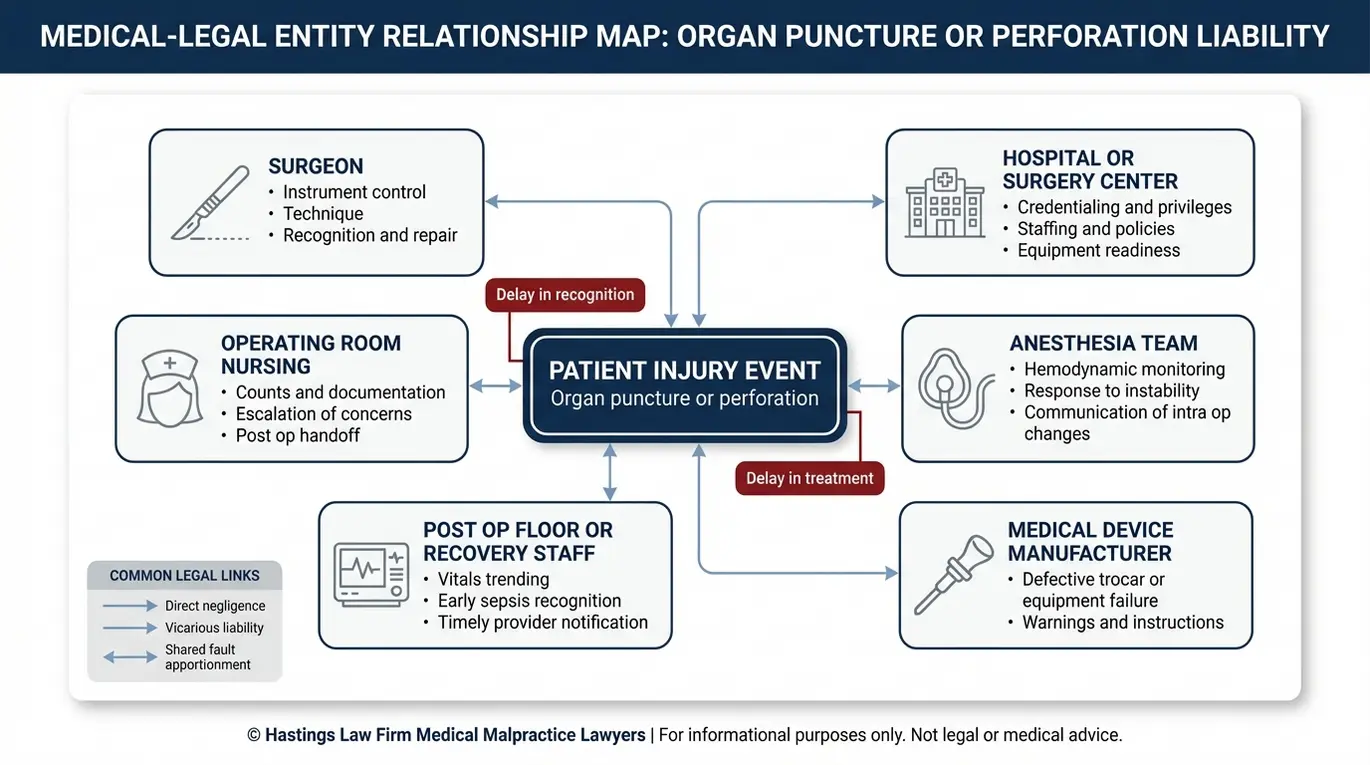
Liability often extends beyond the surgeon to include the hospital for inadequate staffing or policies, and the nursing staff for failing to monitor post-operative vitals indicating sepsis. Liability is the legal responsibility one party has for the harm caused to another. Identifying every responsible party is essential to building a complete claim.
Who may be held liable:
- The surgeon carries primary responsibility for instrument control, knowledge of anatomy, and verifying the integrity of surrounding structures before closing. If the operative notes reveal a failure to follow standard safety checks, the surgeon may bear direct liability.
- The hospital or surgical facility can be liable for hospital negligence, such as systemic failures, credentialing a surgeon who lacked adequate training for the procedure, or failing to maintain surgical equipment. This may also include failing to enforce safety protocols that could have prevented the error.
- Nursing and post-operative staff are responsible for monitoring a patient’s vitals after surgery. Nursing, the anesthesia team, and post-operative staff must escalate concerns to the medical team when worsening signs like dropping blood pressure, rising pulse, or fever appear. The delay can turn a survivable injury into a fatal one.
Arizona follows a comparative fault system. Under Arizona Revised Statutes § 12-2506, liability is apportioned based on each party’s degree of fault. While doctors are often independent contractors, vicarious liability may apply if the hospital held the physician out as an employee. This means the hospital may be held responsible for the actions of its staff.
When our surgical malpractice lawyer team investigates these cases, we examine the full chain of care, from pre-operative planning through post-discharge instructions. Injuries to the ureter (the tube connecting the kidney to the bladder) or the common bile duct (CBD), which carries bile from the liver, are often attributable to failures at multiple points in the process.
Recovering Compensation for Surgical Perforation Injuries
Patients who suffer surgical perforation injuries may recover both economic damages for measurable financial losses and non-economic damages for the pain, suffering, and lasting impact on their daily lives. These payments help cover the high costs of recovery and the personal toll of a medical error. Arizona does not cap non-economic damages in medical malpractice cases, which means the full scope of your harm can be presented to a jury.
Damages you may be entitled to recover include:
- Current and future medical expenses: Emergency treatment for sepsis, ICU stays, corrective and revision surgeries, wound care, and long-term follow-up appointments. We also consider future losses, such as the cost of life care plans and projected medical inflation, to ensure your settlement lasts a lifetime. Data from the Healthcare Cost and Utilization Project (HCUP) on inpatient sepsis outcomes shows that sepsis-related hospitalizations are among the most costly inpatient stays in the United States, often reaching tens of thousands of dollars per admission.
- Lost wages and loss of earning capacity: Time missed from work during extended recovery, as well as the diminished ability to earn income if the injury results in permanent physical limitations.
- Pain, suffering, and loss of quality of life: Living with chronic pain, the physical and emotional burden of a colostomy (a surgically created opening, called a stoma, that reroutes the intestine to an external bag), scarring, and the psychological toll of a preventable medical injury. These non-economic damages acknowledge the grief, anxiety, and loss of enjoyment of life that accompany a serious surgical error.
- Wrongful death: When an undetected perforation leads to sepsis or organ failure and the patient does not survive, the family may pursue a wrongful death claim. These cases seek compensation for funeral expenses, loss of companionship, and the financial support the family has lost.
Every surgical perforation case involves a unique set of medical facts. Arizona surgical injury attorneys at Hastings Law Firm work with medical experts to calculate the true cost of the harm, both what you have already endured and what lies ahead.
Why Choose Hastings Law Firm for Your Medical Injury Claim
Hastings Law Firm combines board-certified legal expertise with in-house medical knowledge to give your case the attention and strategy it demands. Choosing a legal team with medical knowledge can provide the technical expertise needed to prove how a surgical error occurred. Our team includes former defense attorneys who understand the tactics hospitals and insurers rely on, as well as nurse consultants and Board Certified Patient Advocates who can interpret your medical records and identify where the standard of care broke down.
We are not a high-volume firm. We take fewer cases so that each client receives dedicated, personal attention from our legal and medical team. When you work with an Arizona Organ Puncture or Perforation Lawyer at Hastings, your case is prepared from day one as though it is going to trial. This trial-ready readiness allows us to negotiate from a position of strength, knowing we are fully equipped to present your case to a jury if the insurance carrier refuses to offer a fair settlement.
We also understand the emotional weight of what you are going through. Many of our clients feel a deep sense of betrayal by the medical system. We are here to listen, to answer your questions honestly, and to give you a clear path forward. There is no financial risk to getting started. We work on a contingency fee basis, which means you pay no attorney fees or costs unless we recover compensation for you.
Contact the Arizona Surgical Error Attorneys at Hastings Law Firm Today for Help
If you or a loved one suffered an organ perforation during surgery, do not accept it as a “known complication” without a thorough investigation. Seeking legal advice is an important step in understanding your rights after a medical injury. What happened in the operating room and in the hours that followed matters, and the answers are in the medical records.
Hastings Law Firm is ready to uncover the truth and pursue the compensation you deserve. We serve clients throughout Phoenix and the entire state of Arizona, and our team is equipped to manage complex surgical malpractice claims anywhere in the country.
Contact us today for a free, confidential case evaluation with our legal and medical team. The consultation costs you nothing, and there is no fee unless we win.
Frequently Asked Questions About Organ Puncture or Perforation in Arizona


This content was researched and written by the Hastings Law Firm editorial team, which includes attorneys, medical professionals, and experienced researchers. Our writing is informed by internal knowledge and practical experience, and we cross-check critical details against authoritative sources cited throughout. Every piece undergoes human-led fact-checking and legal review. Because legal and medical information can change, if you spot an error, please contact us. Learn more about our content standards and review process on our editorial policy page.

Tommy Hastings, founder of Hastings Law Firm, is a board-certified personal injury trial lawyer dedicated exclusively to healthcare injury cases. Since 2001, he has represented injured patients and families in litigation against major hospital systems, pharmaceutical companies, and negligent healthcare providers nationwide. He has handled numerous high-profile cases that have drawn national media attention and resulted in multi-million dollar recoveries. He draws on that experience in his writing, helping readers understand how these cases work and what options may be available to them.
