


Arizona Refractive Surgeon Malpractice Lawyer
Vision loss after refractive surgery can leave patients feeling blindsided, especially when the procedure was elective and the outcome feels preventable. The key issue is separating known risks of properly performed LASIK or PRK from errors in screening, surgery, or follow up care that fall below the standard of care. Problems tied to inadequate screening, missed warning signs, or poor management of complications can permanently affect daily life and independence. If you or a loved one were harmed or worse due to refractive surgery negligence in Phoenix, Arizona, contact Hastings Law Firm for a free, confidential case review.

Last Updated: July 27, 2026
Trial-Ready Arizona Medical Negligence Attorneys for Vision Loss Claims
If your vision was permanently changed after LASIK, PRK, or another refractive procedure, and you believe something went wrong during the process, you are not imagining it. Many patients walk away from elective eye surgery with complications they were never warned about, left wondering whether what happened was a known risk or a preventable mistake.
That distinction matters, and it is exactly what an Arizona refractive surgeon malpractice lawyer investigates. At Hastings Law Firm, our team includes in-house medical professionals and former defense attorneys who know how to analyze surgical records, identify where the standard of care broke down, and hold negligent providers accountable.
If you or a loved one suffered vision loss or other serious complications after refractive surgery, we can review what happened and explain your options at no cost and no obligation.

Identifying Refractive Surgery Negligence and LASIK Errors
Refractive surgery negligence occurs when an ophthalmologist deviates from the standard of care during screening, surgery, or post-operative management, resulting in permanent vision impairment. Refractive surgery includes procedures like LASIK and PRK that aim to reduce a patient’s reliance on glasses.
Not every bad outcome after laser surgery is malpractice. Procedures like LASIK carry known risks, including temporary dry eye or mild visual disturbances. But there is a clear legal line between an accepted complication of a properly performed procedure and an injury caused by a preventable error. Eye surgery malpractice cases focus on that line.
An Arizona refractive surgeon malpractice lawyer examines whether the surgeon made specific, identifiable mistakes. These can include:
- Decentered ablation, where the laser removes tissue off-center from the visual axis, causing permanent double vision or distortion
- Microkeratome blade malfunction, where the instrument used to create the corneal flap jams or produces an irregular cut during the procedure
- Software or nomogram programming errors, where incorrect patient data is entered into the laser system, resulting in over-correction or under-correction
- Failure to diagnose post-operative complications, such as infection or epithelial ingrowth, a condition where surface cells migrate under the corneal flap and compromise healing
LASIK malpractice claims often hinge on whether the surgeon identified and responded to these problems in time, or whether warning signs were missed altogether. When refractive surgery negligence leads to vision loss, the consequences reach into every part of a patient’s daily life.

Failure to Screen for Thin Corneas and Contraindications
Surgeons are legally obligated to disqualify candidates with thin corneas or pre-existing conditions like keratoconus, as operating on these patients carries a significantly increased risk of severe complications. Medical screening helps surgeons determine if a patient’s eyes can safely undergo laser treatment.
The screening process before any vision correction surgery should include precise measurement of the residual stromal bed (RSB), the amount of corneal tissue that remains after the laser reshapes the eye. Research published through PubMed Central on the safety of a 250 µm residual stromal bed highlights the minimum tissue threshold needed to maintain corneal stability. Falling below that threshold dramatically increases the risk of corneal ectasia, a progressive bulging of the cornea that can lead to severe vision loss and may ultimately require a corneal transplant. A systematic review published in PubMed on ectasia after corneal refractive surgery confirms these risks.
High-volume refractive surgery centers often face malpractice lawsuits in Phoenix for rushing pre-operative evaluations, potentially overlooking early signs of forme fruste keratoconus, a subclinical form of the disease that standard topography may miss without careful interpretation.
An Arizona refractive surgeon malpractice lawyer will look for the following red flags, including a failure to identify contraindications or risks like chronic dry eye, during a case review:
- Corneal thickness measurements that fell below safe thresholds before surgery
- Absence of corneal topography maps in the pre-operative records
- Evidence that keratoconus or irregular astigmatism was present but undocumented
- Signs that the RSB calculation was incorrect or never performed
- Failure to refer the patient for additional testing when borderline results appeared
When poor screening leads to corneal ectasia, vision correction surgery negligence is often the cause, and the consequences are often irreversible. Arizona law, including the collateral source provisions outlined in Arizona Revised Statutes § 12-565, governs how damages and related evidence are handled in these cases. Suing an eye doctor involves managing these statutes, and an experienced attorney ensures these rules are applied correctly from the start.

The Hastings Law Firm Difference
Results matter, but what truly sets us apart is how we achieve them. Every verdict, every settlement, and every Arizona courtroom victory comes from one guiding promise: To treat each client’s fight for justice as if it were our own.
This balance of skill, experience, and empathy reflects our core philosophy that justice should not only compensate the injured, but also make health care safer nationwide.

Informed Consent and the Validity of Signed Waivers
A signed waiver or consent form does not grant a doctor the right to be negligent; it only covers known risks of a properly performed surgery, not preventable errors. Informed consent is the process of discussing surgical risks so a patient can make an educated choice.
For informed consent to be legally valid, the surgeon must have personally discussed the material risks of the procedure with the patient. Material risks in refractive surgery include chronic dry eye, epithelial ingrowth (where surface cells grow underneath the corneal flap), permanent halos and glare (visual disturbances like rings around lights and increased light sensitivity, especially at night), and reduced quality of vision.
If the surgeon handed the patient a form to sign without a meaningful conversation about these specific outcomes, the consent may be legally insufficient. This failure is often a key factor in laser eye surgery settlements. Arizona case law provides important context for how courts evaluate the adequacy of informed consent in medical malpractice claims.
Many patients describe feeling pressured to sign quickly, a dynamic sometimes called the “White Coat Effect,” where the trust placed in a physician’s authority discourages questions. An Arizona refractive surgeon malpractice lawyer examines what was said before the signature to determine if the patient has grounds for compensatory damages.
Proving Liability and Recovering Damages in Arizona Courts
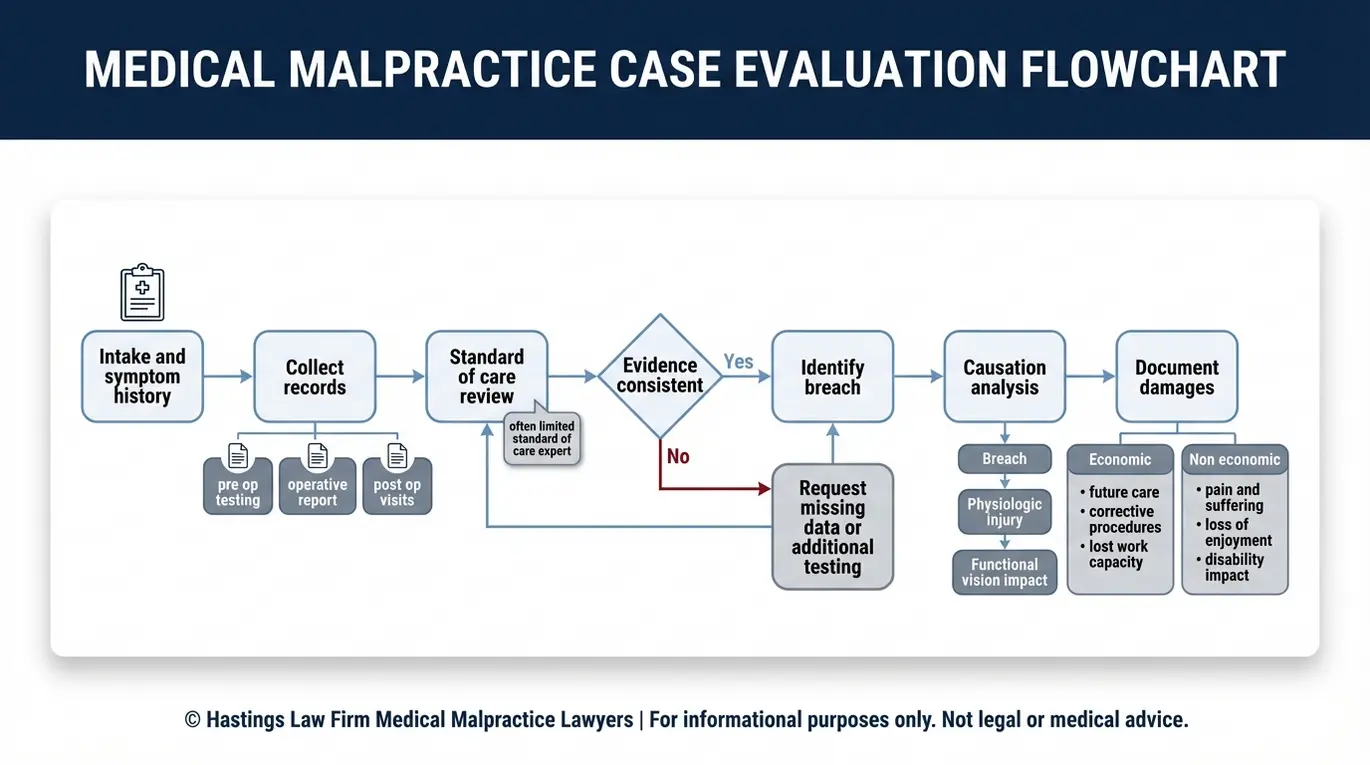
To secure compensation, a plaintiff must prove via expert testimony that the surgeon’s actions caused specific damages, such as lost income, medical costs for corrective surgeries, or permanent disability.
Arizona medical malpractice cases require establishing three connected elements: negligence, causation, and damages. Proving refractive surgeon liability demands that an expert witness, typically a board-certified ophthalmologist, testify that the treating surgeon’s conduct deviated from accepted practice and that the deviation produced the patient’s injuries. Arizona courts often limit plaintiffs to a single expert on the standard of care, which makes the selection of the right expert, and the right Arizona refractive surgeon malpractice lawyer, one of the most consequential decisions in the case.
Damages for vision loss after refractive surgery generally fall into two categories:
| Economic Damages | Non-Economic Damages |
|---|---|
| Cost of scleral lenses (rigid, gas-permeable contact lenses that vault over the damaged cornea) | Pain and suffering from ongoing visual impairment |
| Corneal cross-linking (CXL), a procedure that uses UV light and riboflavin to strengthen weakened corneal tissue | Loss of enjoyment of life, such as the inability to drive at night or work on screens |
| Corneal transplant surgery and follow-up care | Emotional distress and anxiety related to permanent disability |
| Lost wages and reduced future earning capacity | Loss of independence in daily activities |
| Ongoing medical expenses for specialist visits and prescriptions |
In rare cases involving especially reckless conduct, punitive damages may also be available. Our team works with qualified ophthalmology experts across the country to build the medical and financial evidence these claims require.
Product Liability Claims for Defective Lasers
Not every refractive surgery injury is caused by surgeon error. Product liability involves claims against companies that manufacture defective medical devices. If a device malfunction contributed to the outcome, the claim may extend to the manufacturer. For example, in the context of laser surgery, an excimer laser’s eye-tracking system, the technology that follows the patient’s eye movement during the procedure, can fail mid-ablation. Errors in the laser nomogram, the ablation algorithm programmed into the device, can also produce incorrect corrections. In these situations, a product liability claim may be pursued alongside or instead of a malpractice claim against the doctor.
Contact the Arizona Surgical Error Attorneys at Hastings Law Firm Today for Help
Vision loss after refractive surgery affects more than your eyesight. It can change your ability to work, drive, and live independently. If you believe your injury was caused by a preventable error, you deserve clear answers about what happened and what your legal options are.
At Hastings Law Firm, our medical and legal teams work together to investigate every aspect of your care, from the initial screening through post-operative follow-up. Founded by board-certified trial attorney Tommy Hastings, our entire team is focused solely on medical malpractice litigation. Tommy Hastings is board-certified in Personal Injury Trial Law, a credential held by fewer than 2% of practitioners. This focus gives us the resources needed to take on well-funded defendants.
We charge no fees unless we recover compensation for you. Contact an Arizona refractive surgeon malpractice lawyer at Hastings Law Firm for a free, confidential case evaluation.
Frequently Asked Questions About Refractive Surgeon Malpractice in Arizona


This content was researched and written by the Hastings Law Firm editorial team, which includes attorneys, medical professionals, and experienced researchers. Our writing is informed by internal knowledge and practical experience, and we cross-check critical details against authoritative sources cited throughout. Every piece undergoes human-led fact-checking and legal review. Because legal and medical information can change, if you spot an error, please contact us. Learn more about our content standards and review process on our editorial policy page.

Tommy Hastings, founder of Hastings Law Firm, is a board-certified personal injury trial lawyer dedicated exclusively to healthcare injury cases. Since 2001, he has represented injured patients and families in litigation against major hospital systems, pharmaceutical companies, and negligent healthcare providers nationwide. He has handled numerous high-profile cases that have drawn national media attention and resulted in multi-million dollar recoveries. He draws on that experience in his writing, helping readers understand how these cases work and what options may be available to them.
