


Arizona Outpatient Surgery Center Malpractice Lawyer
Ambulatory surgery centers are designed for same day procedures, but a breakdown in safety can leave patients facing serious harm and lasting uncertainty. Liability can be complicated when surgeons and anesthesiologists are independent contractors and the facility may still be responsible for staffing, equipment, credentialing, and recovery room monitoring. The article discusses common negligence patterns, anesthesia risks in outpatient settings, and how Arizona law affects time limits and damages. If you or a loved one were harmed or worse due to outpatient surgery center malpractice in Arizona, contact Hastings Law Firm for a free, confidential case review.

Last Updated: July 27, 2026
Trial-Ready Legal Representation for Ambulatory Surgery Center Injuries
When you trust a medical team to perform same-day surgery, an outpatient procedure designed to let you recover at home, you expect to leave in better shape than when you arrived. If that trust was broken and you or someone you love was harmed at an ambulatory surgery center in Arizona, the confusion and frustration that follow can feel overwhelming. You may not know who is responsible, what went wrong, or where to turn for answers.
As an Arizona outpatient surgery center malpractice lawyer, Hastings Law Firm focuses exclusively on medical malpractice cases. Our team includes in-house medical professionals and former defense attorneys who understand how surgical facilities and their insurers respond to injury claims. If you believe negligence played a role in your outcome, we welcome the chance to review what happened and explain your options through a free, confidential case evaluation.

Understanding Liability in Arizona Outpatient Surgery Centers
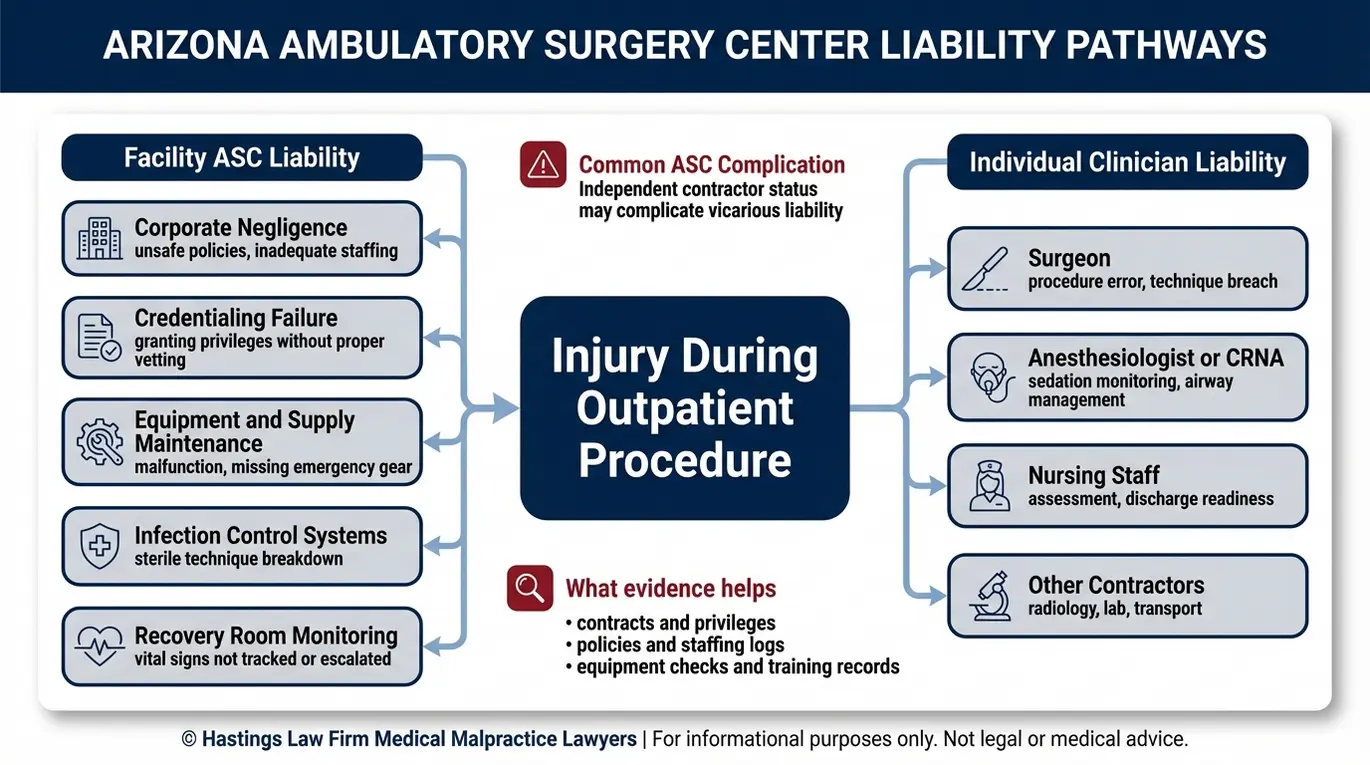
Outpatient surgery centers in Arizona typically do not employ surgeons directly, and that distinction complicates liability in meaningful ways. The facility itself can be held responsible for corporate negligence, such as inadequate staffing, poor equipment maintenance, or credentialing failures, while the surgeon may be sued separately for individual medical errors. Identifying the right parties, and the right insurance policies, is one of the first challenges an Arizona outpatient malpractice lawyer must resolve.
An Ambulatory Surgery Center (ASC), a licensed facility where surgical procedures are performed without an overnight hospital stay, operates under a different legal and regulatory framework than a traditional hospital. ASCs in Arizona must comply with licensing standards set by the Arizona Administrative Code Title 9, Chapter 10, Article 9, which govern everything from staffing ratios to emergency protocols in a Phoenix surgery center. When a facility cuts corners on any of these requirements, it can face direct liability regardless of which physician performed the procedure.
Most surgeons and anesthesiologists working in these centers are independent contractors, not employees. This matters because it affects which entity is legally and financially responsible when something goes wrong. A lawyer for surgery center negligence must trace the contractual relationships to determine whether the claim runs against the physician, the facility, or both. The legal process requires precision when you sue an Arizona surgery center or a specific doctor.
Corporate negligence is a separate theory of liability that holds the ASC accountable for its own institutional failures. This can include hiring unqualified staff, failing to properly credential physicians, not maintaining equipment, or lacking a properly staffed post-anesthesia care unit (PACU), the monitored recovery area where patients are observed after sedation. If the facility allowed an under-credentialed surgeon to operate or failed to equip the PACU for emergencies, suing an Arizona surgery center on a corporate negligence theory may be appropriate. An experienced Arizona outpatient malpractice lawyer can help determine the best path forward, and retaining a lawyer for surgery center negligence is often necessary to handle these challenges.
Hospital vs. Outpatient Center Liability Standards
| Factor | Hospital | Outpatient Surgery Center (ASC) |
|---|---|---|
| Physician relationship | Often employed directly | Typically independent contractors |
| Overnight care available | Yes | No; patients discharged same day |
| Emergency resources on site | Full ICU and trauma support | Limited; may require hospital transfer |
| Regulatory oversight | State and federal (CMS) | State licensing; CMS if Medicare-certified |
| Corporate negligence exposure | Broad institutional liability | Focused on credentialing, staffing, and equipment |
Understanding these differences is essential. The legal path forward depends on who failed, how they failed, and what duty they owed you under Arizona law.
Common Signs of Negligence in Same-Day Surgical Procedures
Negligence in outpatient settings often involves premature discharge before anesthesia has fully worn off, failure to monitor vital signs in the recovery room, lack of emergency equipment, or non-sterile environments that lead to severe infections. These are not just poor outcomes; they can reflect a facility’s failure to meet the standard of care.
An outpatient surgery malpractice attorney evaluates the specific facts of each case, but certain patterns come up repeatedly in ASC injury claims. As your same-day surgery negligence counsel, we identify the exact moment safety protocols were breached. The standard of care is the level of care a reasonably competent medical professional would provide under similar circumstances.
Red Flags of ASC Negligence
- Premature discharge: Sending a patient home before they are clinically stable, sometimes to free up bed space for the next procedure. This can lead to undetected bleeding, airway problems, or dangerous reactions to medication.
- Recovery room negligence: Failing to check vital signs at appropriate intervals after surgery, or leaving patients unattended in the PACU during a critical monitoring window.
- Infection control failures: Not following sterile technique, the set of practices used to prevent contamination during and after surgery, which can result in a post-operative infection or sepsis. The CDC’s National Healthcare Safety Network tracks surgical site infections as one of the most preventable complications in outpatient settings.
- Lack of emergency preparedness: When surgical complications like hemorrhage or cardiac arrest occur, a facility that lacks the proper equipment or trained staff to stabilize and transfer the patient may bear direct responsibility for the resulting harm.
Premature discharge, meaning a patient is released before meeting safe clinical criteria, is one of the more common issues an Arizona surgery center injury lawyer encounters. The risk is that a patient who appears stable in the recovery room may deteriorate rapidly at home, far from the monitoring and intervention they still need. An anesthesia error can also be exacerbated by rushing a patient out the door.
If any of these scenarios sound familiar, the question is whether the facility or the medical team deviated from what a reasonably competent provider would have done. That is the core of every medical negligence claim, and it is why hiring an experienced outpatient surgery malpractice attorney or Arizona surgery center injury lawyer is important.
The Hastings Law Firm Difference
Results matter, but what truly sets us apart is how we achieve them. Every verdict, every settlement, and every Arizona courtroom victory comes from one guiding promise: To treat each client’s fight for justice as if it were our own.
This balance of skill, experience, and empathy reflects our core philosophy that justice should not only compensate the injured, but also make health care safer nationwide.

The Risks of Anesthesia Errors in Outpatient Facilities
Anesthesia errors in outpatient centers are especially dangerous because these facilities often lack the full intensive care support found in hospitals. A failure to properly monitor oxygen levels or detect an adverse reaction to sedation can become life-threatening in minutes. An outpatient anesthesia injury attorney understands how quickly these situations can escalate.
ASCs typically use two categories of anesthesia. General anesthesia renders the patient fully unconscious, while conscious sedation, sometimes called twilight sedation, keeps the patient in a relaxed, semi-aware state. The American Society of Anesthesiologists defines these as points along a continuum. This means a patient under conscious sedation can slip into a deeper, unintended level of unconsciousness if dosing or monitoring is not carefully managed, which can cause intubation errors or airway obstruction.
In a hospital, over-sedation triggers an immediate response from a nearby ICU team. In an outpatient center with limited staff, the window for intervention shrinks significantly. When resuscitation is delayed, even by minutes, the patient can develop hypoxia, a dangerous drop in blood oxygen that may lead to permanent brain damage. Determining anesthesiologist liability is complex in this setting.
Proper patient monitoring is an essential safeguard. Capnography, a technology that measures carbon dioxide levels in a patient’s exhaled breath, can detect airway compromise before oxygen levels begin to fall. An anesthesia malpractice lawyer Arizona relies on will examine whether the facility used appropriate monitoring tools, whether staff were trained to interpret the readings, and whether the response to warning signs was timely and adequate. A skilled surgery center malpractice lawyer knows these are the details that separate a tragic but unavoidable complication from actionable medical negligence. If you suspect negligence, consult a surgery center malpractice lawyer or an outpatient anesthesia injury attorney immediately.

Arizona Statute of Limitations for Surgery Center Lawsuits
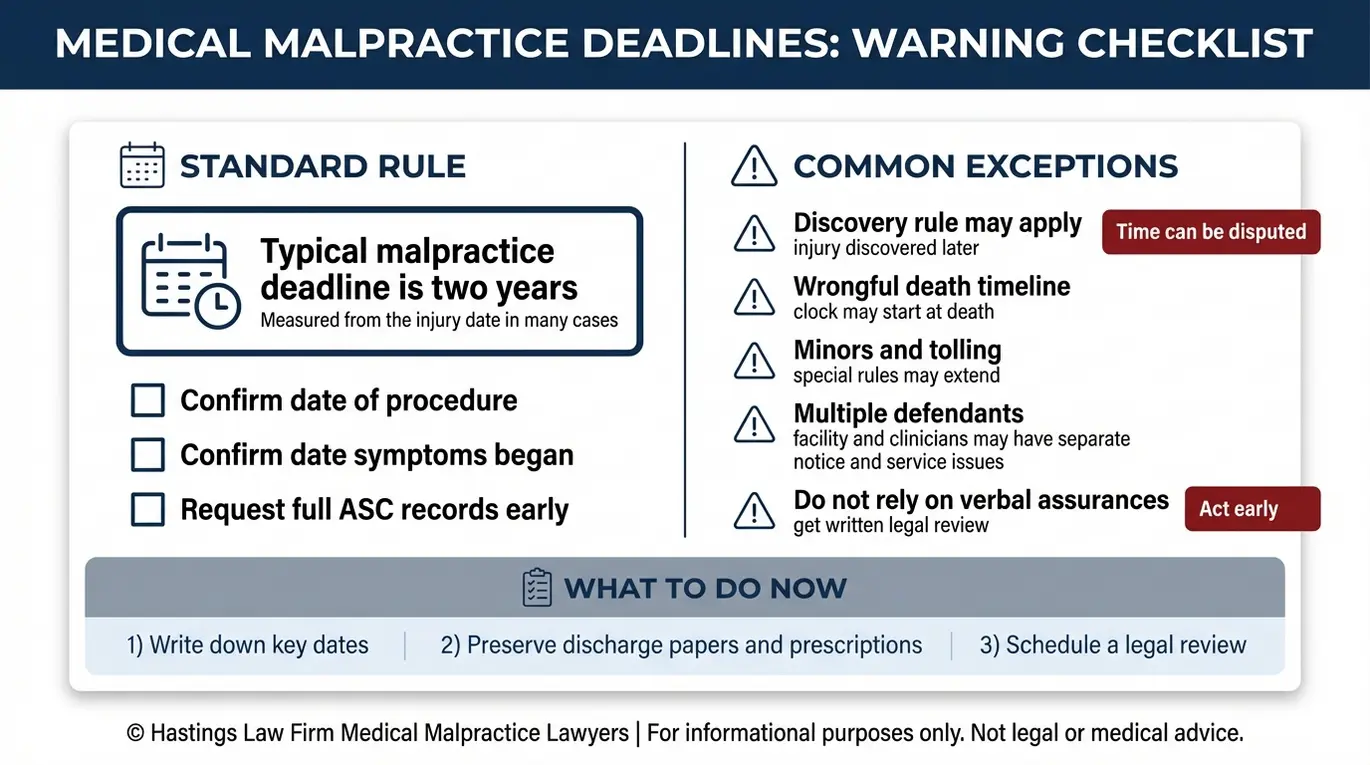
Under Arizona Revised Statutes, patients who are harmed by medical malpractice generally have two years from the date of the injury, or the date the injury should reasonably have been discovered, to file a lawsuit against a surgery center or physician. This is the medical negligence statute of limitations in the state. The statute of limitations is the legal deadline for filing a lawsuit.
This two-year window is established by A.R.S. § 12-542 and applies to most medical negligence claims. Missing this deadline can permanently bar your right to seek compensation, regardless of how strong your case may be. Understanding the time limit to sue surgery center defendants is necessary.
Arizona does recognize the discovery rule, which can extend the filing deadline in certain situations. If a surgical error was not immediately apparent, the statute may begin running from the date the patient knew about the harm. This exception applies to errors like a retained foreign object or an undetected internal injury.
There are also different timelines for specific circumstances. Cases involving minors may benefit from tolling for minors, meaning the clock is paused until the child reaches a certain age. Wrongful death statute deadlines also differ. An Arizona outpatient surgery center malpractice lawyer can evaluate whether any exceptions apply to your situation. The most important step is to seek legal guidance early, well before the time limit to sue surgery center facilities becomes a concern.
Critical Deadlines for Filing:
- The standard filing deadline is two years from the date of injury
- The discovery rule may extend that deadline for injuries not immediately apparent
- Cases involving minors may have a tolled or extended filing period
- Wrongful death claims follow a separate statutory timeline
- Preserving medical records and evidence early strengthens your position
Your Arizona outpatient surgery center malpractice lawyer will ensure every deadline is met.
Damages Recoverable for Outpatient Surgical Errors
Patients harmed by outpatient surgical errors can recover economic damages for medical bills and lost wages, as well as non-economic damages for pain, suffering, and loss of enjoyment of life. Arizona does not cap economic recovery in damages in medical negligence cases.
Economic damages cover the financial losses directly caused by the injury. These include past and future medical expenses, corrective surgeries, rehabilitation, prescription costs, and lost income. If the injury limits your ability to earn a living going forward, lost earning capacity is also recoverable. An Arizona outpatient malpractice lawyer will work with medical and financial experts to calculate the full scope of these costs, including future medical care you may need years from now.
Non-economic damages address the human toll of the injury. Physical pain, emotional distress, disfigurement, and the loss of the ability to enjoy daily activities all fall into this category. These damages are harder to quantify, but they are no less real, and Arizona law protects your right to seek full compensation for surgery center injury.
In cases where a patient dies during or after an outpatient procedure, the family may pursue a wrongful death claim. Compensation in these cases can include funeral expenses, loss of financial support, and loss of companionship. Article 2, Section 31 of the Arizona Constitution specifically prohibits any law that would limit the amount of damages recoverable for personal injury or death. This ensures full accountability is a constitutional right in this state.
Every case is different, and the damages available depend on the specific facts. What matters is that you understand the full range of compensation for surgery center injury the law provides, so that no part of your loss goes unaddressed. An experienced Arizona outpatient malpractice lawyer can fight for the damages in medical negligence cases you deserve.
Contact the Arizona Surgical Error Attorneys at Hastings Law Firm Today for Help
Outpatient surgery is designed for convenience and efficiency, but when a facility or provider fails to meet the standard of care, patients pay the price. You deserve to know what happened and whether negligence caused your injury.
Hastings Law Firm is built for cases like these. Our legal team, which includes in-house medical professionals and former defense attorneys, investigates surgery center injuries with the depth and precision these claims require. Founded by board-certified trial attorney Tommy Hastings, our firm prepares every case as if it will go to trial, and that preparation gives us strength at every stage of the process.
There is no cost to get started. As your Arizona outpatient surgery center malpractice lawyer, we work on a contingency fee basis, meaning you pay no attorney fees unless we recover compensation on your behalf. Contact us today for a free, confidential case evaluation and let us help you find the answers you deserve.
Frequently Asked Questions About Outpatient Surgery Center Malpractice in Arizona


This content was researched and written by the Hastings Law Firm editorial team, which includes attorneys, medical professionals, and experienced researchers. Our writing is informed by internal knowledge and practical experience, and we cross-check critical details against authoritative sources cited throughout. Every piece undergoes human-led fact-checking and legal review. Because legal and medical information can change, if you spot an error, please contact us. Learn more about our content standards and review process on our editorial policy page.

Tommy Hastings, founder of Hastings Law Firm, is a board-certified personal injury trial lawyer dedicated exclusively to healthcare injury cases. Since 2001, he has represented injured patients and families in litigation against major hospital systems, pharmaceutical companies, and negligent healthcare providers nationwide. He has handled numerous high-profile cases that have drawn national media attention and resulted in multi-million dollar recoveries. He draws on that experience in his writing, helping readers understand how these cases work and what options may be available to them.
