


Phoenix Nursing Home Fall Lawyer
A nursing home fall can leave an older adult with serious injuries and can shake a family’s trust in the facility responsible for daily care. These incidents are often linked to preventable safety breakdowns such as missed risk assessments, inadequate supervision, unsafe environments, or medication problems that increase fall risk. Understanding how care plans, staffing, and facility practices connect to a fall can help families recognize when neglect may have played a role and why accountability matters. If your loved one was harmed or worse due to a nursing home fall in Phoenix, Arizona, contact Hastings Law Firm for a free, confidential case review.
Last Updated: July 27, 2026
Trusted Phoenix Injury Attorneys for Nursing Home Negligence Claims
When an elderly loved one is injured in a fall at a nursing home, it can feel like the facility you trusted to keep them safe has broken that promise. You may not know exactly what went wrong, but you know something should have been different. That instinct matters, and you deserve answers.
At Hastings Law Firm, we focus exclusively on medical negligence cases, including nursing home falls that leave elderly residents with life-altering injuries. Our team includes former defense attorneys and hospital nurses who understand exactly how facilities and their insurers respond to these claims. If your family member was hurt in a fall at an Arizona care facility, a Phoenix Nursing Home Fall Lawyer at our firm can review what happened, explain your legal options, and help you decide on the right path forward.
Consultations are free and confidential, and you pay no fees unless we recover compensation for your family.

Common Causes of Falls in Arizona Assisted Care Facilities
Nursing home falls in Arizona are frequently caused by inadequate staffing levels, failure to assist residents with mobility, environmental hazards like wet floors, and medication errors that cause dizziness or confusion. These incidents often involve a failure to follow safety protocols or maintain adequate staffing levels. While every case is different, our Phoenix nursing home fall attorneys see the same patterns of nursing home negligence come up again and again when we review facility records.
Most falls are not random accidents. They stem from breakdowns in the systems a nursing home is required to have in place. Here are some of the most common causes:
- Inadequate staffing: When a facility does not have enough trained staff on duty, residents who need help getting out of bed, walking to the bathroom, or transferring to a wheelchair may attempt to move on their own. A safe transfer, meaning the physical assistance required to move a resident from a bed to a chair or to the toilet, depends on staff being available when the resident needs them. Delayed response to call lights is one of the most frequent staffing failures we identify.
- Medication mismanagement: Some facilities use sedatives or anti-anxiety drugs as chemical restraints, which are medications given primarily to control a resident’s behavior rather than to treat a diagnosed condition. Improper dosing of blood pressure medications, sleep aids, or psychotropic drugs can cause dizziness, drowsiness, and loss of balance, dramatically increasing fall risk.
- Environmental hazards: Wet or freshly mopped floors without warning signs, poor lighting in hallways and bathrooms, missing or broken handrails, and unsecured rugs all create preventable fall risks. State inspection records, such as those available through the Arizona State Veteran Home Tucson survey on Medicare Care Compare, can reveal whether a facility has been cited for these types of hazards before.
- Poor staff training: Even when enough staff members are present, inadequate training on lifting techniques, fall risk assessment protocols, and safe transfer methods can lead to injuries during routine care.
Lawyers for nursing home falls in Phoenix look closely at these operational failures because they often point to deeper problems with how a facility is run.
Specific Staff Failures in Care Planning and Implementation
A fall often traces back to a failure to follow the resident’s care plan, a written, individualized document that federal law requires every nursing home to maintain for each resident. This plan outlines the specific assistance, supervision, and safety measures a resident needs based on their medical conditions.
Before a nursing home care plan can be created, the facility must perform a fall risk assessment. This clinical evaluation identifies whether a resident is likely to fall based on mobility limitations, medications, cognitive status, and prior fall history. If the assessment is incomplete or never updated after a change in the resident’s health, the care plan will not reflect the actual level of risk. When staff then fail to follow even the plan that does exist, the result is often a preventable injury and a violation of accepted standards of care.

Proving Liability and Negligence in Fall Injury Cases
Proving liability requires demonstrating that the facility breached the standard of care by failing to assess fall risks, failing to implement a safety plan, or failing to supervise a resident known to be a fall risk. Liability in Arizona refers to the legal responsibility of a facility for the harm suffered by a resident. Our team identifies the link between what the facility was required to do and what actually happened to show how they breached the standard of care.
The Duty of Care
Under 42 U.S.C. § 1395i-3, every Medicare- and Medicaid-certified nursing home must provide care that helps each resident attain or maintain their highest practicable physical, mental, and psychosocial well-being. This includes conducting assessments, creating individualized care plans, and ensuring adequate staffing.
The Breach
In a legal claim, a breach occurs when the facility fails to meet that duty. One indicator is the Minimum Data Set (MDS), which is a standardized clinical assessment that nursing homes must complete for every resident at regular intervals. The MDS records a resident’s functional abilities, health conditions, and risk factors. If the facility fails to update the MDS after a significant health change, such as a new medication or a decline in mobility, it can miss critical risk factors. That failure is often central to proving nursing home negligence.
| Standard of Care (What Should Happen) | Common Breach (What Goes Wrong) |
|---|---|
| Complete a fall risk assessment at admission and after any health change | Assessment is skipped, outdated, or incomplete |
| Develop an individualized care plan with fall prevention measures | No plan created, or plan does not reflect actual risk level |
| Update the MDS at required intervals and after significant changes | MDS is not updated after new medications or mobility decline |
| Staff trained and available to assist with transfers and mobility | Understaffing leads to unassisted transfers and delayed responses |
| Maintain a hazard-free environment (lighting, handrails, dry floors) | Environmental hazards persist despite prior citations |
Violation History
An attorney for facility falls can also use state inspection records to show a pattern of neglect. The Arizona Department of Health Services Licensing Services Statement of Deficiencies search allows us to review a facility’s violation histories and identify whether it has been flagged for similar problems before. A pattern of repeated violations can strengthen the case significantly.

The Hastings Law Firm Difference
Results matter, but what truly sets us apart is how we achieve them. Every verdict, every settlement, and every Phoenix courtroom victory comes from one guiding promise: To treat each client’s fight for justice as if it were our own.
This balance of skill, experience, and empathy reflects our core philosophy that justice should not only compensate the injured, but also make health care safer nationwide.

Types of Injuries Sustained in Nursing Home Falls
Falls in elderly residents often result in catastrophic injuries such as hip fractures, subdural hematomas, spinal cord damage, and in severe cases, wrongful death due to complications like immobility or pneumonia. Due to age and underlying health conditions, even a minor trip can result in life-threatening complications for seniors.
Orthopedic injuries and broken bones are among the most common outcomes. A hip fracture, which is a break in the upper portion of the femur, can be devastating for an older adult. Research from PubMed Central on hip fracture mortality confirms these fall-related injuries carry significant risk. This is particularly true for patients over age 65. Many elderly patients never regain their prior level of mobility, and the forced immobility that follows can trigger a dangerous chain of secondary complications.
Traumatic brain injuries and head injuries are another serious concern. A subdural hematoma, which is bleeding between the brain and its outer covering, can result from a resident’s head striking a floor, bed frame, or piece of furniture during a fall. Symptoms may not appear immediately, making timely detection critical.
Wrongful death can result when what seems like a “simple fall” leads to extended bed rest, which increases the risk of pressure ulcers, blood clots, pneumonia, and sepsis. Our Phoenix nursing home fall legal team reviews the medical timeline to determine whether serious injuries from a fall set off a cascade of complications that ultimately proved fatal.
Damages and Compensation Available to Arizona Families
Arizona law allows families to recover economic damages for medical bills, non-economic damages for pain, suffering, and loss of quality of life, as well as potential punitive damages if the facility’s conduct was especially reckless or egregious. Damages represent the financial and personal losses intended to compensate families for their suffering.
According to the State Bar of Arizona’s guide on personal injury damages, recoverable damages in these cases typically include:
- Economic damages: Past and future medical expenses, hospitalization costs, rehabilitation, physical therapy, assistive devices, and any additional long-term care the resident now requires because of the injury.
- Non-economic damages: Pain and suffering, emotional distress, loss of enjoyment of life, and loss of consortium (the loss of companionship and support from a spouse or family member).
- Punitive damages: In cases where the facility’s conduct reflects willful disregard for resident safety or violates the Adult Protective Services Act, Arizona courts may award punitive damages to deter similar behavior.
A Phoenix nursing home fall lawyer at Hastings Law Firm evaluates the full scope of harm your family has experienced, not just immediate medical bills, but the long-term cost of the injury and the toll it has taken on your loved one’s daily life. Compensation for nursing home falls should reflect the true impact of what happened.
Steps to Take Immediately After a Nursing Home Fall
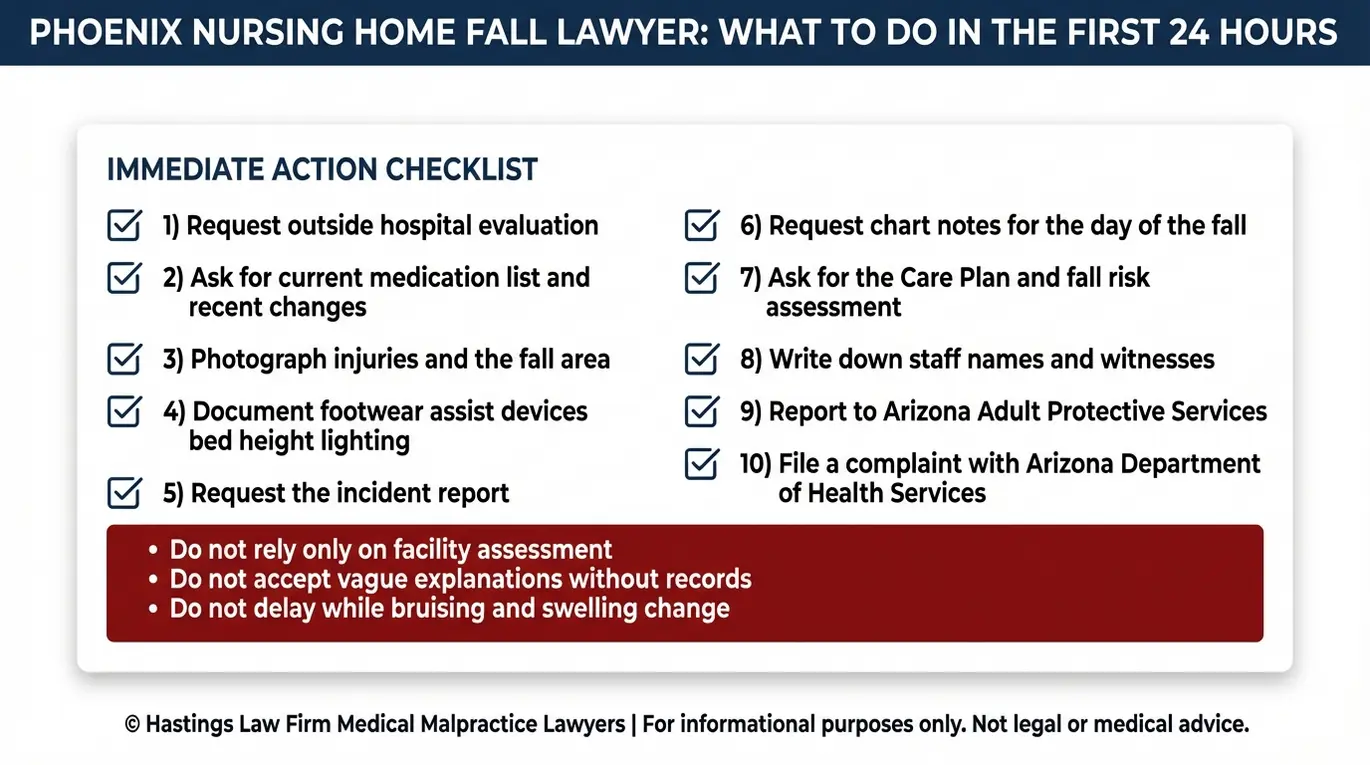
Families should immediately insist on a medical evaluation at an outside hospital, photograph the scene of the fall and the injuries, request copies of the incident report and medical records, and report the incident to Arizona Adult Protective Services. Following specific steps helps establish a clear timeline and preserves essential evidence for a legal claim.
Here is what we recommend:
- Get an independent medical evaluation. Do not rely solely on the facility’s internal assessment. Take your loved one to an outside emergency room or hospital where providers have no connection to the nursing home.
- Document everything you can. Photograph your loved one’s injuries, the area where the fall occurred, and any visible hazards such as wet floors. Take notes on the date, time, and what staff members tell you about what happened. Evidence collection is critical.
- Request the incident report and medical records. Ask the facility for a copy of the written incident report as well as your loved one’s current medical records. Facilities sometimes alter records after an incident, so requesting them promptly helps preserve the evidence.
- Report the fall to Arizona Adult Protective Services (APS). If you suspect nursing home abuse, elder abuse, or neglect, file a report with APS. This creates an official record and may trigger a state investigation.
- Contact a Phoenix nursing home fall lawyer. Early legal help for nursing home falls ensures that evidence is preserved and the facility is put on notice. At Hastings Law Firm, our in-house medical staff can begin reviewing records immediately to determine whether the fall was preventable.
Reporting Suspected Neglect to Arizona Authorities
If you believe your loved one’s fall resulted from elder neglect or abuse, filing a formal complaint with the state under the Adult Protective Services Act can trigger an official investigation. Complaints can be submitted to both Arizona Adult Protective Services and the Arizona Department of Health Services (ADHS).
The Arizona Department of Health Services Health Complaints FAQ page outlines how the complaint process works for residential facilities. Once a complaint is filed, ADHS may conduct a state survey of the facility, which can result in a Statement of Deficiencies (SOD), a formal document listing specific regulatory violations the surveyors identified. These deficiency reports become part of the public record and can serve as powerful evidence in a nursing home fall lawsuit.
Contact the Phoenix Nursing Home Attorneys at Hastings Law Firm Today for Help
Falls in nursing homes are not just accidents. They are often the result of systemic problems, from staffing shortages and missed assessments to ignored care plans and unsafe environments. Our firm is led by Tommy Hastings, a board-certified trial lawyer with over 20 years of experience in medical malpractice. When a facility fails the people it was trusted to protect, families have every right to ask what went wrong and hold that facility accountable.
Hastings Law Firm is dedicated exclusively to medical negligence. Our team includes in-house nurses and former defense attorneys who previously worked for the systems we now challenge. We do not split our attention across unrelated practice areas, and we prepare every case as if it is going to trial.
If your loved one was injured in a fall at a Phoenix-area nursing home, we are ready to listen and help you understand what happened. Contact our Phoenix office for a free, confidential case evaluation. A Phoenix Nursing Home Fall Lawyer on our team can review the records, identify the failures, and explain your family’s options. You pay nothing unless we recover compensation on your behalf.
Frequently Asked Questions About Nursing Home Fall in Phoenix


This content was researched and written by the Hastings Law Firm editorial team, which includes attorneys, medical professionals, and experienced researchers. Our writing is informed by internal knowledge and practical experience, and we cross-check critical details against authoritative sources cited throughout. Every piece undergoes human-led fact-checking and legal review. Because legal and medical information can change, if you spot an error, please contact us. Learn more about our content standards and review process on our editorial policy page.

Tommy Hastings, founder of Hastings Law Firm, is a board-certified personal injury trial lawyer dedicated exclusively to healthcare injury cases. Since 2001, he has represented injured patients and families in litigation against major hospital systems, pharmaceutical companies, and negligent healthcare providers nationwide. He has handled numerous high-profile cases that have drawn national media attention and resulted in multi-million dollar recoveries. He draws on that experience in his writing, helping readers understand how these cases work and what options may be available to them.
