


How Long Does a Medical Malpractice Lawsuit Take in Arizona?
Medical care that goes wrong can leave a patient hurt or worse and a family managing recovery, bills, and changes to daily life all at once. Thinking about a legal claim on top of all that raises a fair worry about how much more waiting it would add. Whatever time a claim asks for has to fit around healing, work, and the care of a loved one. A realistic picture of how long a medical malpractice case can take in Arizona, and what makes it shorter or longer, helps families plan with fewer unknowns.

Last Updated: November 4, 2026
What You Should Know About How Long an Arizona Medical Malpractice Lawsuit Takes:
- No Arizona rule sets how long a medical malpractice lawsuit takes, and a 2013 national insurer study found claims took an average of 20.3 months from being reported to closing and 43.1 months from the injury.
- A 2006 study of closed malpractice claims in the New England Journal of Medicine reported an average of five years from injury to resolution, with one in three claims taking six years or longer.
- The Arizona Supreme Court’s goals call for superior courts to resolve 90% of civil cases within 365 days of filing and 96% within 540 days, goals for the courts and not deadlines for any one case.
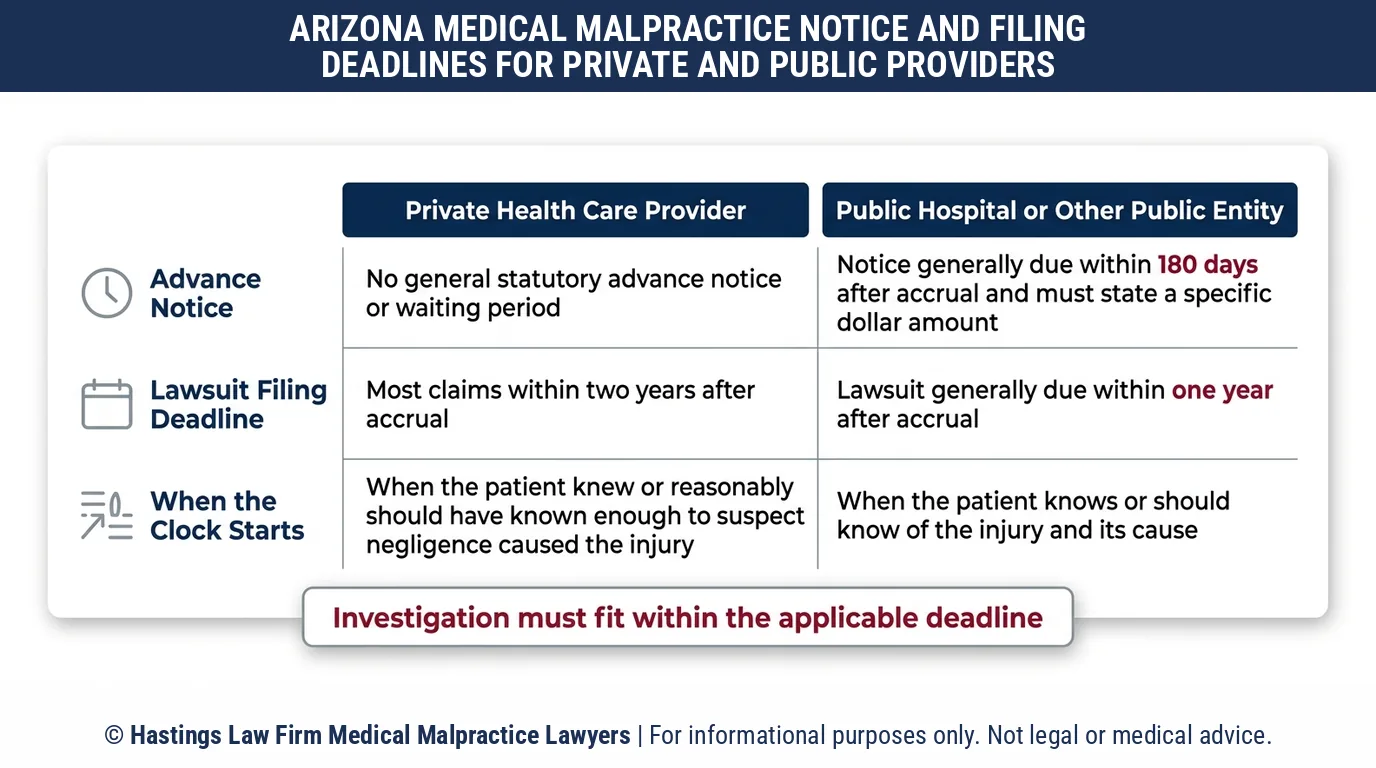
- Arizona’s medical malpractice statutes set no general notice or waiting period before suing a private health care provider, but a claim against a public hospital needs a written notice of claim stating a specific dollar amount within 180 days.
- Most Arizona medical malpractice claims must be filed within two years under A.R.S. § 12-542, counted from when the patient knew or reasonably should have known enough to suspect negligence caused the injury.
- Arizona medical malpractice cases generally belong in Tier 3, which allows 240 days from the Early Meeting to complete discovery, and the court’s schedule generally sets a settlement conference or mediation deadline no more than 15 months after the case begins.
- After an Arizona court enters judgment, either side generally has 15 days to ask for a new trial, and a notice of appeal is generally due within 30 days.
- When a conservator settles a child’s injury claim in Arizona, A.R.S. § 14-5424 requires a court to approve the settlement.
- An Arizona medical malpractice recovery can cover the injury-related losses the evidence proves, and a valid settlement and release can end the claims they cover.
What is the Typical Timeline for an Arizona Medical Malpractice Case?
No rule sets how long a medical malpractice lawsuit takes in Arizona. The length depends on how long the investigation runs, whether and when the case settles, and whether it goes to trial. In a 2013 study in Health Affairs, closed claims at one national insurer took an average of 20.3 months from when a claim was reported to when it closed, and 43.1 months from the injury.
A 2006 study in the New England Journal of Medicine reported an average of five years from injury to resolution, with one in three claims taking six years or longer. Claims that ended in a payment tended to stay open longer. In the 2013 study, 81% of paid claims took at least a year and 27% at least three years, compared with 50% and 12% of claims closed without a payment.
Arizona’s courts keep their own measure of time. Under Administrative Order 2014-81, the Arizona Supreme Court set goals for superior courts to resolve 60% of civil cases within 180 days of filing, 90% within 365 days, and 96% within 540 days, roughly six, twelve, and eighteen months. Those targets cover a court’s whole civil caseload and are not deadlines for any one case or a measure of malpractice cases.
The two sets of figures start the clock at different points. The studies count national claims from the injury or from when a claim was reported, while the court’s goals count from the filing of the complaint that starts the lawsuit, so the investigation before filing comes on top of any court figure.
Most claims in the 2006 study ended without a trial verdict. A case can resolve before a lawsuit is filed, somewhere along the court’s schedule, or at trial, and the stage it reaches is a large part of why two claims with similar injuries can take very different lengths of time.
How Long Does It Take Before an Arizona Medical Negligence Lawsuit is Filed?
No set waiting period has to pass before an Arizona medical negligence lawsuit is filed against a private health care provider, because the state’s medical malpractice statutes set no general advance notice or waiting period for those claims. The investigation before filing still has to finish within the filing deadline, which for most Arizona medical malpractice claims is two years.
Once the records and the expert review show what happened, a claim can sometimes resolve before any lawsuit is filed. When it does not, the case moves into court with that groundwork in place.
That groundwork starts with the records. A patient, or a person legally allowed to make health care decisions for the patient, can request them in writing under Section 12-2293 of the Arizona Revised Statutes, which sets a 30-calendar-day response period for a request made for litigation. Reasonable copy charges may apply, and the expert review waits on the records.
The expert’s opinion has to be ready early as well. Under A.R.S. § 12-2603, the person suing must state in writing, when the lawsuit is filed, whether expert testimony is needed to prove the claim. If it is, a sworn preliminary expert opinion affidavit must be delivered to the other side with the initial disclosures, the first information each side must share in the case. The expert must meet Arizona’s qualification rules for the provider’s field.
That work has to finish in time. Under A.R.S. § 12-542, most Arizona medical malpractice claims must be filed within two years. The clock starts when the patient knew, or reasonably should have known, enough to suspect that negligence caused the injury, which can be later than the date of the care. A child’s two-year clock generally does not start running until age 18.
A claim against a public hospital or other public entity runs on shorter deadlines. Under A.R.S. § 12-821.01, a written notice of claim stating a specific dollar amount generally must be filed with the entity within 180 days after the claim accrues, which happens once the patient knows or should know of the injury and its cause. The claim is treated as denied after 60 days unless the entity denies it in writing sooner, and the lawsuit itself generally must be filed within one year after the claim accrues. Those shorter deadlines leave less time for the investigation.
What is the Court Schedule for an Arizona Medical Malpractice Case After Filing?
After filing, an Arizona medical malpractice lawsuit follows a court schedule that generally allows 240 days for discovery, counted from the Early Meeting where the parties plan the case, and sets a deadline for a settlement conference or mediation no more than 15 months after the case begins. Under Rule 16 of the Arizona Rules of Civil Procedure, the court sets that schedule in a scheduling order.
The first deadlines come before that order. Each defendant, meaning each provider or facility being sued, generally must be formally served with the complaint within 90 days after filing, though the court can allow more time and must do so when there is a good reason. A defendant served in Arizona generally has 20 days to file an answer, its written response to the complaint, and filing certain motions can change that deadline.
The parties then hold the Early Meeting, generally no later than 30 days after a defendant answers or files a motion challenging the complaint, or 120 days after the case begins, whichever comes first. Within 14 days of that meeting they generally file a joint report and a proposed scheduling order, and the court then issues its scheduling order.
The exchange of evidence starts early. Each side’s initial disclosures generally come due 30 days after the first answer or other response is filed, unless the parties agree or the court orders otherwise. Discovery is the wider exchange that gives each side the chance to see the other’s evidence and to question witnesses.
Under Rule 26.2, medical malpractice cases generally belong in Tier 3, the tier for larger claims, and the 240-day discovery period is the Tier 3 standard, subject to the changes the rules allow. That period covers discovery only, not the whole lawsuit.
Within that period, the parties, the disclosed experts, and the treating physicians can be questioned under oath in depositions, and the parties answer each other’s written questions in the same way. Tier 3 cases also generally require signed reports from the experts each side hires to testify. Fitting each deposition into several people’s calendars takes time.
Settlement talks are built into the same schedule. The deadline for a settlement conference or private mediation, where a neutral person helps the sides try to settle, generally falls no later than 60 days after discovery is scheduled to close, unless the court orders otherwise for good cause. At a court-ordered settlement conference, every party attends with someone who has actual authority to settle unless the court excuses them, and no one has to accept an offer. Settlement can come at any point along this schedule, before or after that conference, and a case that does not settle moves toward trial.
How Long Does a Medical Malpractice Trial Take in Arizona?
No Arizona rule or court figure sets how long a medical malpractice trial lasts. Under Rule 16 of the Arizona Rules of Civil Procedure, the court sets the trial date in its scheduling order or at a trial-setting conference, and schedules another conference if the first one does not produce a date.
At trial, the jury hears from each side’s medical experts, the treating providers, and often the patient and family. Under A.R.S. § 21-102, a superior court civil jury ordinarily has eight jurors, and six must agree on the verdict unless the parties agree otherwise.
A verdict is not always the last step. Once the court enters judgment, its formal decision in the case, the Arizona Rules of Civil Procedure generally give either side 15 days to ask for a new trial or to renew an earlier motion for judgment as a matter of law. That renewed motion asks the judge to decide whether the evidence legally supports the other side’s result, and the judge may leave the verdict in place, order a new trial, or enter judgment as a matter of law.
A final judgment can also be appealed to the Arizona Court of Appeals, with the notice of appeal generally due within 30 days after entry of judgment, though certain post-judgment motions can change when that period starts. In its 2025 annual report, Division One of the court reported that 98% of the civil appeals in its timing table met its 390-day benchmark from the start of an appeal to its decision.
Why Do Some Arizona Medical Negligence Cases Take Longer Than Others?
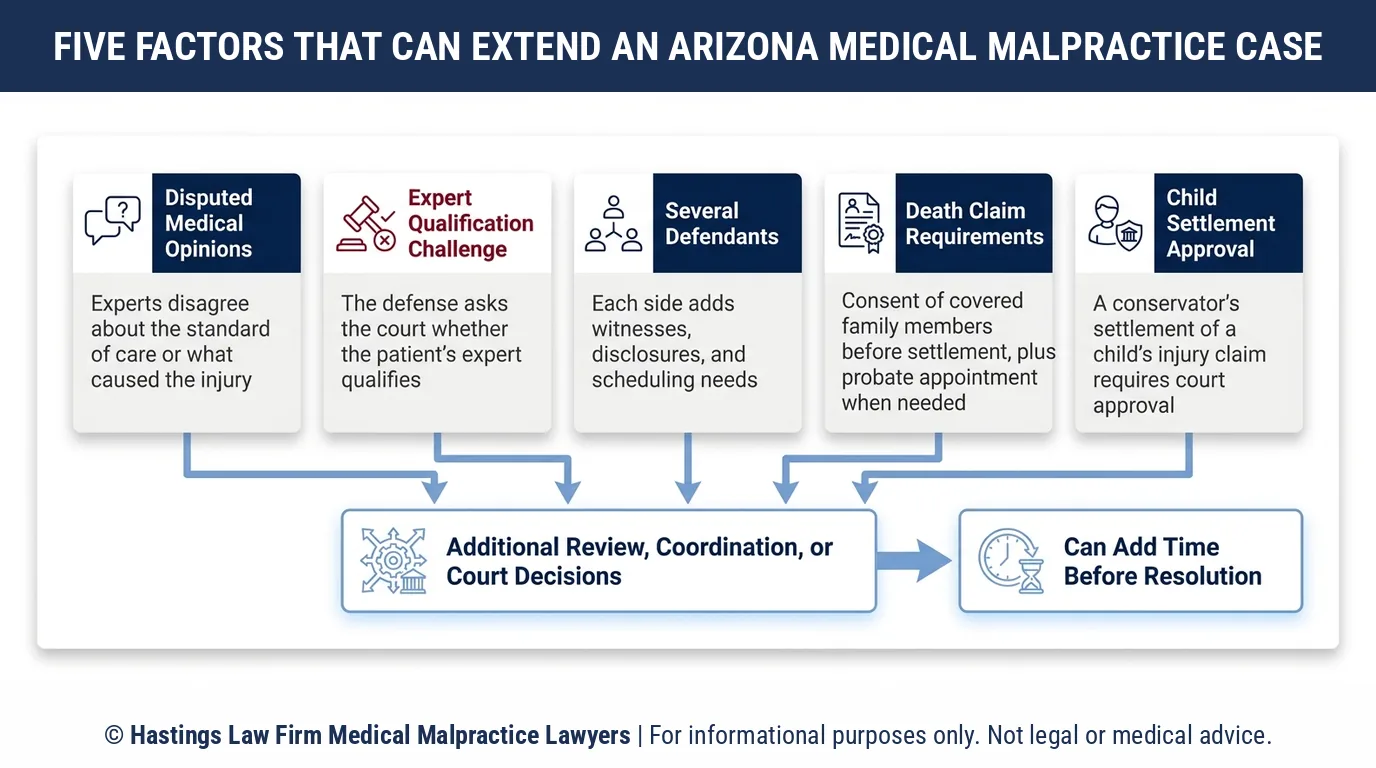
Some Arizona medical negligence cases take longer than others because the medical experts disagree, the defense challenges the patient’s expert, several defendants are involved, or the law adds steps after a death or for a child. The disagreement can be over whether the care fell below the accepted standard or whether a medical error caused the injury, and working through it in reports, depositions, and motions takes time.
A defendant can also challenge the qualifications of the patient’s expert. Under A.R.S. § 12-2604, an expert who testifies about the standard of care must share the provider’s specialty, be board certified in it when the provider is, and have spent most of the year before the care practicing or teaching in that field. The defense can ask the court to rule that the expert does not qualify, including through a motion for summary judgment, which asks the judge to decide the claim without a trial. Such motions take time to decide.
More than one defendant adds time too. When a hospital, a physician group, and individual providers are all named, each files its own answer and disclosures, its witnesses may be deposed, and the schedule has to fit every side.
A death adds steps of its own. The claim is brought by the surviving spouse, child, parent, or guardian, or by a personal representative for the family, and becoming a personal representative requires an appointment through probate. Before settling, the person bringing the claim must have the consent of the other family members the claim covers.
A child’s case can add a court step before a settlement is complete. When a conservator, a person a court appoints to manage a child’s property, settles the child’s injury claim, A.R.S. § 14-5424 requires a court to approve the settlement. Arizona courts can approve other arrangements that protect the child’s recovery without a permanent conservatorship.
Does Taking More Time Lead to a Bigger Medical Malpractice Settlement in Arizona?
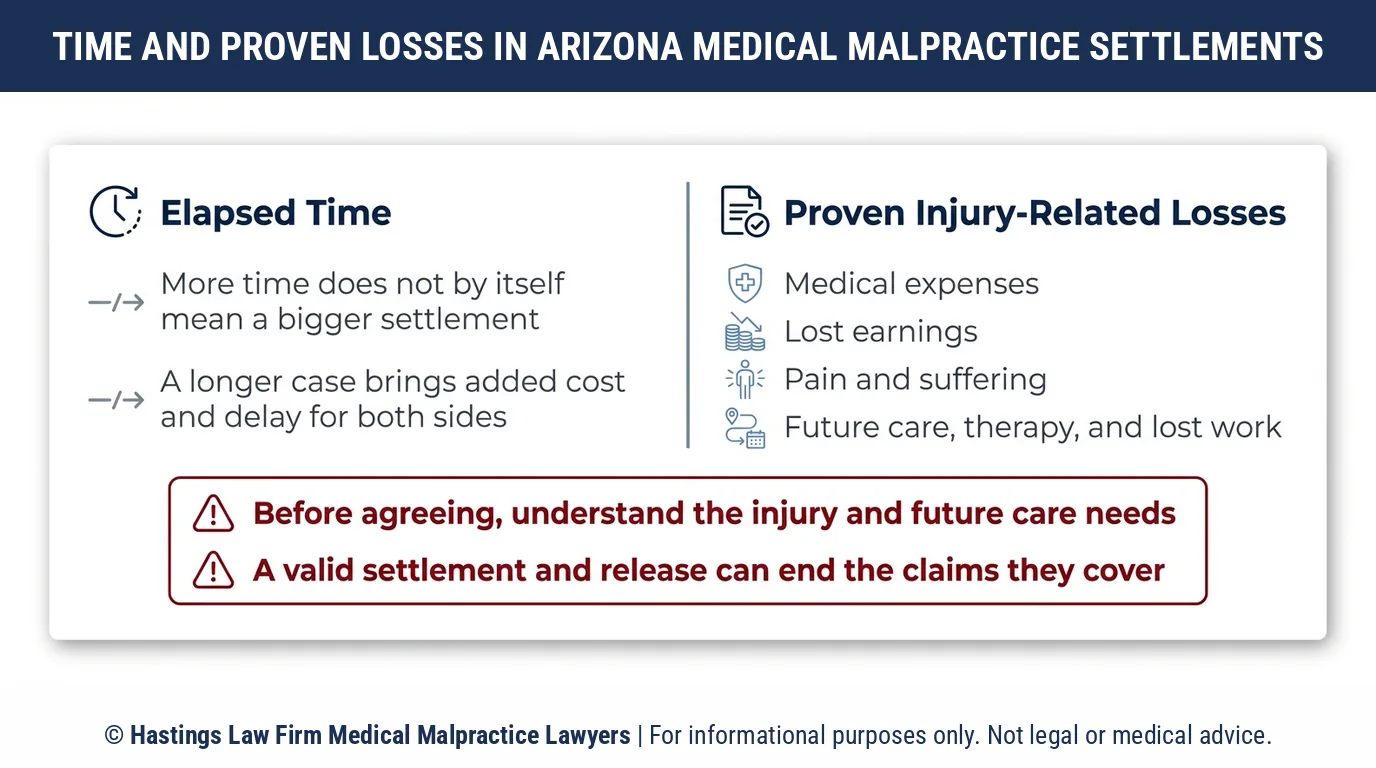
A longer case does not by itself mean a bigger settlement, because an Arizona medical malpractice settlement reflects the injury-related losses the evidence proves, such as medical expenses, lost earnings, and pain and suffering. What a claim is worth depends on the injury, the losses it caused, and the strength of the evidence, and a longer case brings added cost and delay for both sides.
Time still matters for a different reason. Arizona courts enforce a valid settlement as a contract, as the Arizona Supreme Court explained in Robertson v. Alling, and a valid settlement and release can end the claims they cover. So the full extent of the injury, and the care it will need, should be known before anyone agrees to a number.
Settling before treatment ends, or before the long-term effects of the injury are clear, can leave future care out of the amount. Waiting until the treating doctors can describe what lies ahead takes time, but it lets the settlement account for the care, the therapy, and the lost work that may still come.
The wait does not always end when the case resolves. Payment follows the terms of the settlement agreement or the final judgment, and an appeal of a judgment can delay it.
The Hastings Law Firm Difference
Results matter, but what truly sets us apart is how we achieve them. Every verdict, every settlement, and every courtroom victory comes from one guiding promise: To treat each client’s fight for justice as if it were our own.
This balance of skill, experience, and empathy reflects our core philosophy that justice should not only compensate the injured, but also make health care safer nationwide.

What Can You Do to Keep an Arizona Medical Negligence Claim Moving?
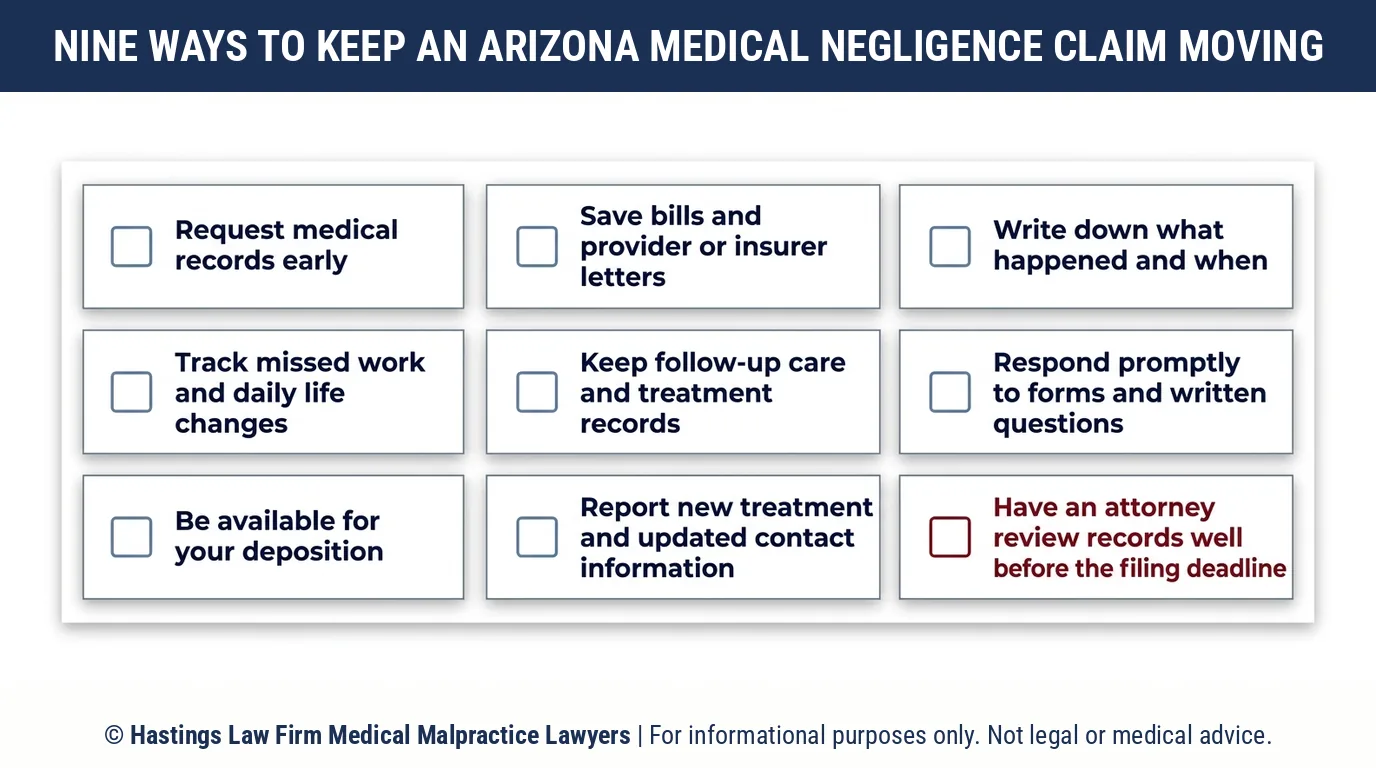
To keep an Arizona medical negligence claim moving, request the medical records early, save every bill, and track the time missed from work and how the injury has changed daily life. Write down what happened and when, and have the records reviewed by a medical malpractice attorney well before the filing deadline.
Stay on track with follow-up care, and keep those records as well. The treatment record shows what the injury has cost so far and what care is still needed, and the value of the claim depends on both. Hold on to any letters from a provider, a hospital, or an insurer, since they can matter later.
Once a case is under way, respond to requests quickly. Signing forms that release your records, answering written questions under oath, and being available for a deposition keep the schedule from slipping because of a delay at your end. Tell your attorney about any new treatment, a change of address, or a new phone number, so your attorney can reach you without delay.
Talk to an Arizona Medical Malpractice Attorney About Your Case
Our free case review starts with listening to what happened. We request the medical records at no cost to you, and our attorneys and medical professionals review them, with a medical expert when the case calls for one. Once that review is complete, we give you an honest answer about whether you have a claim.
Our Arizona medical malpractice lawyers are experienced in handling medical negligence claims across the state, from the first records request through settlement or trial. We understand that a claim can take time while a family is still recovering, and that knowing what each stage asks of them makes the wait easier to plan around. We prepare every case as if it were going to trial.
That preparation does not depend on what you can pay. We work on a contingency fee, so you pay no attorney fees or costs unless we win, and we advance the cost of the experts and everything else it takes to build the claim, however long the case takes. Hastings Law Firm has been dedicated exclusively to medical malpractice since 2005, and every case review is free and confidential. Contact us now.
Sources
- 2013 Health Affairs study of how long malpractice claims took to close | National Library of Medicine
- 2006 New England Journal of Medicine study of closed malpractice claims | National Library of Medicine
- Administrative Order 2014-81 adopting Arizona’s civil case processing time standards | Arizona Supreme Court
- A.R.S. § 12-2293 on patient requests for medical records and response times | Arizona State Legislature
- A.R.S. § 12-2603 on the preliminary expert opinion affidavit | Arizona State Legislature
- A.R.S. § 12-542 setting the two-year deadline for medical malpractice actions | Arizona State Legislature
- A.R.S. § 12-821.01 on the notice of claim against a public entity | Arizona State Legislature
- Arizona Rule of Civil Procedure 16 on the Early Meeting, scheduling and trial setting | Arizona Court Rules on Westlaw
- Arizona Rule of Civil Procedure 26.2 on Tier 3 and its 240-day discovery period | Arizona Court Rules on Westlaw
- Arizona Rule of Civil Procedure 33 on written questions answered under oath | Arizona Court Rules on Westlaw
- A.R.S. § 21-102 setting an eight-person civil jury with six agreeing | Arizona State Legislature
- Order R-16-0010 adopting the 15-day deadlines in Rules 50(b) and 59 | Arizona Supreme Court
- Court of Appeals Division One 2025 report on civil appeal timing | Arizona Court of Appeals, Division One
- A.R.S. § 12-2604 on the qualifications of a standard-of-care expert witness | Arizona State Legislature
- A.R.S. § 14-5424 requiring court approval of a conservator’s injury settlement | Arizona State Legislature
- Robertson v. Alling, Arizona Supreme Court opinion on enforcing settlements as contracts | Arizona Supreme Court

This content was researched and written by the Hastings Law Firm editorial team, which includes attorneys, medical professionals, and experienced researchers. Our writing is informed by internal knowledge and practical experience, and we cross-check critical details against authoritative sources cited throughout. Every piece undergoes human-led fact-checking and legal review. Because legal and medical information can change, if you spot an error, please contact us. Learn more about our content standards and review process on our editorial policy page.

Tommy Hastings, founder of Hastings Law Firm, is a board-certified personal injury trial lawyer (by the Texas Board of Legal Specialization) dedicated exclusively to healthcare injury cases. Since 2001, he has represented injured patients and families in litigation against major hospital systems, pharmaceutical companies, and negligent healthcare providers nationwide. He has handled numerous high-profile cases that have drawn national media attention and resulted in multi-million dollar recoveries.
