


What is the Preliminary Expert Opinion Affidavit in an Arizona Medical Malpractice Case?
Harm during medical care can leave a patient and family dealing with pain, setbacks in recovery, and questions about what went wrong that stay with them long after the treatment ends. Many families come to realize that what they saw and lived through is not enough by itself to show that the care fell short. Medicine has its own standards, and judging whether a provider met them takes knowledge that most people outside the field do not have. Knowing what Arizona law asks for in that situation makes the path ahead easier to see.

Last Updated: November 4, 2026
What You Should Know About the Preliminary Expert Opinion Affidavit in Arizona:
- Under A.R.S. 12-2603, a patient suing an Arizona health care professional must certify in writing whether an expert is needed and, if so, serve a sworn preliminary expert opinion affidavit with the initial disclosures, generally due 30 days after the first responsive pleading, usually the defense’s answer, is filed.
- An Arizona court can extend the time to serve the affidavit for good cause or when the parties agree, and when an affidavit is challenged as insufficient, it must allow a reasonable time to fix it where needed.
- Most Arizona medical malpractice claims need an expert, because expert testimony ordinarily establishes the standard of care, with a narrow exception for negligence that is apparent without medical training.
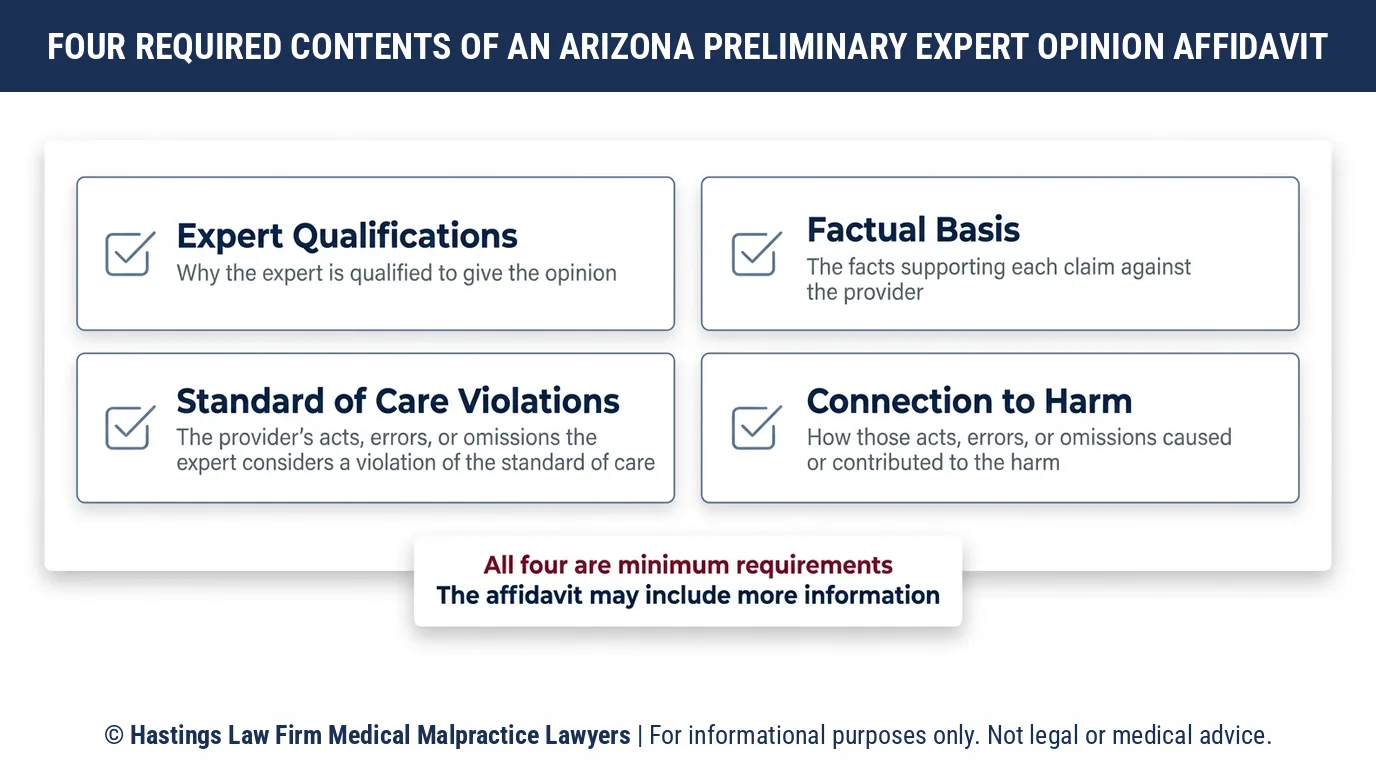
- Under A.R.S. 12-2603(B), the affidavit must state at least the expert’s qualifications, the factual basis for each claim, the provider’s acts, errors, or omissions that the expert considers a violation of the standard of care, and how they caused or contributed to the harm.
- Under A.R.S. 12-2604, a standard of care expert must be a licensed health professional who shares the defendant’s specialty and board certification when the defendant has them, has spent most of the year before the incident practicing or teaching in that field, and is paid a fee that does not depend on the outcome.
- The affidavit and the expert qualification test are separate requirements in Arizona, so a provider can challenge an expert’s qualifications later even if it never challenged the affidavit.
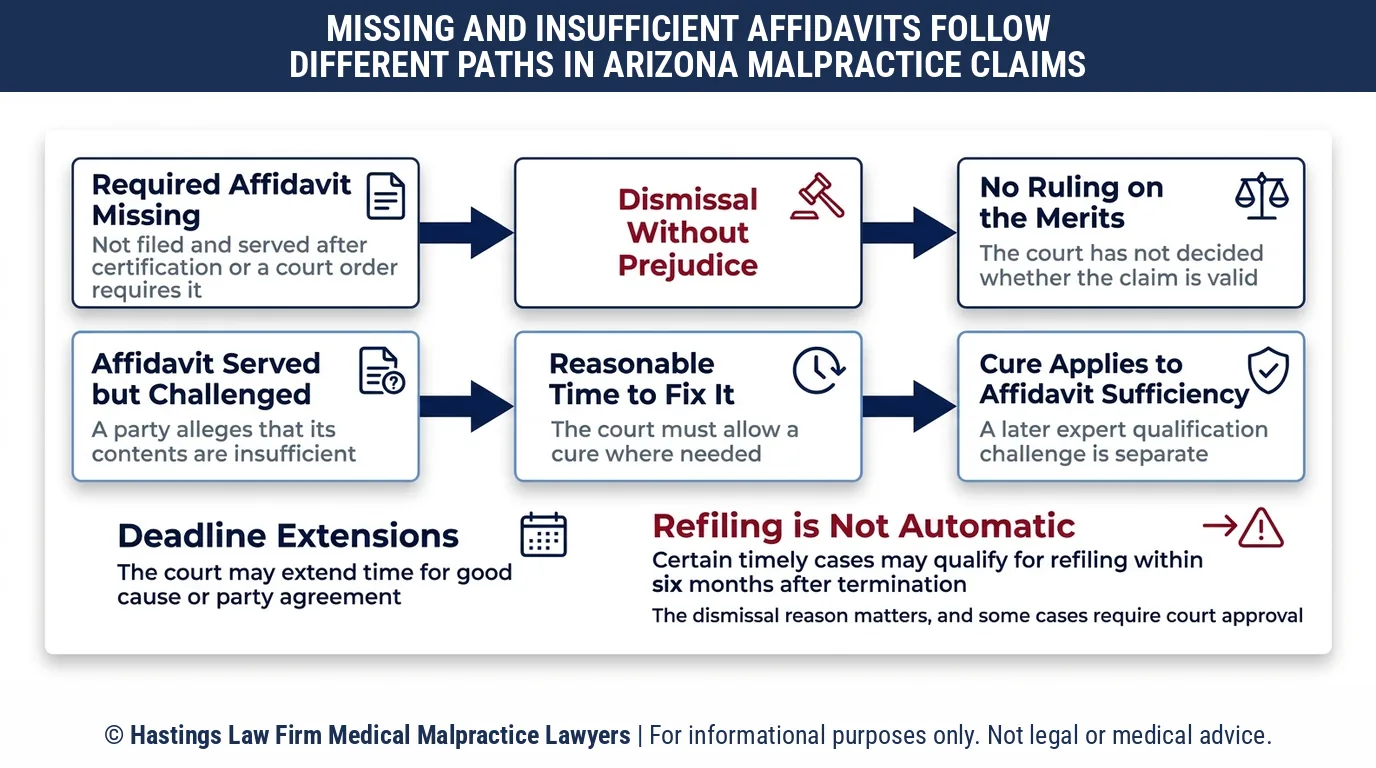
- An Arizona court must dismiss the claim without prejudice when a required affidavit is not filed and served, and that dismissal is not a ruling on the merits.
- Arizona’s savings statute, A.R.S. 12-504, lets certain timely lawsuits that end without a merits judgment be refiled within six months, depending on why the case ended.
- Under A.R.S. 12-2293, an Arizona patient can request medical records in writing, and a request made for litigation has a response period of 30 calendar days.
What Does Arizona Law Require When You File a Medical Malpractice Lawsuit?
Section 12-2603 of the Arizona Revised Statutes requires a patient whose claim needs expert testimony to serve a qualified expert’s sworn opinion early in the case, in a document known as the Arizona preliminary expert opinion affidavit. Medical malpractice claims also start with a written certification, filed and served with the claim, that states whether an expert is needed at all.
Arizona has a similar certification rule for claims against other licensed professionals, A.R.S. 12-2602, but health care claims fall under 12-2603. That section reaches claims under Arizona’s malpractice statutes, A.R.S. 12-561 through 12-563, and those statutes count licensed health care institutions as providers, so a claim against a hospital is not exempt from either step.
The affidavit comes later than the certification. It is served with the initial disclosures, the first information each side must share under Rule 26.1 of the Arizona Rules of Civil Procedure. Those disclosures generally fall due 30 days after the first responsive pleading, usually the defense’s answer to the complaint, is filed, unless the parties agree or the court orders otherwise. The statute mostly speaks of serving the affidavit on the other side, though its dismissal provision refers to filing and serving it.
The patient may serve affidavits from as many experts as the claim needs, and the defense can owe an affidavit too. A defendant that blames a nonparty for the injury and certifies that an expert is needed must serve its own affidavit within 60 days after filing the designation that names the nonparty.
The statute has held up in court. In 2024, the Arizona Supreme Court upheld it in Francisco v. Affiliated Urologists, rejecting a challenge that it was unconstitutional as applied to the patients in that case, so a claim that needs an expert should plan for the affidavit from the start.
Do You Need an Expert to Sue for Medical Malpractice in Arizona?
In most cases, you need an expert to sue for medical malpractice in Arizona. A 2009 ruling of the Arizona Supreme Court, Seisinger v. Siebel, recognized that expert medical testimony ordinarily establishes the standard of care and the provider’s departure from it. A narrow exception covers negligence that is apparent without medical training.
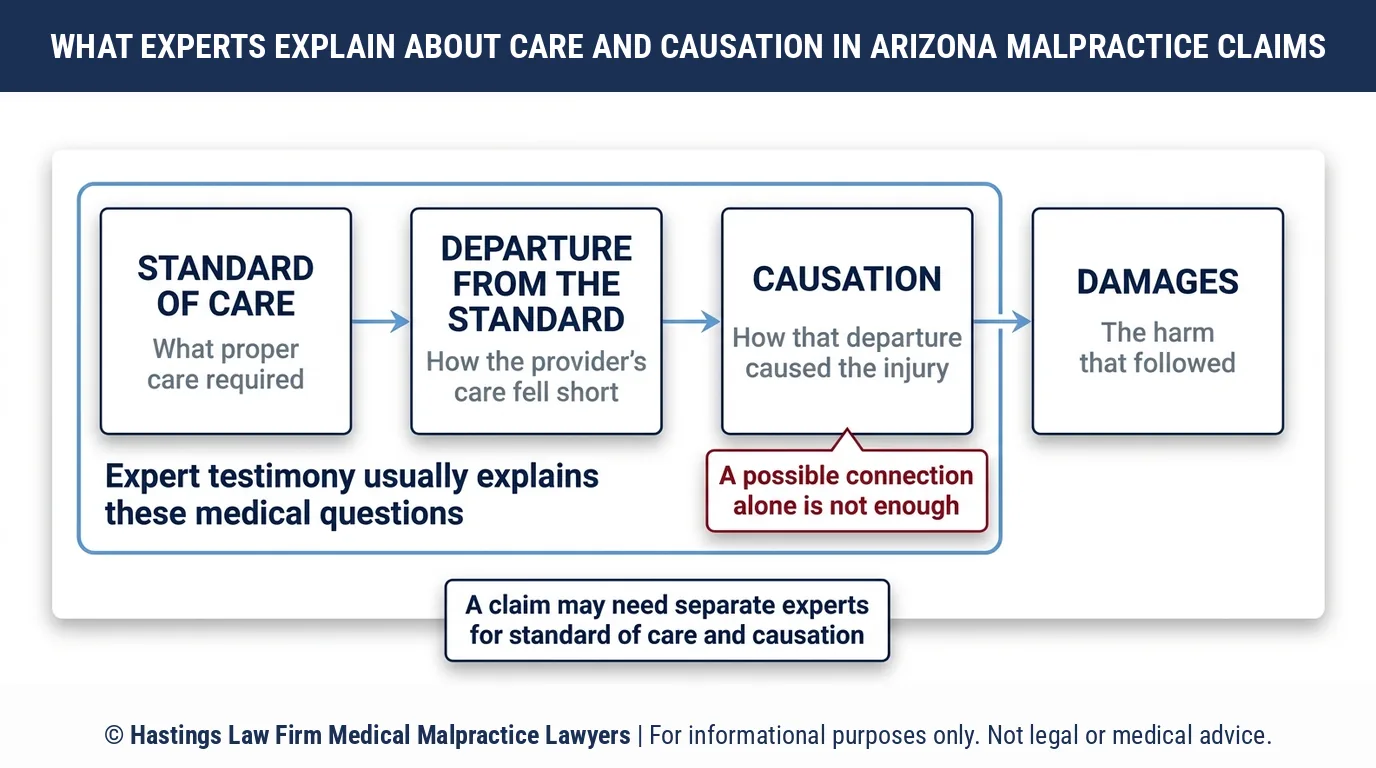
When a claim needs one, the expert explains three things to the court and the jury: what proper care required, how the provider departed from it, and how that departure caused the injury. The first of those is the standard of care, and under A.R.S. 12-563 the patient must show that the provider fell below it for the treatment involved. Jurors cannot settle a disputed medical question by speculation, so the expert tells them what that standard required in the situation the patient faced.
Falling below that standard is only part of the claim. Arizona also requires proof that the failure caused the injury, known as proximate cause. Proving causation after a medical error in Arizona usually takes medical evidence of a probable connection between the care and the harm, not a mere possibility, and the negligence does not have to be the injury’s only cause. The last piece is the harm itself, the damages that followed.
Negligence, causation, and damages are the patient’s to prove, under the ordinary civil standard called a preponderance of the evidence, not proof beyond a reasonable doubt. On the medical questions, expert testimony is usually the main evidence, and a claim may need one expert for the standard of care and another for causation. The defense may call its own experts, including experts who discuss other possible causes of the injury.
Each expert on the patient’s side has to study the medical records before giving an opinion, so expert review is a cost a claim carries from its earliest stage. Medical experts typically charge between $800 and $1,500 an hour for that review of the case information and records, depending on their expertise. How that review is paid for is one of the first practical questions a family faces, and a fair one to raise in the first conversation with a lawyer.
What Must the Preliminary Expert Opinion Affidavit Say in Arizona?
The preliminary expert opinion affidavit in an Arizona medical malpractice case must state the expert’s qualifications to give the opinion, the factual basis for each claim, the provider’s acts, errors, or omissions that the expert considers a violation of the standard of care, and how they caused or contributed to the harm. A.R.S. 12-2603(B) sets those four items as the minimum, so an affidavit may say more.
The affidavit can also grow as the case goes on. The patient may supplement the claim or the affidavit with additional claims, evidence, or expert opinions, as long as they are timely disclosed under the court rules or a court order.
The affidavit is an early look at the expert case, not the full picture. The experts set out their complete opinions later, in the signed reports that Arizona Rule of Civil Procedure 26.1 generally requires in these cases.
Who Can Serve as a Medical Expert Witness Under A.R.S. 12-2604 in Arizona?
To qualify as a medical expert witness on the standard of care in Arizona, a person must be a licensed health professional in the same health profession as the defendant, sharing the defendant’s specialty and board certification when the defendant has them. A.R.S. 12-2604 also requires the expert to have spent most of the year before the incident practicing or teaching in that field.
The same test applies to hospital malpractice claims in Arizona and other claims against a health care institution, where the statute measures the expert against the employed professional whose care is at issue, as if that professional were the defendant. The rest of the test depends on the kind of provider.
For a general practitioner, the expert must have spent most of the prior year practicing as a general practitioner or teaching students in the same health profession. For a specialist, the Arizona Supreme Court has described a two-step test. The trial court first decides whether the care or treatment at issue involved a specialty or subspecialty, and if it did, the expert must share that specialty.
The way the expert is paid matters too. An expert whose fee depends in any way on how the case turns out may not testify.
Meeting the qualification test is its own requirement, separate from the affidavit, and failing either one can end a claim. In Rasor v. Northwest Hospital, the Arizona Supreme Court held that a provider may challenge an expert’s qualifications through a motion for summary judgment, which asks the court to rule before trial, even if the provider never challenged the affidavit. The statute’s automatic chance to fix a faulty affidavit does not carry over to that motion.
The qualification rule itself has been tested in court. In Seisinger v. Siebel, the same court rejected a separation-of-powers challenge to 12-2604(A), so choosing an expert who meets the test is one of the first decisions in building a claim.
What Kind of Arizona Medical Negligence Claim Can Go Forward Without an Expert?
An Arizona medical negligence claim can go forward without an expert only when both the negligence and its link to the injury are apparent without medical training. Under a decision of the Arizona Supreme Court, Sampson v. Surgery Center of Peoria, expert evidence is required on the standard of care unless the negligence is grossly apparent, and on causation unless the link is readily apparent to ordinary jurors.
Even a mistake that looks obvious does not by itself remove the need for expert evidence that it caused the injury. The patient answers whether an expert is needed at the start, in the written certification filed with the claim, and a certification that no expert is needed means no affidavit follows unless the court orders one.
When the two sides disagree in good faith on that point, the court settles it. The patient, the provider, or a nonparty blamed for the injury may ask the court to require an affidavit, and the motion must identify the claim, its elements, and why expert testimony is needed. The court decides whether an affidavit is required and sets the terms and a date for it, and other proceedings and time periods on that claim pause until it rules. If the court orders an affidavit and none is filed and served, the claim is dismissed.
What Happens if an Arizona Expert Affidavit is Missing or Falls Short?
When a required expert affidavit is missing in an Arizona medical malpractice case, the court must dismiss the claim against the health care professional without prejudice, meaning the court has not judged the claim’s merits. A.R.S. 12-2603(F) sets that rule for a patient who certified that an expert is needed, or was ordered to provide an affidavit, and then did not file and serve one.
The court can dismiss on its own, or when the provider or a nonparty blamed for the injury asks it to. The deadline can also move before that point. The court may extend the time to comply when a party applies and shows good cause, meaning a sound reason for more time, or when the parties to the claim agree.
An affidavit that was served but is challenged as insufficient follows a different path. When any party alleges that the affidavit falls short, the court must allow a reasonable time to fix it where needed, a step known as a cure. That right covers the affidavit’s sufficiency only, not a later challenge to the expert’s qualifications.
Whether a dismissed claim can come back depends on how and why it ended. Arizona’s savings statute, A.R.S. 12-504, lets certain timely lawsuits that end without a merits judgment be refiled within six months, even after the filing period has run, and some dismissals need the court to grant that relief.
That filing period is two years in Arizona, and the clock generally starts when the patient knew or reasonably should have known enough to suspect the injury was caused by negligence. A dismissal late in that period can leave little time to file again.
The Hastings Law Firm Difference
Results matter, but what truly sets us apart is how we achieve them. Every verdict, every settlement, and every courtroom victory comes from one guiding promise: To treat each client’s fight for justice as if it were our own.
This balance of skill, experience, and empathy reflects our core philosophy that justice should not only compensate the injured, but also make health care safer nationwide.

What Should You Gather Before an Expert Reviews Your Arizona Malpractice Claim?
The first steps toward an expert review of an Arizona medical malpractice claim are to request your complete medical records, keep the bills and any letters from the doctors and hospitals involved, and write down what went wrong in your care, when, and who provided it. Those materials let a qualified medical expert review your treatment and form an opinion about whether it met the standard of care.
The medical records come first. Under A.R.S. 12-2293, a patient or the patient’s health care decision maker can request them in writing. For a request made for litigation, Arizona sets a response period of 30 calendar days, and reasonable copying charges may apply.
The list of providers matters next, because the expert generally must match each provider’s field, including any specialty and board certification. Knowing who gave the care, from the surgeon to the nurses and the hospital’s staff, shapes which experts the claim needs.
Arizona law does not require those experts to finish their review before the lawsuit is filed. The certification filed with the claim still has to say whether an expert is needed, though, and the affidavit follows early in the case, so the review cannot wait long.
Gathering the records and arranging the review are part of the investigation before a lawsuit, which ends in the decision whether to file at all. Each step takes time, and the two-year filing period limits how much, so starting early leaves room for all of them.
Talk to an Arizona Medical Malpractice Attorney About Your Case
When you contact Hastings Law Firm, we listen to what happened, request and review the medical records, and give you an honest answer about whether you have a claim. If your case needs a medical expert, we find one in the right field, often a specialist in the same area as the care involved. Our attorneys and medical professionals are experienced at preparing the expert side of medical negligence claims for patients and families across Arizona. We understand what it means to a family to wait on an expert’s opinion before a case can move forward.
Our Arizona medical malpractice lawyers are part of a firm dedicated exclusively to medical malpractice since 2005. We work on a contingency fee, so you pay no attorney fees or costs unless we win, and Hastings Law Firm advances the cost of medical experts and everything else it takes to build a claim. Contact us now for a free, confidential case review.
Frequently Asked Questions About Expert Witnesses in Arizona Malpractice Cases
What Must an Expert Disclose Under the Arizona Rules of Civil Procedure in a Medical Negligence Lawsuit?
Under Arizona Rule of Civil Procedure 26.1, an expert hired to testify in a medical negligence lawsuit must give a signed report covering the expert’s qualifications and publications, complete opinions and the reasons for them, and the facts, data, and exhibits behind them. The rule requires that report in Tier 3 cases, the Rule 26.2 category where these lawsuits generally belong, unless the parties agree or the court orders otherwise.
The report also identifies the published works the expert relied on, the expert’s pay for the case, and past testimony as an expert. These disclosures come after the preliminary expert opinion affidavit, which does not replace them.
How Many Expert Witnesses Can Each Side Call in an Arizona Medical Malpractice Case?
In an Arizona medical malpractice case, each side can generally call one retained or specially employed expert witness on each issue, not one for the whole case, so a case with several disputed medical issues can have several experts. Arizona Rule of Civil Procedure 26(b)(4)(F) sets that limit as a presumption, so the parties can agree otherwise, or the court can allow more for good cause.
When several parties on one side cannot agree on an expert, the court may designate one or permit more. A defendant provider may also testify about their own standard of care in addition to the defense’s standard of care expert, and that does not by itself require the court to allow the patient another expert.
Sources
- A.R.S. 12-2603, the certification and preliminary expert opinion affidavit rule | Arizona State Legislature
- Francisco v. Affiliated Urologists, upholding the affidavit statute as applied | Arizona Supreme Court
- Seisinger v. Siebel, on expert testimony and the 12-2604(A) challenge | Arizona Supreme Court
- Arizona Rule of Civil Procedure 26.1 on initial disclosures and expert reports | Thomson Reuters Westlaw, Arizona Court Rules
- A.R.S. 12-2604, qualifications for a medical expert witness | Arizona State Legislature
- Rasor v. Northwest Hospital, on the affidavit and expert qualification requirements | Arizona Supreme Court
- Sampson v. Surgery Center of Peoria, on when expert evidence is required | Arizona Supreme Court
- A.R.S. 12-504, Arizona’s savings statute for timely lawsuits | Arizona State Legislature
- A.R.S. 12-542, Arizona’s two-year filing period for medical malpractice | Arizona State Legislature
- Arizona Rule of Civil Procedure 26.2 on case tiers and discovery limits | Thomson Reuters Westlaw, Arizona Court Rules
- A.R.S. 12-2293 on requesting medical records in writing | Arizona State Legislature
- Order R-18-0007 setting the one-expert-per-issue rule, Rule 26(b)(4)(F) | Arizona Supreme Court

This content was researched and written by the Hastings Law Firm editorial team, which includes attorneys, medical professionals, and experienced researchers. Our writing is informed by internal knowledge and practical experience, and we cross-check critical details against authoritative sources cited throughout. Every piece undergoes human-led fact-checking and legal review. Because legal and medical information can change, if you spot an error, please contact us. Learn more about our content standards and review process on our editorial policy page.

Tommy Hastings, founder of Hastings Law Firm, is a board-certified personal injury trial lawyer (by the Texas Board of Legal Specialization) dedicated exclusively to healthcare injury cases. Since 2001, he has represented injured patients and families in litigation against major hospital systems, pharmaceutical companies, and negligent healthcare providers nationwide. He has handled numerous high-profile cases that have drawn national media attention and resulted in multi-million dollar recoveries.
