


What is the Burden of Proof in Medical Malpractice Cases in Arizona?
Suspecting that a medical mistake caused an injury can leave a patient and their family living with pain, unexpected setbacks, and a question that does not go away. The harm itself is often plain to see, but whether the care fell short is much harder to tell from the outside. Many families in that position want to know who would have to show that something went wrong, and how much proof it would take. Understanding how proof works in a medical malpractice case in Arizona can ease some of that uncertainty and make the next decision clearer.
Last Updated: November 4, 2026
What You Should Know About the Burden of Proof in an Arizona Medical Malpractice Case:
- In an Arizona medical malpractice case, the patient who brings the claim, or the family when the patient has died, carries the burden of proving negligence, causation, and damages.
- The standard in an Arizona malpractice case is a preponderance of the evidence, meaning each fact must be shown more probably true than not true, not the criminal standard of proof beyond a reasonable doubt.
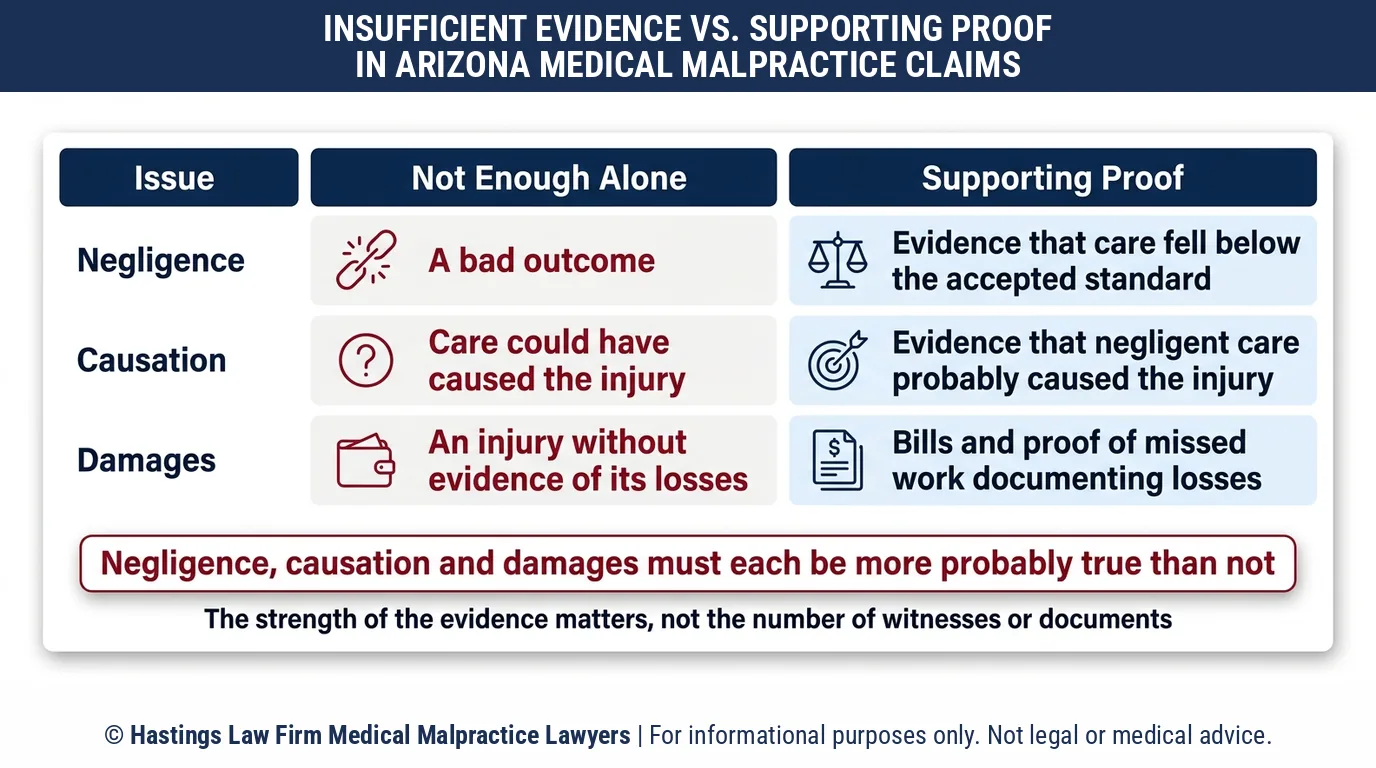
- A bad outcome alone does not prove malpractice in Arizona, because the evidence must show negligent care that probably caused the injury, not care that only could have caused it.
- An Arizona malpractice claim rests on four elements: duty, breach, causation, and damages, with A.R.S. § 12-563 making breach of the standard of care and proximate cause part of what the patient must prove.
- Most Arizona malpractice claims need a medical expert, and A.R.S. § 12-2603 requires a sworn preliminary expert opinion affidavit early in the case when expert testimony is needed.
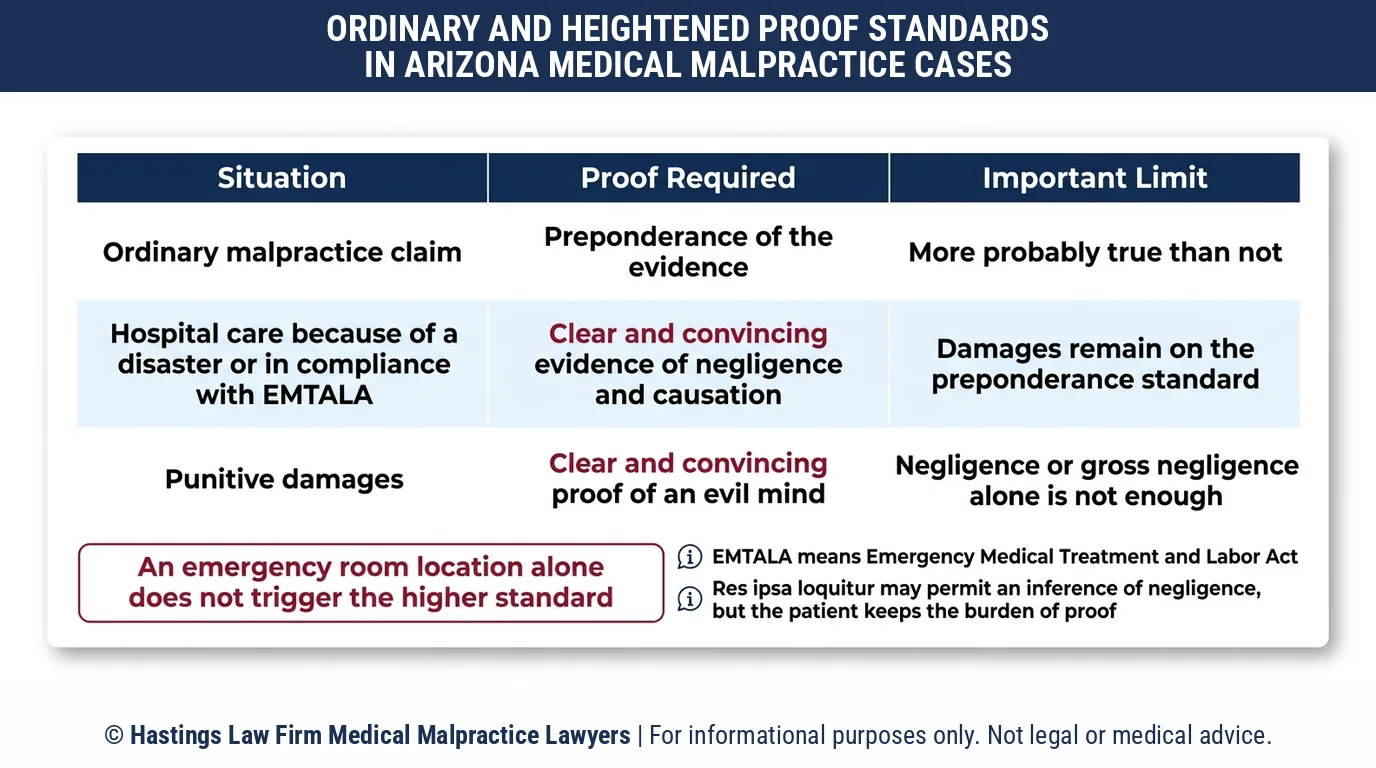
- Under A.R.S. § 12-572, qualifying emergency or disaster care raises the burden on negligence and causation to clear and convincing evidence, while the amount of damages stays on the ordinary standard.
- Res ipsa loquitur lets an Arizona jury infer negligence in some cases, such as a surgical instrument left inside the body, but it does not move the burden of proof to the provider.
- An Arizona healthcare provider that blames the patient or someone outside the lawsuit must prove that fault, and under A.R.S. § 12-2505 a patient found partly at fault can still recover a reduced amount.
- Arizona generally allows two years from when a claim accrues to file a medical malpractice lawsuit under A.R.S. § 12-542, and under the discovery rule that clock can start later than the date of care.
Who Has the Burden of Proof in an Arizona Medical Malpractice Case?
The burden of proof in medical malpractice cases in Arizona rests on the patient who brings the claim, or on the family when the patient has died. Under the Revised Arizona Jury Instructions (Civil), Medical Negligence 1, the patient or family must prove that the healthcare provider was negligent, that the negligence caused the injury, and what damages resulted, each by a preponderance of the evidence.
Section 12-563 of the Arizona Revised Statutes spells out what the patient must prove on negligence and causation. On negligence, that means showing the provider failed to use the care, skill, and learning expected of a reasonable, prudent provider in the same profession or class in Arizona, acting in the same or similar circumstances. On causation, it means showing that this failure was a proximate cause of the injury. Put simply, the evidence has to show what proper care would have looked like, how the care fell short of it, and that the shortfall caused the harm.
Other questions in a case are not the patient’s to prove. Whether the provider owed the patient a legal duty is for the court to decide, not a fact the jury weighs. The provider also does not have to prove that its care met the standard, although it can answer the patient’s evidence with experts of its own. If the patient cannot prove negligence, causation, or damages, the claim fails, which is why the amount of proof required matters so much.
What Does Preponderance of the Evidence Mean in an Arizona Malpractice Case?
A preponderance of the evidence means the patient must show that each fact is more probably true than not true. A decision of the Arizona Court of Appeals, Pfeil v. Smith, describes that standard as the ordinary burden of proof in an Arizona civil case, and the state’s medical negligence jury instructions give jurors the same test.
The standard measures how convincing the proof is, not how much of it there is, so it is not a contest over which side calls more witnesses. The question is whether everything presented, taken as a whole, makes each fact more likely true than not.
That question goes to the jury. Under A.R.S. § 21-102, a superior court civil jury ordinarily has eight jurors, and six must agree on the verdict unless the parties agree otherwise.
Because a medical malpractice claim is a civil case, that jury does not hold the patient to proof beyond a reasonable doubt, the standard used in criminal cases. Other negligence and personal injury claims in Arizona are civil cases too, and juries weigh them under the same preponderance test.
How Much Evidence Does It Take to Win a Medical Malpractice Case in Arizona?
Winning a medical malpractice case in Arizona takes evidence strong enough for the jury to find negligence, causation and damages each more probably true than not, rather than any set amount of paperwork or testimony. A long-standing ruling of the Arizona Supreme Court, Boyce v. Brown, holds that negligence must be affirmatively proved, meaning the patient has to show it with evidence.
In most cases, a qualified medical expert carries much of that proof by explaining what went wrong and how it led to the injury. On causation, the Arizona Supreme Court said in Sampson v. Surgery Center of Peoria that “a plaintiff must show that causation is probable, not merely speculative.” In other words, the evidence must generally show that the negligent care probably caused the injury, not merely that it could have. Limited exceptions affect what evidence can reach the jury, but speculation does not meet the burden.
A bad outcome alone does not meet the burden either. Medicine carries risk, and a poor result is not always negligence. When an injury was preventable, the providers responsible should be held accountable, and showing that it was preventable takes evidence about the care itself.
That evidence starts with the chart, which shows what was done, when, and by whom, and the expert’s review explains what those entries mean. Witnesses who saw the care or its effects can add what was never written down, while bills and proof of missed work document the losses.
What Elements Must Be Proven in an Arizona Medical Malpractice Case?
An Arizona medical malpractice claim rests on four elements: a duty of care, a breach of the standard of care, causation, and damages. The court decides whether a duty existed, A.R.S. § 12-563 requires proof of breach and causation, and the jury instructions add proof of damages. A claim missing any one of the four cannot succeed.
Breach means the provider fell below the accepted standard of care, measured by what a careful provider in the same field would have done in that situation. The patient’s evidence compares that standard with what the provider actually did. The gap between the two is the negligence the jury is asked to find, and an expert usually explains it.
Causation links the breach to the harm, and the negligence does not have to be the only cause of it. Our guide to proving causation in an Arizona medical error case explains how that connection is built.
Damages are the actual harm the negligence caused, and a mistake that injures no one does not support a claim. Depending on the evidence, compensation can cover medical expenses, lost earnings, pain and suffering, disability, and reduced enjoyment of life, as long as each loss traces back to the care that fell short.
That link is where causation can become the most contested of the four elements. A patient is often already ill or injured when the care begins, and the defense may argue that the underlying condition, not the care, explains the harm. The proof then has to separate what the illness would likely have done from what the mistake added.
Do You Need a Medical Expert to Prove Malpractice in Arizona?
Most Arizona medical malpractice claims need a medical expert. A ruling of the Arizona Supreme Court, Seisinger v. Siebel, recognizes that expert testimony ordinarily establishes what proper care required and how the provider departed from it. A narrow exception applies when the negligence, or its link to the injury, is apparent without medical knowledge.
Arizona also asks for that expert proof early. Under A.R.S. § 12-2603, a patient suing a health care professional must certify whether expert testimony is needed and, if it is, serve a sworn preliminary expert opinion affidavit. That affidavit sets out, under oath, the expert’s qualifications, the facts, the breach of the standard of care, and how the breach caused the injury. Failing to serve one can lead to the case being dismissed.
State law limits who can act as that expert. Under A.R.S. § 12-2604, the expert must be a licensed health professional who works in the provider’s specialty, holds the same board certification if the provider is board certified, and spent most of the year before the incident practicing or teaching in that specialty. The expert’s fee cannot depend on the outcome of the case. Because a qualification problem can end a claim on its own, the choice of expert matters from the start.
When Does the Burden of Proof Change in an Arizona Malpractice Case?
The burden of proof in an Arizona malpractice case rises for emergency or disaster care covered by A.R.S. § 12-572 and for punitive damages. Under that statute, for care given to a hospital patient because of a disaster or in compliance with the federal Emergency Medical Treatment and Labor Act (EMTALA), negligence and causation require clear and convincing evidence. Damages are still proved by a preponderance of the evidence.
That higher burden does not require proof of gross negligence. A treatment location alone does not decide whether the statute applies, so not every claim of emergency room malpractice in Arizona, or of harm in a labor and delivery unit, falls under it.
Punitive damages carry a higher burden of their own. In Swift Transportation Co. of Arizona v. Carman, the Arizona Supreme Court confirmed that they require clear and convincing proof of an evil mind. Negligence or gross negligence alone is not enough, and neither is a serious injury by itself.
Res ipsa loquitur, a Latin phrase meaning “the thing speaks for itself,” works in the patient’s favor by letting a jury infer negligence in some cases, without changing who carries the burden. Under Arizona’s Negligence 7 jury instruction, the inference is available when something under the provider’s control caused the injury, an injury of that kind does not ordinarily happen without negligence, and the patient cannot show exactly what happened. The instructions’ own example is a surgical instrument left inside the body, a type of case involving retained medical objects. The jury may draw that inference or reject it.
What Must a Healthcare Provider Prove When It Blames Someone Else in Arizona?
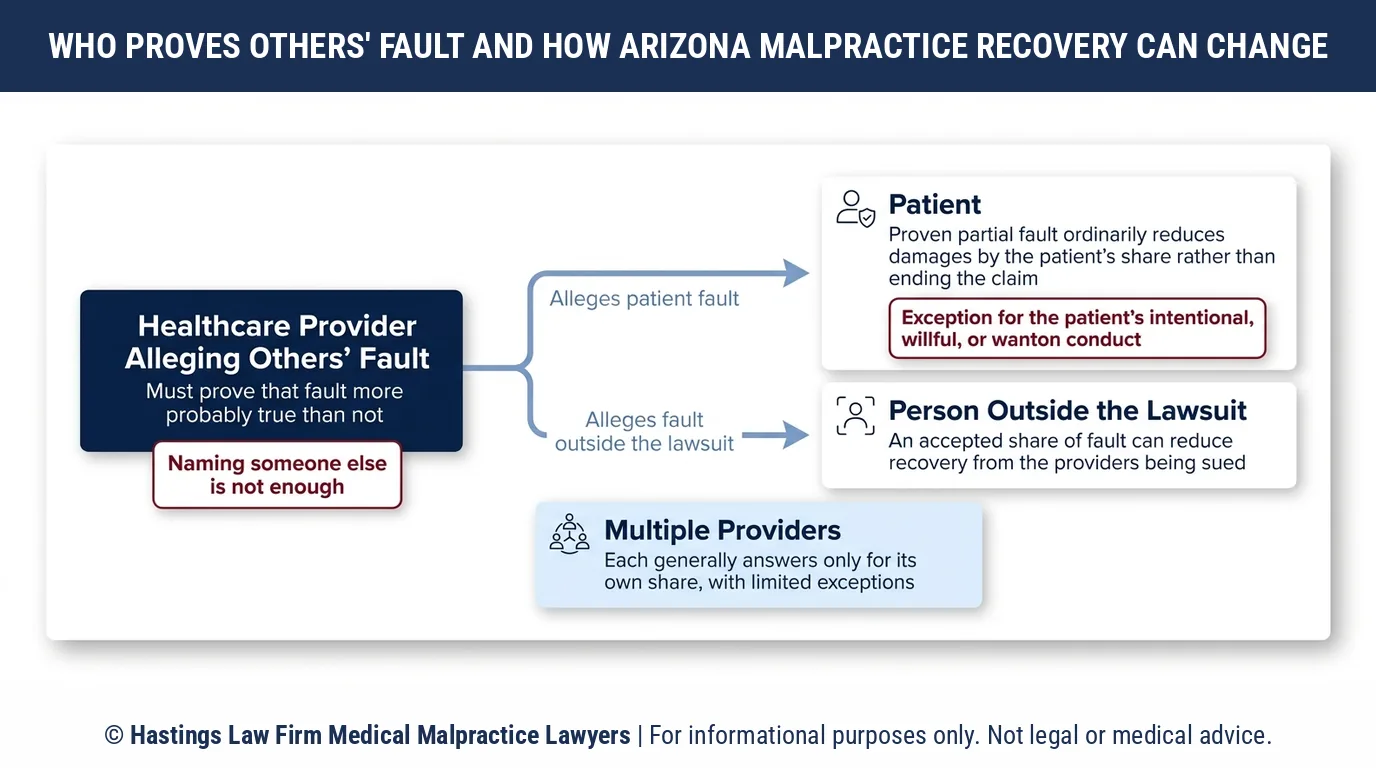
A healthcare provider that blames the patient or someone outside the lawsuit for part of the harm must prove that fault. Under the Revised Arizona Jury Instructions (Civil), Fault 7, the provider carries the burden on that claim by the same standard the patient meets, more probably true than not. Naming someone else is not enough.
Blaming someone outside the lawsuit also takes formal notice. Under A.R.S. § 12-2506 and the civil rules, the provider must give notice identifying that person and the facts behind the claim before the jury can weigh their fault, unless the patient settled with them. Even with notice, the jury decides whether any blame belongs outside the lawsuit, and an accepted share can reduce what the patient recovers from the providers being sued.
If the jury finds the patient was partly at fault, Arizona’s pure comparative fault rule in A.R.S. § 12-2505 reduces the damages by the patient’s share rather than ending the claim. A patient found partly responsible can still recover for the provider’s share of the harm, with an exception for the patient’s own intentional, willful, or wanton conduct.
Fault can be divided among providers too, such as a hospital and a physician who treated the patient there, and Arizona generally makes each one responsible only for its own share, with limited exceptions. The proof then has to address each provider’s part.
The Hastings Law Firm Difference
Results matter, but what truly sets us apart is how we achieve them. Every verdict, every settlement, and every courtroom victory comes from one guiding promise: To treat each client’s fight for justice as if it were our own.
This balance of skill, experience, and empathy reflects our core philosophy that justice should not only compensate the injured, but also make health care safer nationwide.

What Are the First Steps Toward Proving a Medical Malpractice Claim in Arizona?
The first steps toward proving a medical malpractice claim in Arizona are to write down what happened and when, request the medical records, and have an attorney and a medical expert review them. That review shows whether the evidence can meet the burden of proof before a claim is filed.
Notes written soon after the care, with dates, symptoms, and names, give the attorney and expert a place to start. A patient, or the patient’s health care decision maker, can request the records in writing under A.R.S. § 12-2293. When the request is for a legal case, Arizona sets a response period of 30 calendar days, and reasonable copy charges may apply.
Once the records arrive, the question is whether a qualified expert can say the care fell below the standard, whether that failure probably caused the injury, and what the injury has cost the patient and the family. Sometimes the answer is that what happened was not negligence, and a family deserves to hear that clearly too.
Reaching that answer takes time, which matters because Arizona generally allows two years to file a medical negligence lawsuit under A.R.S. § 12-542, counted from when the claim accrues. Under the discovery rule, the clock starts when the patient knew or reasonably should have known enough to suspect the injury was caused by negligence, which can be later than the date of care. Requesting the records early leaves room to finish the expert’s work before that deadline.
Talk to an Arizona Medical Malpractice Attorney About Your Case
At Hastings Law Firm, we start by listening to what happened. We then request the medical records, and our attorneys and medical professionals review them, bringing in a medical expert when the care calls for one. Once the review is complete, we give you an honest answer about whether you have a claim.
Our lawyers are experienced in handling medical malpractice claims in Arizona and in building the proof these cases require. We understand what a medical injury can mean for a patient and the family, from added treatment and lost income to the strain of not knowing what went wrong. Our team is here for you.
We work on a contingency fee, so there is no fee unless we win. Hastings Law Firm has been dedicated exclusively to medical malpractice since 2005. Contact us now for a free, confidential case review.
Sources
- Arizona civil jury instructions on medical negligence and the burden of proof | State Bar of Arizona
- A.R.S. § 12-563, the elements of proof in a medical malpractice action | Arizona State Legislature
- Pfeil v. Smith, on the preponderance standard in Arizona civil cases | Justia
- A.R.S. § 21-102, jury size and verdicts in Arizona superior court | Arizona State Legislature
- Boyce v. Brown, on proving negligence beyond an unsuccessful result | Justia
- Sampson v. Surgery Center of Peoria, on probable causation and expert evidence | Arizona Supreme Court
- Seisinger v. Siebel, on expert testimony in Arizona medical malpractice cases | Arizona Supreme Court
- A.R.S. § 12-2603, the preliminary expert opinion affidavit requirement | Arizona State Legislature
- A.R.S. § 12-2604, qualifications for a standard of care expert witness | Arizona State Legislature
- A.R.S. § 12-572, the clear and convincing standard for emergency care | Arizona State Legislature
- Swift Transportation Co. of Arizona v. Carman, on the punitive damages burden | Arizona Supreme Court
- Arizona negligence jury instructions, including res ipsa loquitur in Negligence 7 | State Bar of Arizona
- Arizona fault jury instructions on the defendant’s burden to prove fault | State Bar of Arizona
- A.R.S. § 12-2506, several liability and allocating fault to nonparties | Arizona State Legislature
- A.R.S. § 12-2505, Arizona’s pure comparative fault rule | Arizona State Legislature
- A.R.S. § 12-2293, patient access to medical records and response times | Arizona State Legislature
- A.R.S. § 12-542, the two-year deadline for injury lawsuits | Arizona State Legislature

This content was researched and written by the Hastings Law Firm editorial team, which includes attorneys, medical professionals, and experienced researchers. Our writing is informed by internal knowledge and practical experience, and we cross-check critical details against authoritative sources cited throughout. Every piece undergoes human-led fact-checking and legal review. Because legal and medical information can change, if you spot an error, please contact us. Learn more about our content standards and review process on our editorial policy page.

Tommy Hastings, founder of Hastings Law Firm, is a board-certified personal injury trial lawyer (by the Texas Board of Legal Specialization) dedicated exclusively to healthcare injury cases. Since 2001, he has represented injured patients and families in litigation against major hospital systems, pharmaceutical companies, and negligent healthcare providers nationwide. He has handled numerous high-profile cases that have drawn national media attention and resulted in multi-million dollar recoveries.
