


Arizona Emergency Room Malpractice Lawyer
Written by: Hastings Law Firm | Reviewed by: Tommy Hastings | Updated: July 27, 2026
Emergency room negligence can leave patients and families struggling to understand how a visit meant to provide urgent care resulted in serious harm or worse. In Arizona, these claims are shaped by a higher burden of proof for emergency medical care, and hospitals may dispute responsibility by pointing to the fast paced nature of the ER or by arguing that physicians were independent contractors. Clear documentation, credible medical experts, and careful review of what occurred during triage, diagnosis, and treatment can be central to accountability. If you or a loved one were harmed or worse due to emergency room negligence in Arizona, contact Hastings Law Firm for a free, confidential case review.

Trusted Arizona Medical Attorneys for Emergency Room Negligence Claims
What You Should Know About ER Negligence Claims in Arizona:
- Recovery can be harder to obtain in Arizona emergency room cases because the burden of proof is higher than in most civil claims.
- Liability can be disputed when hospitals argue that emergency medicine conditions excuse errors that would otherwise be negligent.
- Accountability can be unclear when an ER physician is treated as an independent contractor rather than a hospital employee.
- Compensation can cover both financial losses and personal harms when emergency room negligence causes injury.
- Full compensation can remain available in Arizona because state law prohibits caps on damages for personal injury or wrongful death.
- Options can be lost entirely if the filing deadline is missed, even when the underlying harm is serious.
- The time to file can be affected when an injury is not immediately apparent and is discovered later.
- Case outcomes can turn on what medical records show about triage, testing, medication administration, and handoff communication.
- Severe outcomes can result from failures such as delayed diagnosis, medication mistakes, or delayed airway management.
- Institutional liability can arise from failures to monitor or from hospital acquired infections tied to facility care.

A Healthcare Focused Law Firm
When something goes wrong during an emergency room visit, the experience can feel disorienting. You went to the ER expecting urgent, competent care, and now you’re dealing with an injury or loss that shouldn’t have happened. You may not know exactly what went wrong, but you know something did. That instinct deserves to be heard.
Emergency departments are high-pressure environments where communication errors can lead to serious harm. These occur when critical information is not shared properly during patient handoff, the transfer of care responsibility between clinicians. If you or a loved one suffered an injury because of emergency room negligence, an experienced Arizona Emergency Room Malpractice Lawyer can help you understand what happened and whether you have a legal claim.
At Hastings Law Firm, founded by board-certified trial attorney Tommy Hastings, our team of medical malpractice attorneys, in-house nurse consultants, and former defense lawyers focuses exclusively on cases like yours. Contact us for a free, confidential case evaluation so we can review your situation and explain your options.
Defining Emergency Room Malpractice Under Arizona Law
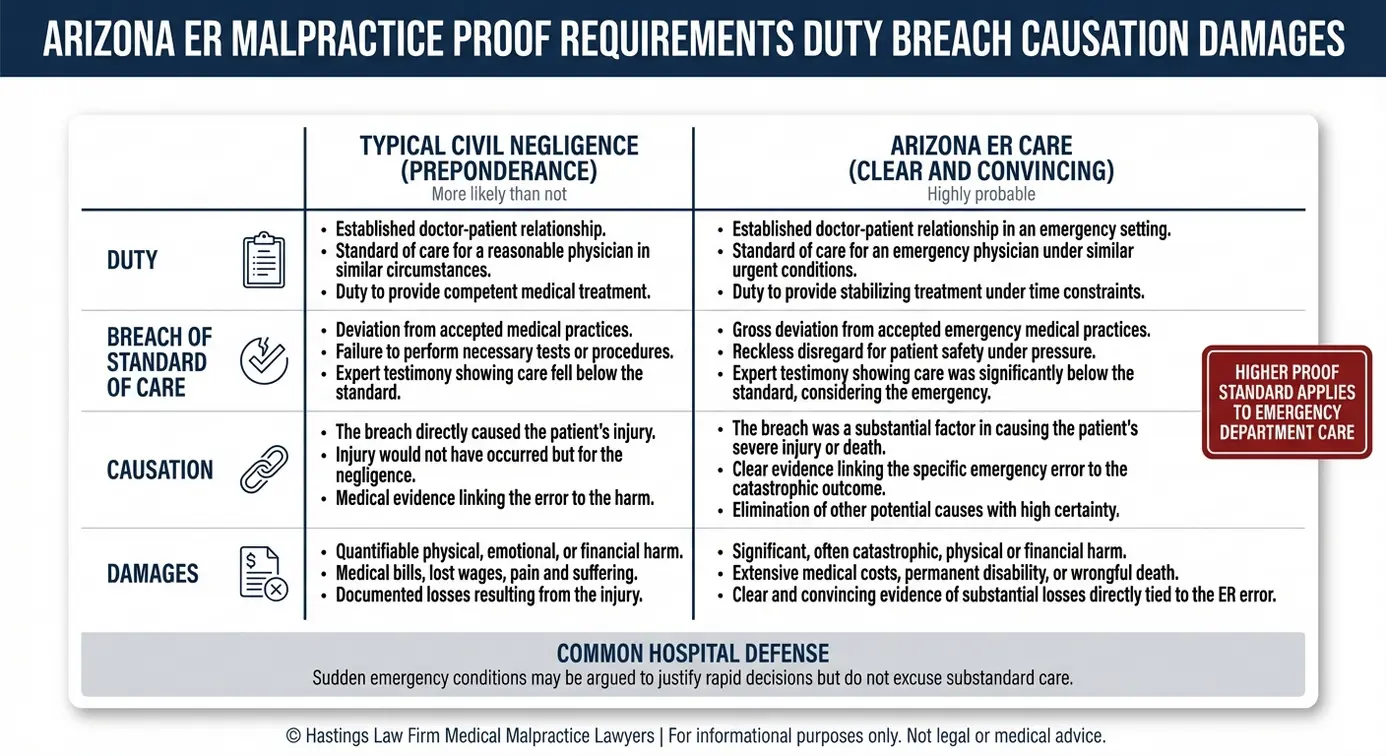
Emergency room malpractice occurs when a medical professional deviates from the accepted standard of care, causing injury or death. Under Arizona law, the elements of an ER malpractice claim must be proven by clear and convincing evidence rather than the lower standard used in most civil cases. The standard of care refers to the level of treatment a reasonably competent provider would deliver under similar circumstances. In Arizona, proving these cases requires meeting a higher burden of proof than most people expect.
Like all medical malpractice claims, an ER negligence case rests on four elements:
- Duty of care: The ER provider had a professional obligation to treat you competently.
- Breach of duty: The provider failed to meet the accepted standard of care.
- Causation: That failure directly caused your injury.
- Damages: You suffered measurable harm as a result.
These elements may sound familiar if you’ve researched medical malpractice before. But Arizona ER cases carry a critical distinction that sets them apart.
We have found that the single biggest challenge in these cases is the burden of proof. Research published by the Agency for Healthcare Research and Quality (PSNet) confirms that diagnostic errors in emergency departments are widespread. Yet Arizona law makes these errors harder to prove in court than in most other states.
Hospitals and their attorneys also frequently argue that the chaotic, time-pressured nature of emergency medicine should excuse errors that might otherwise constitute negligence. This defense can be overcome, but only with thorough medical evidence and qualified expert testimony.
The Clear and Convincing Evidence Standard
Under A.R.S. § 12-572, plaintiffs in Arizona ER cases must prove the elements of their malpractice claim by “clear and convincing evidence” rather than the lower “preponderance of the evidence” standard used in most civil cases.
What does this mean in practice? In a standard malpractice case, you need to show it’s “more likely than not” that negligence occurred. In an Arizona ER case, you must present evidence strong enough to produce a firm belief that the provider was negligent. This is a significantly higher bar.
Meeting this standard requires detailed medical records analysis, expert testimony from qualified physicians, and a legal team that understands how to build a case that establishes liability under this threshold. This is why choosing a firm with dedicated medical and legal resources matters so much in Arizona emergency room claims.
Triage errors occur when ER staff fail to correctly assess a patient’s condition and assign the proper Emergency Severity Index (ESI). This five-level system prioritizes patients based on urgency. We frequently investigate these failures under the heightened legal standard.
Common Types of ER Negligence Cases We Handle in Arizona
Common ER errors include diagnostic failures involving conditions like heart attacks and strokes, medication overdoses, surgical mistakes during emergency procedures, and failures to triage critical patients in a timely manner. These cases involve both errors of omission, where a provider fails to act when they should, and errors of commission, where a provider takes an incorrect action.
Every emergency room case begins with understanding what should have happened versus what actually did. We frequently encounter misdiagnosis or delayed diagnosis of critical conditions. We also see medication errors, mistakes involving the wrong drug or dosage, and issues with airway management like failure to intubate, the unsuccessful or delayed placement of an endotracheal tube, during emergency procedures. Below is a breakdown of the types of ER negligence our team regularly evaluates:
| Error Type | Standard of Care | Negligent Action |
|---|---|---|
| Triage Errors | Patients presenting with life-threatening symptoms should be assessed and prioritized immediately | Dismissing chest pain as heartburn or delaying evaluation of stroke symptoms |
| Diagnostic Errors | Appropriate imaging and testing should be ordered based on clinical presentation | Misreading X-rays, failing to order a CT scan for a patient showing signs of stroke or internal bleeding |
| Medication Errors | Correct drug, correct dosage, verified against patient history and allergies | Administering the wrong medication or an incorrect dosage in a high-pressure setting |
| Failure to Intubate | Endotracheal intubation, the placement of a breathing tube into the airway, should be performed promptly when a patient cannot maintain their own airway | Delayed or failed airway management leading to oxygen deprivation |
| Communication and Handoff Failures | Critical patient information must transfer accurately between providers during shift changes | Incomplete or missing information during patient handoff, leading to gaps in treatment |
| Hospital-Acquired Infections | Sterile technique and infection control protocols must be followed during all procedures | Contaminated equipment, improper wound care, or failure to follow sanitation standards |
As emergency room error lawyers, we know that the difference between a defensible judgment call and actionable negligence often comes down to what the medical records reveal. Our in-house nursing staff and national network of medical experts review those records to identify exactly where the standard of care was or was not met.
The Hastings Law Firm Difference
Results matter, but what truly sets us apart is how we achieve them. Every verdict, every settlement, and every Arizona courtroom victory comes from one guiding promise: To treat each client’s fight for justice as if it were our own.
This balance of skill, experience, and empathy reflects our core philosophy that justice should not only compensate the injured, but also make healthcare safer nationwide.

Liability and Compensation for ER Injuries
Patients who are harmed by emergency room negligence can recover economic damages for medical bills and lost wages, as well as non-economic damages for pain and suffering, by holding the hospital or independent physicians liable.
Who can be held liable? Identifying responsible parties is often more complicated than patients realize in an Arizona hospital setting. Hospitals employ some ER staff directly but frequently contract with outside physician groups. When the ER doctor is an independent contractor rather than a hospital employee, the hospital may argue it is not responsible for that doctor’s actions.
However, Arizona recognizes “ostensible agency,” which means the hospital can still be held liable if the patient reasonably believed the doctor was part of the hospital’s team. We investigate the employment and contractual relationships in every case to identify all responsible parties and deal with the relevant insurance carriers.
You should also know that failure to monitor, the neglect of tracking a patient’s vital signs or clinical status over time, and hospital-acquired infections (HAIs), infections contracted as a direct result of treatment in a healthcare facility, can both form the basis of a liability claim against the institution itself.
What compensation is available? Recoverable damages in Arizona ER malpractice cases may include:
- Past and future medical expenses
- Lost income and diminished earning capacity
- Pain and suffering
- Loss of enjoyment of life
- Wrongful death damages for surviving family members
One important protection for Arizona patients: the Arizona Constitution (Article 2, Section 31) prohibits the legislature from placing caps on damages for personal injury or wrongful death. Unlike many other states, Arizona allows juries to award full compensation based on the evidence. This is especially significant given the severity of injuries that can result from ER negligence.
For patients in rural communities served by critical access hospitals, these cases can involve unique challenges related to staffing, resource limitations, and transfer protocols. A Phoenix medical malpractice attorney with experience in ER cases understands how to handle whether these factors contributed to a patient’s harm.

Arizona Statute of Limitations for ER Claims
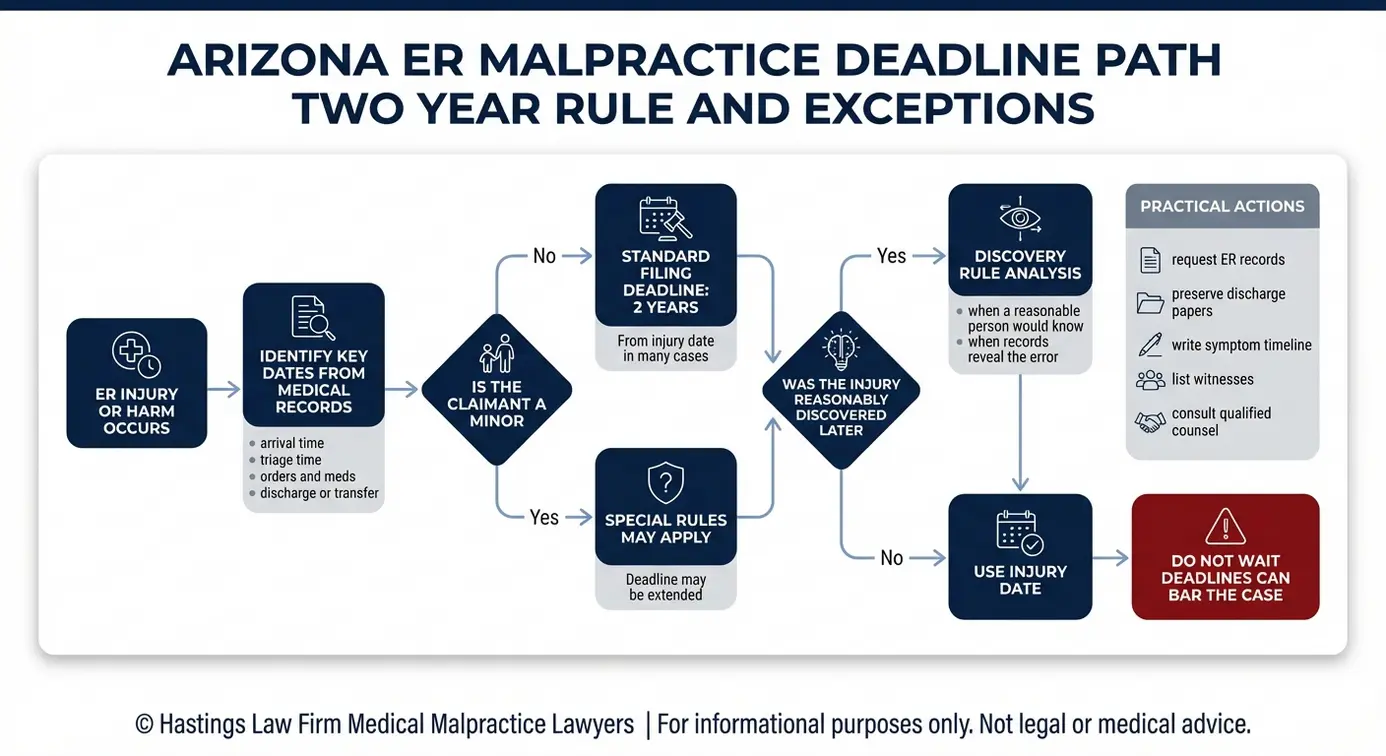
Generally, you have two years from the date of injury to file a lawsuit, though exceptions exist for minors and cases involving the discovery rule. This Arizona legal deadline, known as the statute of limitations, is set by A.R.S. § 12-542, and missing it almost always means losing the right to pursue your claim entirely.
There are limited exceptions to the Arizona statute of limitations for ER negligence claims. Arizona’s “Discovery Rule” may extend the deadline in cases where the injury was not immediately apparent. If a delayed diagnosis or delayed treatment, meaning a failure to identify or act on a condition within a medically appropriate timeframe, caused harm that only became evident later, the two-year clock may start from the date you reasonably discovered the injury rather than the date it occurred. Separate rules may also apply for minors.
These exceptions are narrow, and courts interpret them strictly. If you believe emergency room negligence caused harm to you or a loved one, the safest course is to speak with a medical negligence lawyer in Arizona as soon as possible. Early consultation protects your legal rights and gives our team the best opportunity to preserve necessary medical records and evidence.
Contact the Arizona Healthcare Malpractice Attorneys at Hastings Law Firm Today for Help
Emergency room malpractice cases in Arizona face a higher legal standard than most medical negligence claims. Proving that an ER provider’s care fell below the accepted standard requires clear and convincing evidence, qualified medical experts, and a legal team that prepares every case as if it’s going to trial.
That is exactly how Hastings Law Firm operates. Our team includes former defense attorneys who understand hospital litigation strategies, in-house nursing professionals who can analyze your medical records, and a national network of medical experts. We focus exclusively on medical malpractice because these cases demand nothing less than full commitment.
You pay no attorney fees or costs unless we recover compensation for you. If you or a loved one was harmed by emergency room negligence, we’re here to help you find answers and understand your legal options.
Contact our Arizona emergency room malpractice law firm today for a free, confidential case evaluation. Let us review what happened and explain the path forward.
Frequently Asked Questions About Emergency Room Malpractice in Arizona


This content was researched and written by the Hastings Law Firm editorial team, which includes attorneys, medical professionals, and experienced researchers. Our writing is informed by internal knowledge and practical experience, and we cross-check critical details against authoritative sources cited throughout. Every piece undergoes human-led fact-checking and legal review. Because legal and medical information can change, if you spot an error, please contact us. Learn more about our content standards and review process on our editorial policy page.

Tommy Hastings, founder of Hastings Law Firm, is a board-certified personal injury trial lawyer dedicated exclusively to healthcare injury cases. Since 2001, he has represented injured patients and families in litigation against major hospital systems, pharmaceutical companies, and negligent healthcare providers nationwide. He has handled numerous high-profile cases that have drawn national media attention and resulted in multi-million dollar recoveries. He draws on that experience in his writing, helping readers understand how these cases work and what options may be available to them.
