


Texas Surgical Error Lawyer
Surgical care depends on careful planning, clear communication, and strict safety protocols. When a preventable mistake happens in the operating room, the results can be life changing, bringing added procedures, lasting pain, emotional distress, and financial strain or worse. This information outlines common forms of surgical negligence, how known risks differ from actionable malpractice, and how responsibility may extend beyond the surgeon to a hospital or device maker. If you or a loved one were harmed or worse due to surgical negligence in Texas, contact Hastings Law Firm for a free, confidential case review.

Last Updated: July 27, 2026
Dedicated Legal Representation for Victims of Negligent Surgery in Texas
Surgery requires an extraordinary level of trust. You place your life in someone else’s hands, believing the team in that operating room will follow the protocols designed to keep you safe. When that trust is broken by a preventable error, the physical and emotional impact can be extensive.
If you or a loved one suffered harm because of a surgical mistake, you are not alone. These injuries often raise difficult questions about whether the outcome was unavoidable or the result of negligence.
We provide dedicated legal representation for patients harmed by surgical negligence. At Hastings Law Firm, we focus exclusively on medical malpractice. We can review what happened during your procedure, explain your legal options, and help you understand the path forward. Contact us for a free, confidential case evaluation.

Why Choose Hastings Law Firm for Your Surgical Malpractice Case
Hastings Law Firm focuses exclusively on medical malpractice, using a team of board-certified attorneys and former defense counsel to build the strongest possible case for patients harmed by surgical negligence. We do not handle car accidents, slip-and-fall cases, or general personal injury claims. Every resource in our firm is directed toward one goal: holding negligent medical providers accountable.
That singular focus gives us a meaningful edge when investigating surgical error cases. Our legal team includes former defense attorneys who previously represented hospitals and their insurers. They understand the internal strategies hospitals use to minimize liability, from how records are documented to how expert testimony is framed. We also employ experienced hospital nurses and board-certified patient advocates who review medical records and interpret clinical data.
We build our approach on one principle: every case is prepared from day one as if it will go before a jury. This trial-ready philosophy means we build detailed medical timelines and secure qualified expert witnesses for testimony long before a settlement offer is made. When defense attorneys and insurers know a qualified surgical malpractice attorney is prepared for trial, it changes the negotiation entirely.
Key credentials that set us apart:
- 100% dedicated to medical malpractice litigation
- In-house medical staff, including nurse practitioners and patient advocates
- Former defense attorneys who bring insider knowledge of hospital legal strategy
- A national network of expert witnesses across every surgical specialty
- Board-certified trial attorney Tommy Hastings leads our case strategy
Common Forms of Surgical Negligence in Texas Hospitals
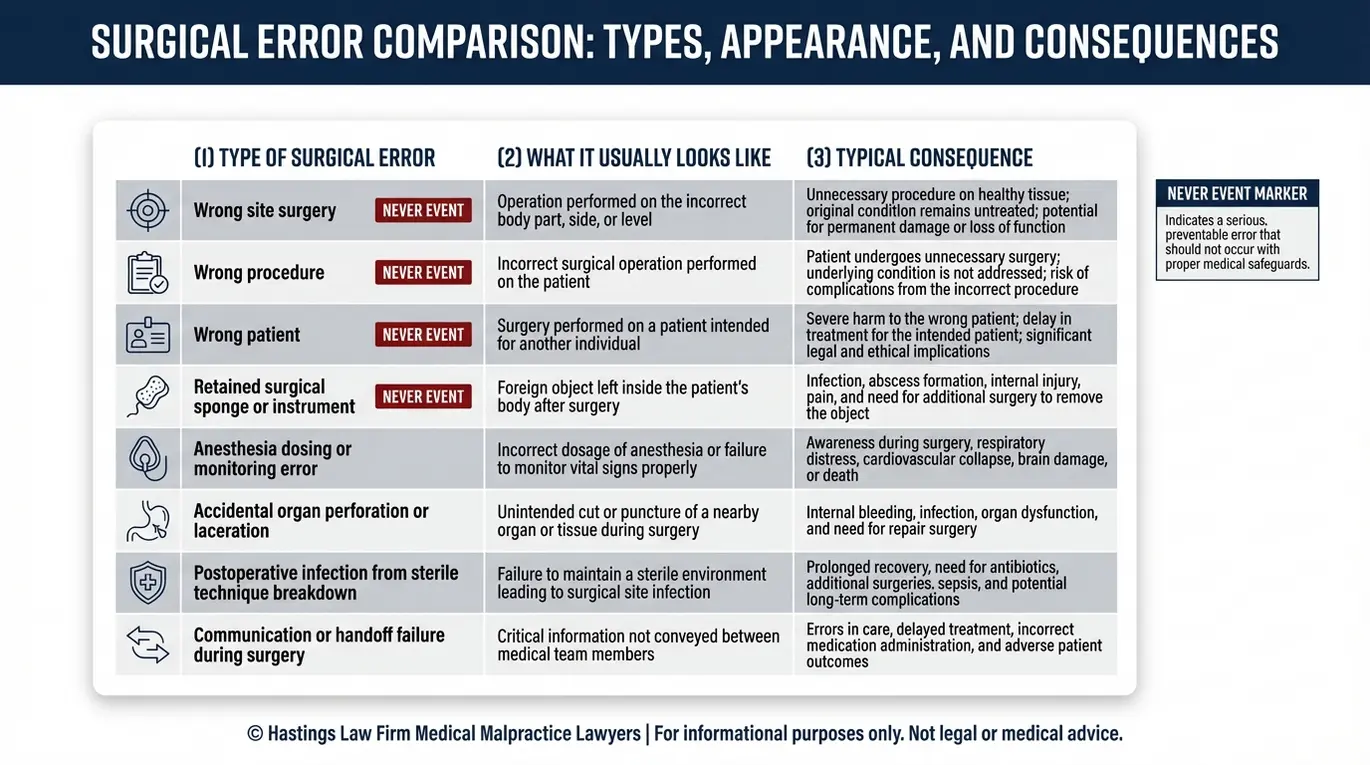
Common surgical errors include wrong-site surgery, retained foreign objects, anesthesia mistakes, and accidental perforation of organs or tissues. While these may sound extreme, they occur more often than most patients realize. A surgical error lawyer in Texas knows these injuries often reflect systemic breakdowns rather than isolated accidents. In many surgical negligence cases, the error is classified as an event that should never happen during competent medical care.
The Agency for Healthcare Research and Quality (AHRQ) Patient Safety Network defines never events as serious, largely preventable patient safety incidents that should not occur if proper protocols are followed. Surgical never events include operating on the wrong body part or performing the wrong procedure entirely. These errors typically reflect systemic breakdowns in verification protocols.
Retained surgical items, or RSIs, represent another category of preventable harm. These are surgical instruments, sponges, or other materials unintentionally left inside a patient’s body after a procedure. Patients may not discover a retained object for weeks or even years. Texas medical malpractice law, governed by Texas Civil Practice and Remedies Code Chapter 74, recognizes a “discovery rule” that can affect when the filing deadline begins in these situations.
Anesthesia errors add another layer of risk. Incorrect dosing, failure to monitor oxygen levels, or unaddressed allergic reactions can result in brain injury, nerve damage, or death.
| Type of Surgical Error | Typical Consequence |
|---|---|
| Wrong-site surgery (operating on the incorrect body part) | Unnecessary tissue removal, loss of function, additional corrective surgery |
| Wrong procedure or wrong patient | Unneeded surgical trauma, delayed treatment of actual condition |
| Retained surgical instruments or sponges | Infection, internal abscess, organ perforation, chronic pain |
| Anesthesia dosing or monitoring errors | Brain damage, cardiac arrest, prolonged sedation, death |
| Accidental organ or vessel perforation | Internal bleeding, emergency reoperation, organ loss |
| Nerve damage from improper technique | Chronic pain, numbness, paralysis, loss of motor function |
Surgical Fires and Operating Room Hazards
In an operating room setting, surgical fires are rare but serious events caused by what is known as the surgical fire triangle: an ignition source, a fuel source, and an oxidizer. In most operating rooms, electrocautery devices provide the ignition source. Alcohol-based surgical prep solutions or surgical drapes act as fuel, while supplemental oxygen completes the triangle.
When surgical teams fail to follow established operating room safety and fire prevention protocols, the result can be severe burns or airway injuries. These injuries are preventable with proper coordination, making them a strong basis for a surgical negligence case.
Robotic Surgery Complications and Device Failures
During minimally invasive procedures, robotic-assisted surgery, most commonly performed using the da Vinci Surgical System, has expanded rapidly in Texas hospitals. The da Vinci is a robotic platform that allows surgeons to operate through small incisions using mechanical arms controlled from a console. While these systems can improve precision, they also introduce unique liability questions.
When a complication occurs during robotic surgery, we investigate whether the harm resulted from the surgeon’s decisions or a mechanical malfunction. In some cases, the hospital may bear responsibility for credentialing a surgeon who lacked sufficient experience with the system. In others, the device manufacturer may be liable for a defect.
The Hastings Law Firm Difference
Results matter, but what truly sets us apart is how we achieve them. Every verdict, every settlement, and every Texas courtroom victory comes from one guiding promise: To treat each client’s fight for justice as if it were our own.
This balance of skill, experience, and empathy reflects our core philosophy that justice should not only compensate the injured, but also make health care safer nationwide.

Distinguishing Known Risks From Actionable Malpractice
Malpractice occurs when a surgeon deviates from the accepted standard of care, causing injury that was not a known or accepted risk of the procedure. When reviewing a medical negligence case, this distinction is one of the most important concepts, and it is often where hospitals focus their defense.
The standard of care refers to the level of treatment a reasonably competent surgeon with similar training and experience would provide. Not every poor outcome is malpractice. Surgery carries inherent risks, and informed consent forms exist to document that a patient understood those risks before agreeing to the procedure.
Signing a consent form does not give a surgeon permission to be negligent. Informed consent covers known complications. It does not shield a provider from liability when the injury resulted from a departure from accepted medical practice.
Consider the difference between a known risk and a preventable error. Minor scarring after an incision is a recognized surgical outcome. However, a surgical “never event” is not. We examine the records to determine if your injury resulted from an accepted medical practice or negligence.
Risks Associated with Non-Board-Certified Physicians
To protect patients from harm, hospitals must verify the qualifications of every surgeon they grant operating privileges to. This process, known as hospital privileging, is the formal review of a physician’s training and competency. It is supposed to protect patients from unqualified providers.
When a hospital allows a surgeon to perform procedures outside their expertise, the facility itself may be liable. We examine credentialing records to determine whether the hospital met its obligations.
Identifying Liable Parties in the Operating Room
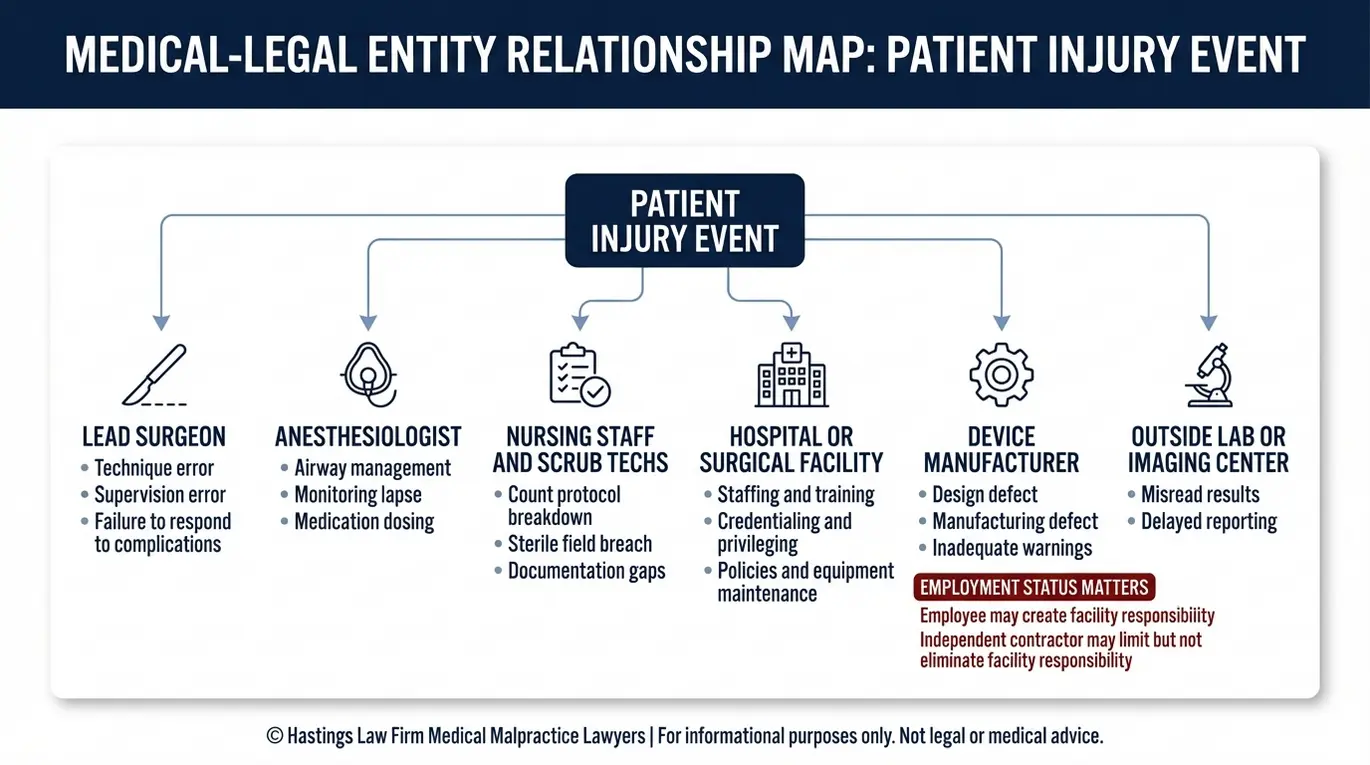
Liability for surgical errors may extend beyond the lead surgeon to the anesthesiologist, nursing staff, or the hospital facility itself. In a medical malpractice lawsuit, identifying every responsible party is essential to building a complete case.
Potential defendants in a surgical malpractice claim include:
- The lead surgeon, who may be an independent contractor rather than a hospital employee
- The anesthesiologist or nurse anesthetist, responsible for monitoring sedation and airway management
- Surgical nurses and scrub technicians, who assist with instrument counts and sterile technique
- The hospital or surgical facility, which can be held liable for staffing failures or unsafe protocols
- Medical device manufacturers, if a defective surgical instrument contributed to the injury
Suing a surgeon in Texas often involves untangling complex employment relationships. A hospital may argue that the surgeon was an independent contractor to distance itself from liability. Our team investigates the actual working relationship and supervision structures to determine who bears legal responsibility.
Recoverable Damages for Surgical Injuries and Wrongful Death
Patients harmed by surgical negligence may recover compensation for medical bills, revision surgeries, lost income, physical pain, and mental anguish. In a Texas surgical negligence case, the specific value of a settlement depends on the severity of the injury and its long-term impact on your life.
Economic damages cover the measurable financial losses caused by the error. Patients can seek compensation for surgical injury including past and future medical expenses and lost wages. Economic damages are not subject to a cap under Texas law.
Non-economic damages address the physical and emotional toll of the injury. These include pain and suffering, disfigurement, and the loss of enjoyment of life. Texas does impose caps on non-economic damages in medical malpractice cases, which your attorney can explain.
Wrongful death damages apply when a surgical error results in the loss of a loved one. Surviving family members may seek compensation for funeral costs, loss of financial support, and mental anguish. These cases carry their own procedural requirements, and families benefit from early legal guidance.
Immediate Steps to Take After Suspecting a Botched Surgery
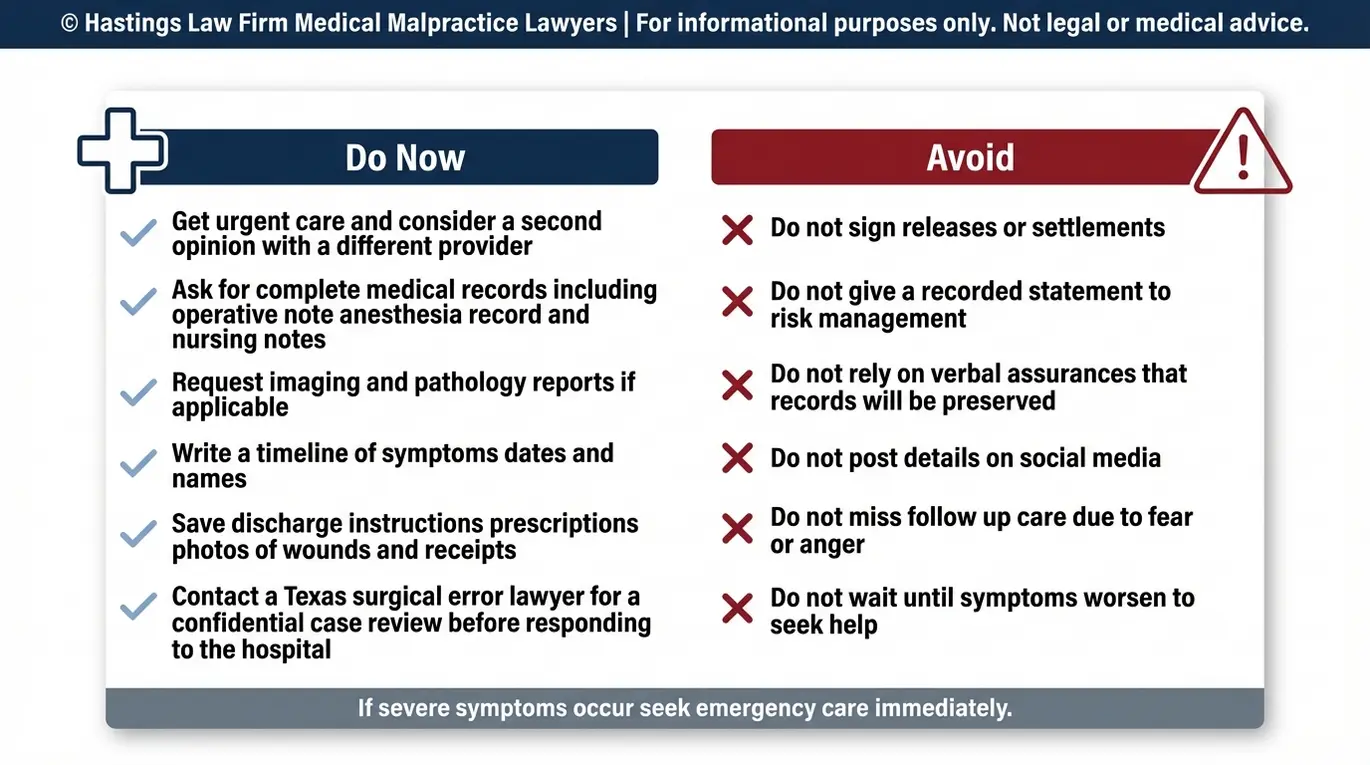
If you suspect a surgical error caused your injury, your first priority should be getting a second medical opinion from a different provider to assess and stabilize the damage. After that, preserving evidence and protecting your legal rights becomes critical.
Seek follow-up care from an independent physician not involved in the original procedure. A second opinion can identify complications and document the extent of the harm.
Request a complete copy of your medical records. You should specifically ask for the operative report, which is the surgeon’s detailed account of the procedure. The Texas Department of State Health Services provides guidance on patient rights regarding medical information.
Action Plan Checklist:
- Seek immediate medical attention from a different physician or facility
- Request your complete medical records, including the operative report and anesthesia logs
- Document your symptoms and any physical changes in writing and with photographs
- Do not sign any documents or settlement offers from the hospital or its risk management team
- Do not provide recorded statements to hospital administrators
- Contact a Texas surgical error lawyer before engaging with any representative of the facility
Understanding the Texas Statute of Limitations for Surgery Claims
In Texas, medical malpractice claims must generally be filed within two years of the date the error occurred or the date treatment by the provider was completed. Missing this deadline almost always results in losing your right to file a claim, regardless of how strong the evidence may be.
Under Texas Civil Practice and Remedies Code § 74.251, the two-year filing deadline applies to most surgical malpractice claims. Limited exceptions exist for minors and for injuries that were not immediately discoverable, such as a retained surgical instrument. Even with these exceptions, Texas imposes an absolute 10-year statute of repose, which bars claims filed more than a decade after the negligence occurred.
Building a viable surgical malpractice case takes months. We must gather medical records and secure qualified experts to evaluate the care. Texas surgical error lawyers at Hastings Law Firm encourage patients to seek legal guidance early so that no deadline is missed and no evidence is lost.
Contact the Texas Surgical Error Attorneys at Hastings Law Firm Today for Help
Surgical errors are often preventable. When a patient is harmed by a mistake that should not have happened, they deserve honest answers about what went wrong and who is responsible. We handle surgical mistake cases all across Texas from our Houston, Dallas, and Austin offices.
We represent patients and families who have experienced life-changing injuries due to surgical negligence. Our team of attorneys, former defense counsel, in-house nurses, and medical experts works together to uncover the facts that hospitals and insurers may not want you to see.
You pay nothing unless we recover compensation for you. There are no upfront costs and no fees unless your case is successful.
If you or a loved one was injured during surgery, we are here to help you understand your options. Contact Hastings Law Firm today for a free, confidential legal evaluation. Call us or complete the form on this page to get started.
Frequently Asked Questions About Surgical Error in Texas


This content was researched and written by the Hastings Law Firm editorial team, which includes attorneys, medical professionals, and experienced researchers. Our writing is informed by internal knowledge and practical experience, and we cross-check critical details against authoritative sources cited throughout. Every piece undergoes human-led fact-checking and legal review. Because legal and medical information can change, if you spot an error, please contact us. Learn more about our content standards and review process on our editorial policy page.

Brady D. Williams is a nationally recognized medical malpractice attorney who has spent his career handling high-stakes litigation for injured patients and families across the country. Licensed in both Texas and California, Brady draws on experience from hundreds of resolved medical cases to break down complex legal and medical topics for the people who need that information most. His writing reflects the same attention to detail and commitment to clarity that he brings to every case he handles.
