


Austin Surgical Error Lawyer
Surgical negligence can leave patients facing unexpected pain, prolonged recovery, added medical bills, and lasting uncertainty about what went wrong in the operating room. Some errors are considered preventable never events, and others involve anesthesia mistakes or missed warning signs during recovery that can escalate into life threatening consequences or worse. Understanding how malpractice differs from known surgical risks and who may be responsible can shape what happens next. If you or a loved one were harmed or worse due to surgical negligence in Austin, Texas, contact Hastings Law Firm for a free, confidential case review.

Last Updated: July 27, 2026
Trusted Medical Attorneys for Surgical Negligence in Austin
When a surgery results in unexpected complications, the experience can shake your confidence in the medical professionals you trusted with your care. You may be dealing with unexpected pain, a longer recovery, new medical bills, or questions that no one at the hospital seems willing to answer. Those feelings of confusion and frustration are valid.
Founded in 2005 by board-certified trial attorney Tommy Hastings, our firm focuses exclusively on medical malpractice. Our legal team, which includes former defense attorneys and in-house nurse consultants, understands both the medicine and the law behind surgical error cases. As your Austin surgical error lawyer, we work to uncover what happened in the operating room and hold the responsible parties accountable.
If you believe a surgical mistake caused you or a loved one harm, we can review your situation and explain your options at no cost and with no obligation.

Common Surgical Errors We Litigate in Austin Hospitals
Surgical errors are preventable mistakes that fall below the accepted standard of care. Many qualify as “never events,” a term the Agency for Healthcare Research and Quality (AHRQ) Patient Safety Network uses to describe preventable mistakes so serious they should never occur under proper protocols. These include operating on the wrong body part, leaving instruments inside a patient, or damaging surrounding organs during a procedure. When these failures occur, they often result in life-altering consequences for patients who trusted their surgical teams to keep them safe.
Our team has handled cases involving a wide range of operating room negligence. Below are the most common categories we investigate as a surgical error attorney in Austin.
Procedural Errors
Procedural errors involve mistakes that occur during the surgical performance itself.
- Wrong-site surgery, where a surgeon operates on the incorrect body part, wrong side, or even the wrong patient. Pre-operative verification checklists exist specifically to prevent this, so when it happens, it often signals a breakdown in protocol.
- Retained surgical instruments, meaning sponges, clamps, needles, or other tools are accidentally left inside the body after the incision is closed. This can cause infection, internal bleeding, or organ damage that requires emergency reoperation.
- Organ perforation and tissue damage, where a surgeon accidentally nicks, cuts, or punctures a nearby organ, nerve, or blood vessel. A perforated organ, such as a bowel puncture during an abdominal procedure, can lead to sepsis if not identified and treated quickly. Internal bleeding from a severed vessel may not become apparent until hours after the patient leaves the operating room.
Anesthesia Errors
Anesthesia negligence involves mistakes made by the anesthesiologist or medical team during the sedation process. Anesthesia negligence can involve administering the wrong dosage, using a contraindicated agent, or failing to monitor a patient’s vitals during the procedure. If the anesthesiologist fails to recognize distress signals immediately, these errors can result in permanent brain injury, respiratory failure, or even death.
Post-Operative Negligence
Post-operative negligence refers to failures in care that occur during the recovery period following surgery. Not all surgical errors happen during the procedure itself. Failures in post-operative monitoring, such as missing signs of a developing infection or internal hemorrhage, can turn a recoverable situation into a life-threatening one. When the surgical team fails to respond to warning signs after the operation, that lapse can be just as actionable as a lawyer for surgical mistakes finding an error made with a scalpel.
If you suspect any of these errors contributed to your injury, we can help determine whether the standard of care was met.
Proving Negligence and The Standard of Care in Texas
To prove surgical negligence in Texas, a patient must show that the surgeon or medical team breached the accepted medical standard of care and that this breach directly caused an injury or complication that would not have occurred under competent care.
The medical standard of care refers to the level of treatment a reasonably skilled surgeon with similar training would have provided under the same circumstances. Under Chapter 74 of the Texas Civil Practice and Remedies Code, medical malpractice claims require the plaintiff to establish a breach of this duty through qualified expert testimony.
Expert testimony is central to every surgeon malpractice case in Texas. Under Texas Civil Practice and Remedies Code § 74.351, plaintiffs must serve an expert report identifying the standard of care, the deviation, and the link to the patient’s harm. This is particularly important when claiming damages for organ perforation, an accidental puncture of nearby tissue, or internal bleeding (hemorrhage) resulting from a severed vessel. Our firm works with a national network of board-certified surgeons who can provide credible testimony about what a competent surgeon would have done differently.
One point that often concerns patients is informed consent. Signing a consent form before surgery acknowledges that you understood certain known risks. This document does not give the surgeon permission to be negligent. If your injury resulted from a preventable error rather than a recognized complication, that consent form does not shield the provider from liability. An Austin surgical negligence attorney can review your consent documents alongside the operative records to determine whether the injury falls outside what you agreed to accept.
Distinguishing Malpractice from Known Surgical Risks
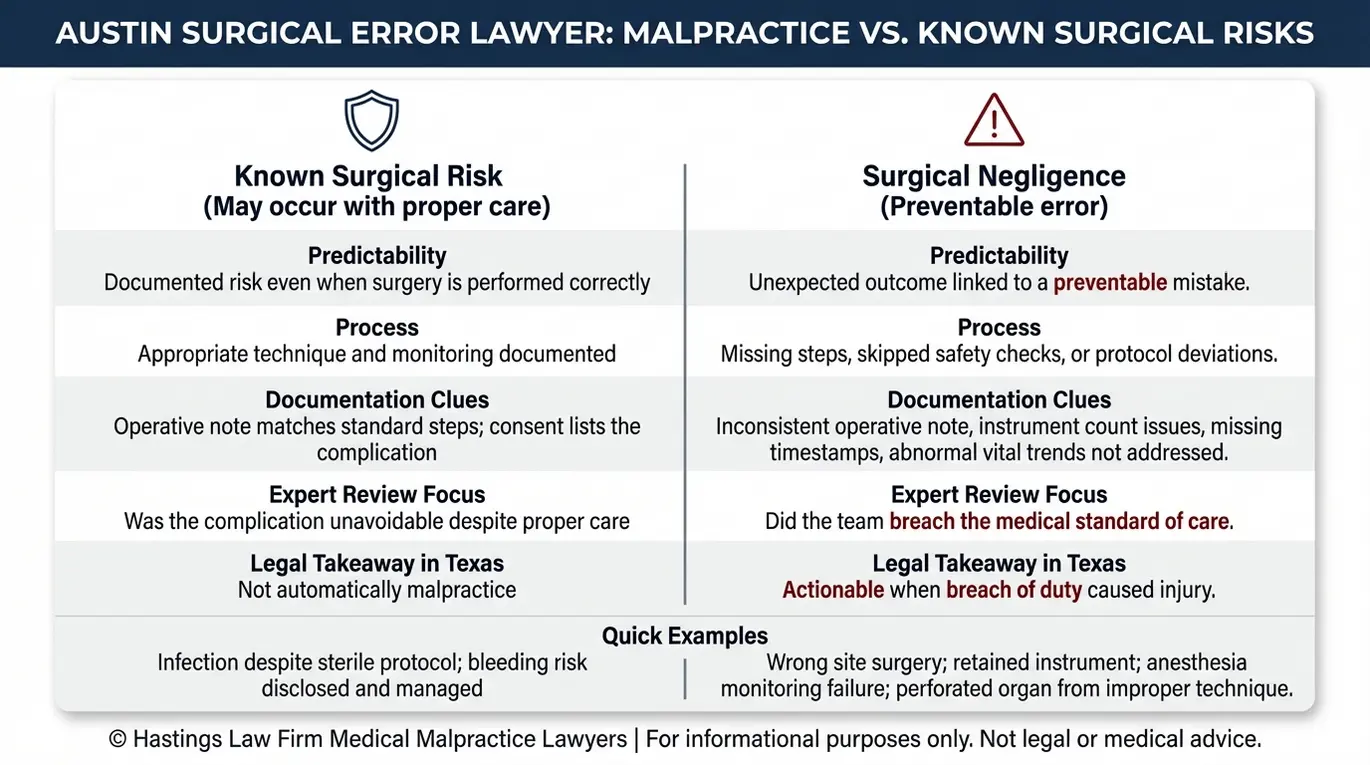
Distinguishing malpractice from known risks is necessary to determine if legal grounds for a claim exist. Every surgery carries some degree of risk. A surgical site infection (SSI), which is an infection that develops at or near the incision after a procedure, can sometimes occur even when proper sterile techniques were followed. That would generally be considered a known post-operative complication, not malpractice.
But if an infection developed because instruments were not properly sterilized or because the surgical team failed to follow established protocols, that may cross the line into negligence. A never event, a term for errors deemed entirely preventable under standard safety measures, almost always indicates a breach of duty. Surgical mistakes like leaving a sponge in the body or operating on the wrong limb are not inherent risks of surgery.
The Hastings Law Firm Difference
Results matter, but what truly sets us apart is how we achieve them. Every verdict, every settlement, and every Austin courtroom victory comes from one guiding promise: To treat each client’s fight for justice as if it were our own.
This balance of skill, experience, and empathy reflects our core philosophy that justice should not only compensate the injured, but also make health care safer nationwide.

Liability and Suing Surgeons vs. Austin Hospitals
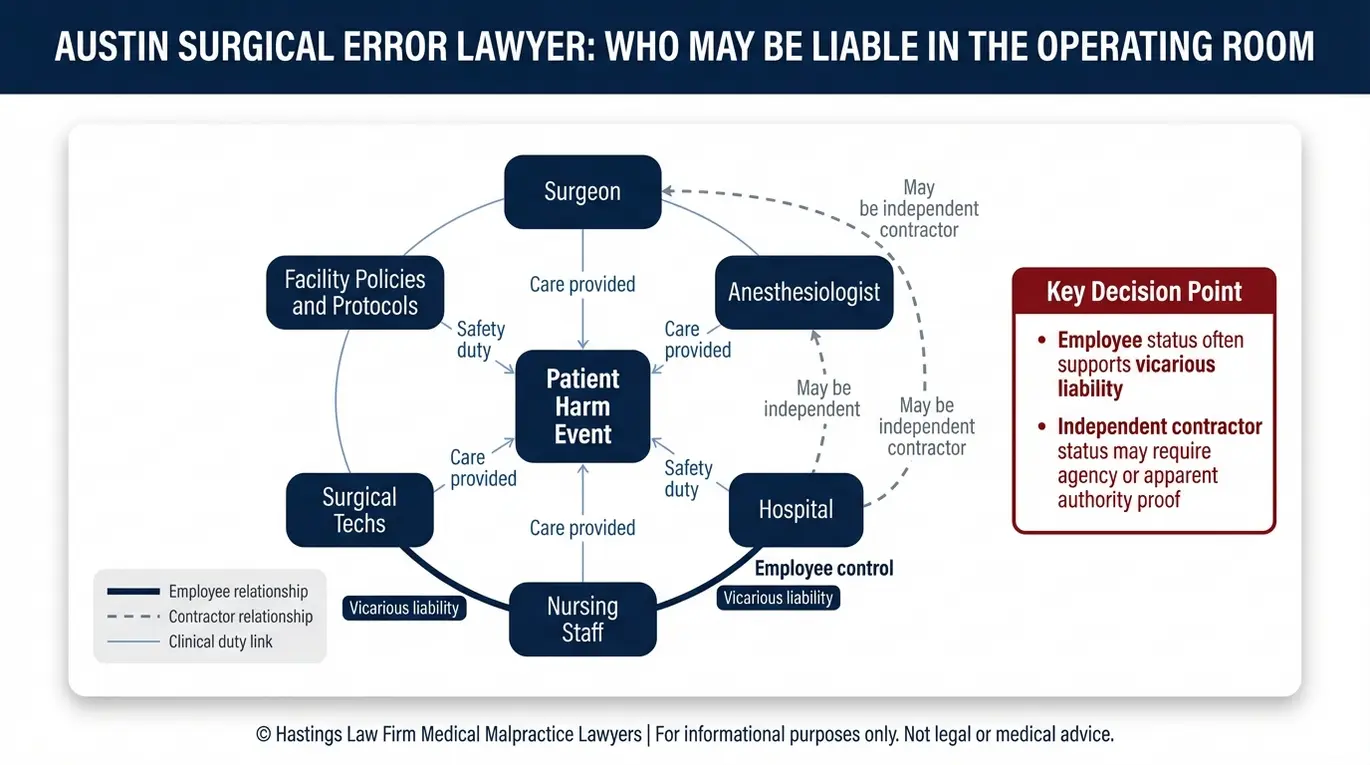
Liability in a surgical error case can fall on the individual surgeon, the anesthesiologist, other members of the surgical team, or the hospital itself. Determining who is legally responsible depends on the employment relationship between the provider and the facility, and whether hospital negligence or institutional failures contributed to the harm.
When a nurse, surgical technician, or other hospital employee makes an error, such as an incorrect sponge and instrument count, the hospital may be held responsible under a legal theory called vicarious liability. The formal process of tracking every tool used ensures nothing is left inside the patient. This means the employer bears legal responsibility for the negligent acts of its employees performed within the scope of their duties.
Surgeons, however, often work as independent contractors rather than hospital employees. Texas hospitals frequently use this distinction as a defense to avoid liability. As your surgical injury counsel, we investigate the actual working relationship, including scheduling, billing, and supervision, to determine whether an agency theory can hold the hospital accountable despite the independent contractor label.
Anesthesia negligence, meaning errors in drug selection, dosage, or patient monitoring by the anesthesiologist or anesthesia tech, may create anesthesiologist liability, hospital liability, or both, depending on who employed the provider and who controlled the protocols.
| Factor | Surgeon Liability | Hospital Liability |
|---|---|---|
| Employment Status | Often independent contractor | Liable for employees (nurses, techs) |
| Protocol Failures | Responsible for own technique | Responsible for systemic safety policies |
| Staffing Decisions | Generally not applicable | Liable for inadequate staffing or training |
| Vicarious Liability | Typically not imputed to hospital | Applies when employee acts within scope of duties |
Understanding these distinctions early helps us build a claim against every responsible party, not just the most obvious one.
Compensation for Surgical Injuries and Revision Procedures
Patients harmed by surgical errors may recover damages covering both the financial and personal toll of the injury. A surgical malpractice lawyer in Austin can help identify the full scope of losses, which often extend well beyond the initial hospital bill to help you recover damages.
Recoverable damages generally include:
- Past and future medical costs, including emergency treatment, hospitalization, medications, rehabilitation, and any additional procedures needed to correct the original error
- Lost wages and reduced earning capacity if the injury has prevented you from working or limited your ability to return to your previous occupation
- Pain and suffering, accounting for the physical pain, emotional distress, and diminished quality of life caused by the error
- Physical impairment and disfigurement, particularly in cases involving nerve damage, scarring, or loss of function
- Long-term life care costs when a surgical injury results in permanent disability requiring ongoing assistance. We use forensic damage modeling to project these lifetime expenses accurately.
According to data tracked by the AHRQ Healthcare Cost and Utilization Project (HCUP), surgical complications significantly increase both inpatient costs and length of hospital stays, underscoring why accurate damage calculations matter from the start.
Risks and Costs of Revision Surgery
Revision surgery involves follow-up procedures meant to correct issues from the first operation. Revision surgery is one of the most significant consequences of a surgical error. Patients may need one or more corrective procedures, each carrying its own risks of infection, anesthesia complications, and extended recovery.
The physical toll compounds with each operation. Scar tissue from the first surgery can make revision procedures more complex and less predictable. Patients also face more time away from work, mounting medical bills, and prolonged pain. As an Austin surgical error attorney, we work with medical experts to review medical records and document the full cost of revision care so that settlement or trial demands reflect the true burden on the patient and their family.
Steps to Take After a Botched Surgery in Texas
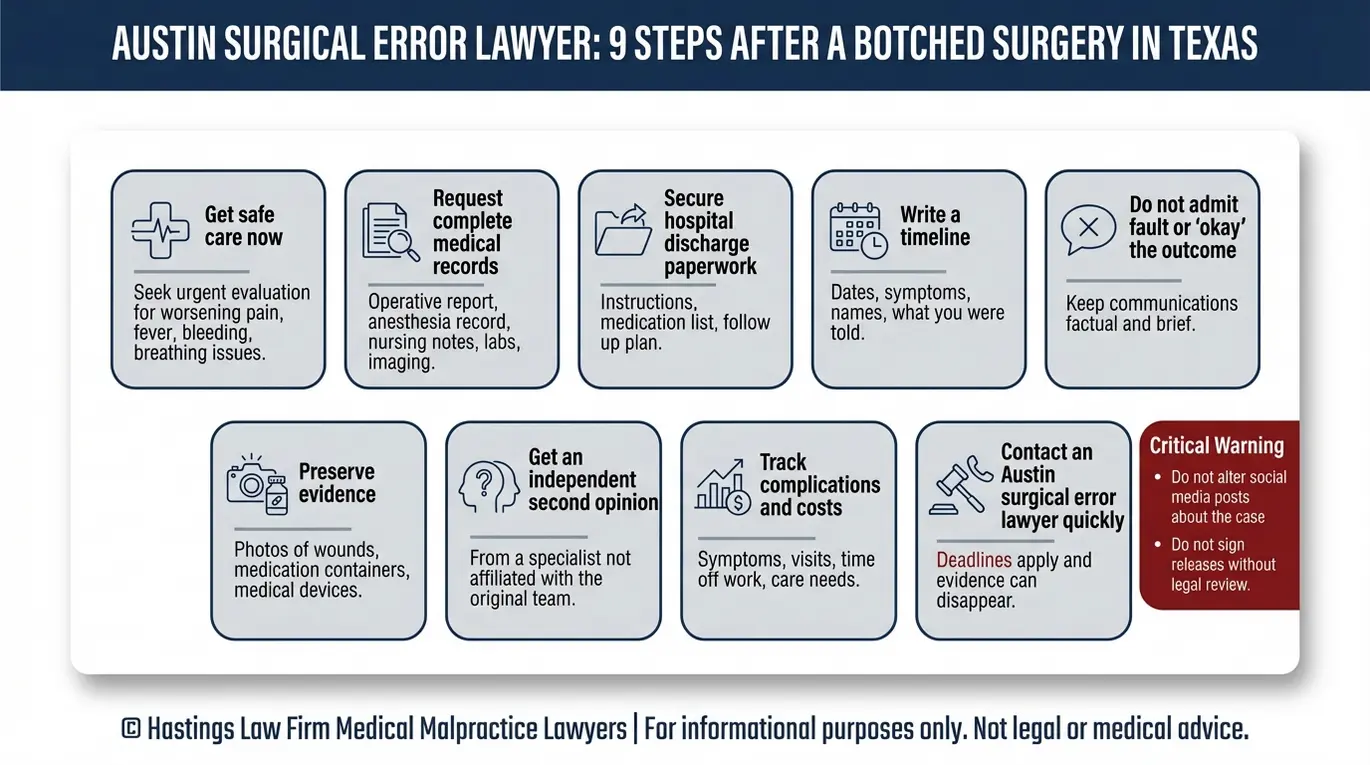
Immediate steps to take after a botched surgery include securing your medical records, seeking a second opinion, and contacting a lawyer. If you suspect a surgical error caused your injury, taking the right steps early can make a meaningful difference in preserving your legal options. Here is what we recommend:
- Request your complete medical records immediately. This includes the operative report (the surgeon’s written account of what happened during the procedure), anesthesia logs, nursing notes, and post-operative records. Under Texas law governing medical records access, you have the right to obtain copies of your records. Our in-house medical team can help you request and interpret these documents.
- Seek a second opinion from an independent specialist. An unaffiliated physician can evaluate your current condition, identify what may have gone wrong, and recommend corrective treatment. This evaluation also creates an independent medical record that can support your case.
- Avoid making statements that minimize the error. Patients often instinctively reassure the doctor that “it’s okay” or apologize for raising concerns. These statements can later be used to suggest you did not believe the care was substandard.
- Contact a specialized malpractice attorney as soon as possible. Texas imposes strict filing deadlines on medical malpractice claims, known as the statute of limitations. An Austin surgical error lawyer can begin preserving evidence and building your case while the details are still fresh.
Acting quickly protects both your health and your legal rights. Every day that passes makes records harder to secure and memories less reliable.
Contact the Austin Surgical Error Attorneys at Hastings Law Firm Today for Help
If a surgical mistake has left you or someone you love dealing with unexpected pain, additional procedures, or unanswered questions, you deserve to know what happened and whether it could have been prevented.
Hastings Law Firm is not a general personal injury practice. We handle medical malpractice cases exclusively. Our team includes former hospital defense attorneys, in-house nurse consultants, and access to a national network of surgical experts. This focused approach gives our clients a distinct advantage when going up against hospitals and their insurers.
There is no fee unless we recover compensation for you, and your initial case evaluation is completely confidential.
Contact an Austin surgical error lawyer at Hastings Law Firm today. Let our medical-legal team investigate the truth of what happened in your operating room.
Frequently Asked Questions About Surgical Error in Austin


This content was researched and written by the Hastings Law Firm editorial team, which includes attorneys, medical professionals, and experienced researchers. Our writing is informed by internal knowledge and practical experience, and we cross-check critical details against authoritative sources cited throughout. Every piece undergoes human-led fact-checking and legal review. Because legal and medical information can change, if you spot an error, please contact us. Learn more about our content standards and review process on our editorial policy page.

Tommy Hastings, founder of Hastings Law Firm, is a board-certified personal injury trial lawyer dedicated exclusively to healthcare injury cases. Since 2001, he has represented injured patients and families in litigation against major hospital systems, pharmaceutical companies, and negligent healthcare providers nationwide. He has handled numerous high-profile cases that have drawn national media attention and resulted in multi-million dollar recoveries. He draws on that experience in his writing, helping readers understand how these cases work and what options may be available to them.
