


Austin Gallbladder Surgery Error Lawyer
Gallbladder surgery is common, but preventable mistakes during removal can cause severe injuries with lasting medical and financial consequences. Some complications are recognized risks even with proper care, while others point to errors such as misidentifying anatomy or failing to confirm structures before cutting. Serious bile duct injuries can lead to infection, repeated procedures, and long term health challenges that affect daily life. If you or a loved one were harmed or worse due to a gallbladder surgery error in Austin, Texas, contact Hastings Law Firm for a free, confidential case review.

Last Updated: July 27, 2026
Trusted Austin Medical Attorneys for Surgical Negligence Claims
When you trust a surgeon to perform a routine procedure and something goes wrong, the aftermath can feel overwhelming. Gallbladder surgery is one of the most common operations in the United States, yet preventable errors during these procedures cause serious, sometimes life-altering injuries every year. If you or a loved one suffered a complication that shouldn’t have happened, you may be wondering if what occurred was simple bad luck or genuine negligence.
That distinction matters, and it’s exactly what an experienced Austin gallbladder surgery error lawyer can help you understand. At Hastings Law Firm, our team of medical malpractice attorneys, in-house nurses, and former defense counsel reviews surgical records every day. These professionals previously worked for the hospital systems we now challenge, providing us with a unique perspective on how to build your case. If you’d like us to look at what happened, we offer a free, confidential case evaluation with no obligation and no fees unless we recover compensation on your behalf.

Why Choose Our Team for Your Gallbladder Surgery Malpractice Claim
Our firm combines the expertise of Board Certified trial attorneys with the insights of former defense counsel and in-house medical staff to build strong cases against negligent surgeons. Finding the right gallbladder surgery malpractice attorney in Austin is important, and medical malpractice is all we do. We don’t split our time across car wrecks, slip-and-falls, or contract disputes. Every attorney, nurse consultant, and staff member at Hastings Law Firm is focused entirely on holding healthcare providers accountable when they fall below the standard of care.
That singular focus gives our Austin gallbladder surgery error lawyers a distinct edge. Our team includes former hospital defense attorneys who spent years protecting the same systems we now challenge. They understand how medical facilities respond to claims, how records are documented, and which defense strategies insurers rely on most. We also have in-house nurse practitioners and Board Certified Patient Advocates who can interpret operative reports, identify charting gaps, and flag deviations from accepted surgical protocols for procedures like laparoscopic cholecystectomy.
Our trial-ready philosophy shapes every case from day one. Rather than preparing to settle quickly, we investigate and build each case as though it will go before a jury. That level of preparation often leads to stronger settlement offers because defense counsel and insurers know we won’t accept less than what the case is worth, whether it involves medical negligence during a routine gallbladder removal or a wrongful death caused by a catastrophic surgical error.
Here’s what sets our firm apart:
- Exclusive medical malpractice focus with no distractions from unrelated practice areas
- Former defense attorneys on staff who anticipate hospital and insurer tactics
- In-house medical professionals including nurse practitioners and patient advocates
- Board Certified trial attorney and founder Tommy Hastings, recognized as a Texas Super Lawyer since 2013
- National expert network providing qualified testimony across surgical specialties
- Contingency fee structure so you pay nothing unless we win
Identifying Common Errors Committed During Gallbladder Removal
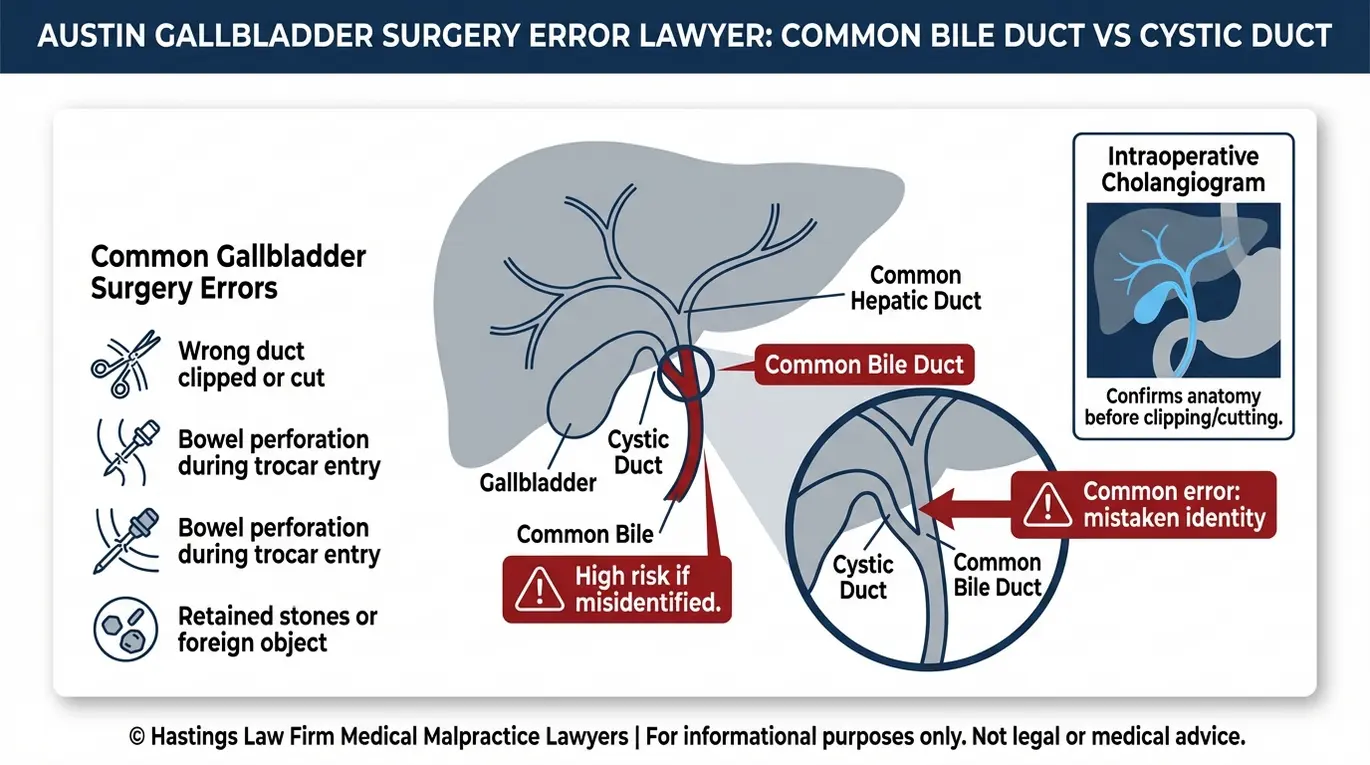
Surgical errors during cholecystectomy often involve cutting the wrong duct, perforating the bowel, or failing to identify anatomical variations before clipping. Understanding the specific type of error is the first step in determining whether you have a viable legal claim in Austin, and it’s something an Austin gallbladder surgery error lawyer can help clarify through a detailed review of your operative records.
The most frequent and dangerous mistake occurs when a surgeon confuses the common bile duct with the cystic duct, the small tube that connects the gallbladder to the biliary system. The cystic duct is the structure that should be clipped and cut during removal. When a surgeon clips or severs the common bile duct instead, the result can be a devastating injury requiring major reconstructive surgery.
This misidentification often happens during a lap chole (laparoscopic cholecystectomy) when the surgeon fails to achieve the critical view of safety (CVS). This is a dissection technique that requires clearly exposing and confirming two specific structures before any clipping occurs. According to the National Center for Biotechnology Information’s overview of bile duct strictures, injury to the biliary ducts during cholecystectomy remains a significant surgical concern with serious long-term consequences.
Other common gallbladder surgery errors include:
| Error Type | What Happens | Error vs. Known Complication |
|---|---|---|
| Bile duct misidentification | Surgeon clips or cuts the common bile duct instead of the cystic duct | Error: Failure to confirm anatomy before cutting |
| Bowel perforation | Trocar or surgical instrument punctures the intestine during insertion | May be error if surgeon used improper technique or failed to recognize the injury |
| Retained surgical materials | Stones, clips, or foreign objects left inside the patient | Error: Failure to account for all materials before closing |
| Vascular injury | Accidental cut to the hepatic artery or portal vein | Error if caused by inadequate visualization or reckless instrument use |
The distinction between an unavoidable complication and a preventable error is central to every gallbladder surgery malpractice case. A known complication is a risk that can occur even with proper technique. A surgical error is a mistake that a competent surgeon, exercising reasonable care, would not have made.
The Critical Role of Intraoperative Cholangiograms
One tool surgeons can use to reduce misidentification is an intraoperative cholangiogram (IOC), an X-ray dye test performed during surgery to map the biliary anatomy in real time. During an IOC, contrast dye is injected into the bile ducts so the surgeon can see exactly where each structure leads before making any cuts. Surgeons in Austin hospitals use this tool to confirm they are clipping the correct structures.
While not every surgeon performs an IOC routinely, the failure to use one when the anatomy is unclear can fall below the standard of care. If a surgeon proceeded with clipping and cutting without confirming the anatomy through an IOC or another reliable method, that decision may be a key piece of evidence in your case.
The Hastings Law Firm Difference
Results matter, but what truly sets us apart is how we achieve them. Every verdict, every settlement, and every Austin courtroom victory comes from one guiding promise: To treat each client’s fight for justice as if it were our own.
This balance of skill, experience, and empathy reflects our core philosophy that justice should not only compensate the injured, but also make health care safer nationwide.

Understanding the Severity of Bile Duct Injuries and Complications
Bile duct injuries range from minor leaks that resolve with stenting to major transections requiring complex reconstructive surgery like a Roux-en-Y hepaticojejunostomy, a procedure that reroutes the bile drainage system by connecting a healthy portion of the bile duct directly to the small intestine. These bile duct injuries resulting from surgical errors can lead to a lifetime of medical challenges.
The immediate consequences of an undetected bile duct injury can be severe. When bile leaks into the abdominal cavity, a condition known as a bile leak, it can trigger intense pain, dangerous infection, and in some cases sepsis or peritonitis (infection of the abdominal lining). Patients experiencing these post-operative complications often return to the emergency room with fever, jaundice, or worsening abdominal pain days after their initial surgery.
Diagnosis typically requires an endoscopic retrograde cholangiopancreatography (ERCP), a specialized imaging procedure where a scope is guided through the mouth and into the biliary structures to locate and sometimes repair the source of the leak. If the injury is too extensive for ERCP, open reconstructive surgery becomes necessary.
Patients should also know about an emerging concern involving medications like semaglutide (sold under the brand name Ozempic), which have been associated with gallbladder-related complications. The FDA’s prescribing information for Ozempic lists cholelithiasis (gallstones) and cholecystitis (gallbladder inflammation) among reported adverse events. Patients taking these medications who then require gallbladder removal may face additional surgical challenges that the operating surgeon must account for.
Defining Minor vs. Major Common Bile Duct Injuries
The severity of a common bile duct (CBD) injury, a trauma to the primary tube carrying bile from the liver, directly affects both the medical outcome and the legal value of a claim:
- Minor injuries involve a partial cut affecting less than roughly 50% of the duct’s circumference. These may be treatable with stenting or endoscopic repair, though they still carry risks of stricture and long-term monitoring needs.
- Major injuries include a complete transection or excision of a segment of the bile duct. These typically require Roux-en-Y hepaticojejunostomy, a major reconstructive procedure with extended recovery, potential for lifelong digestive issues, and the need for ongoing liver function monitoring.
Patients with major bile duct injuries may face permanent dietary restrictions, chronic pain, and in the most serious cases, eventual liver transplant. A gallbladder surgery error lawyer serving Austin families can help quantify these long-term consequences when pursuing full compensation.
How We Prove Negligence in Austin Surgical Malpractice Cases
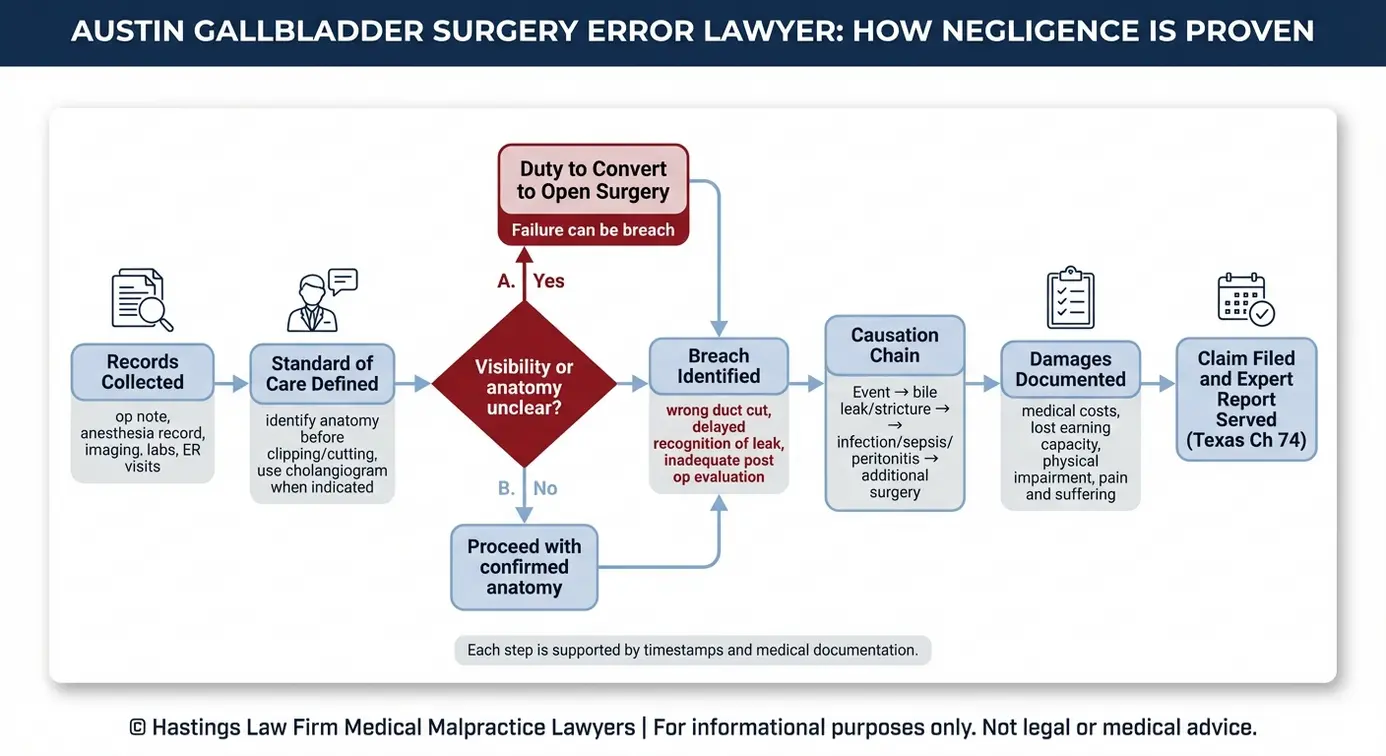
We establish negligence by proving the surgeon breached the standard of care, typically by failing to convert to open surgery when visibility was obscured or by cutting without conclusive identification of anatomy. As an Austin gallbladder surgery error lawyer, our job is to reconstruct what happened in the operating room and demonstrate, through qualified medical experts, that a reasonably competent surgeon would have acted differently.
Here is how our team builds these cases:
- Prioritize evidence collection by obtaining and analyzing the complete surgical record, including operative notes, anesthesia logs, nursing documentation, and any imaging performed during the procedure.
- Identify the specific breach by comparing what the surgeon did against what the standard of care required. In a laparoscopic cholecystectomy, a minimally invasive surgical technique, this often centers on whether the surgeon achieved the critical view of safety, used an IOC when anatomy was unclear, or continued operating when visibility was poor.
- Evaluate the duty to convert. Conversion to open cholecystectomy, switching from a laparoscopic approach to a traditional open incision, is sometimes the safest course of action. Failing to convert when the anatomy cannot be clearly identified can itself be a breach of the standard of care.
- Assess post-operative care. Negligence doesn’t always happen during surgery. If a patient reports worsening pain, fever, or jaundice in the days following a lap chole and the surgical team fails to investigate promptly, that delayed response may constitute a separate act of negligence.
- Retain qualified medical expert witnesses who can review the records and provide testimony about what should have been done. Under Texas Civil Practice and Remedies Code § 74.351, a qualified expert must provide a written report within 120 days after the defendant’s original answer is filed. This requirement makes early expert involvement important.
Surgeon experience levels can also be relevant. Research consistently shows that less experienced surgeons have higher error rates in laparoscopic procedures, and our investigation examines the surgeon’s training, case volume, and any prior adverse outcomes.
Recovering Compensation for Gallbladder Surgery Errors
Patients harmed by gallbladder surgery errors may recover economic damages for corrective surgeries and lost wages, as well as non-economic damages for pain, suffering, and physical impairment under Texas law. Your Austin gallbladder surgery error lawyer will work to document every category of loss, both current and future, to pursue the full settlement amount or trial value of your claim.
Economic damages cover the financial costs tied directly to the injury:
- Corrective and reconstructive surgeries, including Roux-en-Y repairs and any future procedures such as liver transplant evaluation
- Hospital stays, medications, imaging, ERCP procedures, and follow-up care
- Lost wages during recovery and reduced earning capacity if the injury prevents you from returning to your previous work
Non-economic damages address the personal toll of the injury:
- Physical pain and suffering from additional surgeries and prolonged recovery
- Mental anguish and emotional distress
- Physical impairment and loss of enjoyment of life
- Disfigurement from additional surgical scars
The Texas damage cap on non-economic damages in medical malpractice cases is strict. Under current law, non-economic damages are generally limited to $250,000 against all individual physicians and healthcare providers, and $250,000 per healthcare institution (up to $500,000 for two or more institutions), with an aggregate cap of $750,000 for non-economic losses in cases involving multiple defendants. There is no cap on economic damages, which is why thorough documentation of every medical expense and financial loss is so important.
An experienced lawyer for gallbladder surgery errors will work with medical and financial experts to project the true lifetime cost of your injury, not just what you’ve spent so far, to ensure fair compensation by analyzing comparable jury verdicts / payouts.
Texas Statute of Limitations for Surgical Error Claims
In Texas, you generally have two years from the date of the surgical error to file a lawsuit, though exceptions exist for cases where the injury was not immediately discoverable. Missing this filing deadline can permanently bar your claim, which is why consulting an Austin gallbladder surgery error lawyer early matters.
The two-year filing requirement is established by Texas Civil Practice and Remedies Code § 74.251. For most gallbladder surgery cases, the clock starts running on the date the procedure was performed.
However, Texas also recognizes the discovery rule. If a bile duct injury, retained surgical object, or other complication was not and could not have been reasonably discovered at the time of surgery, the statute may begin running from the date you knew or should have known about the injury. This can apply in cases where symptoms develop gradually or where post-operative complaints were initially dismissed.
There is also an absolute outer boundary. Under the Texas Civil Practice and Remedies Code Chapter 74, a 10-year statute of repose applies, meaning no medical malpractice claim can be filed more than 10 years after the date of the act or omission, regardless of when the injury was discovered.
Because these deadlines are strict and the pre-suit requirements under Texas medical malpractice law (including the expert report) take time to prepare, early action is important.
Anticipating Defense Arguments in Surgical Liability Cases
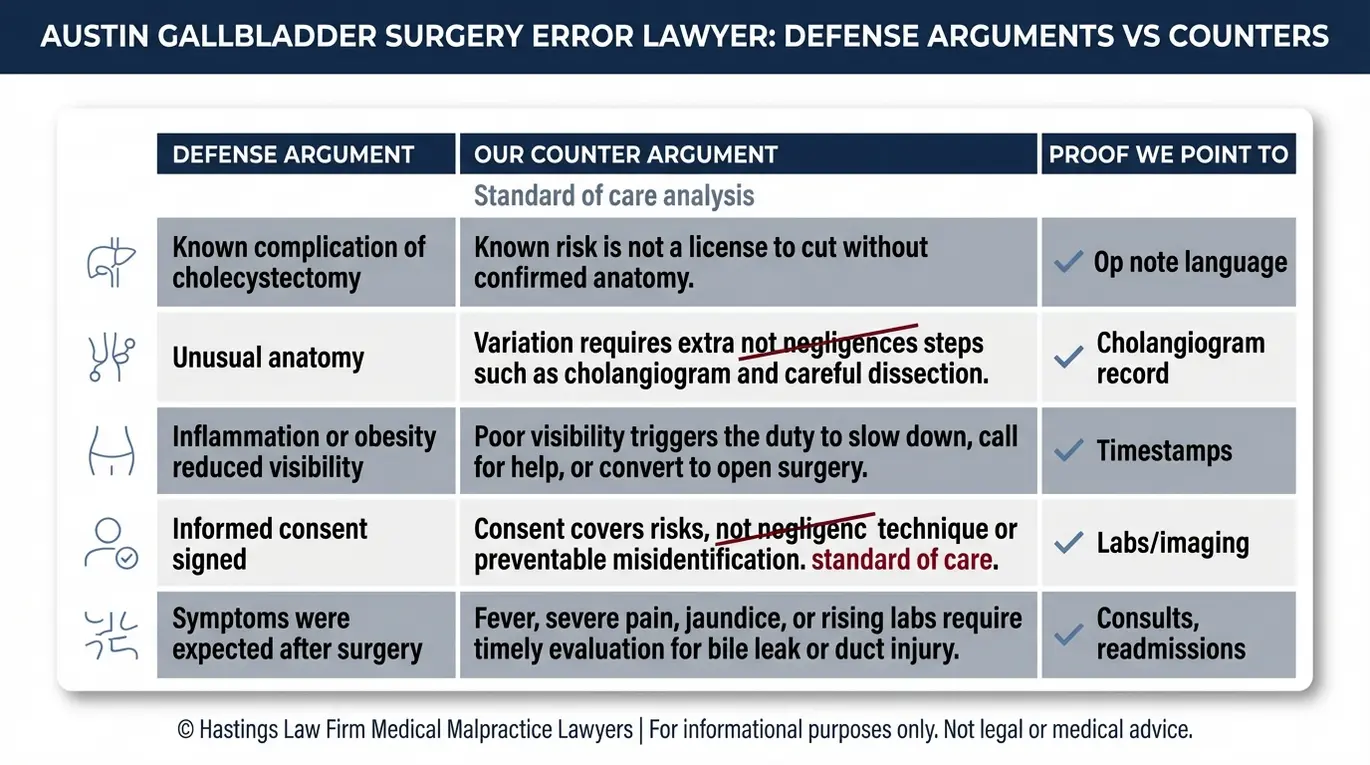
Defense attorneys often argue that bile duct injury is a known complication of the surgery rather than negligence, or blame the patient’s unique anatomy for the error. As your Austin gallbladder surgery error lawyer, we prepare for these arguments from the start and build the evidence to counter them.
Here are the most common defense strategies and how we respond:
| Defense Argument | Our Response |
|---|---|
| “Bile duct injury is a known risk of cholecystectomy.” | A known risk does not excuse a surgeon from properly identifying anatomy before cutting. The standard of care requires confirmation, and “it can happen” is not the same as “it was unavoidable.” |
| “The patient had unusual or variant anatomy.” | Anatomical variations are well-documented in surgical literature. A competent surgeon accounts for this possibility by using tools like intraoperative cholangiograms or converting to open surgery when landmarks are unclear. |
| “Obesity or inflammation made visualization difficult.” | Difficult conditions do not lower the standard of care. They raise the surgeon’s obligation to take additional precautions, including slowing down, obtaining better imaging, or converting to an open approach. |
| “The patient signed informed consent acknowledging this risk.” | Informed consent covers known risks of a properly performed procedure. It does not authorize negligent technique or relieve the surgeon of the duty to meet the standard of care. |
Understanding these defense tactics is part of our preparation. Our team, which includes former defense attorneys who used to make these very arguments, knows how to anticipate them and build a record that holds up under cross-examination.
Contact the Austin Surgical Error Attorneys at Hastings Law Firm Today for Help
A surgical error during gallbladder removal can change the course of your life, leading to additional surgeries, chronic health issues, and mounting financial pressure. While no amount of money can undo the physical harm, compensation can help cover the medical care you need and the income you’ve lost. Hastings Law Firm is a nationally recognized firm that focuses exclusively on medical malpractice litigation.
Hastings Law Firm works on a contingency fee basis, which means you pay no attorney fees and no costs unless we recover compensation for you. If you believe your gallbladder surgery went wrong because of a preventable mistake, our Austin team is ready to review your surgical records and explain your options.
Contact us today for a free, confidential case evaluation. Let us help you find the answers you deserve.
Frequently Asked Questions About Gallbladder Surgery Error in Austin


This content was researched and written by the Hastings Law Firm editorial team, which includes attorneys, medical professionals, and experienced researchers. Our writing is informed by internal knowledge and practical experience, and we cross-check critical details against authoritative sources cited throughout. Every piece undergoes human-led fact-checking and legal review. Because legal and medical information can change, if you spot an error, please contact us. Learn more about our content standards and review process on our editorial policy page.

Gabe Sassin has focused exclusively on medical malpractice law since 2007. After spending more than a decade as a malpractice defense attorney, he knows exactly how the other side works. He has seen firsthand how healthcare providers, insurers, corporate defendants, and their legal teams think, prepare, and build their defense against claims. That knowledge works for the people who need it most today, injured patients and their families. His unique experience shapes everything he writes, giving readers a look at how these cases actually work from someone who has handled them from both sides.
