


Texas Hospital Negligence Lawyer
Hospital negligence can leave patients facing serious setbacks, financial strain, and a loss of trust in care. In Texas, hospital malpractice claims often focus on institutional failures such as staffing decisions, safety protocol breakdowns, infection control lapses, and record irregularities rather than a single provider mistake. Liability disputes may also arise when hospitals argue that physicians were independent contractors. Understanding how corporate responsibility, agency theories, and damage limits affect accountability can help families make informed decisions after a preventable injury. If you or a loved one were harmed or worse due to hospital malpractice in Texas, contact Hastings Law Firm for a free, confidential case review.
Last Updated: September 28, 2026
Trial-Ready Hospital Negligence Attorneys in Texas
When a hospital causes harm through preventable errors, the physical and emotional toll can feel overwhelming. You may be dealing with worsening health, mounting medical bills, and a sense of loss of trust in the system that was supposed to help you heal. You deserve honest answers about what happened.
Hospital negligence cases are among the most complex areas of medical malpractice law. They involve layers of corporate responsibility, institutional policies, and staffing decisions that go far beyond any single doctor’s mistake. Holding a hospital accountable requires a legal team that understands both medicine and the inner workings of these facilities.
As a Texas hospital malpractice law firm built exclusively around medical negligence, Hastings Law Firm has the clinical insight and litigation experience to investigate what went wrong. If you or a loved one suffered harm due to a hospital’s failures, we welcome the chance to review your situation and explain your options in a free, confidential consultation.

Understanding Hospital Negligence and Corporate Liability in Texas
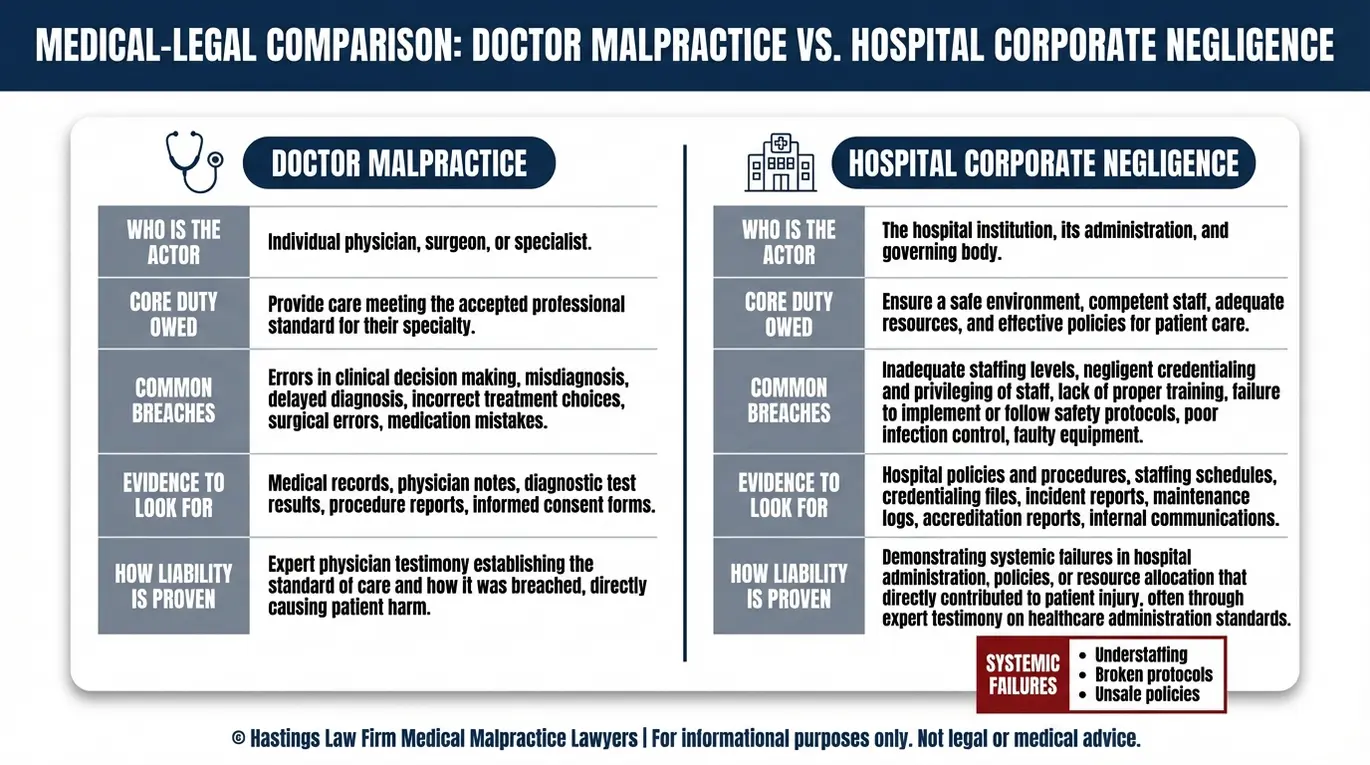
Hospital negligence occurs when a medical facility fails to meet the accepted standard of care through administrative breakdowns, inadequate staffing, or violations of its own safety protocols, and a patient is harmed as a result. This is a distinct legal concept from a single doctor making an error during treatment.
Hospitals themselves carry independent legal obligations to their patients. Under the Texas Civil Practice and Remedies Code, Chapter 74.001, a “health care liability claim” can target the institution directly, not just the provider at the bedside.
The legal theory of corporate negligence holds a hospital responsible for its own institutional failures separate from any individual provider’s conduct. When a hospital commits a breach of duty by ignoring these obligations, the facility itself is liable. These systemic failures can include:
- Staffing decisions that reduce personnel below levels needed for safe care
- Failing to maintain or properly sanitize medical equipment, leading to malfunctions or infections
- Failing to establish or enforce evidence-based safety protocols that prevent foreseeable errors
- Inadequate credentialing and privileging, which is the process a hospital uses to verify that physicians are qualified and competent
The hospital’s duty of care extends to every operational decision that affects patient safety. When those decisions create dangerous conditions, taking legal action against a hospital in Texas may be the only way to uncover the full scope of what went wrong. Our hospital malpractice attorneys investigate these institutional breakdowns with the help of in-house nursing staff who understand how hospitals actually operate.
Who is Liable? Navigating the Independent Contractor Defense
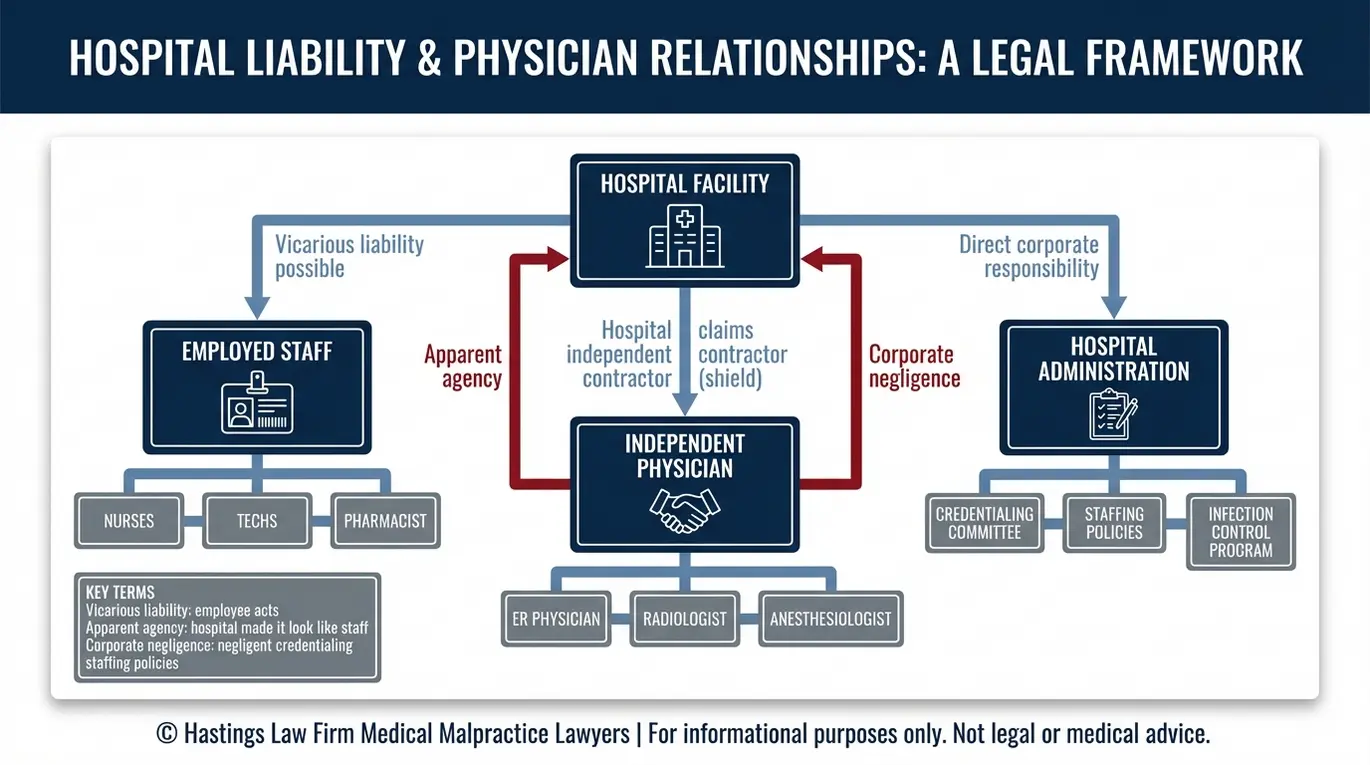
Hospitals in Texas frequently try to shield themselves from liability by arguing that the physician who caused the injury was an independent contractor, not an employee. While this defense can limit a hospital’s exposure in some situations, several legal exceptions allow injured patients to hold the facility accountable.
The Corporate Shield
In Texas hospital liability cases, the corporate shield is a common defense used to distance the facility from the actions of physicians. When you receive care at a hospital, it is reasonable to assume that every provider treating you works for that facility. In reality, many physicians may be contracted through separate staffing companies. Hospitals rely on this independent contractor status to argue that they should not be responsible when one of these contracted doctors makes a negligent decision.
Direct liability often involves operational decisions. For example, understaffing can create dangerous gaps in coverage that the hospital is directly responsible for. Failing to maintain an appropriate nurse-to-patient ratio, which is a key metric for safe monitoring, exposes patients to avoidable risk. A Texas hospital malpractice lawyer will evaluate the specific employment relationships in your case to determine every responsible party.
| Liability Type | Who It Covers | How the Hospital Is Connected |
|---|---|---|
| Vicarious Liability | Nurses, technicians, and other direct employees | The hospital is automatically responsible for negligent acts committed by its employees during their job duties |
| Direct Corporate Liability | Independent contractor physicians | The hospital can be held liable for negligent hiring, credentialing failures, or failing to enforce quality standards |
| Ostensible (Apparent) Agency | Contracted doctors who appear to be hospital staff | If the hospital created the impression that a physician was its employee, and the patient reasonably relied on that impression, the hospital may still be liable |
Administrative Failures and Protocol Violations
Hospital administrative negligence refers to non-medical errors that affect patient safety. These include protocol failures such as patient misidentification, where a mix-up in records or wristbands leads to the wrong person receiving treatment. This is often called a wrong-patient error and can lead to severe medication or surgical complications.
Failure to transfer is another common breakdown. When a facility lacks the specialists needed, protocols typically require a timely transfer to a higher-level facility. Delays in initiating that transfer can have serious consequences. We examine transfer logs and communication records to evaluate whether the hospital met its obligations.
The Hastings Law Firm Difference
Results matter, but what truly sets us apart is how we achieve them. Every verdict, every settlement, and every Texas courtroom victory comes from one guiding promise: To treat each client’s fight for justice as if it were our own.
This balance of skill, experience, and empathy reflects our core philosophy that justice should not only compensate the injured, but also make health care safer nationwide.

Common Types of Hospital Errors We Litigate
Common hospital errors include medication administration mistakes, surgical site confusion, failure to monitor stable patients, and hospital-acquired infections caused by unsanitary conditions. These represent patterns of institutional failure that our team encounters in hospital malpractice cases across Texas.
Nursing Negligence and Failure to Rescue
Nurses are often the first line of defense in recognizing when a patient’s condition is deteriorating. Nursing negligence, such as administering the wrong drug or the wrong dose, remains one of the most frequent types of hospital negligence. Equally dangerous is failure to rescue, which occurs when nursing staff fail to recognize critical changes in a patient’s vitals and do not escalate care.
Surgical and Facility Errors
Surgical errors are some of the most devastating preventable mistakes. Some hospital errors are so clearly preventable that the medical industry has classified them as Never Events. Never Events are serious adverse events that should not occur under proper protocols, such as wrong-site surgery or leaving foreign objects inside a patient. These events represent a breakdown of safety protocols and institutional oversight.
Infection Control Failures
Hospitals are required to follow strict infection prevention protocols to protect patients from harm. When those protocols break down, patients can develop life-threatening conditions like sepsis. The Centers for Disease Control and Prevention (CDC) publishes guidelines that hospitals are expected to follow. A failure to maintain proper hygiene or sterilize equipment can expose the facility to direct liability for hospital-acquired infections.
Charting Irregularities and EMR Audits
Medical records tell the story of what happened and when. In hospital negligence cases, our team conducts Electronic Medical Record (EMR) audits to examine the digital audit trail. This metadata shows exactly when entries were created, modified, or deleted. This process can reveal whether records were altered after an event, which is a significant indicator of potential error.
The Texas Chapter 74 Hurdle and Proving Your Case
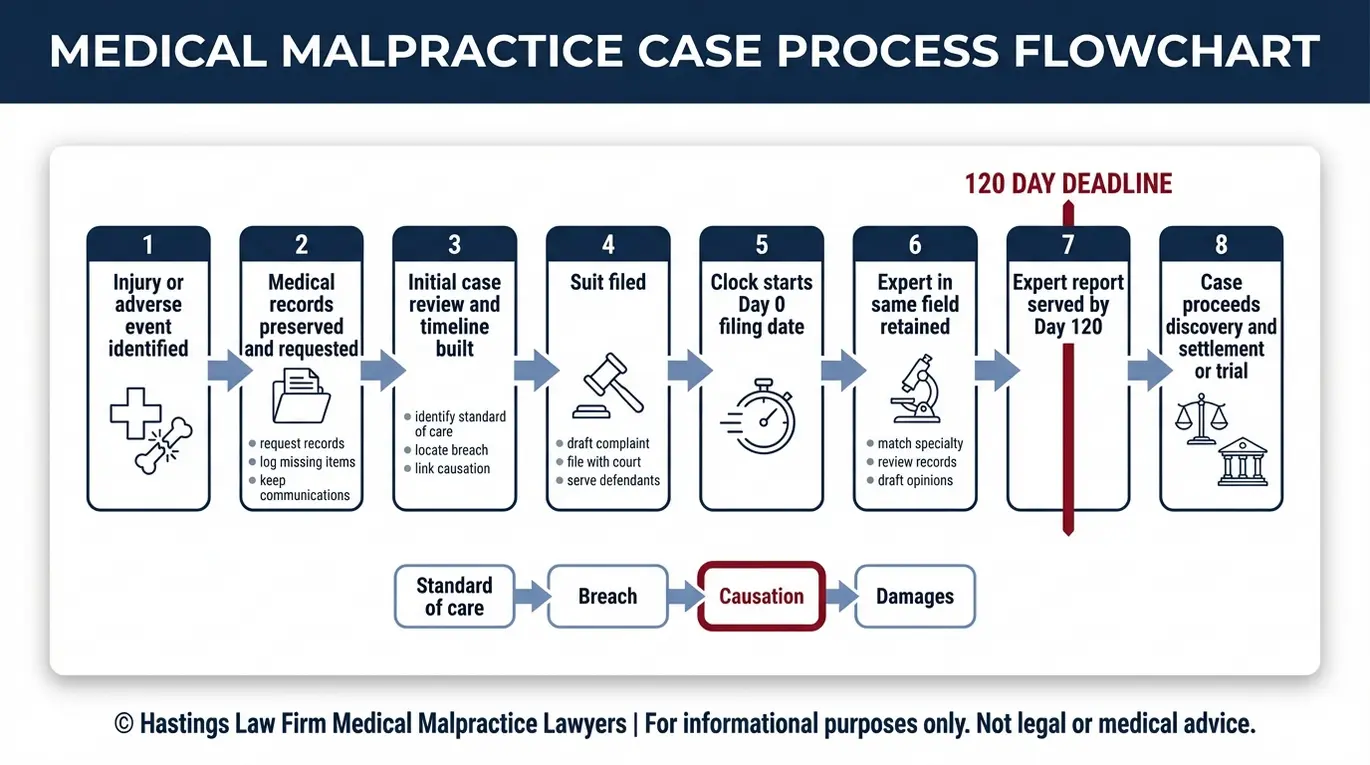
Texas law requires plaintiffs in medical malpractice claims to serve a qualified expert report within 120 days after each defendant files their original answer. This report must identify the applicable standard of care, explain how the hospital breached that standard, and establish how the breach directly caused the patient’s injury. Missing this deadline can result in dismissal of the case.
This requirement is outlined in Texas Civil Practice and Remedies Code Chapter 74.351. It is one of the most significant procedural barriers for patients pursuing hospital negligence claims in Texas. The litigation process typically includes several key stages:
- Pre-suit notice and investigation: We review all relevant medical records and conduct a thorough audit. We then consult with qualified medical experts to evaluate the case before filing.
- Filing the lawsuit: The petition is filed in the appropriate Texas court, formally initiating the legal action.
- 120-day expert report deadline: A qualified medical expert must provide a report addressing the standard of care and causation.
- Discovery and depositions: Both sides exchange evidence and take sworn testimony from witnesses.
- Trial preparation or resolution: The case either proceeds to jury trial or is resolved through negotiation.
The burden of proof in these cases is a preponderance of the evidence. This means you must show it is more likely than not that the hospital’s conduct caused your injury. Our team works with nationally recognized medical experts to draw a direct line between the institutional failure and the harm you suffered.
At Hastings Law Firm, our team begins building your case with trial-level preparation from day one. Because our attorneys include former defense counsel who previously represented hospitals, we anticipate the strategies the other side may use and prepare to counter them early. Our hospital negligence attorneys have offices in Austin, Dallas, and Houston, giving patients and families across Texas access to a law firm with local resources and statewide reach. Our Fort Worth hospital malpractice lawyers represent patients injured at hospitals across Tarrant County and the surrounding area.
Recoverable Damages in Hospital Negligence Cases
Securing full compensation for hospital negligence is vital. Patients harmed by negligence may recover economic damages for medical expenses and lost income, as well as non-economic damages for pain and suffering. Texas imposes statutory caps on certain categories of compensation, which makes thorough damage documentation important.
Economic Damages
Economic damages cover the measurable financial losses caused by the injury. There is no cap on economic damages in Texas. In catastrophic cases, we often develop a Lifecare Plan to outline the costs of long-term medical care, surgery, and rehabilitation. These damages also include lost wages and diminished earning capacity.
Non-Economic Damages
Non-economic damages compensate for losses that do not carry a specific price tag. Texas caps non-economic damages at $250,000 per hospital, with an aggregate cap of $500,000 when multiple facilities are involved. These damages include physical pain, mental anguish, and physical impairment.
Wrongful Death and Gross Negligence
When hospital negligence results in a patient’s death, surviving family members may pursue a wrongful death claim. This claim can seek compensation for loss of companionship and financial support. In cases involving gross negligence, where the hospital’s conduct reflects an extreme departure from the standard of care, punitive damages may also be available.
Contact the Texas Hospital Malpractice Attorneys at Hastings Law Firm Today for Help
No amount of money can undo the harm caused by a hospital’s failures. But financial recovery provides the resources you need for future medical care, lost income, and the stability your family deserves. Holding a hospital accountable sends a clear message that patient safety matters.
Hastings Law Firm is a Texas hospital negligence law firm focused on medical negligence cases. Our founder, Tommy Hastings, is board-certified in personal injury trial law and has dedicated his career to this field since 2005. Our team of attorneys, nurse consultants, and patient advocates is ready to listen and investigate your case.
We take every case on a contingency fee basis, which means you pay no attorney fees or costs unless we secure a recovery for you. If you or a loved one has been injured by hospital negligence, contact us for a free case evaluation. Let us help you find the answers you deserve.
Frequently Asked Questions About Hospital Negligence in Texas


This content was researched and written by the Hastings Law Firm editorial team, which includes attorneys, medical professionals, and experienced researchers. Our writing is informed by internal knowledge and practical experience, and we cross-check critical details against authoritative sources cited throughout. Every piece undergoes human-led fact-checking and legal review. Because legal and medical information can change, if you spot an error, please contact us. Learn more about our content standards and review process on our editorial policy page.

Tommy Hastings, founder of Hastings Law Firm, is a board-certified personal injury trial lawyer (by the Texas Board of Legal Specialization) dedicated exclusively to healthcare injury cases. Since 2001, he has represented injured patients and families in litigation against major hospital systems, pharmaceutical companies, and negligent healthcare providers nationwide. He has handled numerous high-profile cases that have drawn national media attention and resulted in multi-million dollar recoveries.
