


Texas Medical Misdiagnosis Lawyer
A wrong, missed, or delayed diagnosis can lead to unnecessary treatment, worsening illness, and lost chances for effective care. These situations are often complicated by trust in medical authority and by the difficulty of separating an unavoidable outcome from a preventable error. Understanding how diagnostic mistakes happen, what standards of care apply, and how harm is linked to the error can clarify what went wrong and why it matters. If you or a loved one were harmed or worse due to medical misdiagnosis in Texas, contact Hastings Law Firm for a free, confidential case review.

Last Updated: July 27, 2026
Trusted Legal Representation for Wrong Medical Diagnosis Claims in Texas
When a doctor gets it wrong, the consequences go far beyond confusion. A missed or incorrect diagnosis can mean months of unnecessary treatment, a disease advancing unchecked, or the loss of options that were once available. If you suspect a diagnostic error caused you or a loved one serious harm, that instinct deserves to be taken seriously, not dismissed by the same system that failed you in the first place.
Many people struggle with what we call the “White Coat Effect,” a deep-seated tendency to defer to medical authority even when something clearly feels off. You are allowed to question what happened. You are allowed to ask for answers.
At Hastings Law Firm, our team of attorneys, nurse consultants, and Board Certified Patient Advocates focuses exclusively on medical malpractice. Founded in 2005 by Tommy Hastings, the firm brings decades of specialized experience to every case. Tommy Hastings is Board Certified in Personal Injury Trial Law, a distinction earned by less than 2% of Texas attorneys. As your Texas medical misdiagnosis lawyer, we can review the facts of your situation and explain your legal options at no cost and no obligation.

What Constitutes Actionable Medical Misdiagnosis in Texas?
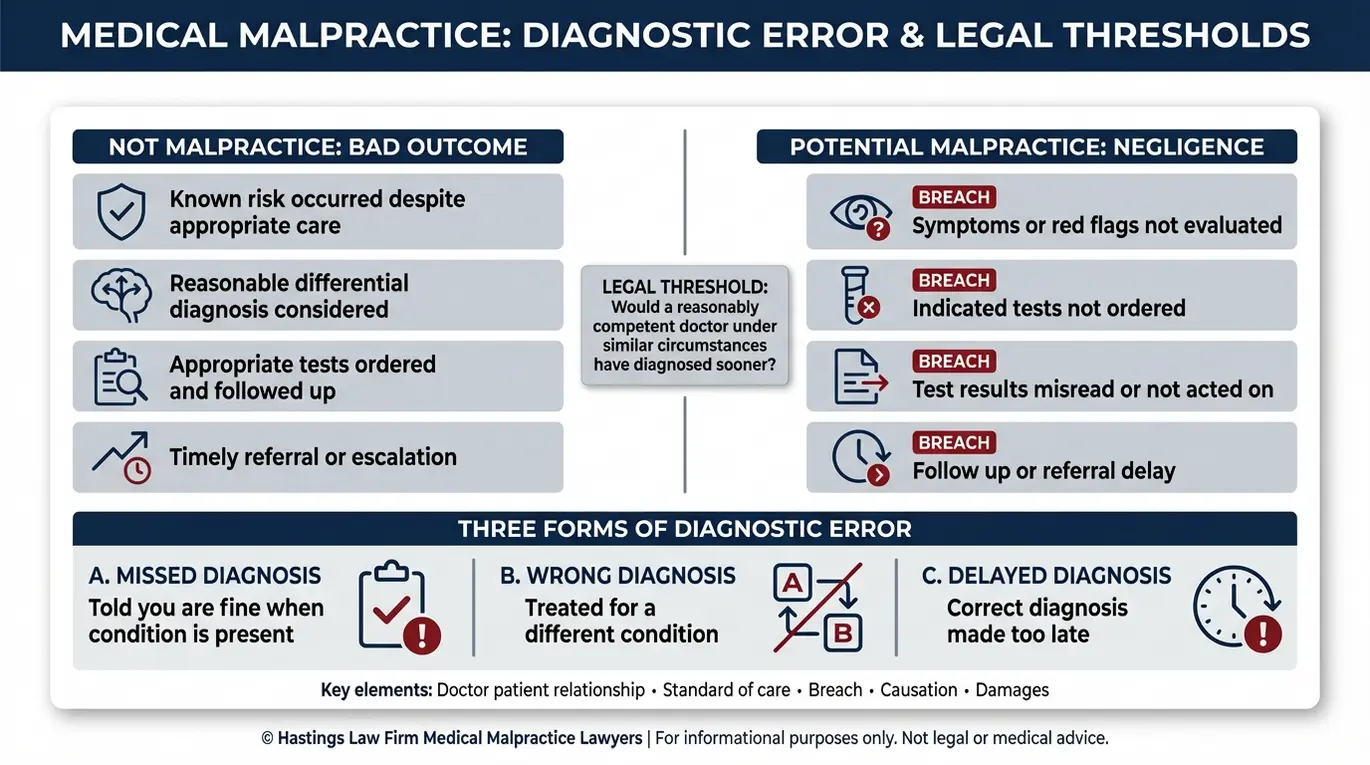
Medical misdiagnosis becomes legal malpractice when a doctor fails to meet the accepted standard of care established by the doctor-patient relationship, resulting in a wrong, delayed, or missed diagnosis that causes specific harm to the patient. Not every diagnostic error qualifies. The law draws an important line between a bad outcome, where the doctor acted reasonably but the disease was simply difficult to detect, and medical negligence, where a breach of duty occurred because a competent peer would not have made the same preventable error.
The legal threshold centers on one question: would a reasonably competent physician, under similar circumstances, have identified the condition? If the answer is yes, and the failure to do so caused you harm, there may be grounds for a claim under Civil Practice and Remedies Code Chapter 74, which governs medical liability actions in Texas. A skilled Texas medical misdiagnosis lawyer can help determine if this threshold is met.
A diagnostic error can take three distinct forms. A missed diagnosis occurs when a doctor gives a patient a clean bill of health despite an existing condition. A wrong diagnosis, sometimes called an incorrect diagnosis, means the patient is identified as having one condition and treated for it while the actual condition goes unaddressed. A delayed diagnosis means the correct condition is eventually identified, but not until the window for early, less aggressive treatment has passed.
The “Double-Risk” Mechanism of Wrong Diagnosis
What makes a wrong diagnosis especially dangerous is that the patient is harmed twice. First, they may suffer from iatrogenic injury, which is harm caused by the medical treatment itself, due to harmful unnecessary treatment for a condition they never had. This could include unnecessary surgeries, toxic medications, or invasive procedures with lasting side effects.
Second, while the patient undergoes the wrong treatment, the real condition continues to advance without intervention. This dual mechanism of causation is what separates misdiagnosis cases from many other malpractice claims and often results in significantly worse outcomes than a simple delay.
Common Conditions That Texas Doctors Fail to Diagnose
High-stakes conditions like cancer, heart attacks, and strokes are among the most frequently misdiagnosed because their early symptoms often mimic less severe ailments like indigestion, fatigue, or general aches. Misreading test results or failing to act on ambiguous symptoms can lead to a failure to diagnose. A delayed diagnosis, where the correct condition is identified only after it has significantly progressed, can dramatically reduce treatment options and survival rates.
Cancer is one of the clearest examples. According to the SEER*Explorer Application maintained by the National Cancer Institute, survival rates drop sharply as cancer advances from early to late stages.
A tumor caught at Stage I may be curable with minor surgery. The same tumor caught at Stage IV may require aggressive chemotherapy with a far worse prognosis. That gap is often the direct result of a failure to diagnose. If you believe your condition was overlooked, a wrong diagnosis attorney can review your case.
These errors frequently happen because of what clinicians call atypical presentation, where symptoms do not match the usual patterns. A heart attack in a woman may present as jaw pain or nausea rather than crushing chest pain. A stroke in a younger patient may be dismissed as a migraine.
| Condition | Commonly Mistaken For |
|---|---|
| Heart Attack | Acid Reflux / Anxiety |
| Stroke | Migraine / Vertigo |
| Cancer (various) | Fatigue / Infection / Aging |
| Meningitis | Flu / Viral Illness |
| Pulmonary Embolism | Muscle Strain / Panic Attack |
Gender and Age Bias in Diagnostic Accuracy
Diagnostic bias, a cognitive distortion where doctors rely on shortcuts rather than evidence, contributes to many of these errors. Two of the most common forms are anchoring, where a doctor locks onto an initial impression and stops considering alternatives, and premature closure, where the evaluation ends before all reasonable possibilities are ruled out.
Women are disproportionately affected. Research has repeatedly shown that women presenting with cardiac symptoms are more likely to be told their complaints are anxiety-related. Younger patients face a similar pattern of negligence, as emergency staff may dismiss stroke symptoms in a 30-year-old because the condition does not fit the profile. When a physician fails to order the appropriate diagnostic tests based on assumptions about who the patient is rather than what the symptoms suggest, that is a failure in the standard of care.
The Hastings Law Firm Difference
Results matter, but what truly sets us apart is how we achieve them. Every verdict, every settlement, and every Texas courtroom victory comes from one guiding promise: To treat each client’s fight for justice as if it were our own.
This balance of skill, experience, and empathy reflects our core philosophy that justice should not only compensate the injured, but also make health care safer nationwide.

How Misdiagnosis Occurs: Systemic Failures vs. Negligence
Diagnostic errors often stem from a failure to order appropriate tests, misinterpreting lab results, or systemic breakdowns in communication between providers. Often, obtaining a second opinion reveals these discrepancies. As outlined in the landmark report Improving Diagnosis in Health Care by the National Academies of Sciences, Engineering, and Medicine, diagnostic error is one of the most underrecognized sources of patient harm.
The failures we investigate as a Texas medical misdiagnosis lawyer generally fall into identifiable categories:
- Testing failures: A doctor does not order imaging such as a computed tomography (CT) scan (detailed X-ray) or magnetic resonance imaging (MRI) (magnetic wave imaging) when the patient’s symptoms call for it.
- Interpretation errors: A radiologist or specialist misreads results, such as overlooking a mass on an X-ray or misinterpreting bloodwork.
- Communication breakdowns: Critical lab results or medical records are lost, delayed, or never communicated between the lab, the hospital, and the primary care physician.
In these instances, a differential diagnosis, which is the systematic process of evaluating all likely conditions before settling on one, either was not performed or was cut short. Texas law allows claims against multiple responsible parties under Texas Civil Practice and Remedies Code Chapter 33, which governs proportionate responsibility.
ER vs. Primary Care: Standards of Care
The standard of care applied to emergency room physicians in Texas is different from that applied to a doctor in private practice. Texas law generally holds ER doctors to a willful and wanton negligence standard, a higher bar for patients to clear. This reflects the fast-paced, high-pressure nature of emergency medicine.
Rushed ER assessments, where doctors spend only minutes with a patient before making a disposition, are a well-documented source of diagnostic error. A primary care physician who has an ongoing relationship with the patient and access to a full medical history is held to the standard negligence threshold. Understanding which standard applies is important to building a viable claim.

Proving Your Case: The Role of Expert Testimony
Texas law requires the plaintiff to produce expert reports from qualified physicians to prove that the defendant breached the standard of care and directly caused the injury. This is not optional. Under Chapter 74, you cannot proceed with a medical malpractice case without a credentialed medical expert who can explain, in detail, what a prudent doctor would have done differently and how that failure led to your harm.
Establishing negligence in these cases is particularly demanding. It is not enough to show that the diagnosis was wrong. Your medical malpractice lawyer and expert must establish causation, meaning the diagnostic error, not the underlying disease alone, caused the worsening of your condition. The Texas Supreme Court addressed this standard in Rogers v. Bagley, reinforcing that expert testimony must draw a clear line between the breach and the resulting injury.
At Hastings Law Firm, our in-house nurse consultants and national network of specialists work together to reconstruct what happened. This medical-legal collaboration is built into every case we accept. By combining legal strategy with clinical expertise, we identify where the standard of care broke down and connect that failure to the harm you experienced.
Calculating Damages for Delayed or Wrong Diagnosis
Patients harmed by misdiagnosis can recover compensation for the worsening of their condition, including additional medical costs, lost earning capacity, and physical pain and suffering. The key legal concept is that damages are measured by the difference between where you are now and where you would have been had the diagnosis been made correctly and on time.
Economic damages cover the tangible financial losses. These include the medical expenses of more aggressive treatment that would not have been necessary with an earlier diagnosis, such as chemotherapy, extended hospital stays, or additional surgeries. They also include lost wages and diminished earning capacity if the injury has affected your ability to work. Economic damages are not capped under Texas law.
Non-economic damages compensate for the anxiety, chronic pain, and reduced quality of life caused by the diagnostic failure. Under Texas Civil Practice and Remedies Code § 74.301, these damages are subject to statutory caps. As a Texas medical misdiagnosis lawyer, we work to document the full scope of both categories so that nothing is left on the table.
In cases where the delay proved fatal, surviving family members may pursue a wrongful death claim to recover damages for their loss, including funeral expenses, lost financial support, and loss of companionship.
Immediate Steps to Protect Your Claim
If you believe you received a wrong or delayed diagnosis, there are steps you can take right now to protect both your health and your legal options.
- Step 1: Get a second opinion. An independent evaluation by another qualified physician is the fastest way to correct your treatment plan and begin addressing the actual condition.
- Step 2: Request your complete medical records. This includes office notes, lab results, imaging, and referral documents. Having these secured early preserves important evidence.
- Step 3: Document your timeline. Write down every symptom, appointment, test, and conversation you can recall. Details fade quickly, and this record can be valuable later.
- Step 4: Contact a misdiagnosis attorney in Texas. At Hastings Law Firm, your case is reviewed by a Board Certified Patient Advocate before a legal strategy is ever discussed. This ensures we understand the medicine first.
Texas enforces a statute of limitations on medical malpractice claims, so acting promptly matters. The sooner you reach out, the more options remain available.

Contact the Texas Misdiagnosis Attorneys at Hastings Law Firm Today for Help
A missed or wrong diagnosis can change the course of your life. While no amount of money can undo that harm, the right legal outcome can provide the resources you need for ongoing medical care, financial stability, and a measure of accountability from the providers responsible. We handle medical diagnostic failure cases all across Texas from our Houston, Dallas, and Austin offices.
Hastings Law Firm was built for cases like yours. Our legal team includes former defense attorneys who know how hospitals and insurers approach these claims, and in-house medical professionals who can identify exactly where the standard of care failed. Every case is prepared as if it will go to a jury, which gives us a firm negotiation posture from the start.
We handle every medical malpractice claim as a Texas medical misdiagnosis lawyer on a contingency fee basis, meaning you pay nothing unless we recover compensation for you. There is no upfront cost and no financial risk to getting started.
If you or a loved one suffered harm because of a diagnostic error, contact us for a free, confidential case review. We can help you find the answers you deserve.
Frequently Asked Questions About Medical Misdiagnosis in Texas


This content was researched and written by the Hastings Law Firm editorial team, which includes attorneys, medical professionals, and experienced researchers. Our writing is informed by internal knowledge and practical experience, and we cross-check critical details against authoritative sources cited throughout. Every piece undergoes human-led fact-checking and legal review. Because legal and medical information can change, if you spot an error, please contact us. Learn more about our content standards and review process on our editorial policy page.

Tommy Hastings, founder of Hastings Law Firm, is a board-certified personal injury trial lawyer dedicated exclusively to healthcare injury cases. Since 2001, he has represented injured patients and families in litigation against major hospital systems, pharmaceutical companies, and negligent healthcare providers nationwide. He has handled numerous high-profile cases that have drawn national media attention and resulted in multi-million dollar recoveries. He draws on that experience in his writing, helping readers understand how these cases work and what options may be available to them.
