


Texas Appendicitis Misdiagnosis Lawyer
A missed or delayed appendicitis diagnosis can turn a treatable condition into a fast moving emergency with serious complications and lasting harm. Appendicitis does not always follow a textbook pattern, and atypical symptoms can lead to discharge, delayed imaging, or misread lab results. When care falls short, people may face emergency surgery, extended hospitalization, and long term effects that could have been avoided with timely evaluation. If you or a loved one were harmed or worse due to appendicitis misdiagnosis in Texas, contact Hastings Law Firm for a free, confidential case review.

Last Updated: July 27, 2026
Trusted Texas Medical Attorneys for Failure to Diagnose Appendicitis Claims
When a doctor misses the signs of appendicitis, a treatable condition can quickly become a medical emergency. If you or a loved one suffered a ruptured appendix, sepsis, or unnecessary surgery because of a delayed or incorrect diagnosis, you may be dealing with the aftermath of medical negligence.
At Hastings Law Firm, we have focused exclusively on medical malpractice since 2005. Our founder, Tommy Hastings, is Board Certified in Personal Injury Trial Law by the Texas Board of Legal Specialization. Our team includes former defense attorneys and hospital nurses who understand the internal protocols and charting methods used by healthcare systems.
If something does not feel right about the care you received, we can review your medical records and explain your options. Contact us for a free, confidential case evaluation.

Recognizing Appendicitis Symptoms That Medical Professionals Overlook
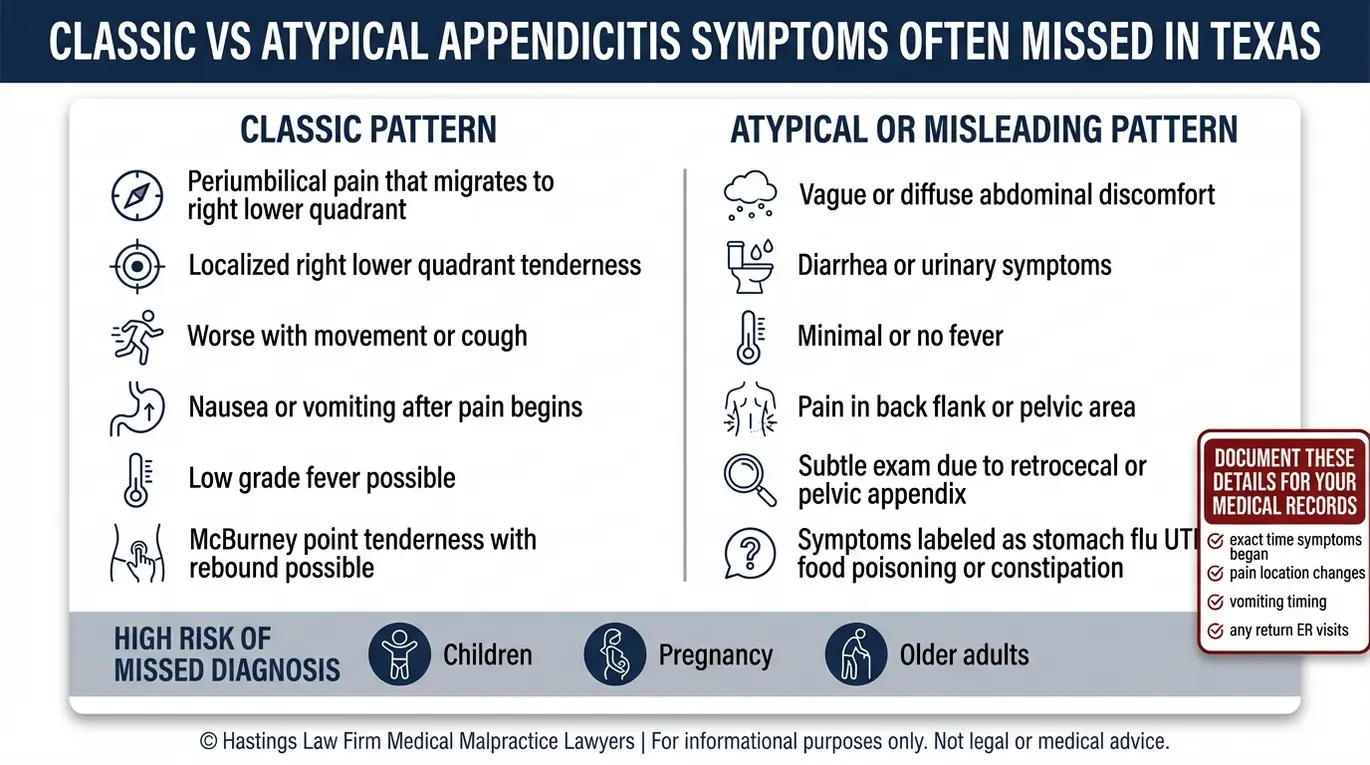
Appendicitis typically presents as periumbilical pain migrating to the right lower quadrant, but doctors often miss the diagnosis when patients exhibit atypical symptoms like diarrhea, vague discomfort, or lack of fever. That gap between textbook presentations and actual patient symptoms often leads to misdiagnosis claims.
The classic presentation of appendicitis includes sharp pain at McBurney’s point, the area about one-third of the way between the hip bone and the navel on the right side. This pain usually begins as periumbilical pain, which means discomfort centered around the belly button. Patients may also experience nausea, vomiting, loss of appetite, and a low-grade fever. When these textbook signs are present, most emergency physicians will consider appendicitis quickly.
The problem arises with atypical appendicitis symptoms. If the appendix sits behind the cecum, known as a retrocecal appendix where the organ is positioned behind the large intestine, the pain may be felt in the back or flank instead of the lower abdomen. A pelvic appendix can mimic urinary tract infections or gynecological conditions. Some patients present only with loose stools or mild, diffuse abdominal pain that does not follow the expected pattern. These variations can lead doctors to misidentify the source of the problem.
Certain groups face a higher risk of misdiagnosis:
Classic Presentation:
- Right lower quadrant pain (McBurney’s point tenderness)
- Nausea and vomiting
- Loss of appetite
- Low-grade fever
- Pain worsening over 12 to 24 hours
Atypical Presentation:
- Back or flank pain (retrocecal appendix)
- Pelvic pain mimicking UTI or ovarian conditions
- Diarrhea or constipation as the primary complaint
- Diffuse abdominal discomfort without localized tenderness
- No fever
High-Risk Groups for Misdiagnosis:
- Children (difficulty describing symptoms accurately to providers)
- Pregnant women (shifted anatomy displaces pain location)
- Elderly patients (blunted immune response, less pain or fever)
An experienced appendicitis misdiagnosis attorney in Texas will review how these symptoms were documented. Recognizing these variations is essential because a delayed diagnosis increases the risk of a rupture.
Common Medical Errors Leading to Missed Appendicitis
Missed appendicitis usually results from a failure to perform a differential diagnosis—the systematic process of ruling out possible conditions based on a patient’s symptoms—or from dismissing abdominal pain as a stomach bug or urinary tract infection. This failure to diagnose the condition promptly is one of the most common forms of medical negligence in emergency settings, often due to overcrowding or rapid triage assessments.
The errors we see most often include:
- Premature discharge from the emergency department before appendicitis has been properly ruled out
- Failure to order a CT scan or ultrasound when the patient’s symptoms and exam findings warranted imaging
- Misinterpreting lab results, such as overlooking an elevated white blood cell count that signals infection
- Attributing symptoms to gastroenteritis or food poisoning without investigating surgical causes of the pain
- Dismissing complaints from women, children, or elderly patients whose symptoms do not fit the textbook pattern
According to the National Center for Biotechnology Information’s clinical overview on appendicitis, appendicitis remains one of the most common surgical emergencies, and delays in diagnosis significantly increase the risk of perforation. When a primary care doctor or emergency department physician fails to consider appendicitis in their workup, the consequences can be severe.
A lawyer for appendicitis errors will examine the medical records to determine whether these diagnostic steps were followed or skipped entirely. We look for evidence that the provider rushed the evaluation or ignored critical data points that suggested a surgical emergency.
The Hastings Law Firm Difference
Results matter, but what truly sets us apart is how we achieve them. Every verdict, every settlement, and every Texas courtroom victory comes from one guiding promise: To treat each client’s fight for justice as if it were our own.
This balance of skill, experience, and empathy reflects our core philosophy that justice should not only compensate the injured, but also make health care safer nationwide.

Diagnostic Standards and Testing Protocols for Abdominal Pain
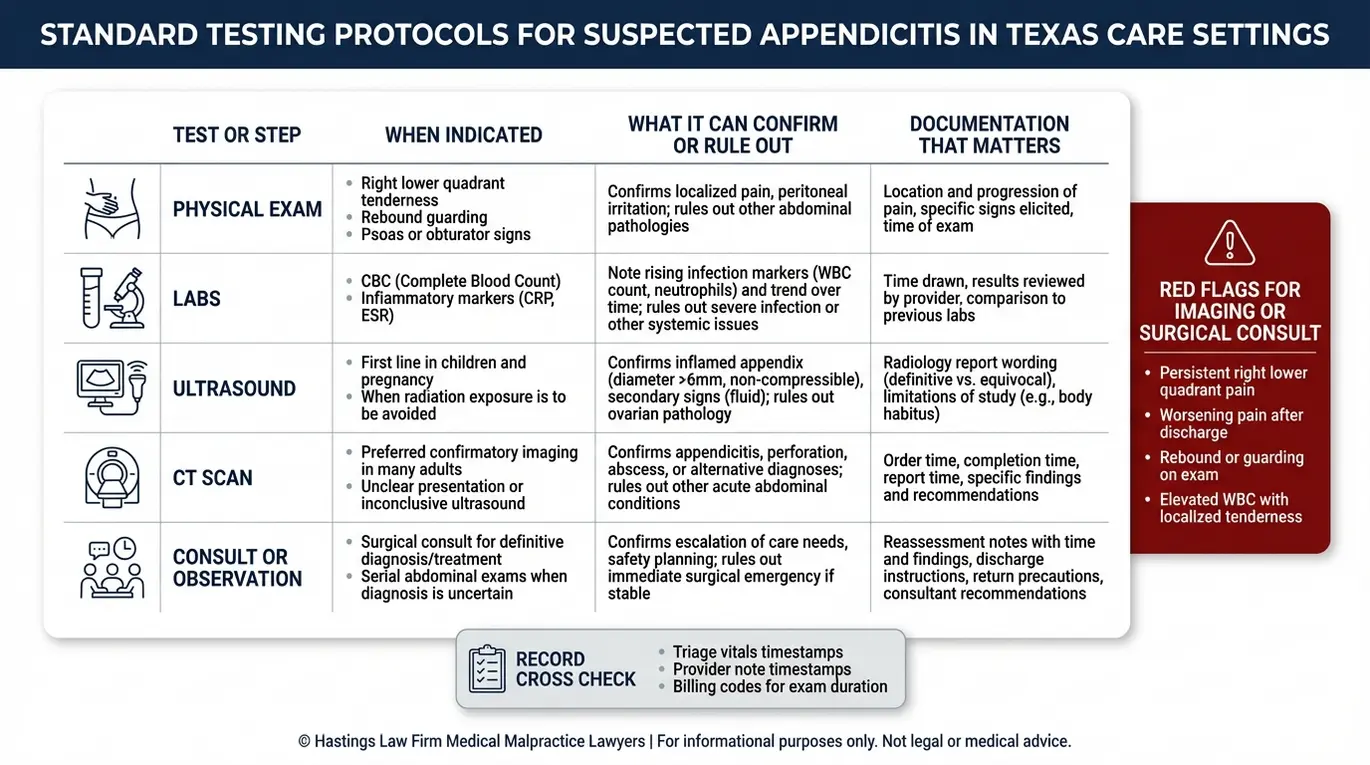
The standard of care for suspected appendicitis requires a thorough physical exam followed by confirmatory imaging, such as a computed tomography (CT) scan or ultrasound, and blood work to check for infection markers. The legal standard of care represents the level of caution and medical skill that a competent professional should provide under similar circumstances.
A proper physical exam should evaluate for rebound tenderness, which is increased pain when pressure is released from the abdomen. The doctor should also check for the psoas sign (pain triggered by extending the hip) and guarding. These findings, combined with the patient’s history, should guide the physician toward ordering imaging, though physical exams alone are often variable and insufficient for a definitive diagnosis.
The CT scan, a detailed cross-sectional X-ray of the body, is considered the gold standard for diagnosing appendicitis in adults. An ultrasound, which uses sound waves to produce images of internal organs, is the preferred first-line test for children and pregnant women because it avoids radiation exposure. A systematic review and meta-analysis published in PubMed confirms that both CT and ultrasound have high diagnostic accuracy, but CT remains more reliable overall.
| Test Type | When Indicated | Diagnostic Accuracy |
|---|---|---|
| CT Scan | Adults with suspected appendicitis | Highest accuracy (gold standard) |
| Ultrasound | Children, pregnant women, or as initial screen | High, but operator-dependent |
| Blood Tests (CBC, CRP) | All patients with abdominal pain | Supportive, not definitive alone |
| Physical Exam | Every patient presenting with abdominal symptoms | Variable; guides further testing |
One area a Texas appendicitis malpractice lawyer may examine closely involves billing records. Under the Texas Health and Safety Code, Chapter 181, patients have a right to access their medical records. Computerized billing timestamps can sometimes reveal inconsistencies, such as a provider billing for a thorough abdominal exam when the visit lasted only a few minutes. This type of evidence can be powerful in establishing that the documented care never actually occurred.
Severe Complications From Ruptured Appendix Negligence
A ruptured appendix releases bacteria into the abdominal cavity, causing life-threatening complications like peritonitis and sepsis that often require emergency surgery and extended hospitalization. Many of these outcomes are preventable with a timely diagnosis.
The timeline matters. An uncomplicated appendicitis caught early can often be treated with a simple laparoscopic procedure and a short recovery. But when diagnosis is delayed by 12 to 24 hours or more, the risk of perforation rises sharply. Once the appendix ruptures or becomes a burst appendix, bacteria flood the abdomen, leading to peritonitis, which is an infection of the peritoneum (the thin tissue lining the abdominal wall). Left untreated, peritonitis can progress to sepsis, which the Centers for Disease Control and Prevention (CDC) describes as the body’s extreme response to infection.
Sepsis from a ruptured appendix can cause organ failure, dangerously low blood pressure, and death. Patients who survive often face weeks or months in the ICU, multiple surgeries, and IV antibiotics.
Beyond the acute crisis, long-term consequences of a ruptured appendix can include adhesions (scar tissue causing chronic pain), bowel obstructions, abscess formation, and in some cases, infertility due to pelvic scarring. These lasting effects go far beyond what a simple appendectomy would have required.
For an attorney for a ruptured appendix case, the central question is causation: would an earlier diagnosis have prevented these complications? We work with medical experts to reconstruct the clinical timeline and demonstrate that the severity of the harm was avoidable.
Proving Medical Negligence in Texas Appendicitis Cases
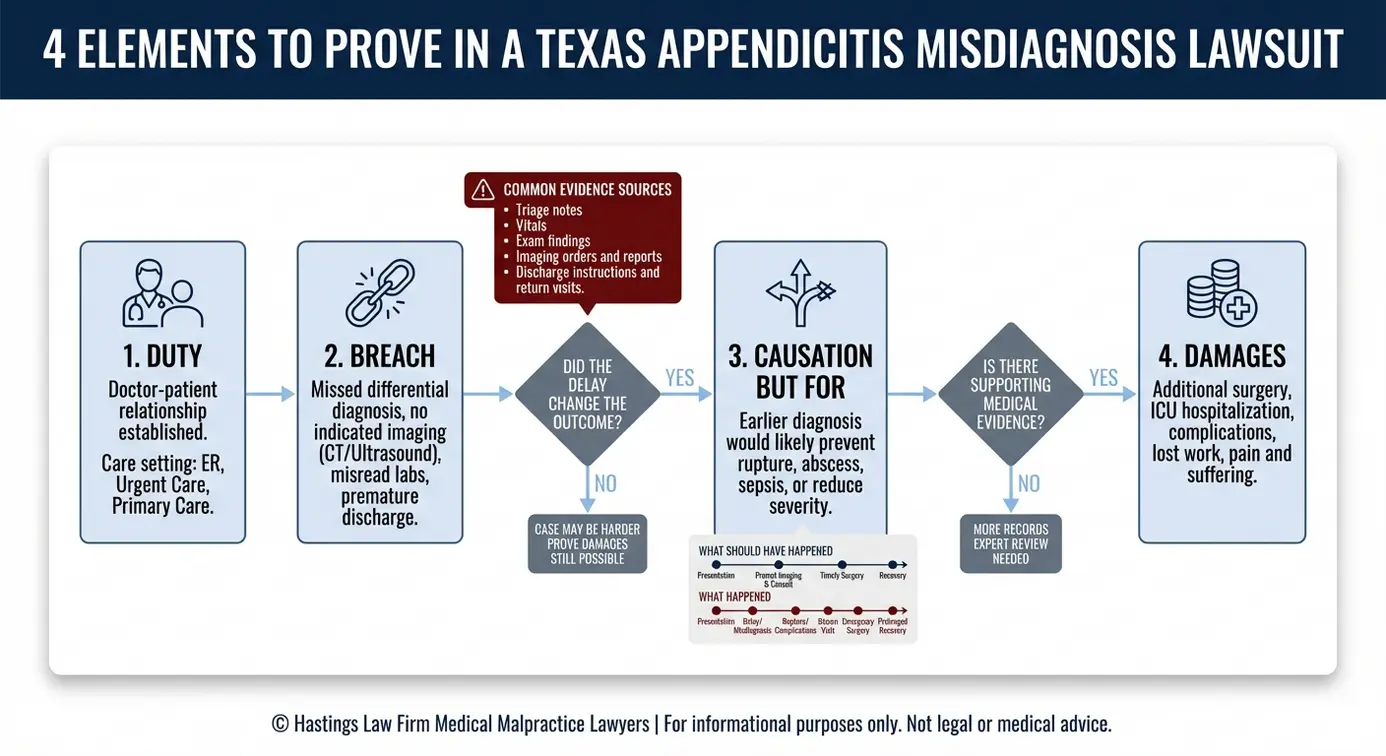
To succeed in a malpractice claim, the patient must prove that a doctor-patient relationship existed, the provider breached the standard of care by failing to diagnose appendicitis, and that breach directly caused the appendix to rupture or led to further harm. Each element builds on the one before it, and all must be established with supporting evidence.
Step 1: Establishing the Standard of Care for Appendicitis. A qualified medical expert reviews the case and explains what a competent physician in the same specialty would have done under similar circumstances. If the treating doctor deviated from that standard, this forms the basis of the claim.
Step 2: Proving the Breach. We examine medical records, imaging orders, lab results, discharge instructions, and nursing notes to identify where the care fell short. Expert testimony is crucial here to explain why the missed diagnosis was negligent rather than a reasonable error. Under the Texas Civil Practice and Remedies Code, Chapter 74, a medical expert report must be served early in litigation to validate the claim.
Step 3: The “But-For” Test (Causation). Proving causation is how the case comes together. We must show that *but for* the provider’s failure, the patient would not have suffered the resulting harm. If a timely CT scan would have identified the appendicitis before rupture, the delay is the direct cause of the worsened outcome. Whether the patient required laparoscopic surgery or more invasive open surgery often depends on when the diagnosis was made.
A Texas appendicitis misdiagnosis lawyer will also investigate less obvious errors. One example is stump appendicitis, a condition where the appendix is incompletely removed during surgery, leaving behind a small remnant that can become infected and mimic the original symptoms. These cases require careful surgical record review and expert analysis.
Recoverable Damages in Texas Appendicitis Malpractice Cases
Victims of appendicitis misdiagnosis in Texas can recover economic damages for medical bills and lost wages, as well as non-economic damages for pain, suffering, and physical impairment. The specific value of a case depends on the severity of the injury and its long-term effects.
Economic damages cover the measurable financial losses caused by the negligence:
- Past and future medical expenses, including emergency surgery, ICU care, antibiotics, follow-up procedures, and rehabilitation
- Lost wages and reduced earning capacity if the injury required extended time away from work or forced a career change due to disability
- Cost of ongoing care for complications like bowel obstructions or chronic infections
Non-economic damages address the personal toll:
- Physical pain and suffering during the recovery process
- Mental anguish and emotional distress caused by the trauma
- Scarring and disfigurement from open surgery or drainage procedures
- Loss of enjoyment of life and inability to participate in daily activities
Texas does place caps on non-economic damages in medical malpractice cases. Under Texas Civil Practice and Remedies Code § 74.301, non-economic damages are generally capped at $250,000 per claimant against each individual physician or health care provider. However, economic damages for medical bills, lost income, and future care costs are not capped, allowing families to secure the financial support they need.
In cases where the misdiagnosis led to fatal sepsis or other lethal complications, surviving family members may pursue a wrongful death claim. An appendicitis negligence lawyer can evaluate the full scope of recoverable damages based on the specific facts of your case.
Understanding Claims Involving Negative Appendectomy
A negative appendectomy occurs when a healthy appendix is surgically removed due to misdiagnosis; while often considered a “safe” error, unnecessary surgery carries risks that may be actionable if negligence is involved.
This medical error becomes actionable when the decision to operate was made without adequate diagnostic workup. If a surgeon proceeded to remove the appendix without ordering imaging or properly evaluating the patient’s symptoms, the surgery may reflect a failure in clinical judgment rather than a reasonable medical decision.
Negative appendectomy rates have declined in recent years as CT scan usage has increased, making them a useful benchmark for diagnostic accuracy at a given facility. A pattern of high negative appendectomy rates can indicate systemic problems in how a hospital evaluates abdominal pain.
Contact the Texas Misdiagnosis Attorneys at Hastings Law Firm Today for Help
You do not have to face the aftermath of a medical error alone. If appendicitis was missed, delayed, or mismanaged, you deserve to know what happened and why.
At Hastings Law Firm, our entire team is dedicated to medical malpractice. Our attorneys, nurse consultants, and in-house medical staff work together to investigate what went wrong and build a clear picture of the care you received. With offices in The Woodlands, Houston, Dallas, and Austin, we are positioned to help families throughout Texas.
We work on a contingency fee basis, which means you pay no attorney fees or costs unless we recover compensation for you. As your Texas appendicitis misdiagnosis lawyer, our goal is to help you find the truth and hold the responsible parties accountable.
Contact us today for a free case evaluation.
Frequently Asked Questions About Appendicitis Misdiagnosis in Texas


This content was researched and written by the Hastings Law Firm editorial team, which includes attorneys, medical professionals, and experienced researchers. Our writing is informed by internal knowledge and practical experience, and we cross-check critical details against authoritative sources cited throughout. Every piece undergoes human-led fact-checking and legal review. Because legal and medical information can change, if you spot an error, please contact us. Learn more about our content standards and review process on our editorial policy page.

Gabe Sassin has focused exclusively on medical malpractice law since 2007. After spending more than a decade as a malpractice defense attorney, he knows exactly how the other side works. He has seen firsthand how healthcare providers, insurers, corporate defendants, and their legal teams think, prepare, and build their defense against claims. That knowledge works for the people who need it most today, injured patients and their families. His unique experience shapes everything he writes, giving readers a look at how these cases actually work from someone who has handled them from both sides.
