


Texas Nurse Malpractice Lawyer
Nursing negligence can leave patients and families facing serious injuries, lasting complications, and a deep loss of trust in medical care. In Texas, these cases often turn on whether a nurse met the nursing standard of care and whether a hospital may also be responsible for what happened. Common problem areas involve medication administration, patient monitoring, documentation and communication, fall prevention, and safe use of medical equipment. Understanding how liability can differ among licensed nurses and support staff can also shape accountability. If you or a loved one were harmed or worse due to nursing negligence in Texas, contact Hastings Law Firm for a free, confidential case review.

Last Updated: July 27, 2026
Trusted Legal Representation for Nursing Negligence in Texas
When a nurse’s error causes serious harm, the experience can leave you feeling confused, frustrated, and unsure of what to do next. You trusted the medical team to provide safe care, and that trust was broken. These feelings are valid, and you deserve answers about what happened.
Nursing negligence cases require a legal team that understands clinical medicine just as well as the law. At Hastings Law Firm, our team includes in-house nurse consultants and former defense attorneys who know how hospitals operate from the inside. Since 2005, our firm has focused exclusively on medical malpractice litigation. Our founder, Tommy Hastings, is a board-certified trial lawyer who has dedicated his career to helping patients affected by medical errors.
If you or a loved one was harmed by a nursing error in Texas, a Texas nurse malpractice lawyer at our firm can review what happened and explain your options during a free, confidential consultation.

Defining the Nursing Standard of Care in Texas
The nursing standard of care in Texas is the level of care, skill, and treatment that a reasonably prudent nurse would provide under similar circumstances. In Texas, this legal standard ensures that healthcare providers are held to a consistent level of professionalism. A breach of the standard of care is essentially a failure to act as a competent professional should. Every nurse owes a legal duty of care to each patient.
When that duty is breached and a patient is harmed as a result, it may constitute negligence. To determine whether a breach occurred, we compare the nurse’s actions to what a qualified nurse with similar training and experience would have done in the same situation. This is not a matter of opinion. It requires a detailed analysis of medical records, hospital protocols, and applicable regulations.
Usually, a qualified expert witness, often an experienced nurse or physician, must evaluate the care and testify about how it fell short. Their testimony is important to proving that the nurse’s actions deviated from acceptable practices and directly caused the injury.
The Texas Board of Nursing (BON), the state agency responsible for regulating nursing practice, establishes rules that define what nurses can and cannot do. The BON also publishes Practice Guidelines and Interpretive Guidelines that outline expected conduct in clinical settings to ensure patient safety. These regulatory standards inform the legal standard of care and are central to building a nurse malpractice case in Texas.
As a nurse malpractice lawyer in Texas, our team works closely with medical experts who can identify exactly where the care went wrong and connect that failure to the injury you or your loved one suffered. Our firm helps you use the Texas Board of Nursing rules to hold providers accountable for these clinical failures.
Liability Distinctions for Registered Nurses and Support Staff
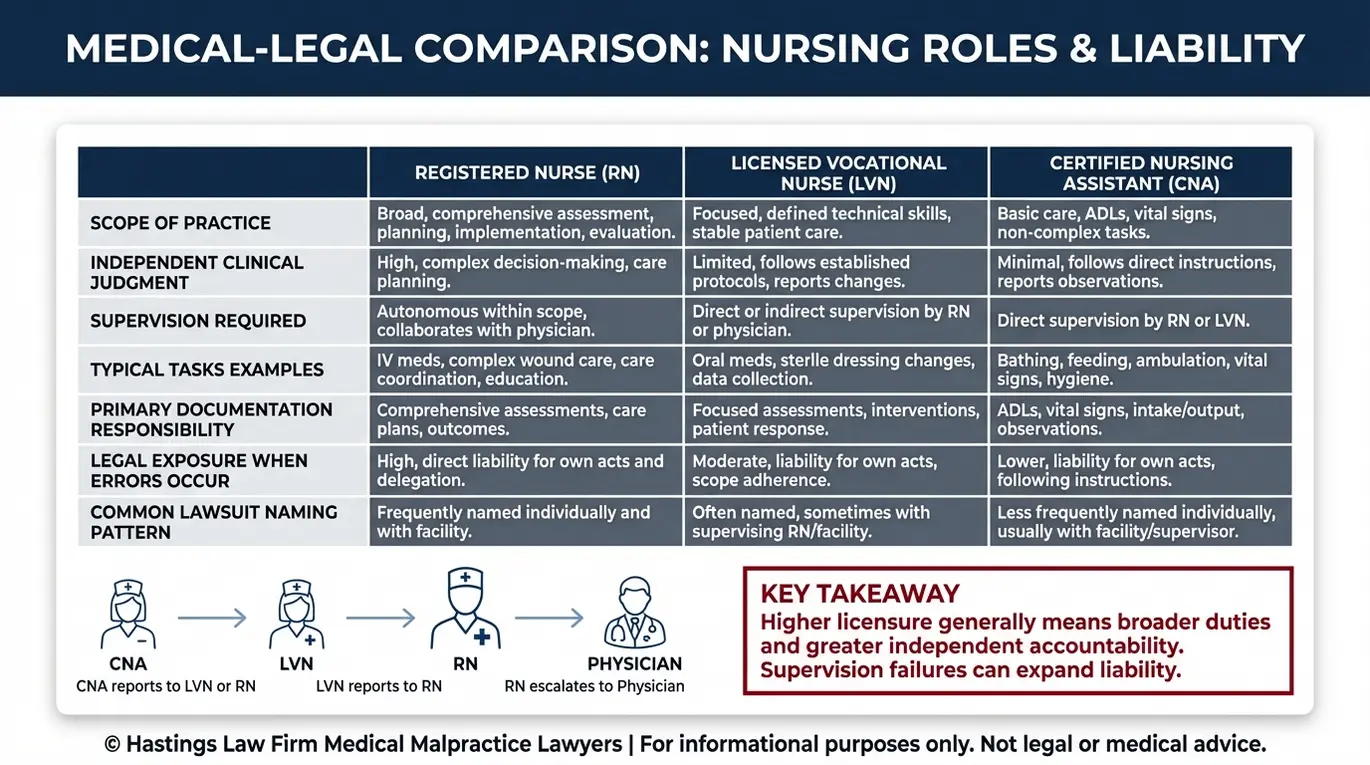
Liability varies based on licensure. Licensure levels determine the clinical responsibilities and oversight required for each staff member. Registered Nurses (RNs) are held to a higher independent standard than Licensed Vocational Nurses (LVNs) or Certified Nursing Assistants (CNAs), who must work under supervision. Understanding these distinctions matters because it affects who can be named in a lawsuit and what standard applies to each individual.
Each nursing license carries a defined scope of practice, which are the specific duties and clinical decisions a professional is legally authorized to perform. RNs are trained and licensed to exercise independent clinical judgment, assess patients, create care plans, and make critical decisions without direct physician orders in certain situations.
LVNs perform many bedside tasks but must do so under the direction of an RN or physician. CNAs provide basic patient care and operate under the supervision of licensed nurses. This chain of command directly shapes liability.
If an LVN administered a medication incorrectly but was following a flawed order from the supervising RN, both may share responsibility. If a CNA failed to report a change in a patient’s condition, the supervising nurse who should have been monitoring may also be liable.
| License Type | Scope of Practice | Liability Scope |
|---|---|---|
| Registered Nurse (RN) | Independent clinical judgment, patient assessment, care planning, medication administration | Held to the highest nursing standard; can be independently liable for clinical decisions |
| Licensed Vocational Nurse (LVN) | Bedside care, medication administration, and procedures under RN or physician direction | Liable for errors within assigned tasks; supervising RN may share liability |
| Certified Nursing Assistant (CNA) | Basic patient care (bathing, feeding, repositioning) under nurse supervision | Limited independent liability; supervising nurse and facility may bear primary responsibility |
The Hastings Law Firm Difference
Results matter, but what truly sets us apart is how we achieve them. Every verdict, every settlement, and every Texas courtroom victory comes from one guiding promise: To treat each client’s fight for justice as if it were our own.
This balance of skill, experience, and empathy reflects our core philosophy that justice should not only compensate the injured, but also make health care safer nationwide.

Determining Liability Between the Nurse and the Hospital System
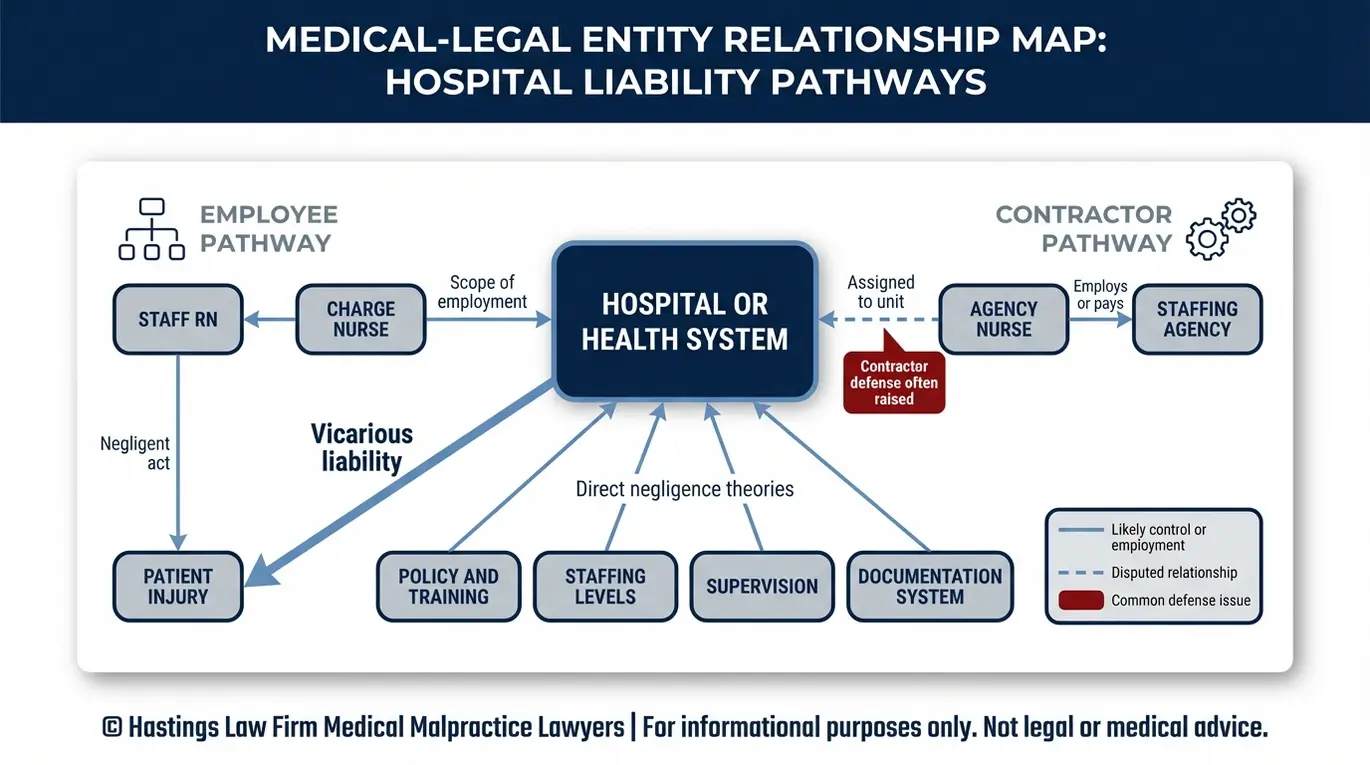
Under the doctrine of vicarious liability, a hospital can be held financially responsible for the negligent actions of its nursing staff if those actions occurred within the scope of employment. Vicarious liability allows patients to hold an organization accountable for the actions of its staff. This legal principle, also known as respondeat superior, means that when a staff nurse causes harm while performing job duties, the hospital that employed and supervised that nurse may be answerable for the resulting damages.
This distinction carries real strategic importance. Individual nurses rarely have the personal assets or insurance coverage to fully compensate a plaintiff who was seriously injured. Hospitals and health systems do.
Our legal team includes former defense attorneys who previously worked for the hospital systems they now challenge, giving us an insider’s view on how to build a case for employer liability. By establishing that the nurse was acting as an employee, Texas nurse malpractice lawyers can pursue a claim of hospital negligence against the institution itself, which also opens the door to examining systemic failures like inadequate staffing, poor training, or missing safety protocols.
However, the analysis changes when the nurse is not a direct employee. Several factors affect how liability is assigned:
- Employment status: Staff nurses are typically employees, making vicarious liability straightforward. Agency or travel nurses may be classified as independent contractor status, which can complicate the hospital’s liability.
- Scope of employment: The negligent act must have occurred while the nurse was performing duties within their job responsibilities.
- Hospital control: Courts examine how much control the hospital exercised over the nurse’s work. The more control, the stronger the argument for employer liability.
- Institutional negligence: Even if the nurse is a contractor, the hospital may still be liable for its own failures, such as not verifying credentials or not providing adequate supervision.
Identifying every liable party early is one of the most important steps in building a strong case. Our team investigates the employment relationships, contracts, and facility policies to determine exactly who should be held accountable.
Injuries Caused by Medication Administration Errors
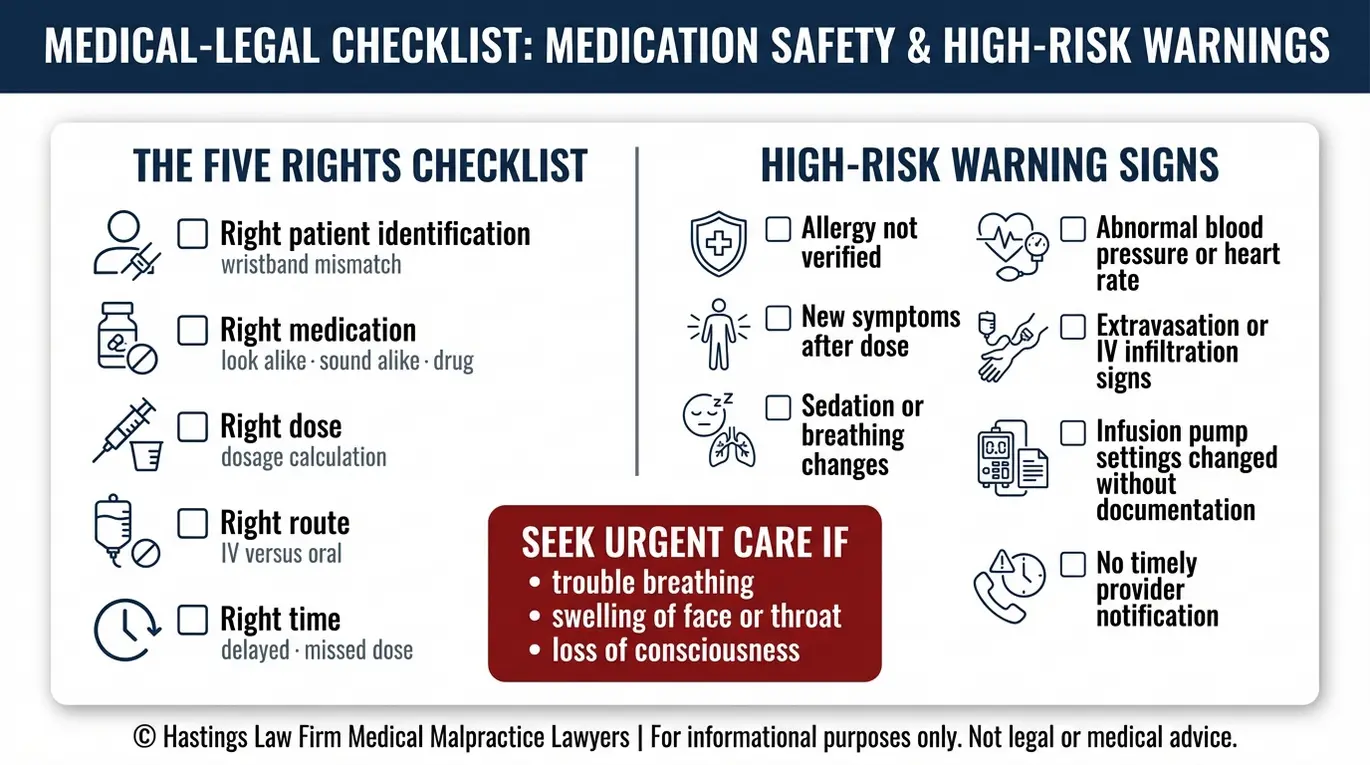
Medication errors occur when a nurse administers the wrong drug, wrong dose, or wrong route, often because they failed to verify physician orders or check for patient allergies. Proper medication protocols are essential for preventing drug-related injuries in a clinical setting. These errors are among the most common and most preventable forms of nursing negligence.
Safe medication administration follows a protocol known as the Five Rights of Medication Administration: the right patient, right drug, right dose, right route, and right time. When even one of these steps is skipped or performed incorrectly, the consequences can be severe.
Research published by PubMed Central on the Five Rights framework has examined both the strengths and limitations of this safety model, but violations of these basic checks remain a leading indicator of negligence.
Common medication errors we investigate as a nurse malpractice lawyer include:
- Administering a drug the patient is allergic to
- Giving an incorrect dosage, resulting in overdose or therapeutic failure
- Delivering medication through the wrong route (oral vs. intravenous)
- Administering medication intended for a different patient
- Failing to monitor for adverse reactions after administration
IV infiltration, a condition where intravenous fluid or medication leaks into the surrounding tissue instead of entering the vein, deserves particular attention. When IV lines are not properly placed or monitored, the resulting tissue damage can range from painful swelling to permanent nerve injury or tissue necrosis, especially with certain chemotherapy drugs or vasopressors.
Consequences of Failure to Monitor Patient Vital Signs
Failure to monitor involves a nurse neglecting to check or record vital signs, the measurable indicators of a patient’s basic body functions such as heart rate, blood pressure, oxygen levels, and temperature, at required intervals. Consistent monitoring allows the medical team to identify and address changes in a patient’s health. This can lead to a dangerously delayed response when a patient’s condition deteriorates.
Nurses are often described as the “eyes and ears” of the physician. Doctors rely on nursing assessments and documented observations to make treatment decisions. When a nurse fails to take or record vital signs on schedule, early warning signs of complications like post-surgical bleeding, sepsis, or respiratory failure can go undetected until the situation becomes life-threatening.
This is closely connected to the legal concept of failure to rescue, which refers to a clinician’s inability to recognize and respond to a deteriorating patient in time to prevent serious harm or death. In wrongful death cases involving emergency room negligence or post-operative care, our nurse malpractice attorneys often find that the medical records reveal gaps in monitoring, missed assessment windows, or vital sign trends that should have triggered an immediate response but were overlooked.
We reconstruct the timeline using nursing logs, electronic health records, and monitor data to determine whether the standard of care for patient monitoring was met.
Impact of Communication and Documentation Failures
Documentation failures occur when nurses fail to record patient changes or communicate critical information to the attending physician, creating dangerous gaps in the continuity of care. Clear communication and documentation ensure that all medical providers have the information needed to treat a patient safely. Continuity of care is the process of ensuring a patient receives consistent treatment and monitoring as they move through different stages of medical care.
In medical malpractice litigation, there is a well-known principle: if it wasn’t charted, it wasn’t done. This means that even if a nurse verbally reported a concern, the absence of written documentation can make it legally difficult to prove that communication happened.
Charting errors, which include inaccurate entries, missing notes, or inconsistencies between nursing documentation and physician records, can obscure what actually occurred during a patient’s care. Making sure there is a complete continuity of care helps prevent errors and ensures all members of the medical team stay informed.
Triage, the process of evaluating and prioritizing patients based on the severity of their condition, is another area where triage mistakes and documentation failures cause harm. If a triage nurse underestimates the severity of symptoms and fails to document key observations, a critically ill patient may wait too long for treatment.
Red flags we look for in medical records include:
- Gaps in charting timelines where no nursing notes exist for extended periods
- Vital sign entries that don’t match monitor data or physician notes
- Absence of documentation for physician notifications about patient changes
- Late entries or altered records that suggest after-the-fact modifications
Under federal law, patients have the right to access their own health information. The U.S. Department of Health and Human Services outlines individuals’ rights under HIPAA to obtain copies of their medical records, which is often the first step in identifying these documentation failures.
Patient Falls and Dropped Patient Injuries
Patient deaths or serious injuries from falls in hospitals are considered “never events,” meaning they are preventable incidents that should not occur when proper safety protocols are followed. Hospitals must implement safety protocols to prevent injuries to patients with mobility or stability issues. These injuries frequently result from a failure to assess fall risk or provide necessary assistance during transport or toileting.
Specific fall precautions, the safety measures put in place to prevent patient falls, include interventions like bed alarms, non-slip socks, raised side rails, and one-on-one assistance for high-risk patients. When nursing staff fail to implement these measures, or when patients are dropped during transfers from bed to chair or wheelchair, the resulting injuries can be devastating, particularly for elderly or already compromised patients. This failure to adhere to patient safety standards can lead to severe consequences.
A hip fracture, traumatic brain bleed, or spinal injury from a fall can turn a routine hospital stay into a life-altering event. In nursing home settings, repeated falls combined with conditions like bedsores and healthcare-associated infections may point to a pattern of systemic neglect rather than an isolated mistake.
Negligence Involving Improper Use of Medical Equipment
Nurses are responsible for ensuring medical equipment functions correctly and must be trained to use devices like infusion pumps, cardiac monitors, and ventilators safely. Medical equipment provides life-sustaining support and must be managed according to specific safety standards. Our in-house medical staff, including nurse practitioners and Board Certified Patient Advocates, help us evaluate whether equipment was used according to the proper standard of care.
When equipment is misused or malfunctions go unaddressed, patients can suffer serious and preventable injuries. One of the most common issues is the improper programming of IV infusion pumps, which can deliver medication at incorrect rates, leading to overdose or inadequate treatment. Scrub nurses assisting in surgical procedures must also handle instruments and devices properly; errors in this setting can contribute to surgical errors and complications.
A growing concern in hospitals is alarm fatigue, a condition where clinical staff become desensitized to the constant sound of equipment alarms and begin to ignore or delay their response to alerts. When a monitor alarm signals a drop in oxygen or a dangerous heart rhythm and no one responds, the consequences can be fatal.
We examine alarm response logs. An expert witness will review equipment maintenance records and staff training documentation to evaluate whether the standard of care was met.
Contact the Texas Nurse Malpractice Attorneys at Hastings Law Firm Today for Help
Nursing negligence cases are medically and legally demanding. Professional legal support can help families understand their rights and pursue accountability. They require a team that can read clinical records with the same fluency as legal filings.
At Hastings Law Firm, our in-house nurse consultants, former defense attorneys, and board-certified trial lawyer Tommy Hastings work together to investigate these cases from the inside out. We understand that you may still be processing what happened. You may not even be certain whether what occurred was negligence or just an unfortunate outcome. That is exactly what our team is here to help you determine.
Every consultation is free and confidential. We work on a contingency fee basis, which means you pay no attorney fees or costs unless we recover compensation for you. If you or a loved one was injured by a nursing error, a Texas nurse malpractice lawyer at Hastings Law Firm is ready to review your case and help you find the truth about what happened.
Call us today or complete our online form to schedule your risk-free case evaluation.
Frequently Asked Questions About Nurse Malpractice in Texas


This content was researched and written by the Hastings Law Firm editorial team, which includes attorneys, medical professionals, and experienced researchers. Our writing is informed by internal knowledge and practical experience, and we cross-check critical details against authoritative sources cited throughout. Every piece undergoes human-led fact-checking and legal review. Because legal and medical information can change, if you spot an error, please contact us. Learn more about our content standards and review process on our editorial policy page.

Gabe Sassin has focused exclusively on medical malpractice law since 2007. After spending more than a decade as a malpractice defense attorney, he knows exactly how the other side works. He has seen firsthand how healthcare providers, insurers, corporate defendants, and their legal teams think, prepare, and build their defense against claims. That knowledge works for the people who need it most today, injured patients and their families. His unique experience shapes everything he writes, giving readers a look at how these cases actually work from someone who has handled them from both sides.
